Ready-made ETF portfolios built for real investor needs. Explore now →



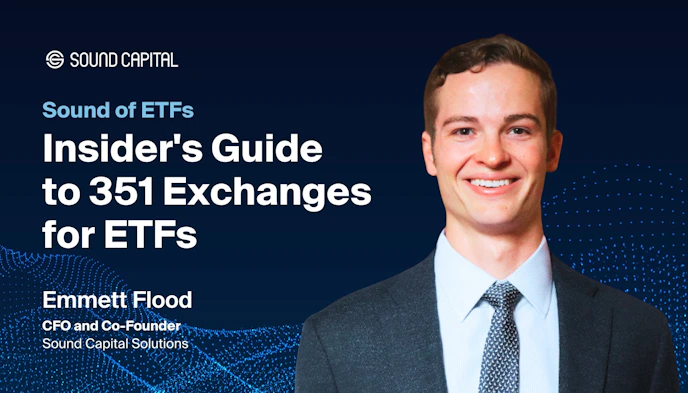
Sound of ETFs: The Insider's Guide to 351 Exchanges for ETFs
Are you familiar with 351 exchanges? Learn how this powerful tool can help you transition your SMA to an ETF efficiently and tax-effectively in this first article of the new "Sound of ETFs" educational series on ETF Central.

Keep up with what matters in ETFs
Get timely ETF insights, market trends, and top ideas straight to your inbox.
Your newsletter subscriptions with us are subject to ETF Central's Privacy Policy and Terms and Conditions.
Sound Capital was founded by ETF industry veterans who have participated in multiple ETF launches during their tenured careers. Our recently instituted ETF Open House is a one-on-one virtual meeting that occurs each month for those looking for information, education, and collaboration for any and all ETF industry topics. Refer to Sound’s website for more information.
The ‘Sound of ETFs’ series was created to provide focused insight into a particular topic stemming from those recent conversations. Our first segment will highlight conversions and reorganizations within the ETF industry.
Like what you're reading?
Stay in the loop — get the latest ETF insights: trends, analysis, and expert picks.
The Insider's Guide to 351 Exchanges for ETFs
As billions and billions of dollars continue to migrate into ETFs, conversions from more traditional investment vehicles into ETFs are often overlooked or misunderstood. When conducted in accordance with IRS Section 1.351, the conversions are known as ‘351 exchanges’ and provide many advantages to advisors and their clients.
Most notably, when done correctly a 351 exchange can result in the movement of assets from a Separately Managed Account (“SMA”) to a newly formed ETF – usually without the realization of any taxable gains.
As advisors look to make this leap they’re often faced with tough questions – what really are 351 exchanges and how do they work? Will this really benefit my strategy and help my firm grow? How can I be sure that I’m not missing something? These are all important questions that anyone thinking about enacting a 351 exchange should ponder.
But be sure – an SMA to ETF exchange is not just possible – in many cases it’s advisable.
What Are 351 Exchanges ?
In its most basic sense, a 351 exchange is the transfer of property from one company to another, in exchange for stock of the company that is receiving the property. In other words, the property of an SMA (i.e. equities) is exchanged for the shares of an ETF. Although it may be easy to illustrate in writing, in practice these exchanges are a more intricate process. There are ownership requirements and portfolio composition limits laid out in the Investment Act of 1940 (“’40 Act”) that must be followed, and numerous sub-processes that occur simultaneously that need oversight.
A 351 exchange can take roughly 90 to 125 days once a plan is instituted and involves the coordination of a handful of different service providers. Extensive due diligence is necessary, and legal, tax, & audit opinions are often required. In addition, everything must be performed in a manner that ensures that all regulatory and operational requirements are met while the standards of fiduciary duty owed to clients are upheld in a smooth transition for both client and advisor.
Why Are 351 Exchanges Beneficial?
Before even considering whether an SMA may be a potential candidate for a 351 exchange, an advisor should first decide if the strategy they are implementing can be successful as an ETF. As mentioned above, ETFs are products registered under the ‘40 Act that require meaningful support from capital markets players and a listing exchange to operate effectively – not all investment strategies are suited to this structure. If an advisor does decide that a 351 exchange is right for their firm and clients, having access to someone with capital markets experience and expertise is an essential part of a successful ETF.
Let’s now discuss one of the major benefits of a 351 exchange: in-kind tax treatment. ‘In-kind’ refers to a transaction that involves assets other than cash, such that when the exchange occurs it is not treated as a taxable event. During a 351 exchange the assets involved are given this treatment – meaning that in addition to being able to take advantage of the tax efficiencies offered by the ETF itself, advisors can take advantage of a tax-free conversion.
In certain situations, it also may be possible for SMAs executing a 351 exchange to import the historical performance of the portfolio into that of the newly formed ETF – an invaluable feature when marketing the fund in its early stages. Finally, the convenience factor realized by launching an ETF in one single transaction versus numerous orders directed out of multiple (sometimes hundreds) accounts cannot be ignored. Any manager considering making the switch would be hard-pressed to consider the option.
How to Navigate the 351 Exchange Process?
As previously mentioned, the first thing an advisor should do is determine whether their current strategy is suitable as an ETF, then they can conduct the necessary due diligence to determine if the transaction will qualify for a 351 exchange. If after considering all the different factors it appears that the pieces are in place for a successful exchange, there’s good news – there is a well-worn path to follow and contacting an expert is never a bad start. I hope that you found insight in this first of many ‘Sound Thoughts’ segments here on ETF Central – the goal of which is to provide topical insight into all aspects of ETFs stemming from our day-to-day conversations with industry professionals. I look forward to continuing to provide relevant and timely information on ETF topics in future articles.
About the Author
Emmett Flood is the CFO and co-founder of Sound Capital Solutions – an Investment Adviser offering both White Label services and a unique Solutions Provider offering that provides clients with the tools to act as their own ETF Adviser. Emmett is a CPA and holds several FINRA licenses (7, 27, 66). He began his career in public accounting prior to adding his financial reporting and regulatory knowledge to the comprehensive list of expertise and decades of ETF industry experience housed at Sound Capital Solutions.
Disclaimer
Please note this article is for information purposes only and does not in any way constitute investment, legal, or tax advice. It is essential that you seek advice from a registered financial professional prior to making any investment decision. Sound Capital Solutions LLC is committed to adhering to the fiduciary standard, acting in the best interest of its clients at all times. As an RIA, we are obligated to disclose any potential conflicts of interest that may exist to our clients. Information about the firm’s services and fees can be found in the firm’s Form ADV which is available upon request or by visiting the SEC's Investment Adviser Public Disclosure (IAPD) website.”
Segments
See all
No specific market segments were tagged
Mentioned ETFs
No specific ETFs were tagged
Further reading
Latest ETF News
See all ETF newsHow Much ETF Infrastructure Do You Really Need?


Are ETFs Getting Too Complicated? Not Necessarily, But Complexity Has a Cost

Form 4 Has 20 Transaction Codes. None Say "Section 351 ETF Swap"


Who Really Owns a White-Label ETF?

What If a Futures-Based ETF Never Had to Roll Again?

How Do You Build a Winning ETF Business?


 Advantages of ETFs over Mutual Funds1/6
Lower Costs
In this guide, we'll explore the advantages of ETFs over mutual funds, giving you valuable insights into why ETFs have gained significant popularity among investors like yourself.
Leveraged ETFs: Unlocking the Potential for Amplified Returns1/6
Understanding Leveraged ETFs
Explore leveraged ETFs: potential for amplified returns & risks. 5 ETFs to consider across equities, commodities & fixed income.
What is a Leveraged ETF?1/6
Introducing Leveraged and Inverse ETFs
In this guide, we'll dive into the world of leveraged ETFs, exploring their definition, mechanics, potential risks, and rewards.
Recent educational content

ETF Trends
ETF Industry KPIs October 5, 2026
This week’s KPI data overview highlights key metrics and trends shaping the ETF landscape.

ETF Trends
ETF Industry KPIs September 28, 2026
This week’s KPI data overview highlights key metrics and trends shaping the ETF landscape.
ETF Trends
ETF Industry KPIs September 22, 2026
This week’s KPI data overview highlights key metrics and trends shaping the ETF landscape.
First Look ETF
First Look ETF: Income, Corporate Arbitrage, and Growth and Value Investing
First Look ETF September 2026: iCapital, Mast Investments and North Square unpack new ETFs targeting monthly income, merger arbitrage and complementary growth and value exposure.

Browse all educational columns



Build and Analyze Your ETF Portfolio Like a Pro
Create your own ETF portfolio in minutes and instantly see allocations, exposures, performance, and risk. Visualize diversification across asset classes, regions, and sectors. Stress-test ideas, compare benchmarks, and refine your strategy with professional-grade analytics.