Create, analyze, optimize your ETF portfolio. Start now →



Small-Cap ETFs See Strong Inflows: Here's What You Need to Know
Here's a look at which ETFs stand to benefit most from the rotation into small cap stocks.


Keep up with what matters in ETFs
Get timely ETF insights, market trends, and top ideas straight to your inbox.
Your newsletter subscriptions with us are subject to ETF Central's Privacy Policy and Terms and Conditions.
Semiconductor stocks were dragged down by former President Donald Trump's comments on Taiwan's defense situation, imperilling market-cap indexes dominated by mega-caps. However, not all segments of the market fared poorly.
Between July 10th and 16th, we saw a 12% rally of the Russell 2000 index, marking its best 5-day outperformance of the S&P 500 in history. While this might not be the most robust comparison, it is a welcome one for small-cap investors following a decade of mega-cap performance.
Here's what ETF Central data on the U.S. small-cap segment says about the current situation and some ways you can position yourself via small-cap ETFs.
Like what you're reading?
Stay in the loop — get the latest ETF insights: trends, analysis, and expert picks.
Small-cap ETF data
If you haven't explored it yet, ETF Central offers various "segments" that correspond to different parts of the market. The segment we're watching closely right now is "U.S. Small Cap ETFs," which currently consists of 41 total ETFs. On the segment page, you can view performance and fund flow data.
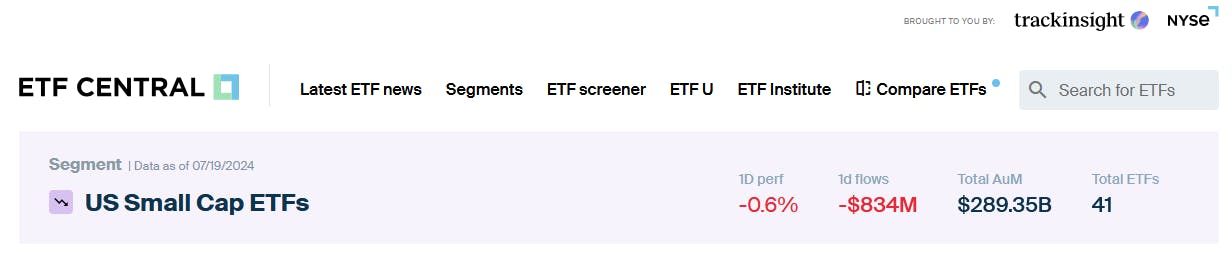
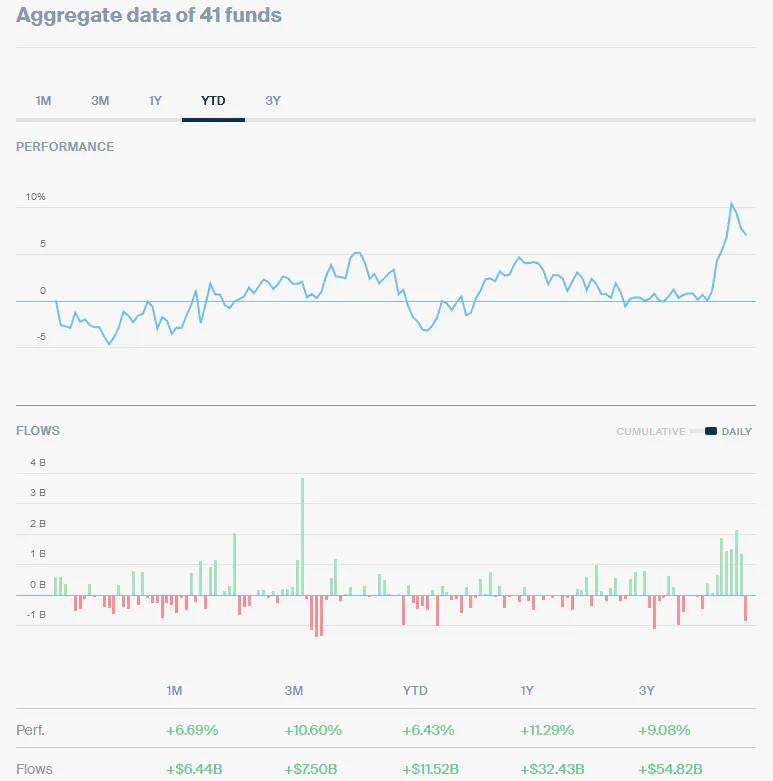
So far, domestic small-cap returns have lagged the broad market year-to-date, but fund flows have been unusually robust, taking in $11.52 billion since the start of the year. Notably, over half of this inflow came within the one-month period ending July 22, amounting to $6.44 billion.
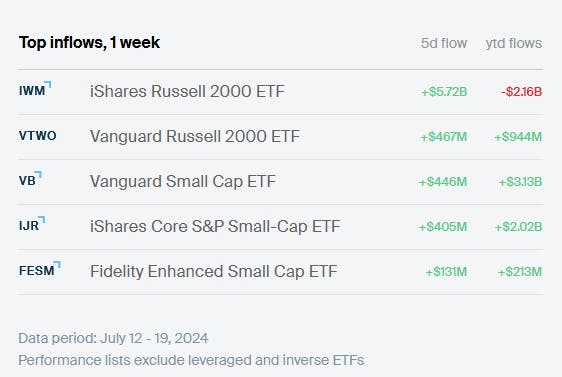
The ETF Central segment data also shows one-week inflows by ETF. Unsurprisingly, the bulk of five-day small-cap ETF inflows have come from just one ETF: the iShares Russell 2000 ETF
Which ETFs to watch?
Russell 2000 ETFs like IWM are excellent for short-term trading within the U.S. small-cap segment due to their strong liquidity. They offer a minuscule bid-ask spread and one of the best ETF options chains out there with numerous strikes and expiry dates.
However, as a buy-and-hold investment, I personally find them suboptimal. This has nothing to do with the ETF itself but everything to do with the index it tracks.
The Russell 2000 Index, by nature, aims to be broad, capturing a vast array of small-cap stocks. This breadth, however, includes a significant amount of what I call "junk"—unprofitable small caps with poor financial health – think your average penny stock.
The Russell 2000 index pretty much includes any domestic small cap stock with sufficient daily volume and public float size. Additionally, its predictable annual reconstitution has drawn criticism for being easy to front-run. To alleviate this, I prefer the competing S&P SmallCap 600 Index, which has a profitability screener in place.
This index requires the sum of the most recent four consecutive quarters' earnings to be positive, with the most recent quarter's earnings also needing to be positive. The S&P committee process further refines the index by adding or dropping constituents as needed.
As seen below, the iShares Core S&P Small-Cap ETF
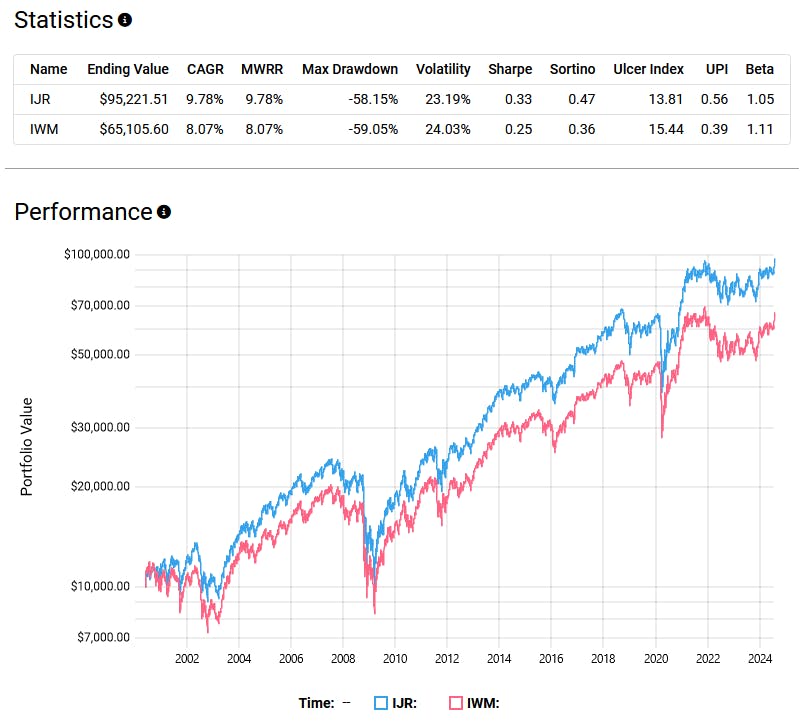
Conveniently enough, IJR is significantly cheaper with a 0.06% expense ratio compared to IWM's 0.19%. Finally, given that it uses a different index, IJR can also be utilized as a viable tax-loss harvesting partner for IWM.
Please note this article is for information purposes only and does not in any way constitute investment advice. It is essential that you seek advice from a registered financial professional prior to making any investment decision.

Latest ETF News
See all ETF newsCould Water ETFs Be the Next AI Bottleneck Trade?

What is a Boomer Candy ETF?

ETF Comparison: NEOS Nasdaq-100 High Income ETF (QQQI) Versus Goldman Sachs Nasdaq-100 Premium Income ETF (GPIQ)





 Advantages of ETFs over Mutual Funds1/6
Lower Costs
In this guide, we'll explore the advantages of ETFs over mutual funds, giving you valuable insights into why ETFs have gained significant popularity among investors like yourself.
Leveraged ETFs: Unlocking the Potential for Amplified Returns1/6
Understanding Leveraged ETFs
Explore leveraged ETFs: potential for amplified returns & risks. 5 ETFs to consider across equities, commodities & fixed income.
What is a Leveraged ETF?1/6
Introducing Leveraged and Inverse ETFs
In this guide, we'll dive into the world of leveraged ETFs, exploring their definition, mechanics, potential risks, and rewards.
Recent educational content

ETF Trends
ETF Industry KPIs September 8, 2026
This week’s KPI data overview highlights key metrics and trends shaping the ETF landscape.

ETF Trends
ETF Industry KPIs August 31, 2026
This week’s KPI data overview highlights key metrics and trends shaping the ETF landscape.
ETF Trends
ETF Industry KPIs August 24, 2026
This week’s KPI data overview highlights key metrics and trends shaping the ETF landscape.
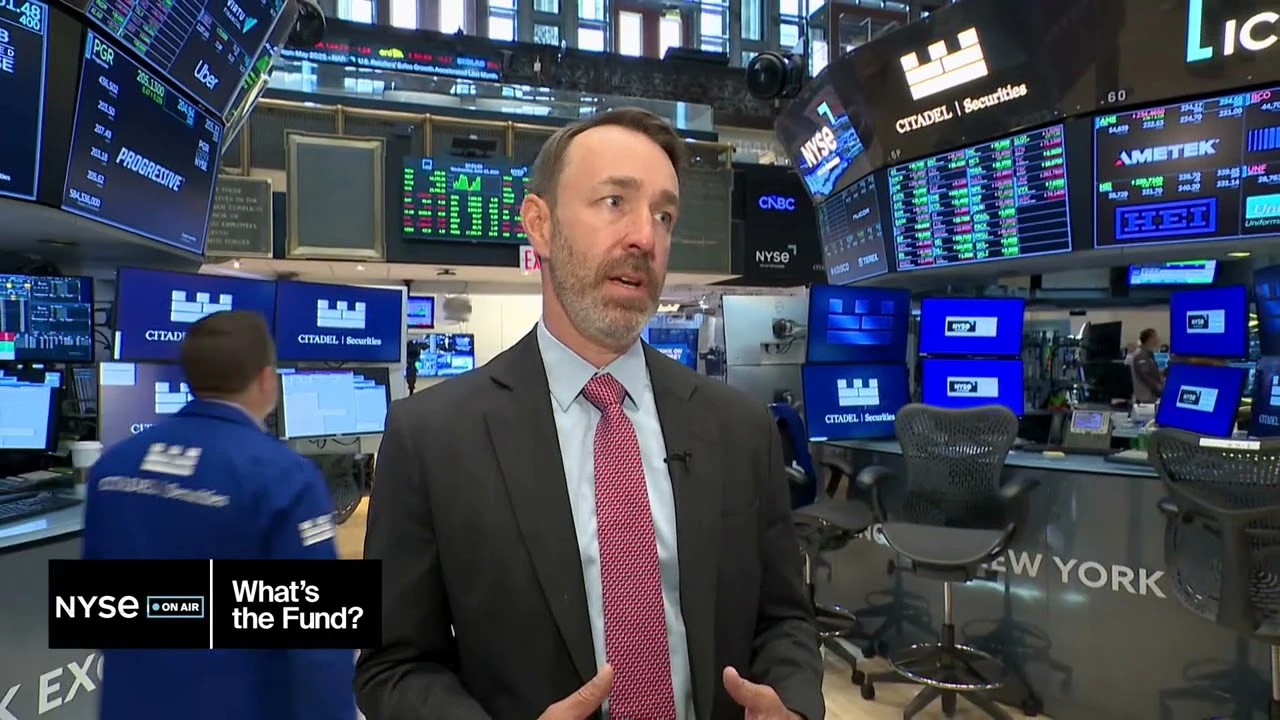
What’sTheFund
What's the Fund | Ocean Park Diversified Income ETF (DUKZ)
James St Aubin, Chief Investment Officer at Ocean Park Asset Management, discuss the DUKZ ETF, exposing investors to the whole spectrum of asset classes in the fixed income markets, through their rules-based process.

Browse all educational columns



Expert-Built ETF Portfolios, All in One Place
Don’t start from scratch. Discover ready-made ETF portfolios built by professionals to match different goals, timelines, and market views. Use them as inspiration or as a starting point for your own allocation.