Global ETF Survey Is Live! 600+ ETF Professionals Weigh In. See Results →



Shorting volatility via ETFs: Genius idea, or not?
Shorting volatility is a great way to make great returns and then lose it all in a day.

Keep up with what matters in ETFs
Get timely ETF insights, market trends, and top ideas straight to your inbox.
Your newsletter subscriptions with us are subject to ETF Central's Privacy Policy and Terms and Conditions.
Prior to the 2021 Gamestop short-squeeze, the last notable (and unintentionally hilarious) market event to roil retail investors was the aptly named "Volmageddon.” During this event, numerous short-volatility exchange-traded products (ETFs and ETNs) melted down amid a sudden spike in the VIX.
Interestingly, before Volmageddon, short volatility strategies via ETFs and ETNs had gained a strong following among the retail crowd, with even dedicated Reddit boards like r/tradexiv set up to discuss strategy and profits. For many, short volatility seemed like a veritable money printer…until it blew up, that is.
Today, only remnants of these products remain (with greatly reduced leverage). That being said, history repeats itself. I can only hope that the traders and investors of the future chance upon this article once the following financially engineered doomsday instrument is released to the public.
Like what you're reading?
Stay in the loop — get the latest ETF insights: trends, analysis, and expert picks.
How does shorting volatility work?
The saga centers around "Wall Street's Fear Meter," also known as the Chicago Board of Options Exchange (CBOE) Volatility Index (VIX). The VIX is calculated via the market's expectations of implied volatility based on SPX index options. When things get rough, volatility spikes, and the VIX goes up.
Investors can't buy the VIX directly. Instead, they can buy ETFs that track various VIX futures contracts, which are derivatives based on a future anticipated value of the VIX at a given date. However, these instruments tend to have a poor risk-return profile.
Look at the charts for long VIX futures like the ProShares Ultra VIX Short-Term Futures ETF (UVXY) and ProShares VIX Short-Term Futures ETF (VIXY) and you'll see that their long-term expected value is zero. This is due to contango and the fact that the VIX is a mean-reverting index.
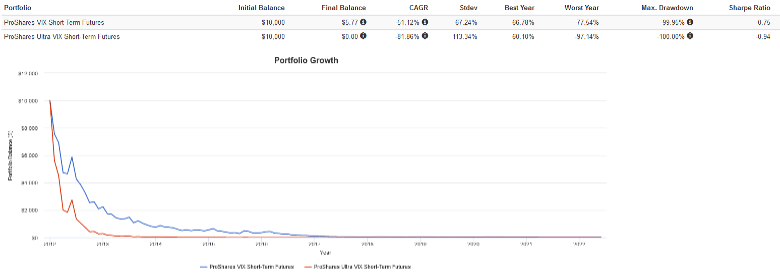
That is, over long periods, volatility tends to fall back to historical averages. This is why going long on volatility is a strategy with high negative carry – volatility rarely goes up for extended periods. Instead, short-term violent surges are more likely, so going long volatility is a market-timing exercise.
Naturally, some geniuses realized that if you shorted the VIX, you could reap handsome profits during low-volatility bull markets as it steadily falls.
That is until a sudden spike in volatility wipes you out. Unlike other indexes, the VIX does not have a circuit breaker built-in for large intra-day drops (or, in this case, surges).
What happened in 2018?
Back in 2018, there were two highly popular short VIX instruments: the VelocityShares Daily Inverse VIX Short-Term ETN (XIV), which is now delisted, and the ProShares Short VIX Short-Term Futures ETF (SVXY). Both ETFs provided investors with a daily return that tracked the inverse performance of the S&P 500 VIX Short-Term Futures Index.
Prior to February 5th, 2018, volatility had been trending abnormally low in the low-interest rate bull market. Traders who were short VIX futures made out like bandits in the years and months prior, thanks to this. Unfortunately, they forgot about reversion to the mean. The VIX was primed for a massive surge to return to its historical averages.
On that day, the VIX suddenly surged after the S&P 500 dropped around 5% intra-day. This led to a sharp fall in the value of short volatility instruments, which triggered rebalancing by the fund manager buying VIX futures to ensure their notional exposure remained market neutral.
The results? A negative feedback loop that ultimately resulted in these funds loosing 90% of their value, and shrinking assets under management from billions to a few million in the span of a day.
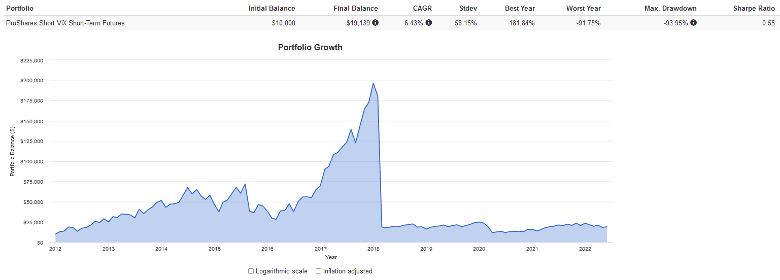
The funny thing is that these funds worked exactly as intended. Their prospectus clearly disclosed the risk of liquidation should net asset value (NAV) fall below a certain percentage. As usual, few retail investors bothered to read this.
The aftermath? Credit Suisse delisted XIV. SVXY survived after restructuring, and had its leverage reduced to just 0.5x to mitigate the possibility of this happening again. Some poor trader on Reddit lost $4 million dollars with this strategy. Ouch.
The final word on shorting volatility
Someone aptly described this strategy as "Like picking up pennies in front of a steamroller," and I couldn't agree more. Shorting volatility using leverage via complex derivatives that possess great counterparty risk is just plain dangerous. This is an example of a "can't go wrong" strategy that works until it doesn't and then proceeds to implode spectacularly. With great returns almost always comes great risk, and a bad tail event like Volmageddon can ruin your portfolio in one fell swoop.
Segments
See all
Mentioned ETFs
Further reading

Latest ETF News
See all ETF newsBeyond Big Tech: The Increasing Specialization of AI ETFs

There's an ETF for That? Humanoid Robotics and Physical AI

How Some ETF Issuers Use Their Own Funds for Cash Management

These Public-Private ETFs Invest in Polymarket and Anduril

There's an ETF for That? Frontier Markets



 Advantages of ETFs over Mutual Funds1/6
Lower Costs
In this guide, we'll explore the advantages of ETFs over mutual funds, giving you valuable insights into why ETFs have gained significant popularity among investors like yourself.
Leveraged ETFs: Unlocking the Potential for Amplified Returns1/6
Understanding Leveraged ETFs
Explore leveraged ETFs: potential for amplified returns & risks. 5 ETFs to consider across equities, commodities & fixed income.
What is a Leveraged ETF?1/6
Introducing Leveraged and Inverse ETFs
In this guide, we'll dive into the world of leveraged ETFs, exploring their definition, mechanics, potential risks, and rewards.
Recent educational content
First Look ETF
First Look ETF: Income, International, and Cash Flow ETFs
In this season 6 episode of First Look ETF, Stephanie Stanton @etfguide examines the latest ETF marketplace trends with NYSE and guests.


ETF Trends
ETF Industry KPIs October 5, 2026
This week’s KPI data overview highlights key metrics and trends shaping the ETF landscape.

ETF Trends
ETF Industry KPIs September 28, 2026
This week’s KPI data overview highlights key metrics and trends shaping the ETF landscape.
ETF Trends
ETF Industry KPIs September 22, 2026
This week’s KPI data overview highlights key metrics and trends shaping the ETF landscape.