NYSE CRTR Economy Event Watch the replay →



Short-Term Bonds: An Attractive Opportunity When Rate Cuts Loom
Short-Term Bond funds outpaced Ultrashort peers since 2004. With potential Fed cuts, extending duration could enhance returns and reduce volatility.

Keep up with what matters in ETFs
Get timely ETF insights, market trends, and top ideas straight to your inbox.
Your newsletter subscriptions with us are subject to ETF Central's Privacy Policy and Terms and Conditions.
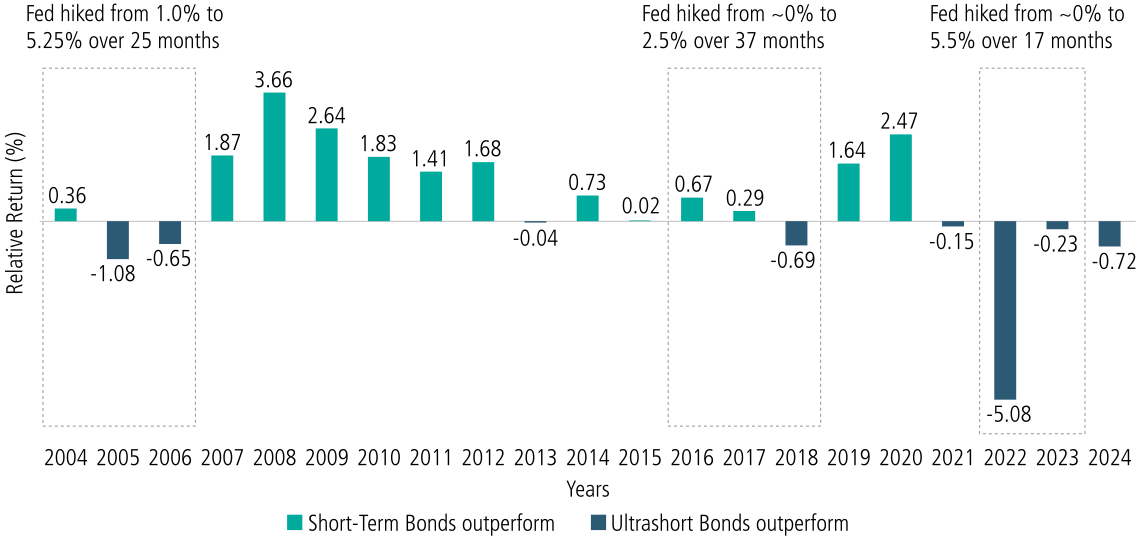
Outperformance by Morningstar Category: Short-Term Bonds vs. Ultrashort Bonds (%)¹
Get data on 14,000+ ETFs
Access Trackinsight's reliable and comprehensive data with 500M+ points on 14,000+ ETFs.
The Morningstar Ultrashort Bond category grew rapidly as investors sought cash alternatives during aggressive Fed hiking cycle in 2022-23².
However, the Morningstar Short-Term Bond category has outperformed the Ultrashort Bond category in 13 of the past 21 calendar years, producing a 13%+ cumulative return over the period from the start of 2004 to the end of 2024.
The more aggressive than anticipated tariff announcement has the potential to weigh heavily on economic growth and inflation expectations, prompting the Fed to ease into a challenging environment.
- Though not a base-case assumption, the Fed may opt to cut short-term interest rates outside of a scheduled meeting as part of their dual mandate of fostering economic conditions that achieve stable prices and maximum sustainable employment.³
We believe investors should consider modestly extending duration in their fixed income allocations, and the Short-Term Bond category offers a potential way to reduce volatility associated with longer duration investments.
This commentary is provided by the Fixed Income team at Neuberger Berman. For investors seeking targeted exposure in this space, consider exploring our NB Short Duration Income ETF (NBSD), which seeks to deliver consistent income while navigating the current rate environment.
¹ Source: Morningstar and St. Louis Fed, as of December 31, 2024.
² Source: Morningstar asset flow data as of February 28, 2025.
³ Source: Federal Reserve Bank of Chicago.
Historical trends and past performance is no guarantee of future results. The information above is not intended to represent the performance of any product, fund or strategy and the performance of a particular product, fund or strategy will differ based on a number of factors, including the investment strategy, risks, fees and expenses.
An investor should consider the Fund’s investment objectives, risks and fees and expenses carefully before investing. This and other important information can be found in the Fund’s prospectus, and if available summary prospectus, which you can obtain by calling 877.628.2583. Please read the prospectus, and if available the summary prospectus, carefully before making an investment.
This graphic represents research insights as of December 31, 2024. Information is for illustrative and educational purposes ONLY. This material is provided for informational purposes only and nothing herein constitutes financial investment, legal, accounting or tax advice. Nothing herein constitutes a prediction or projection of future events or future market behavior. This material is intended as a broad overview of the Fixed Income team’s views and is subject to change without notice. Nothing herein constitutes investment advice or a recommendation to buy, sell or hold a security. It should not be assumed that any investments in securities, companies, sectors or markets identified and described were or will be profitable.
This material is general in nature and is not directed to any category of investors and should not be regarded as individualized, a recommendation, investment advice or a suggestion to engage in or refrain from any investment-related course of action. This material is not intended as a formal research report and should not be relied upon as a basis for making an investment decision. Investment decisions and the appropriateness of this material should be made based on an investor’s individual objectives and circumstances and in consultation with his or her advisors. Information is obtained from sources deemed reliable, but there is no representation or warranty as to its accuracy, completeness or reliability. This material may include estimates, outlooks, projections and other “forward-looking statements.” Due to a variety of factors, actual events may differ significantly from those presented. Past performance is no guarantee of future results. Any views or opinions expressed may not reflect those of the firm as a whole. Investing entails risks, including possible loss of principal.
Morningstar Category Definitions
Short-Term Bond portfolios invest primarily in corporate and other investment-grade U.S. fixed-income issues and typically have durations of 1.0 to 3.5 years. These portfolios are attractive to fairly conservative investors, because they are less sensitive to interest rates than portfolios with longer durations. Morningstar calculates monthly breakpoints using the effective duration of the Morningstar Core Bond Index in determining duration assignment. Short-term is defined as 25% to 75% of the three-year average effective duration of the MCBI.
Ultrashort Bond portfolios invest primarily in investment-grade U.S. fixed-income issues and have durations typically of less than one year. This category can include corporate or government ultrashort bond portfolios, but it excludes international, convertible, multisector, and high-yield bond portfolios. Because of their focus on bonds with very short durations, these portfolios offer minimal interest-rate sensitivity and therefore low risk and total return potential. Morningstar calculates monthly breakpoints using the effective duration of the Morningstar Core Bond Index in determining duration assignment. Ultrashort is defined as 25% of the three-year average effective duration of the MCBI.
©2025 Morningstar, Inc. All rights reserved. The information contained herein: (1) is proprietary to Morningstar and/or its content providers; (2) may not be copied or distributed; and (3) is not warranted to be accurate, complete or timely. Neither Morningstar nor its content providers are responsible for any damages or losses arising from any use of this information. Past performance is no guarantee of future results.
Morningstar uses the Morningstar Category as the primary peer group for a number of calculations, including percentile ranks, fund-versus-category-average comparisons, and the Morningstar Rating. The Morningstar Rating compares funds’ risk-adjusted historical returns. Its usefulness depends, in part, on which funds are compared with others.
The “Neuberger Berman” name and logo and “Neuberger Berman Investment Advisers LLC” name are registered service marks of Neuberger Berman Group LLC. The individual fund names in this piece are either service marks or registered service marks of Neuberger Berman Investment Advisers LLC, an affiliate of Neuberger Berman BD LLC, distributor, member FINRA.
Disclaimer
Please note that this article reflects the author's personal views and does not represent the opinions of the publication or its affiliates. It is for informational purposes only and does not constitute investment advice. It is essential to seek guidance from a registered financial professional before making any investment decisions.

Latest ETF News
See all ETF newsEntering A New Era of Defense Tech Spending

How SPXD Delivers a More Balanced S&P 500 Exposure

Autocallable Yield Advantage and Market Reception





 Advantages of ETFs over Mutual Funds1/6
Lower Costs
In this guide, we'll explore the advantages of ETFs over mutual funds, giving you valuable insights into why ETFs have gained significant popularity among investors like yourself.
Leveraged ETFs: Unlocking the Potential for Amplified Returns1/6
Understanding Leveraged ETFs
Explore leveraged ETFs: potential for amplified returns & risks. 5 ETFs to consider across equities, commodities & fixed income.
What is a Leveraged ETF?1/6
Introducing Leveraged and Inverse ETFs
In this guide, we'll dive into the world of leveraged ETFs, exploring their definition, mechanics, potential risks, and rewards.
Recent educational content
Asset TV
The ETF Show - New Autism-Impact ETF Launched
Defiance ETFs has launched the first ETF, $ASD, focused on the autism ecosystem, investing in companies that provide services, products, and research related to autism and neurodivergence.


ETF Trends
ETF Industry KPIs June 1, 2026
The ETF Industry saw 22 New Launches, 1 Ticker Change and 1 closure last week.

ETF Trends
ETF Industry KPIs May 20, 2026
The ETF Industry saw 44 New Launches, 3 Mutual Fund Conversions and 9 closures last week.
Asset TV
The ETF Show - Politics Becomes Investable Trade through ETFs
Dan Weiskopf, Senior Portfolio Manager at Tidal Financial Group spoke with the ETF Show about Subversive ETFs that help investors trade like politicians.
Browse all educational columns



Build and Analyze Your ETF Portfolio Like a Pro
Create your own ETF portfolio in minutes and instantly see allocations, exposures, performance, and risk. Visualize diversification across asset classes, regions, and sectors. Stress-test ideas, compare benchmarks, and refine your strategy with professional-grade analytics.