Keep tabs on your favorite ETFs with a personalized weekly tracker. Create a Watchlist now →



SEC Clears Major Asset Managers to Launch ETF–Mutual Fund Share Classes
Following the green light for Dimensional, the SEC has opened the door for other asset managers to offer ETFs and mutual funds as share classes of the same portfolio.


Keep up with what matters in ETFs
Get timely ETF insights, market trends, and top ideas straight to your inbox.
Your newsletter subscriptions with us are subject to ETF Central's Privacy Policy and Terms and Conditions.
According to recent regulatory notices, the SEC has signaled greater openness to dual-share-class fund structures, allowing asset managers to offer ETF and mutual fund share classes within the same portfolio. Following approvals granted earlier this year to Dimensional Fund Advisors, several large firms have now received similar relief, including BlackRock and JPMorgan, with others such as Fidelity, State Street, and PIMCO also cleared.
The SEC typically grants these exemptions unless it determines that a hearing is warranted, paving the way for broader adoption of ETF and mutual fund share classes tied to a single investment strategy.
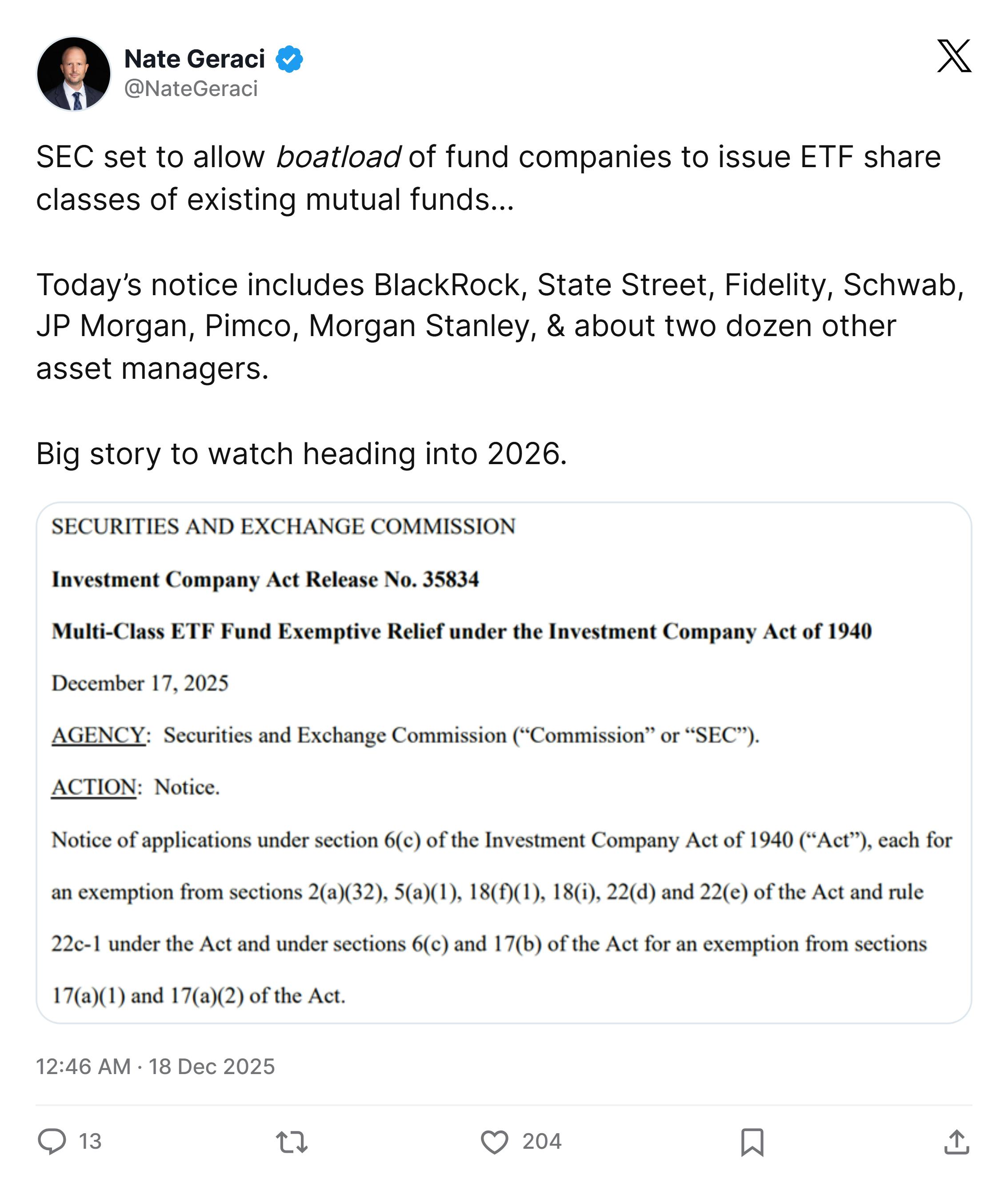
Dimensional Fund Advisors was an early mover, receiving similar approval last month and helping set the stage for broader adoption across the industry.
Asset managers can offer multiple share classes tied to the same underlying strategy. One class trades intraday like an ETF.
Another functions as a conventional mutual fund. Both sit inside the same portfolio. This setup allows investors to align access with their account type, liquidity needs, and investment preferences, without changing the strategy itself.
Global ETF Survey 2026 is Live!
With 1,790 new products launched by July 2026, choosing is harder than ever. Our Global ETF Survey 2026, built on 620 professional investors and allocators, shows how active, fixed income, options-based and thematic ETFs are reshaping fund selection.
Tax Efficiency Moves Center Stage
ETFs typically generate fewer capital gains thanks to in-kind redemptions. By pairing ETF and mutual fund share classes, managers can help investors reduce tax friction while maintaining a single investment engine. A taxable account may favor the ETF version. A retirement account may prefer the mutual fund share class. Same portfolio. Different wrappers.
Modernizing Mutual Funds, Not Replacing Them
ETFs have steadily captured share from mutual funds. Instead of abandoning mutual fund structures, large asset managers are upgrading them. Dual-share-class funds allow firms to remain competitive in an ETF-dominated market without duplicating products or splitting assets across parallel vehicles.
More Choice Also Means More Decisions
For investors, flexibility comes with added complexity. Multiple share classes introduce variables such as fees, trading behavior, and cash-flow dynamics. Advisors are likely to play a larger role in helping clients choose the most appropriate wrapper and integrate it efficiently into a broader portfolio.
Zooming out, the SEC’s approval signals broader regulatory openness to innovation in fund design. It also favors scale. Large firms with robust operational and compliance capabilities are best positioned to capitalize. Smaller managers may feel pressure to specialize, partner, or consolidate as product sophistication becomes the norm.
Please note this article is for information purposes only and does not in any way constitute investment advice. It is essential that you seek advice from a registered financial professional prior to making any investment decision.
Segments
See all
No specific market segments were tagged
Mentioned ETFs
No specific ETFs were tagged
Further reading
Latest ETF News
See all ETF newsThe Weekly ETF Market Monitor (November 9-13, 2026)

ETF News You Missed This Week - November 9-13, 2026

The Weekly ETF Market Monitor (November 2-6, 2026)

ETF News You Missed This Week - November 2-6, 2026

The Weekly ETF Market Monitor (October 26-30, 2026)

ETF News You Missed This Week - October 26-30, 2026


 Advantages of ETFs over Mutual Funds1/6
Lower Costs
In this guide, we'll explore the advantages of ETFs over mutual funds, giving you valuable insights into why ETFs have gained significant popularity among investors like yourself.
Leveraged ETFs: Unlocking the Potential for Amplified Returns1/6
Understanding Leveraged ETFs
Explore leveraged ETFs: potential for amplified returns & risks. 5 ETFs to consider across equities, commodities & fixed income.
What is a Leveraged ETF?1/6
Introducing Leveraged and Inverse ETFs
In this guide, we'll dive into the world of leveraged ETFs, exploring their definition, mechanics, potential risks, and rewards.
Recent educational content

First Look ETF
First Look ETF: Conventional and Unconventional International ETFs
First Look ETF’s November episode covers record-setting ETF launches and inflows with the NYSE, William Blair’s new active international and emerging markets ETFs, and the launch of the Long Nook Uncommon Compounders ETF (LUNC).


ETF Trends
ETF Industry KPIs November 16, 2026
This week’s KPI data overview highlights key metrics and trends shaping the ETF landscape.

ETF Trends
ETF Industry KPIs November 9, 2026
This week’s KPI data overview highlights key metrics and trends shaping the ETF landscape.
ETF Trends
ETF Industry KPIs November 3, 2026
This week’s KPI data overview highlights key metrics and trends shaping the ETF landscape.