Open Now: The Global ETF Survey Take the Survey →



REIT Q1 2025 Earnings Scorecard: No Tariff Trouble
Hoya Capital recaps Q1 as REITs shake off rate shocks and tariff fears.


Keep up with what matters in ETFs
Get timely ETF insights, market trends, and top ideas straight to your inbox.
Your newsletter subscriptions with us are subject to ETF Central's Privacy Policy and Terms and Conditions.
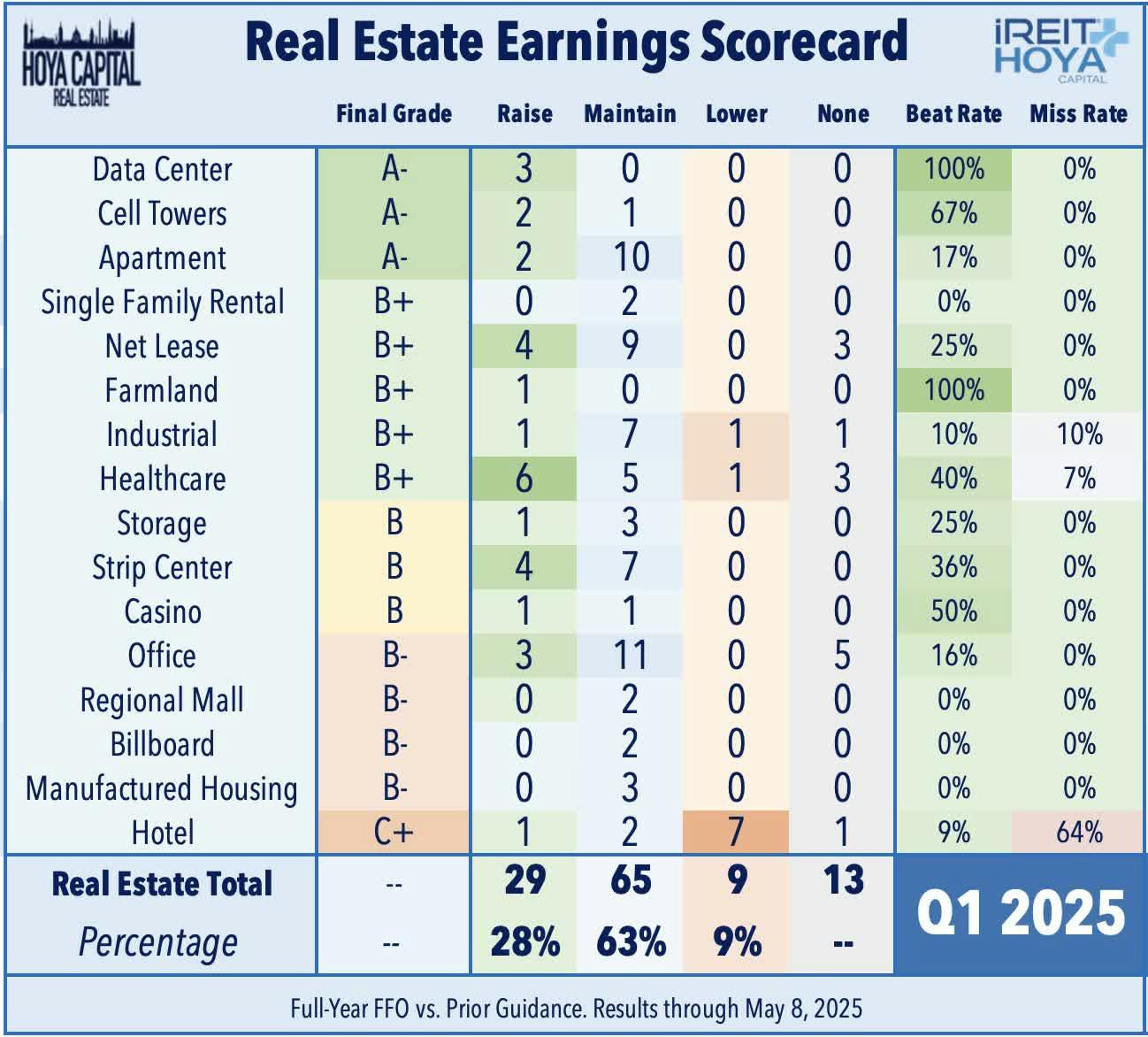
Over 200 U.S. REITs and homebuilders have reported first-quarter earnings results over the past four weeks, providing critical information on the state of the commercial and residential real estate industry. In this report, we provide the earnings "scorecard" for the REIT sector at large, and for each of the 20 individual real estate property sectors, highlighting the upside and downside guidance revisions across each, along with the single top-performer and worst-performer of each sector.
In our subsequent Winners & Losers report, we'll provide additional commentary that will discuss the upside and downside surprises.
Of the 103 equity REITs that provide full-year FFO guidance, 28% raised their outlook, 63% maintained their outlook, while 9% lowered their 2025 FFO target, effectively spot-on with our pre-season forecast and roughly in-line with the typical first-quarter average.
Of the 38 REITs that altered their outlook, 76% were upside revisions while 24% were downside revisions. By comparison, FactSet reports that among the 261 S&P 500 constituents that provided full-year Earnings Per Share ("EPS") guidance, 45% raised their full-year outlook, while 55% downwardly revised their full-year EPS outlook.
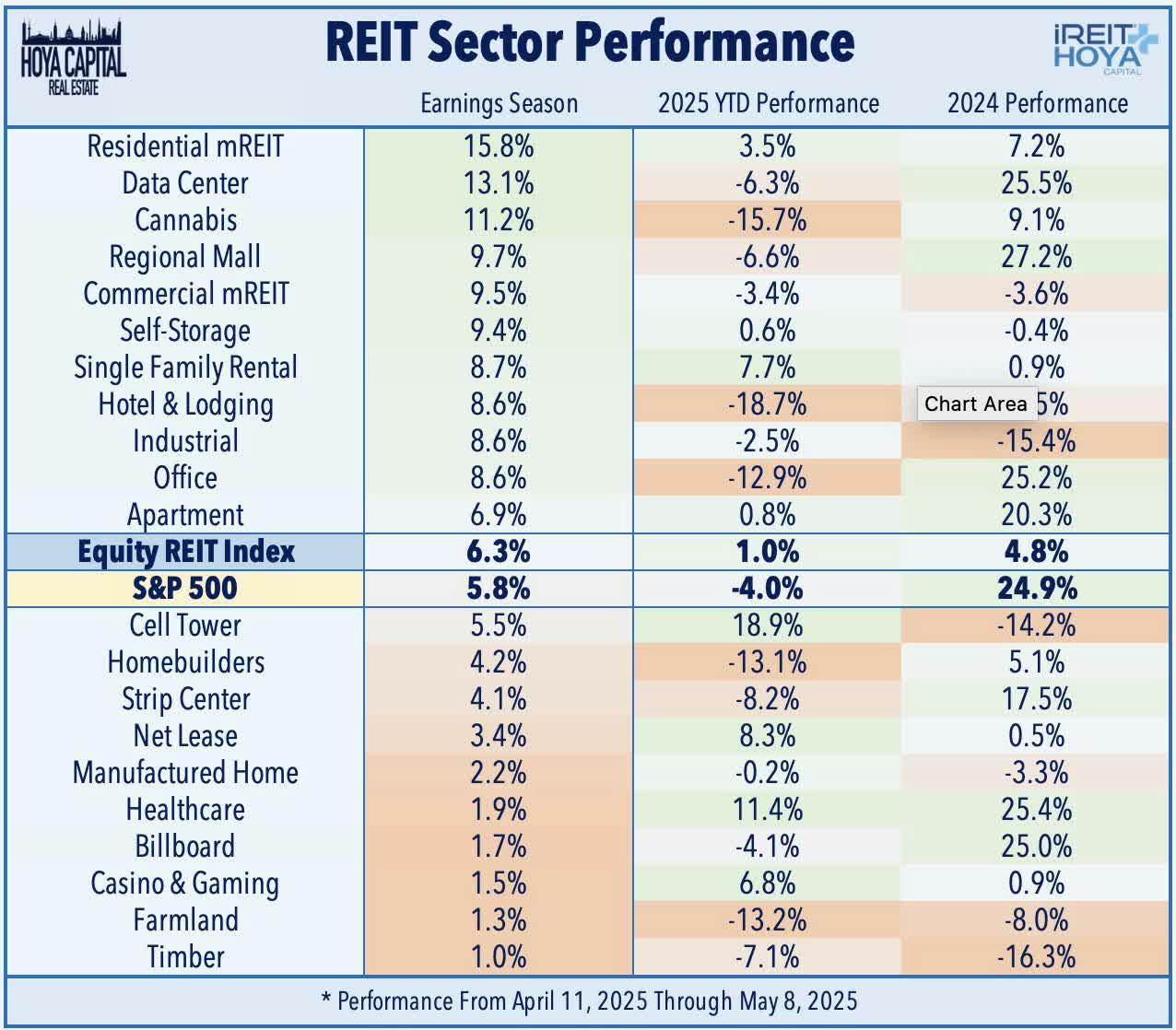
REITs have generally matched the stock price performance of the S&P 500 since the start of season season, each posting gains of roughly 6% since mid-April. Overarching trends were broadly consistent with the "green shoots" identified in our REIT Earnings Preview.
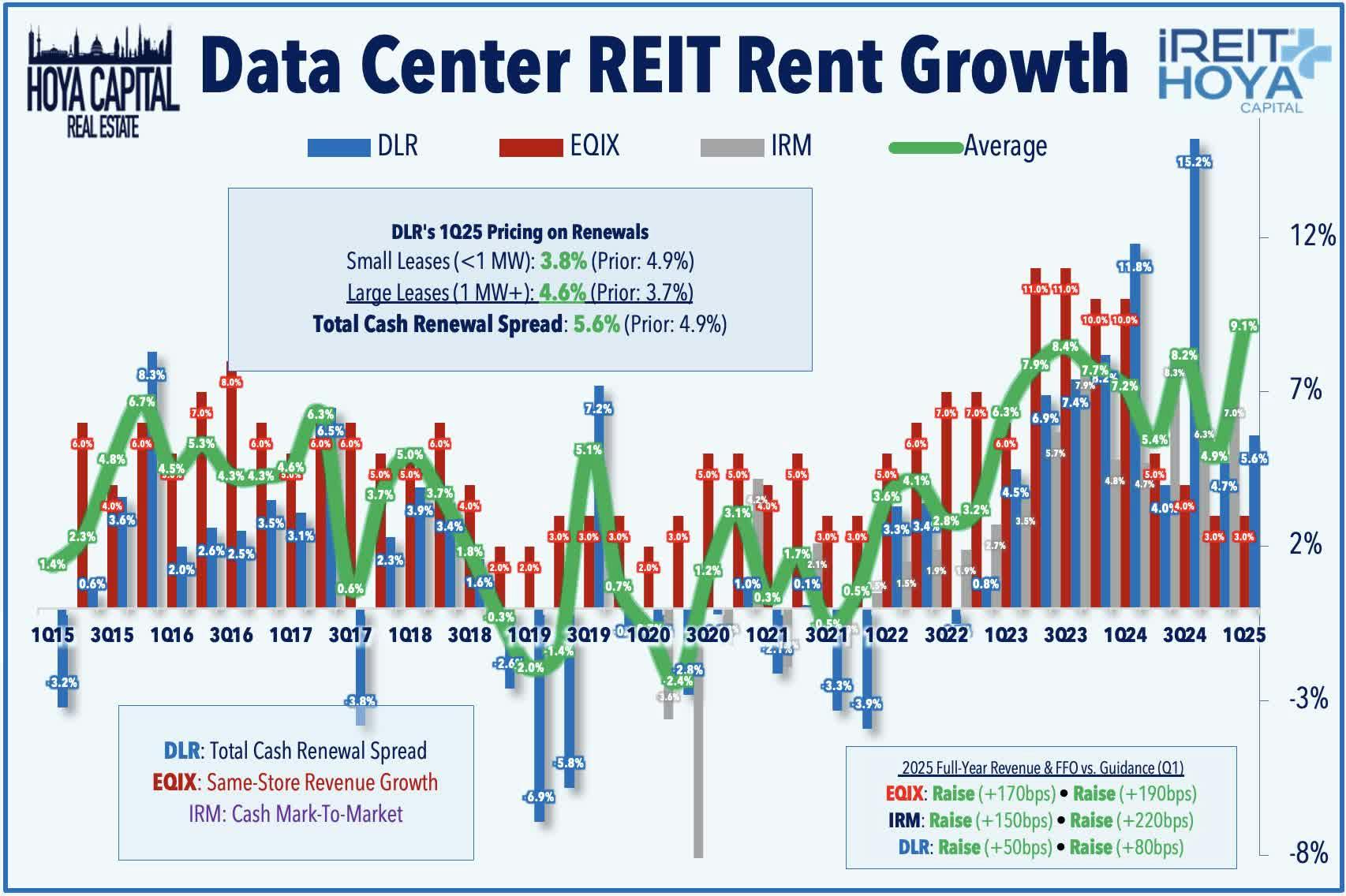
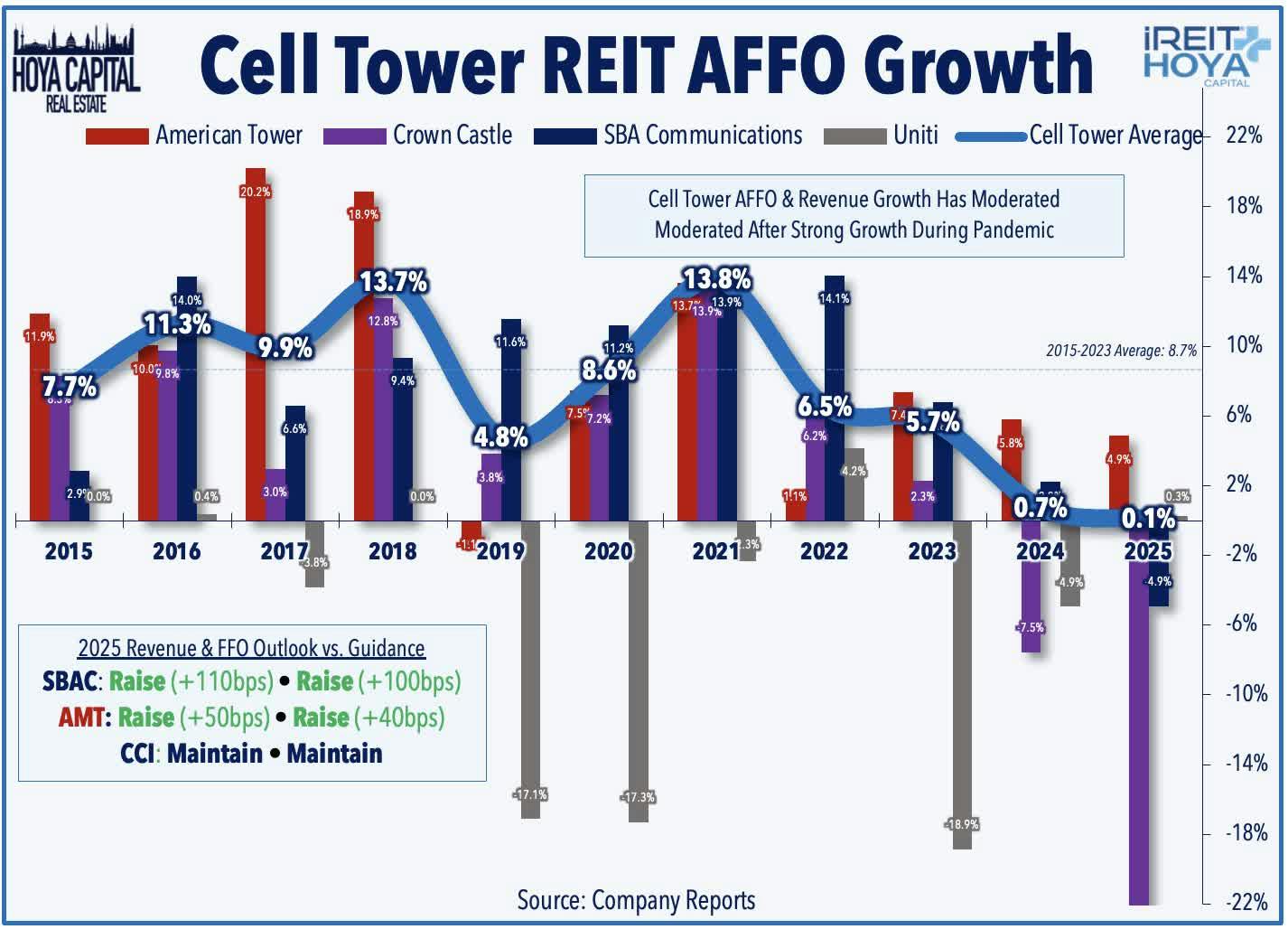
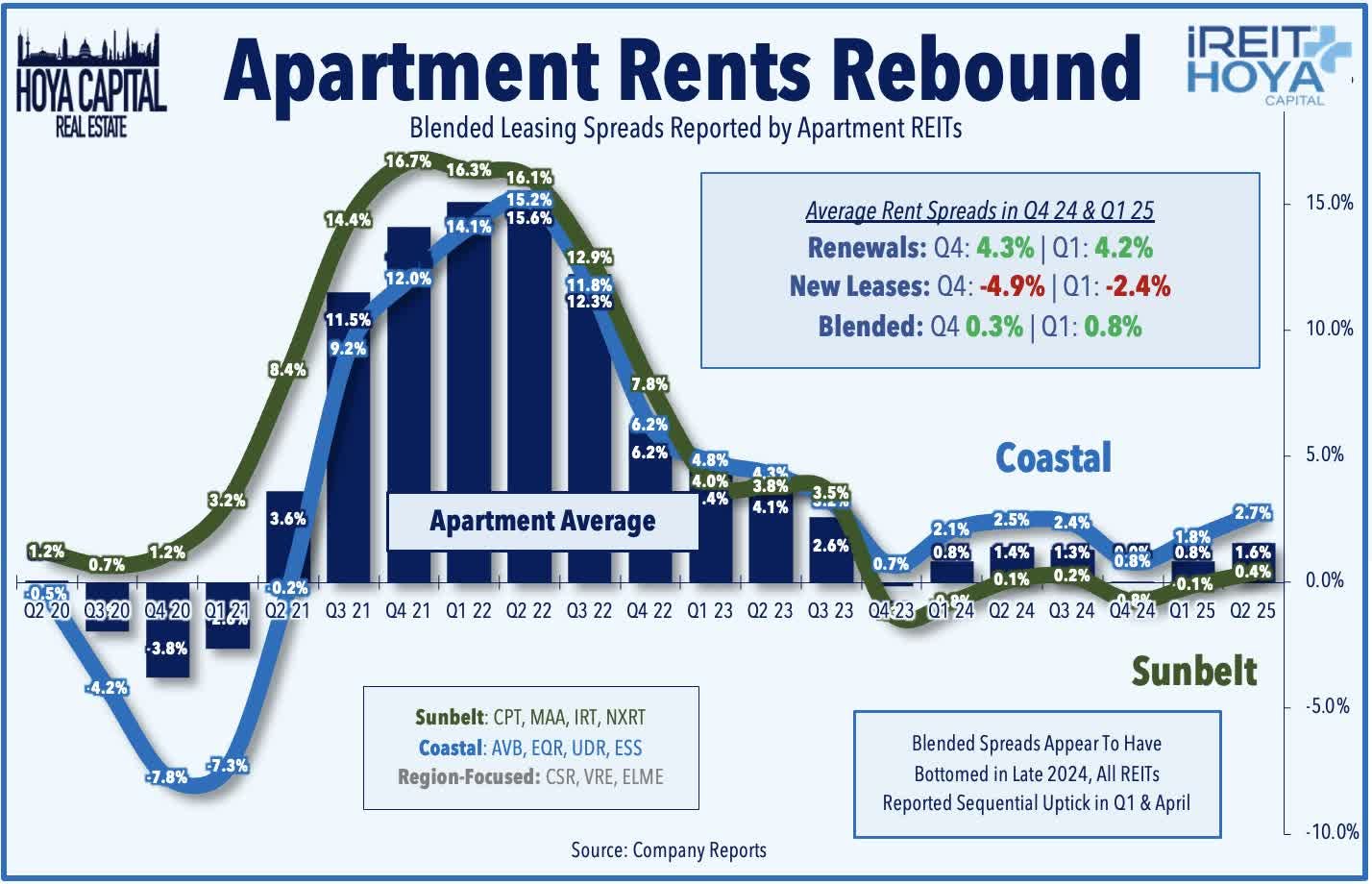
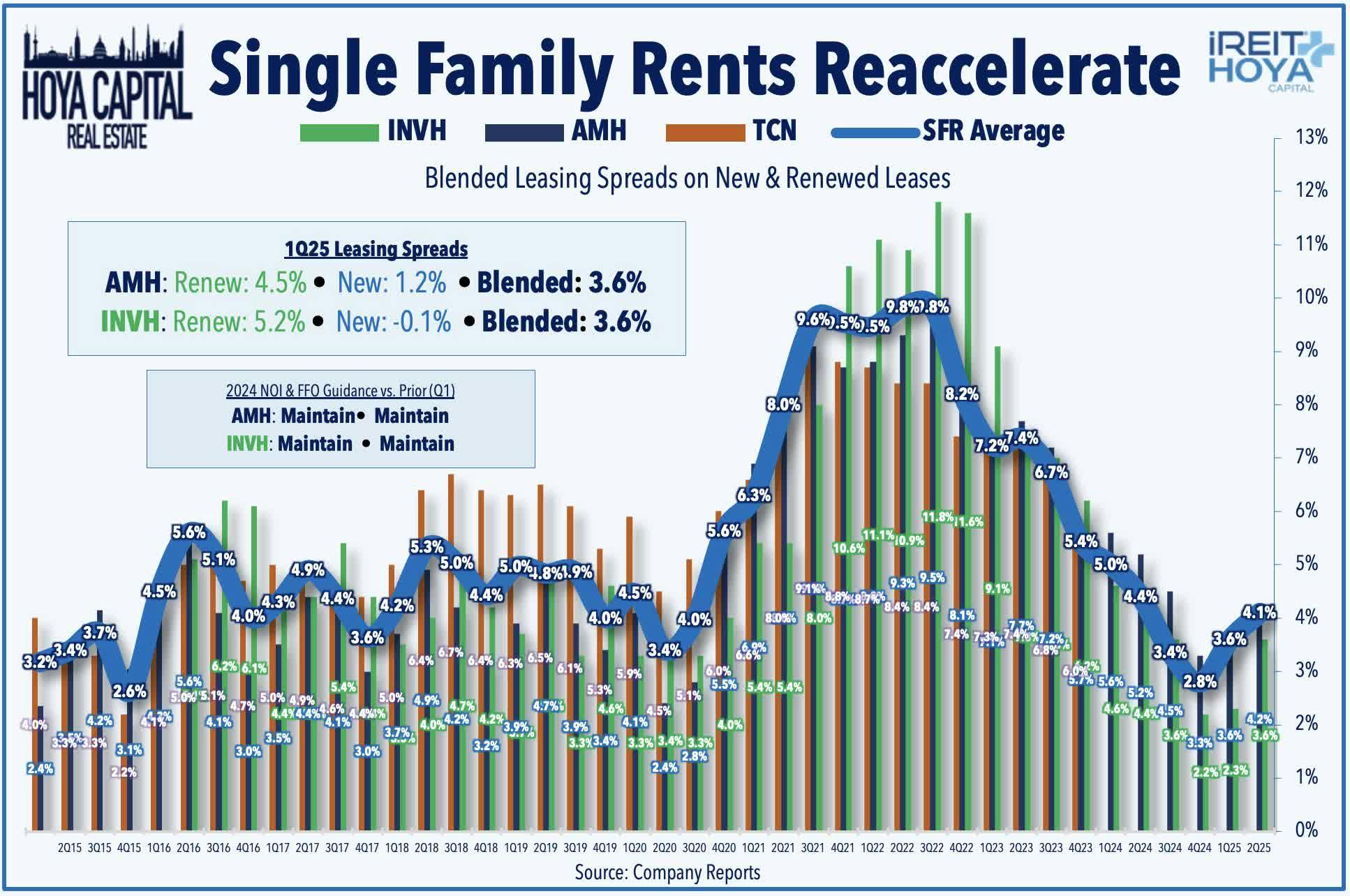
Beginning with the "Winners" - Technology REITs were notable upside standouts, with all three Data Center REITs and two of the three Cell Tower REITs raising their full-year FFO outlook, citing surprisingly solid demand trends. Results from Residential REITs were surprisingly solid, with single-family rental and apartment REITs confirming that rent growth has reaccelerated in early 2025 after two years of sluggish trends.
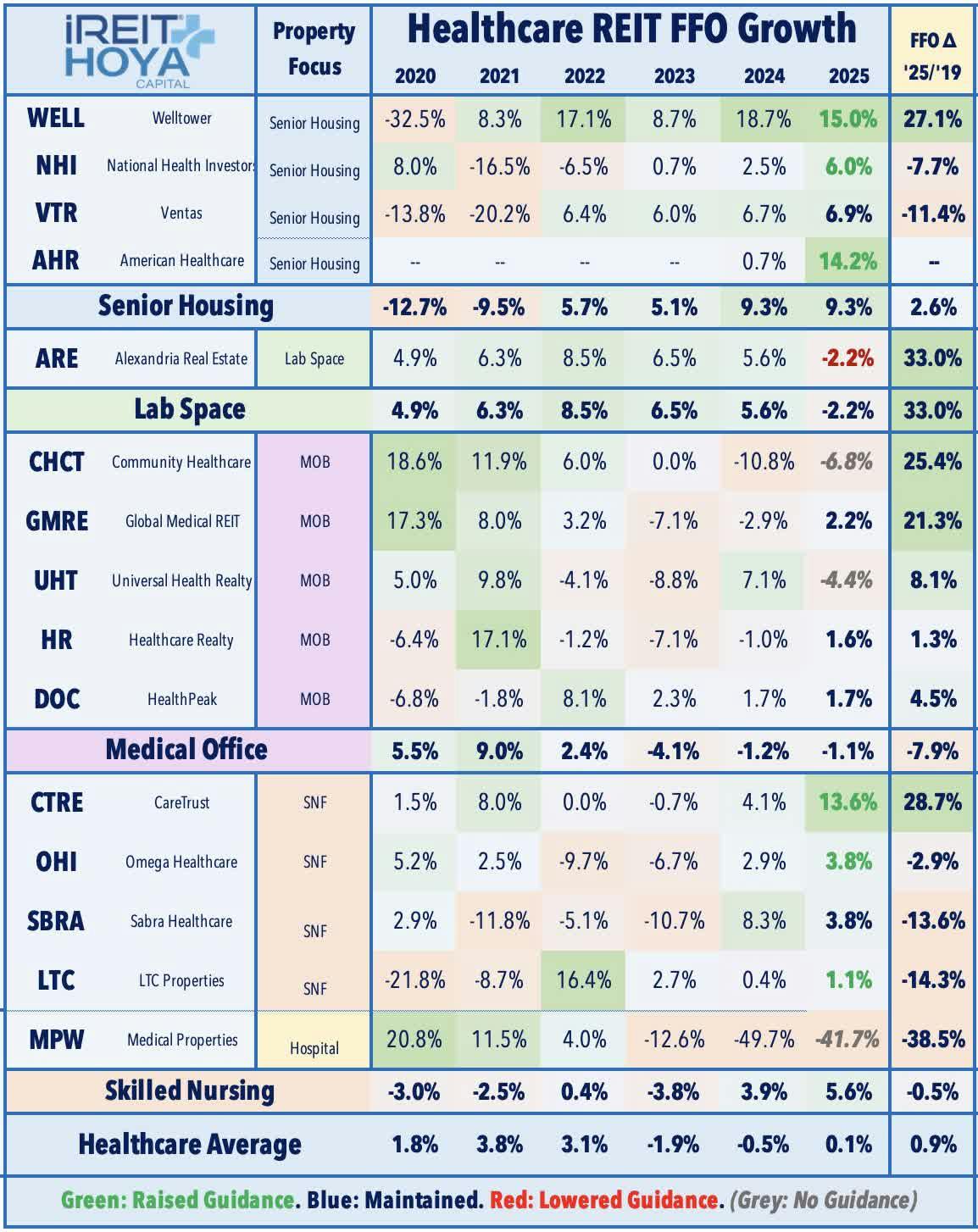
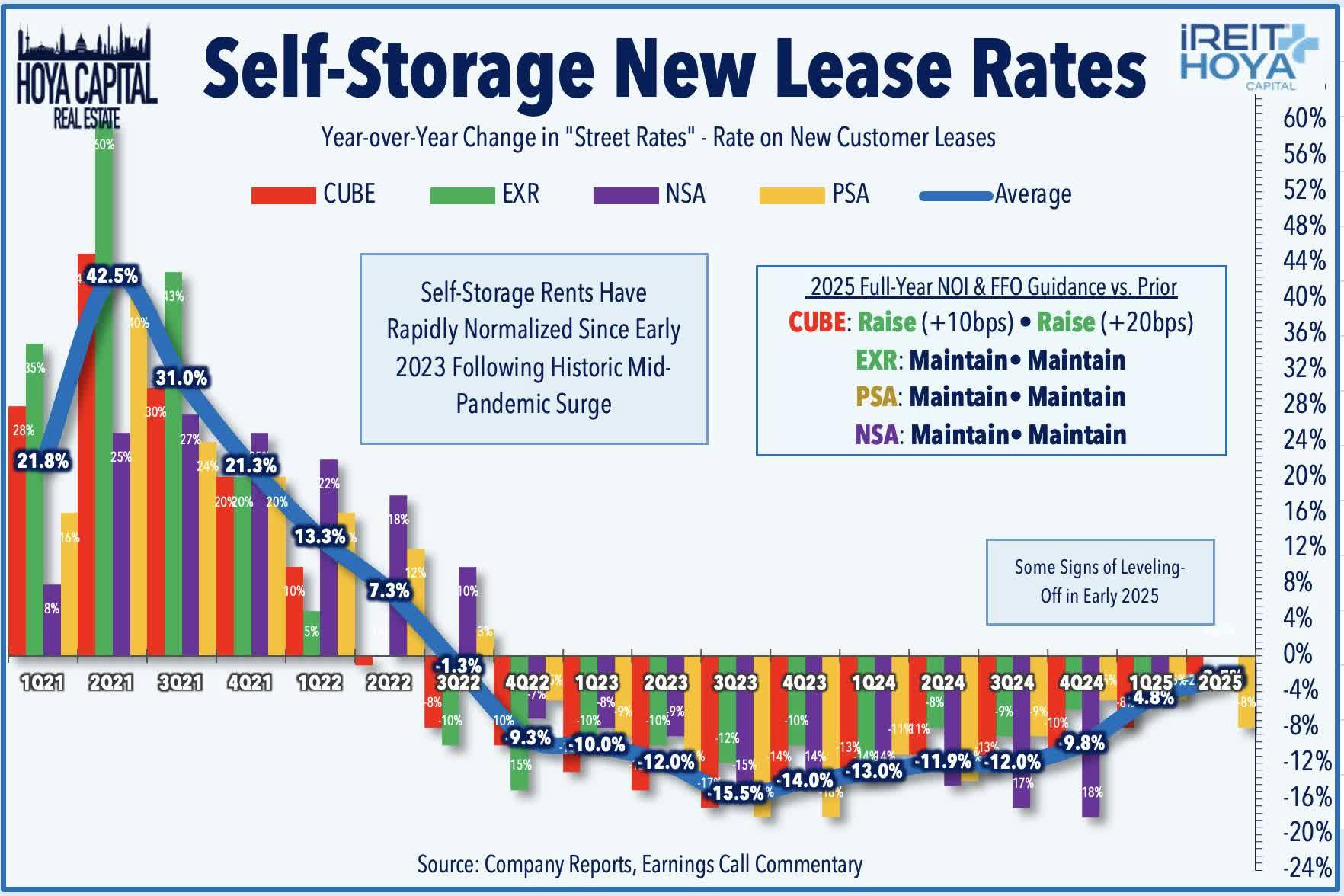
Relatedly, results from Self-Storage REITs were modestly encouraging as new lease rates appear to be stabilizing after eight straight quarters of double-digit annualized declines. Senior Housing REITs posted another rather impressive quarter with another round of significant upward guidance revisions on their critical SHOP segment.
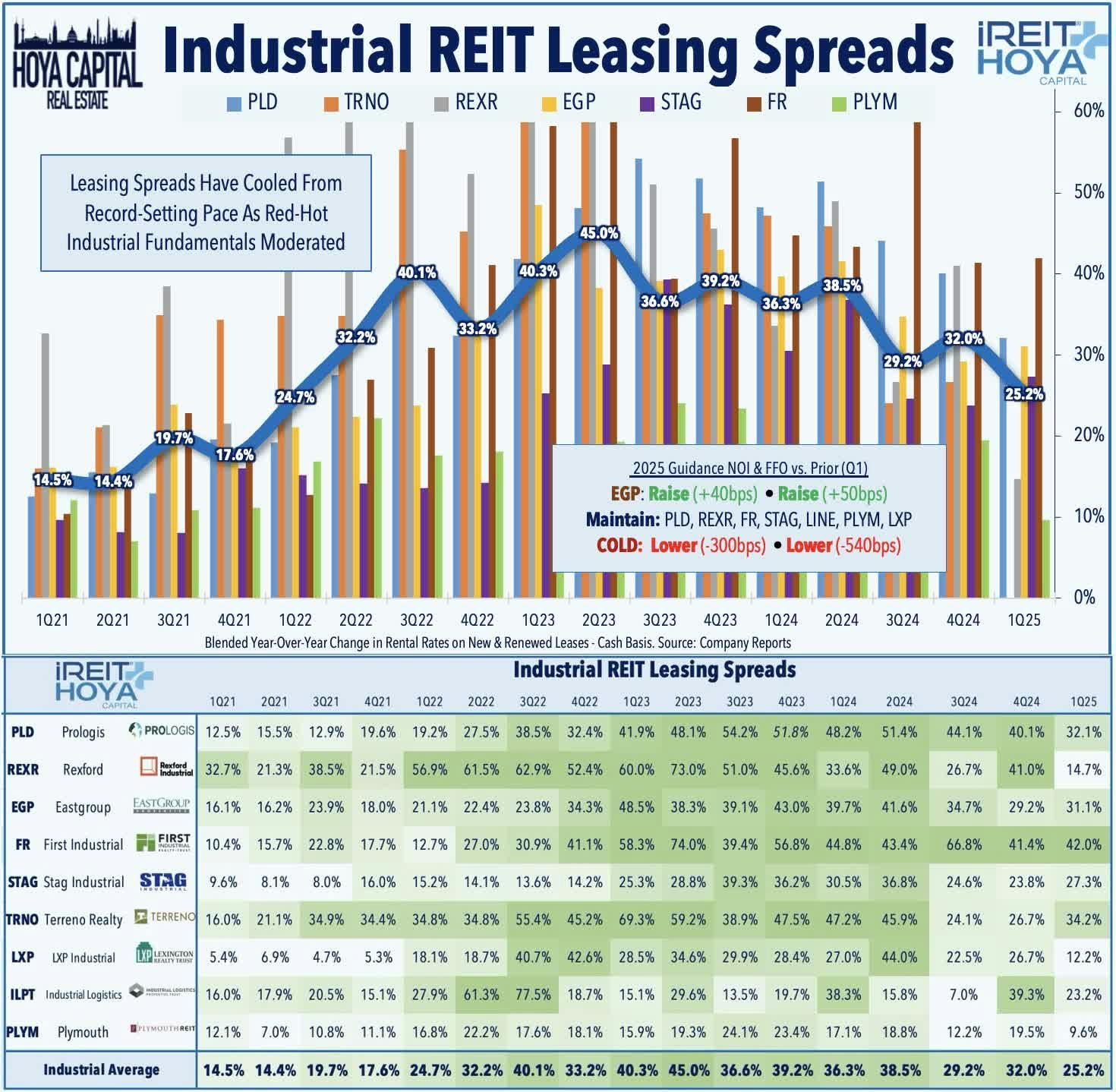
Industrial REITs reported only minimal impacts from tariff-related uncertainty, with expectations that East Coast logistics markets could be net beneficiaries of the China trade war.
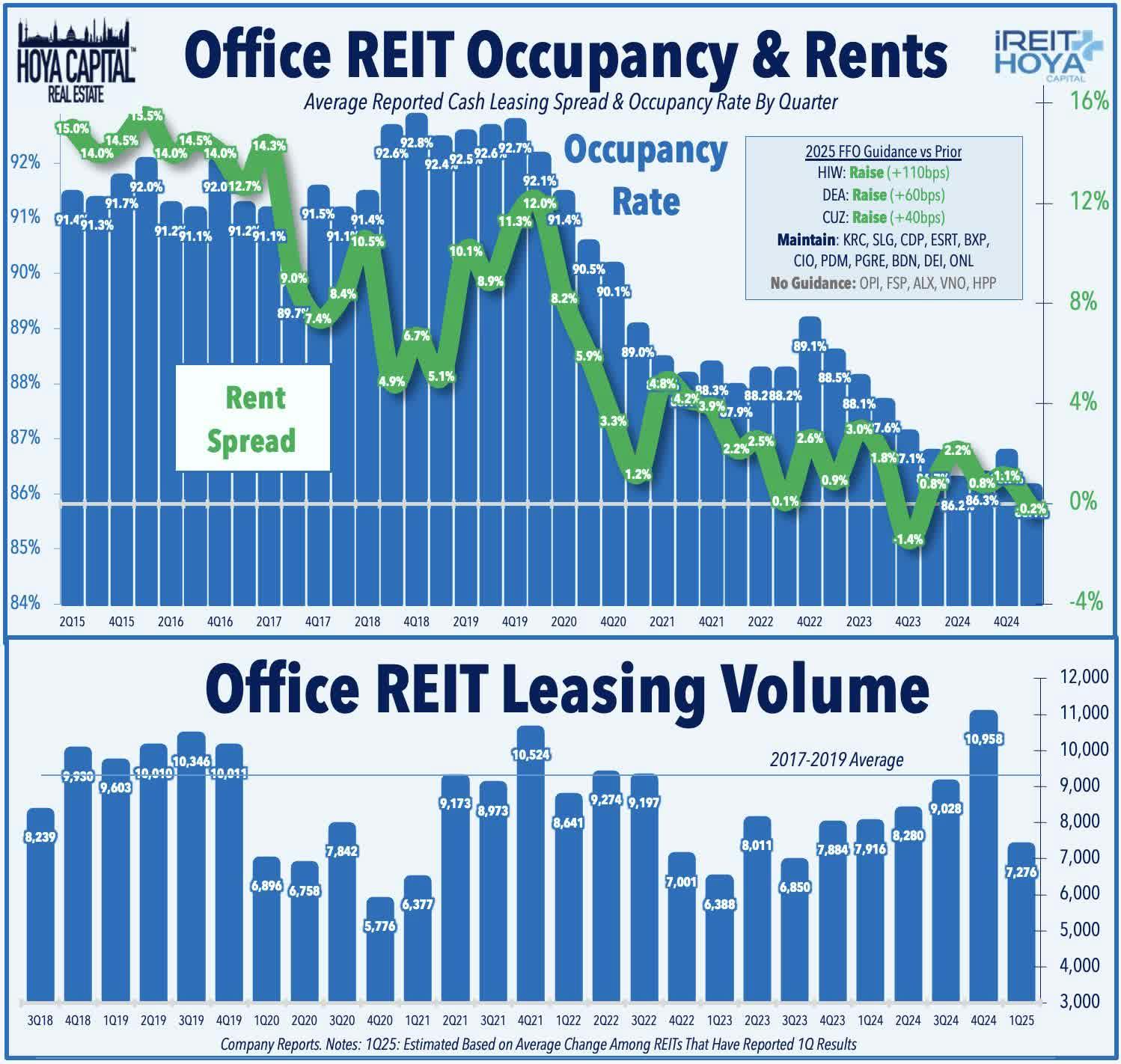
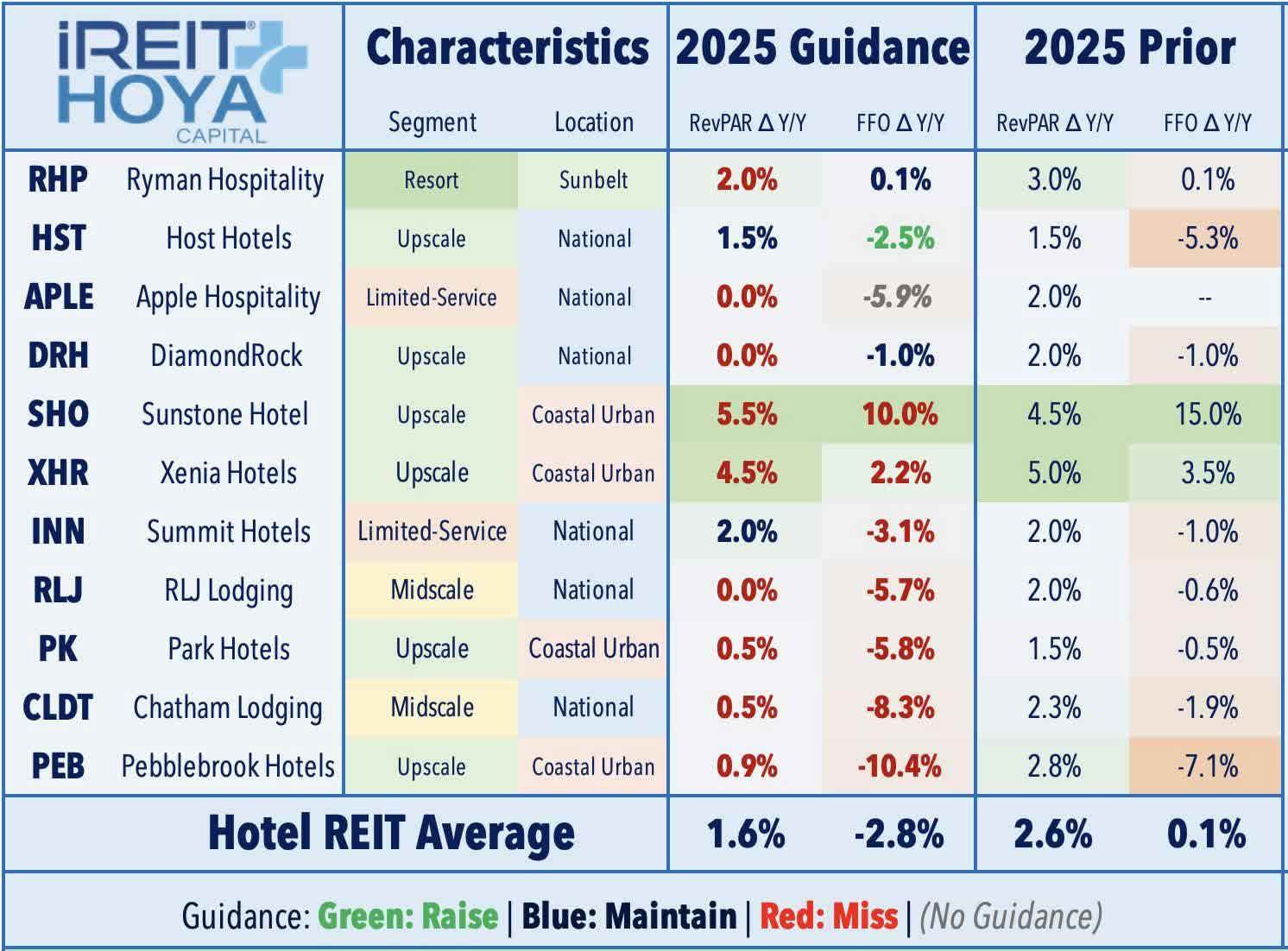
While there weren't major bombshells this earnings season, Hotel REITs were responsible for 7 of the 9 downward guidance cuts this earnings season - all relatively modest downside revisions. Cold Storage and Lab Space REITs accounted for the other two downside revisions. Office REIT results were also modestly disappointing as leasing volumes dipped to a six-quarter low following a very strong third and fourth quarter. Mortgage REITs - both residential and commercial - reported steady results with no major "blow-ups" during the post-Liberation Day interest rate volatility, which was the most extreme since the early COVID turmoil.
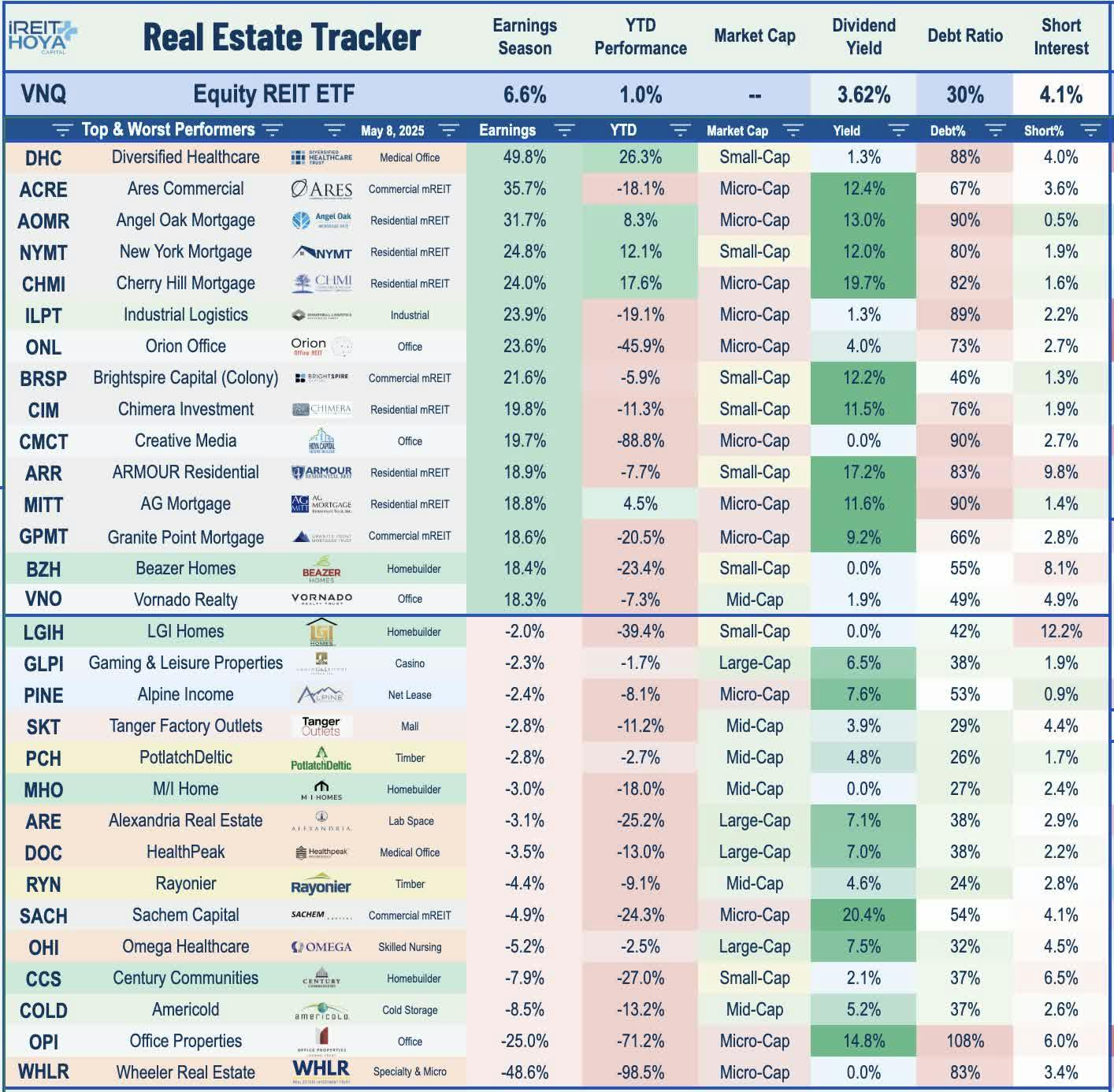
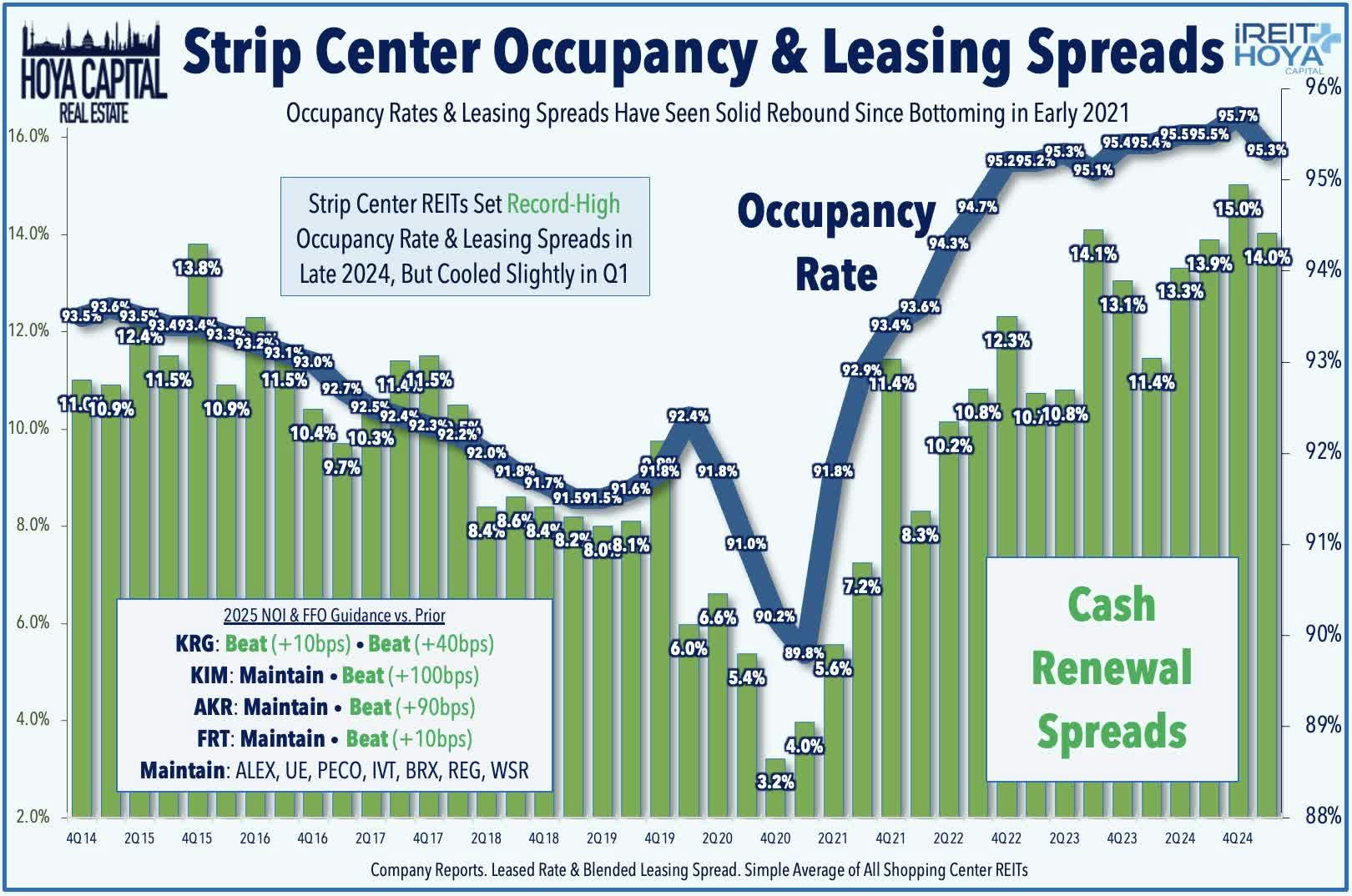
Retail REITs continued to report historically strong occupancy levels and leasing spreads despite the recent uptick in retailer distress, which has been largely concentrated in the mall-based and single-tenant format rather than big-box strip centers. Notable individual performance leaders this earnings season included mortgage REITs Ares Commercial (ACRE), Angel Oak (AOMR), and New York Mortgage (NYMT), which each rallied more than 25% after reporting surprisingly solid results. Notable losers included Office Properties Income (OPI), Americold (COLD), Omega Healthcare (OHI), and HealthPeak (DOC).
Get data on 14,000+ ETFs
Access Trackinsight's reliable and comprehensive data with 500M+ points on 14,000+ ETFs.
Property Sector Earnings Scorecards
Data Center: (Final Grade: A-)
- FFO Guidance: 3 Raise
- Top Performer: Digital Realty (DLR): +15.1%
- Worst Performer: Equinix (EQIX) +11.6%
Cell Tower: (Final Grade: A-)
- FFO Guidance: FFO: 2 Raise, 1 Maintain
- Top Performer: Crown Castle (CCI): +8.3%
- Worst Performer: American Tower (AMT): +2.8%
Apartment: (Final Grade: A-)
- FFO Guidance: FFO: 1 Raise, 10 Maintain
- Top Performer: Camden Property (CPT): +9.1%
- Worst Performer: BRT Apartments (BRT): +0.5%
Single-Family Rental: (Final Grade: B+)
- FFO Guidance: 2 Maintain
- Top Performer: American Homes (AMH): +9.8%
- Worst Performer: Invitation Homes (INVH) +8.2%
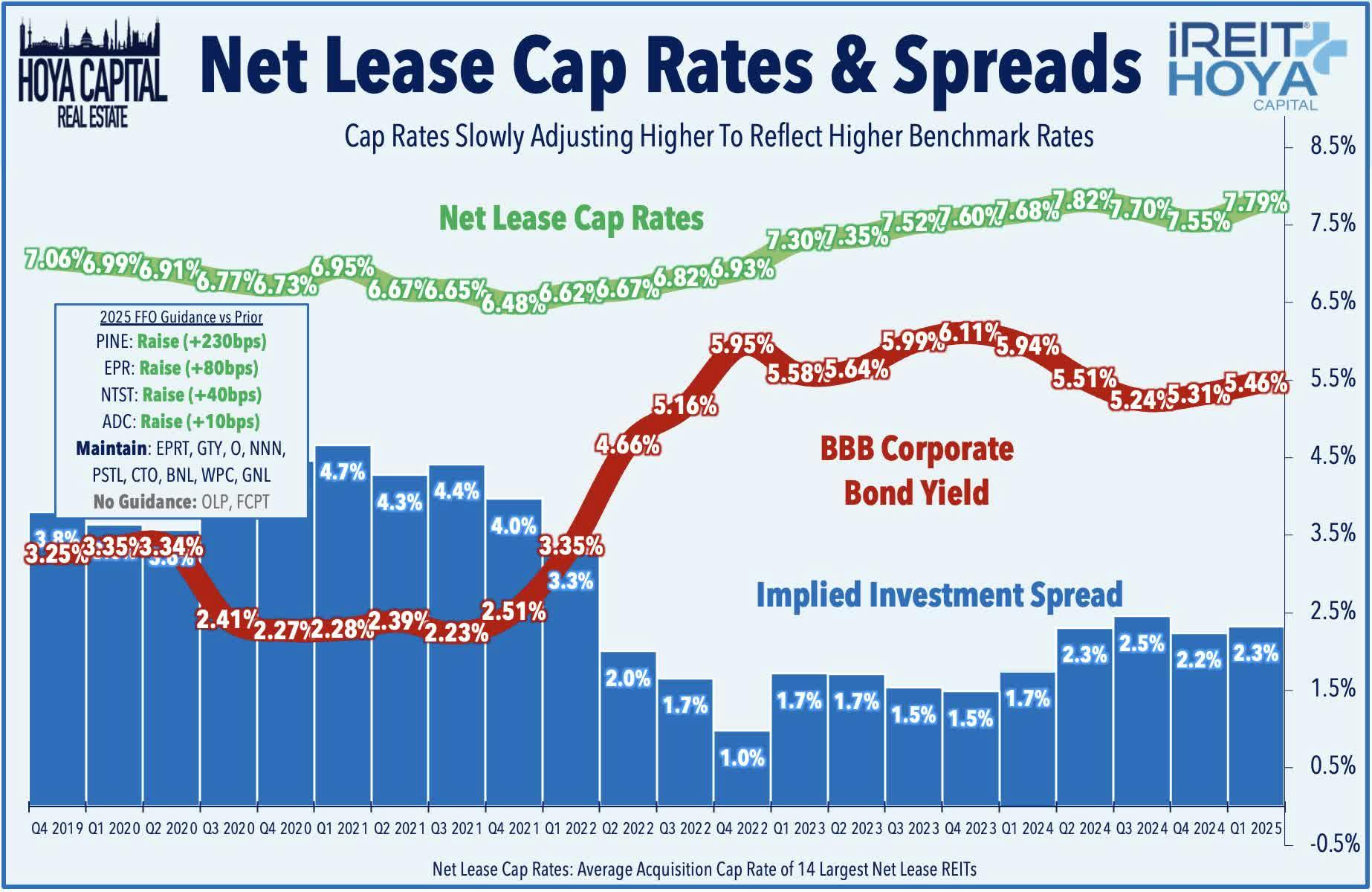
Net Lease: (Final Grade: B+)
- FFO Guidance: 4 Raise, 9 Maintain
- Top Performer: Global Net Lease (GNL): +8.4%
- Worst Performer: Modiv (MDV): -10.5%
Industrial: (Final Grade: B+)
- FFO Guidance: 1 Raise, 7 Maintain, 1 Lower
- Top Performer: Plymouth (PLYM): +11.2%
- Worst Performer: Americold (COLD): -11.2%
Healthcare: (Final Grade: B+)
- FFO Guidance: 6 Raise, 5 Maintain, 1 Lower
- Top Performer: American Healthcare (AHR): +18.5%
- Worst Performer: Omega Healthcare (OHI): -5.3%
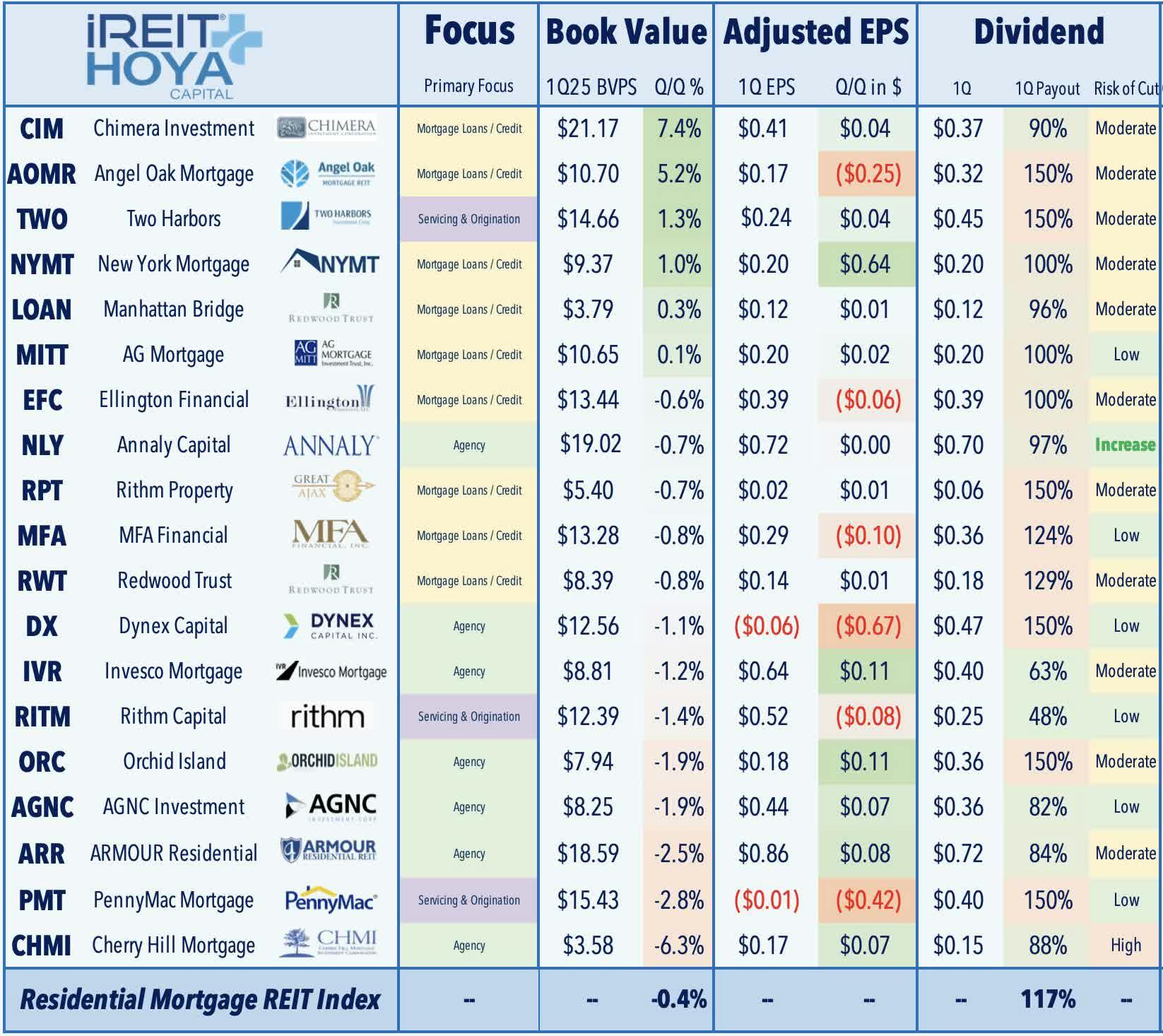
Residential mREITs: (Final Grade: B+)
- Change in Book Value Q/Q: -0.4%
- Top Performer: Angel Oak Mortgage (AOMR): +33.7%
- Worst Performer: PennyMac Mortgage (PMT): +4.5%
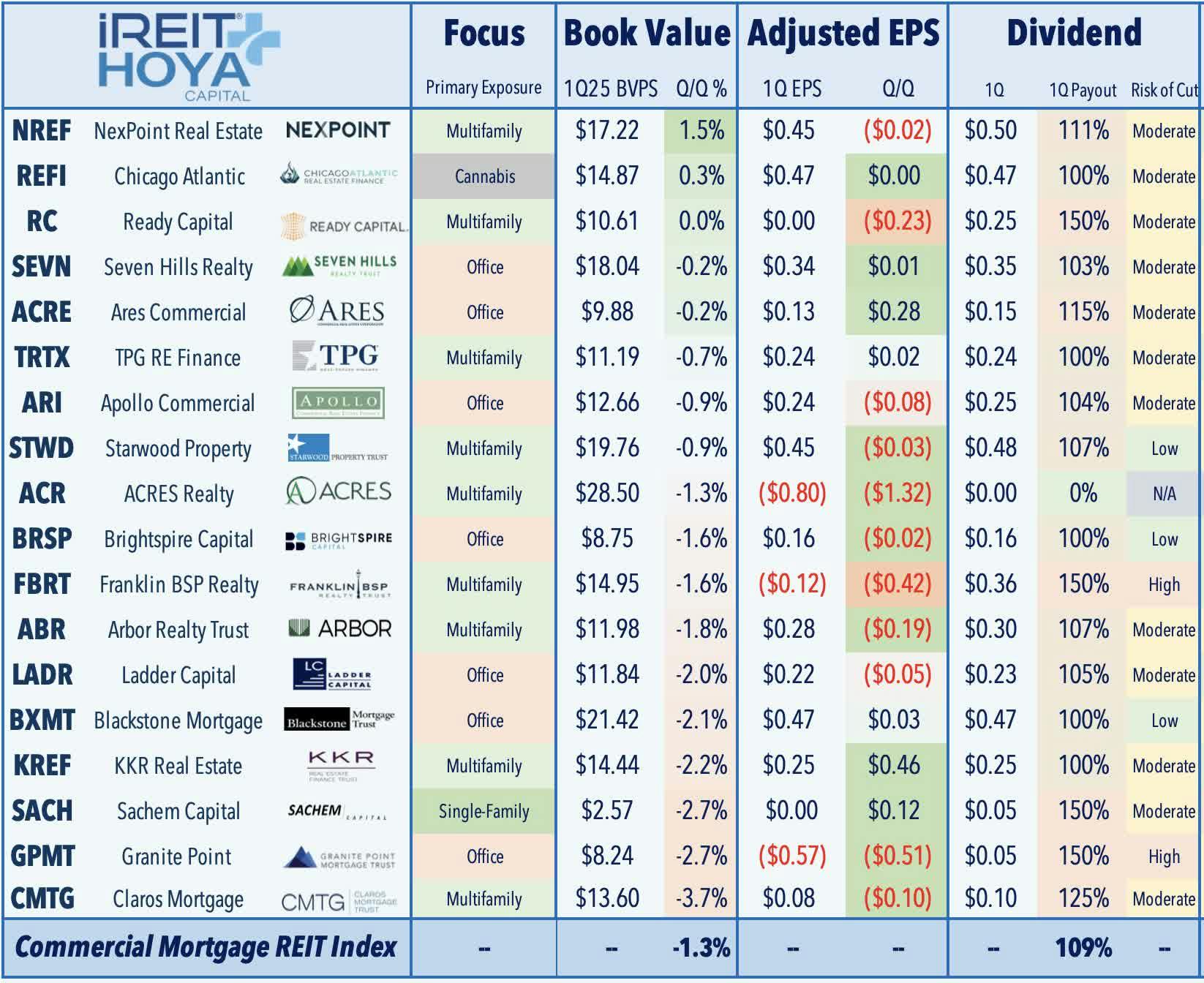
Commercial mREITs: (Final Grade: B+)
- Change in Book Value Q/Q: -1.3%
- Top Performer: Angel Oak Mortgage (AOMR): +33.7%
- Worst Performer: Ready Capital (RC): -6.3%
Self-Storage: (Final Grade: B)
- FFO Guidance: 1 Raise, 3 Maintain
- Top Performer: CubeSmart (CUBE): +13.2%
- Worst Performer: National Storage (NSA): +5.8%
Strip Centers: (Final Grade: B)
- FFO Guidance: 1 Raise, 3 Maintain
- Top Performer: Kite Realty (KRG): +9.6%
- Worst Performer: Whitestone REIT (WSR): -2.3%
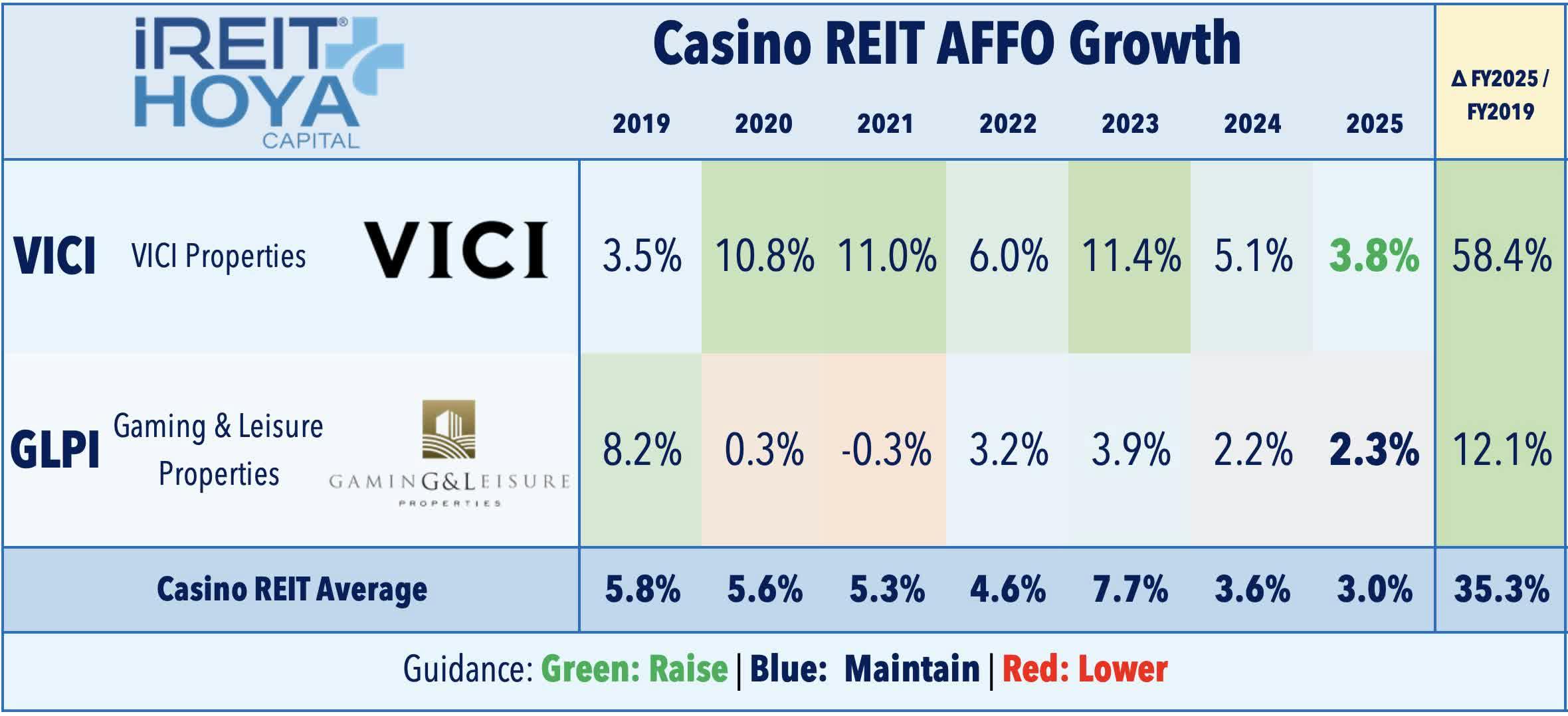
Casino: (Final Grade: B)
- FFO Guidance: 1 Raise, 1 Maintain
- Top Performer: VICI Properties (VICI): +2.5%
- Worst Performer: Gaming & Leisure Properties (GLPI): -1.3%
Office: (Final Grade: B-)
- FFO Guidance: 3 Raise, 11 Maintain
- Top Performer: Orion Properties (ONL): +20.5%
- Worst Performer: Office Properties Income (OPI): -27.8%
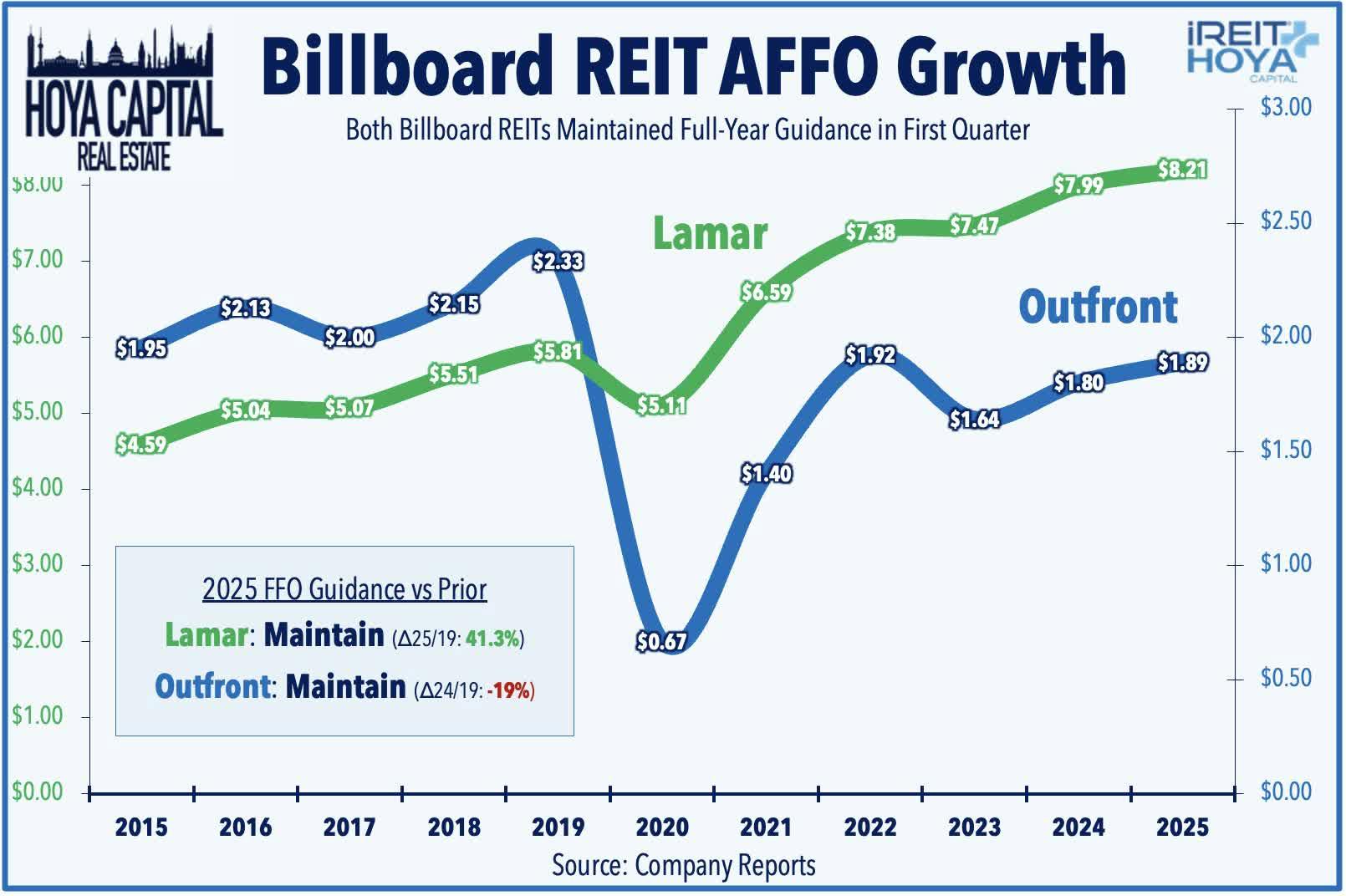
Billboard: (Final Grade: B-)
- FFO Guidance: 2 Maintain
- Top Performer: Outfront Media (OUT): +3.4%
- Worst Performer: Lamar Advertising (LAMR): +1.1%
Manufactured Housing: (Final Grade: B-)
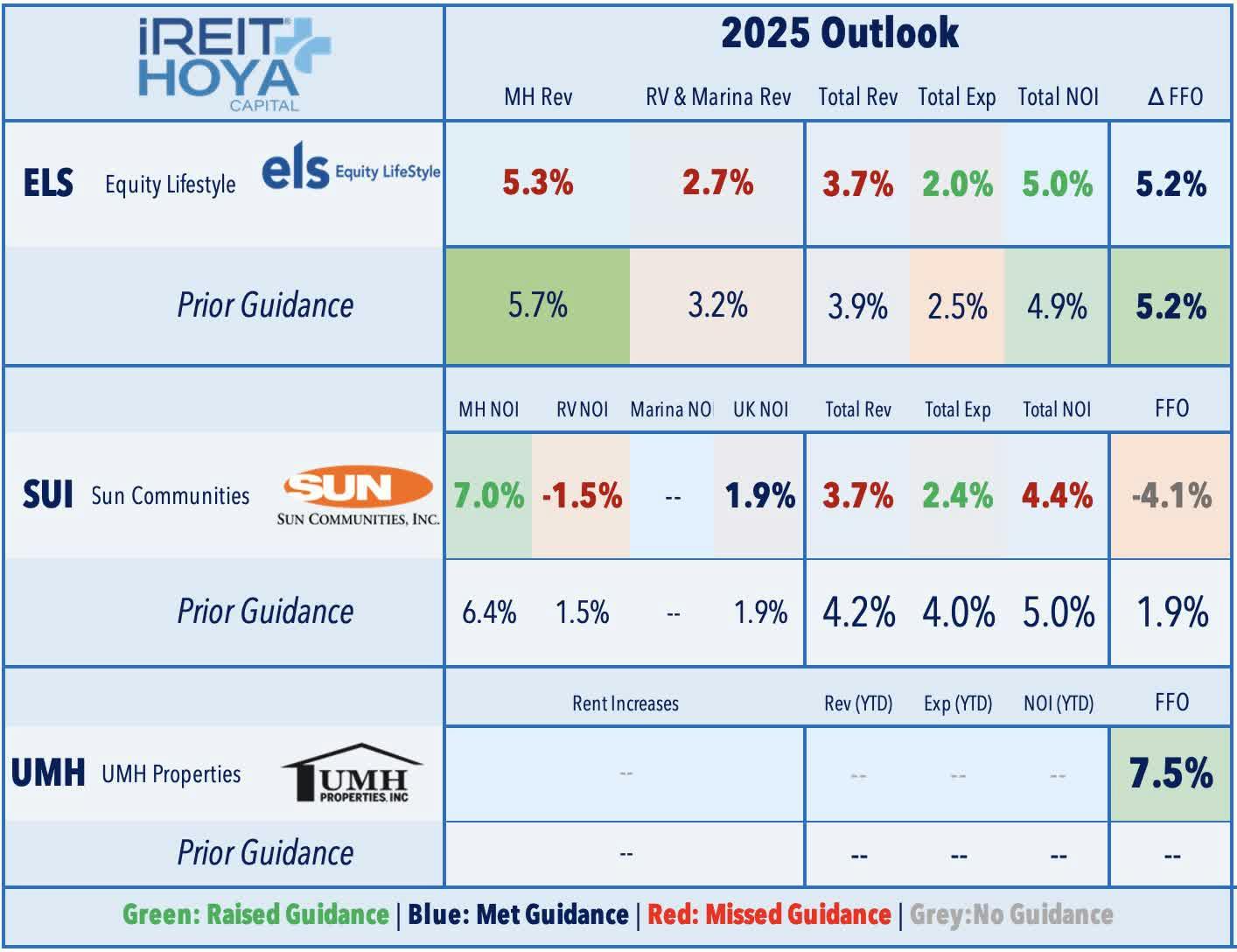
- FFO Guidance: 2 Maintain, 1 Initiate
- Top Performer: Sun Communities (SUI): +3.8%
- Worst Performer: Equity Lifestyle (ELS): +0.0%
Hotels: (Final Grade: C-)
- FFO Guidance: 1 Raise, 2 Maintain, 7 Lower
- Top Performer: Xenia Hotels (XHR): +18.2%
- Worst Performer: Sunstone Hotels (SHO): +1.2%
Bottom Line: Solid Earnings, No Big Surprises
Largely immune from direct trade and tariff risks, REITs are coming back into favor after three years of historic underperformance, which had driven valuations to unusually "cheap" levels. First-quarter earnings results were generally in-line with expectations, with no major downside surprises despite the period of extreme interest rate volatility in early April.
Technology REITs were the notable upside standouts, with all three Data Center REITs and two of the three Cell Tower REITs raising their full-year FFO outlook citing surprisingly solid demand. Results from Residential REITs were surprisingly solid, with single-family rental and apartment REITs confirming that rent growth has reaccelerated slightly in early 2025 after two years of sluggish trends.
Hotel REITs were responsible for 7 of the 9 downward guidance cuts this earnings season - all relatively modest downside revisions. Cold Storage and Lab Space REITs accounted for the other two downside revisions.
Stay tuned for an extended follow-up report covering the Winners and Losers of REIT Earnings season, with notes on incremental positives and negatives we've observed across each of the major property sectors this earnings season.
About the Author
David Auerbach boasts over two decades of experience in the securities industry, specializing as an institutional trader with a focus on Real Estate Investment Trusts (REITs), Equity and Preferred stocks, MLPs, ETFs, and Closed End Funds.
Based in Dallas, TX throughout his entire career, David currently serves as the Chief Investment Officer for Hoya Capital, managing the Hoya Housing 100 ETF (Ticker: HOMZ) and The High Yield Dividend ETF (Ticker: RIET). Previously, David held the position of Managing Director at Armada ETF Advisors, the sub-advisor for the Residential REIT ETF (Ticker: HAUS) and The Private Real Estate Strategy via Liquid REITs ETF (Ticker: PRVT).
Additionally, he acts as a consultant with IRRealized, LLC, focusing on corporate access in the REIT industry. David's industry journey includes roles at World Equity Group, Esposito Securities, and Green Street Advisors where he got his start in the REIT industry.
At Esposito Securities, he played a crucial role in building the REIT/Real Estate platform and worked extensively with institutional investors, Equity REITs, and ETF issuers.
Throughout his career, David has been quoted by reputable publications such as Bloomberg, WSJ, Financial Times, REIT.com, and GlobeSt.com. He has also made notable appearances as a featured guest on networks like Yahoo Finance, TD Ameritrade, and Bloomberg.
David holds a BBA in Finance from the University of Texas at Austin (May 1999) and an MBA in Finance from Southern Methodist University (May 2005). He maintains FINRA Series 7, 24, 55, and 63 registrations.
In his leisure time, David is an avid traveler, often found crisscrossing the country in pursuit of attending as many Phish concerts as possible.
Disclaimer
Please note this article is for information purposes only and does not in any way constitute investment advice. It is essential that you seek advice from a registered financial professional prior to making any investment decision.
Latest ETF News
See all ETF newsThe Leveraged ETF Question Nobody Is Asking





Before You File Your ETF, Read This First



 Advantages of ETFs over Mutual Funds1/6
Lower Costs
In this guide, we'll explore the advantages of ETFs over mutual funds, giving you valuable insights into why ETFs have gained significant popularity among investors like yourself.
Leveraged ETFs: Unlocking the Potential for Amplified Returns1/6
Understanding Leveraged ETFs
Explore leveraged ETFs: potential for amplified returns & risks. 5 ETFs to consider across equities, commodities & fixed income.
What is a Leveraged ETF?1/6
Introducing Leveraged and Inverse ETFs
In this guide, we'll dive into the world of leveraged ETFs, exploring their definition, mechanics, potential risks, and rewards.
Recent educational content

ETF Trends
ETF Industry KPIs July 20, 2026
This week’s KPI data overview highlights key metrics and trends shaping the ETF landscape.

ETF Trends
ETF Industry KPIs July 13, 2026
This week’s KPI data overview highlights key metrics and trends shaping the ETF landscape.

First Look ETF
First Look ETF: Cash Deployment, Bond, and Hedged ETFs
In this season 6 episode of First Look ETF, Stephanie Stanton examines the latest ETF marketplace trends with NYSE and guests.

ETF Trends
ETF Industry KPIs July 6, 2026
This week’s KPI data overview highlights key metrics and trends shaping the ETF landscape.
Browse all educational columns



Active Trader Report: Use of Leveraged & Inverse ETFs Way Up
Direxion partnered with Compound Insights and Vanda to explore what’s driving the evolution of active trading — and how active traders are using leveraged and inverse funds across equities, single stocks, commodities, and volatility.