Open Now: The Global ETF Survey Take the Survey →



REIT Earnings Q3 2024 Preview
Hoya Capital highlights key trends from the real estate earnings season Q3 2024, focusing on REITs' rebound potential amidst fluctuating rate expectations and sector-specific shifts in office, housing, and retail fundamentals.


Keep up with what matters in ETFs
Get timely ETF insights, market trends, and top ideas straight to your inbox.
Your newsletter subscriptions with us are subject to ETF Central's Privacy Policy and Terms and Conditions.
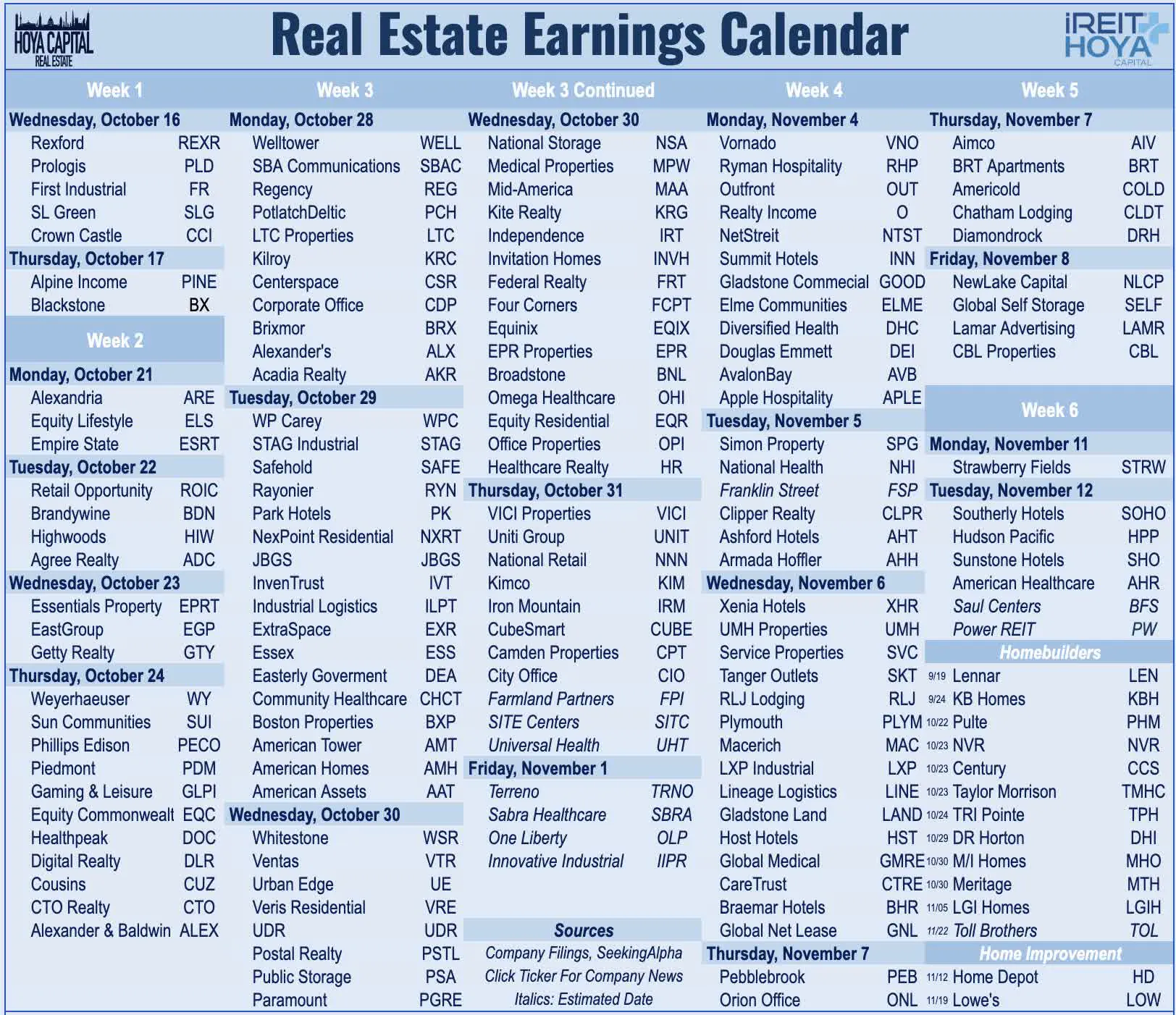
Real estate earnings season kicked off this week, and over the next month, we'll hear results from more than 175 equity REITs, 40 mortgage REITs, and dozens of housing industry companies which will provide key insights into how the real estate industry is adapting to the shifting interest rate regime. This report discusses the major high-level themes and metrics we'll be watching across each of the real estate property sectors this earnings season. Since we last heard from these REITs in July, notable incremental trends gleaned from recent industry data and commentary over the last three months include: 1) gradually recovering office fundamentals; 2) anchored housing market trends despite historically low activity levels; 3) sustained hotel and leisure demand; 4) cooling in (currently robust) retail fundamentals; and 5) stiffer disinflation headwinds in "goods-oriented" sectors (industrial, farmland, timber). Below, we compiled the earnings calendar for equity REITs and homebuilders.
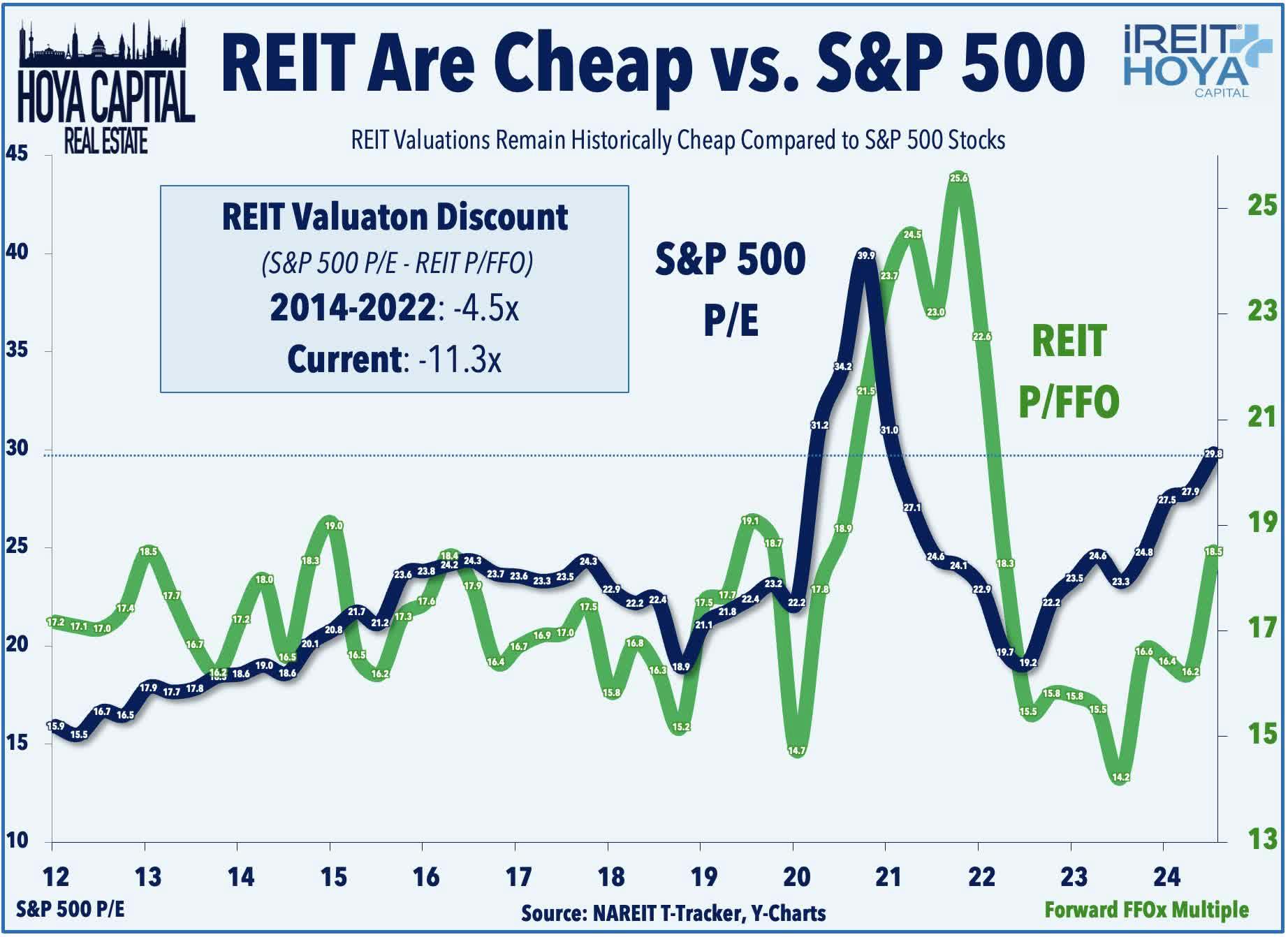
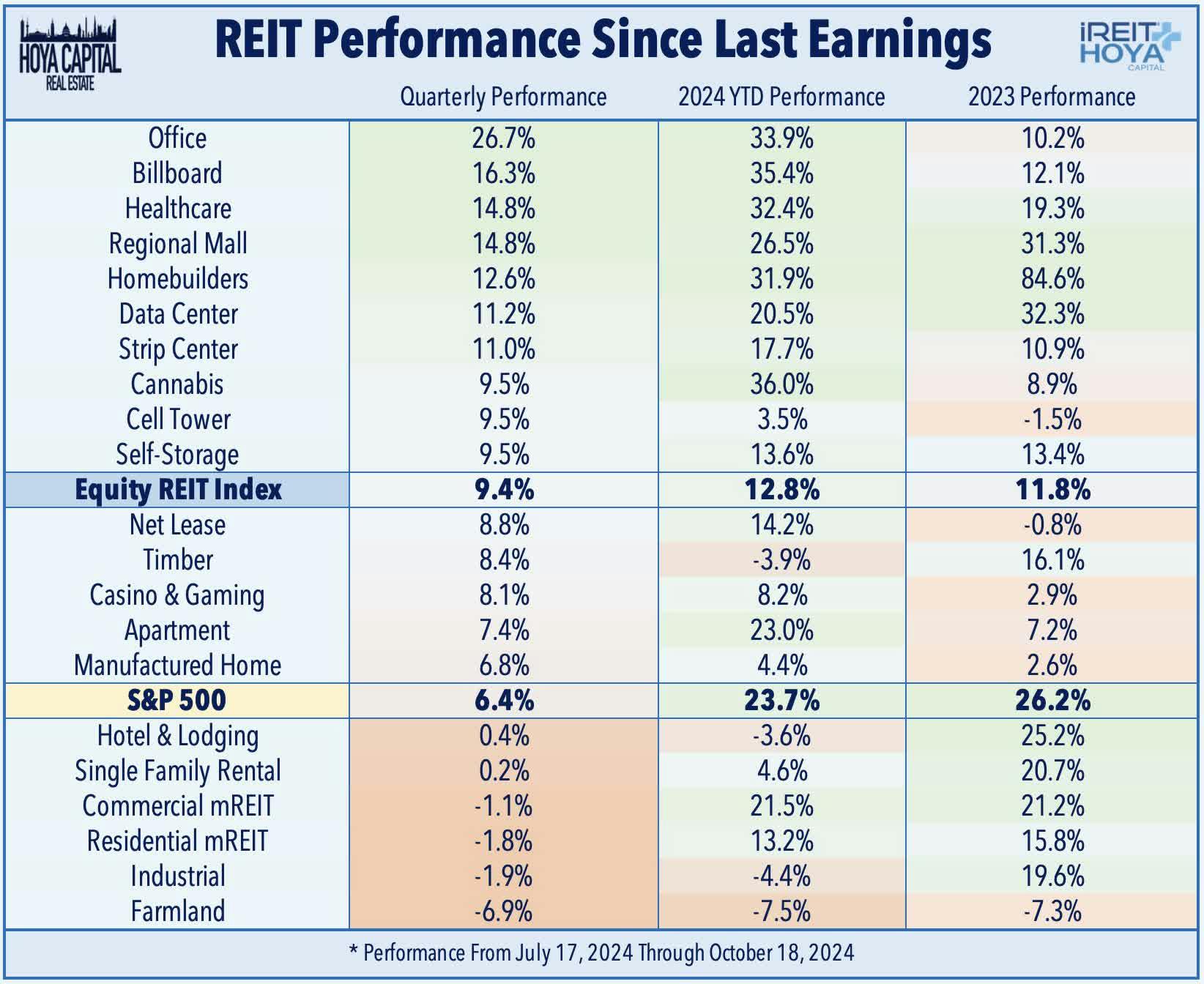
REITs accumulated historic levels of underperformance versus the S&P 500 during the Fed's hiking cycle - peaking at over 45 percentage points in July - but have clawed back some of this gap over the past quarter. Dating back to the start of the Fed's rate hiking cycle in March 2022, this historically wide underperformance gap exceeded that of the Great Financial Crisis and came despite a relatively stable fundamental environment for most property sectors outside of the troubled office sector. The sector with the most upside from easing interest rates, REITs rebounded sharply from early July through mid-September ahead of the Fed's "jumbo" rate cut, but have fluctuated since then amid changing rate cut expectations - losing ground in late September and early October, but seeing some renewed strength over the past week. Since the start of the last earnings season in mid-July, the Equity REIT Index (VNQ) has gained 9.4%, outpacing the 6.4% advance on the S&P 500 (SPY). Despite the recovery, REITs still trade at a historically wide discount to the S&P 500 on a Price-to-Earnings basis (P/FFO for REITs).
Sentiment and macroeconomic conditions have shifted significantly in the past three months, fueled by several months of encouraging inflation data pointing once again towards a "soft landing" for the U.S. economy, and a resulting pivot in central bank tone and narrative from "how many rate hikes" to "how many rate cuts?." Swaps markets now price-in in a total of roughly four rate cuts this year - including the two in September - up from the roughly 2.5 rate cuts that were priced-in at the start of last earnings season. These macroeconomic conditions - combined with rebounding REIT equity valuations - are ideal for a revival of the long-dormant "animal spirits" for public REITs through IPOs and acquisitions of debt-burdened private portfolios - many of which have adopted the "delay and pray" strategy and will be eager to jump at a halfway decent exit opportunity. The "soft landing" trajectory has been particularly supportive of office and retail REITs - along with small-caps - each aching for a "Goldilocks" environment of lower rates and lukewarm growth.
Before diving into the specific sector-by-sector metrics we're focused on this earnings season, we discuss the four higher-level themes that we're focused on this earnings season:
- M&A & IPO Environment: Signs of Animal Spirits?
- Debt Markets - Bottoming or More Pain to Come?
- Updated 2024 Outlook & Election Commentary
- Dividend Commentary - Expect Year-End Hikes
The ETF Industry Is Evolving Fast
From AI infrastructure to active strategies, the ETF landscape is shifting. Share your perspective in the 7th Annual Global ETF Survey and get exclusive early access to the final report.
M&A Environment: Animal Spirits Back?
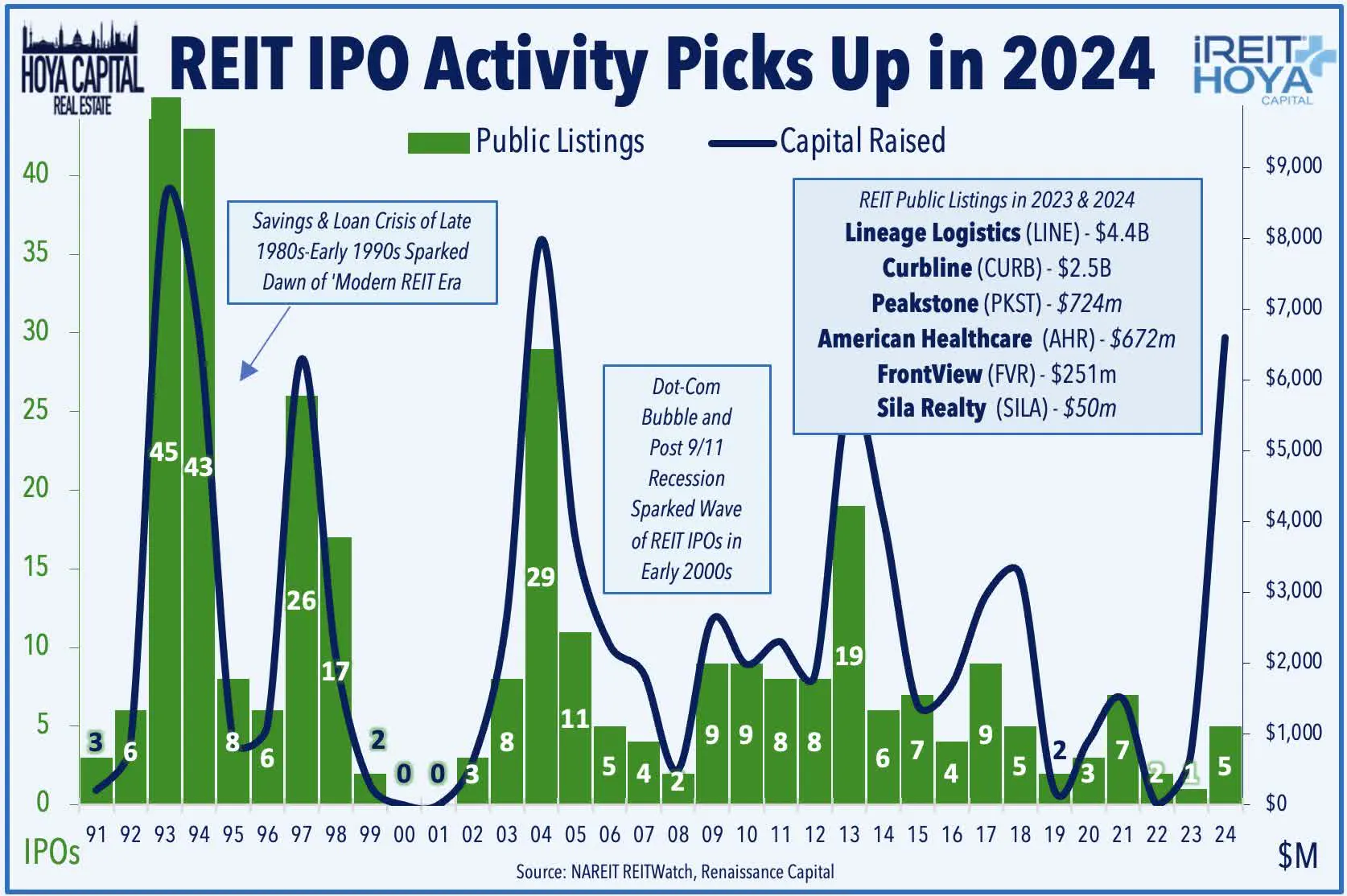
It took a while, but macroeconomic conditions are finally aligning such that the long-dormant "animal spirits" should start to come alive for public REITs through IPOs and acquisitions of debt-burdened private portfolios. Following a historically quiet period of REIT IPO activity dating back to the start of the Fed's rate hiking cycle in early 2022, cold storage operator Lineage (LINE) went public in August in the largest REIT IPO in history. Earlier this month, Dallas-based FrontView REIT - formerly known as North American Development Group ("NADG") NNN - also went public via a $251M IPO. While major REIT M&A announcements have been largely nonexistent apart from this handful of IPOs, we've discussed how REITs have been very busy on the capital-raising front over the past two months, taking advantage of the pullback in interest rates to bolster their balance sheet and filling the coffers in anticipation of a potential wave of acquisition activity in the quarters ahead.
Debt Markets - Bottoming or Pain to Come?
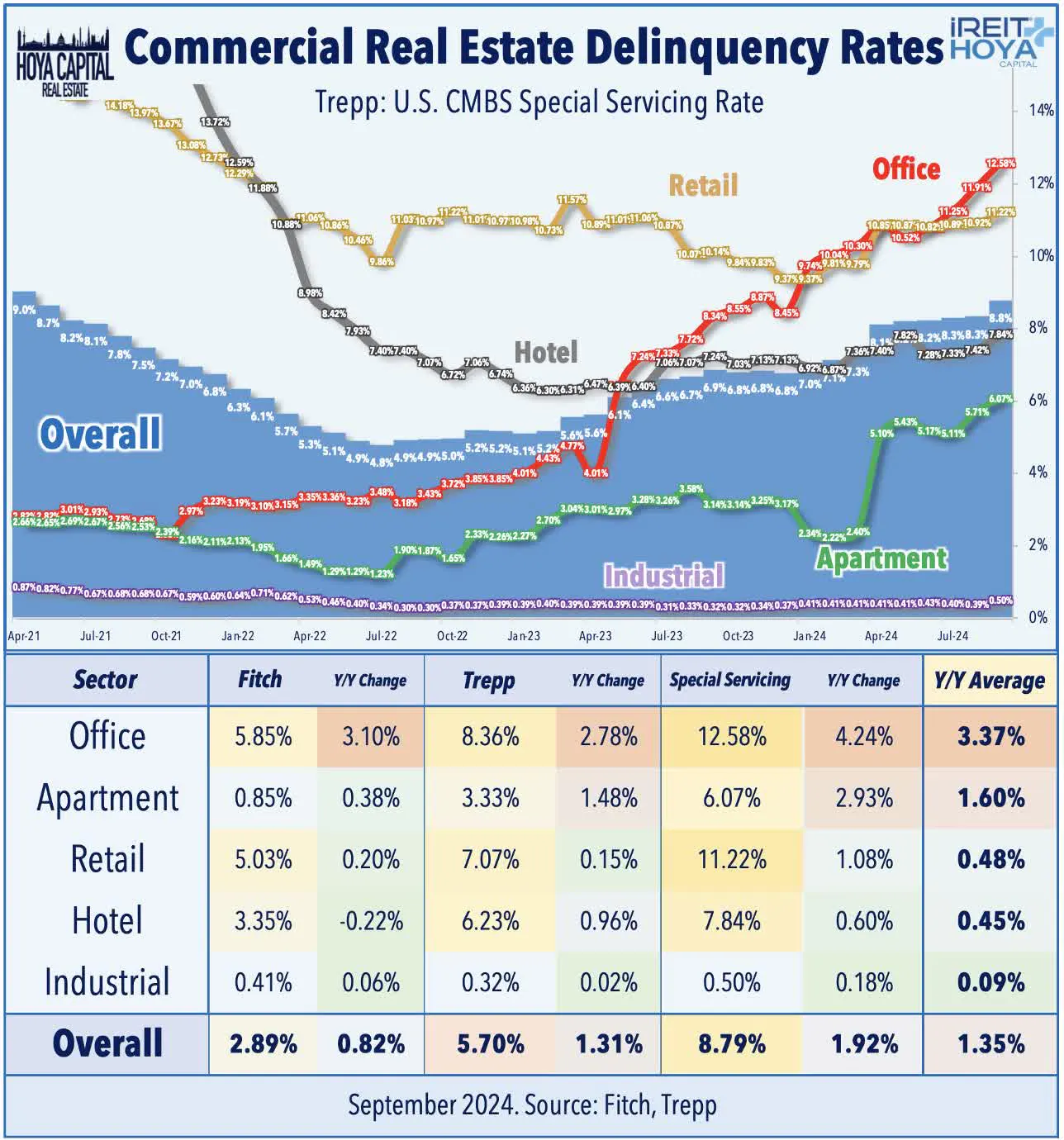
Relatedly, for debt-dependent entities - of which there are many in the private real estate space, and a handful in the public area - conditions have merely gone from highly restrictive to moderately restrictive. Fitch reported last week that its measure of US CMBS delinquency rates rose to 2.89% in September, up 82 basis points from last year. Trepp reported a more significant rise in delinquency rates, with its measure of US CMBS delinquency rates rising to 5.70% in September, up 131 basis points from last year. Its CMBS Special Servicing Rate - a broader measure that captures earlier indications of distress - jumped to 8.79%. While the vast majority of this increase is attributable to ongoing office distress, investors continue to closely monitor the multifamily space given its skew towards smaller "mom and pop" investors that lack the financing options of institutional players. Capitulation from debt-burdened private portfolios should create consolidation opportunities for REITs, underscored by the comments this week by private equity giant Blackstone (BX) hinting that it is "preparing to take some portfolios public."
Updated Outlook & Election Commentary
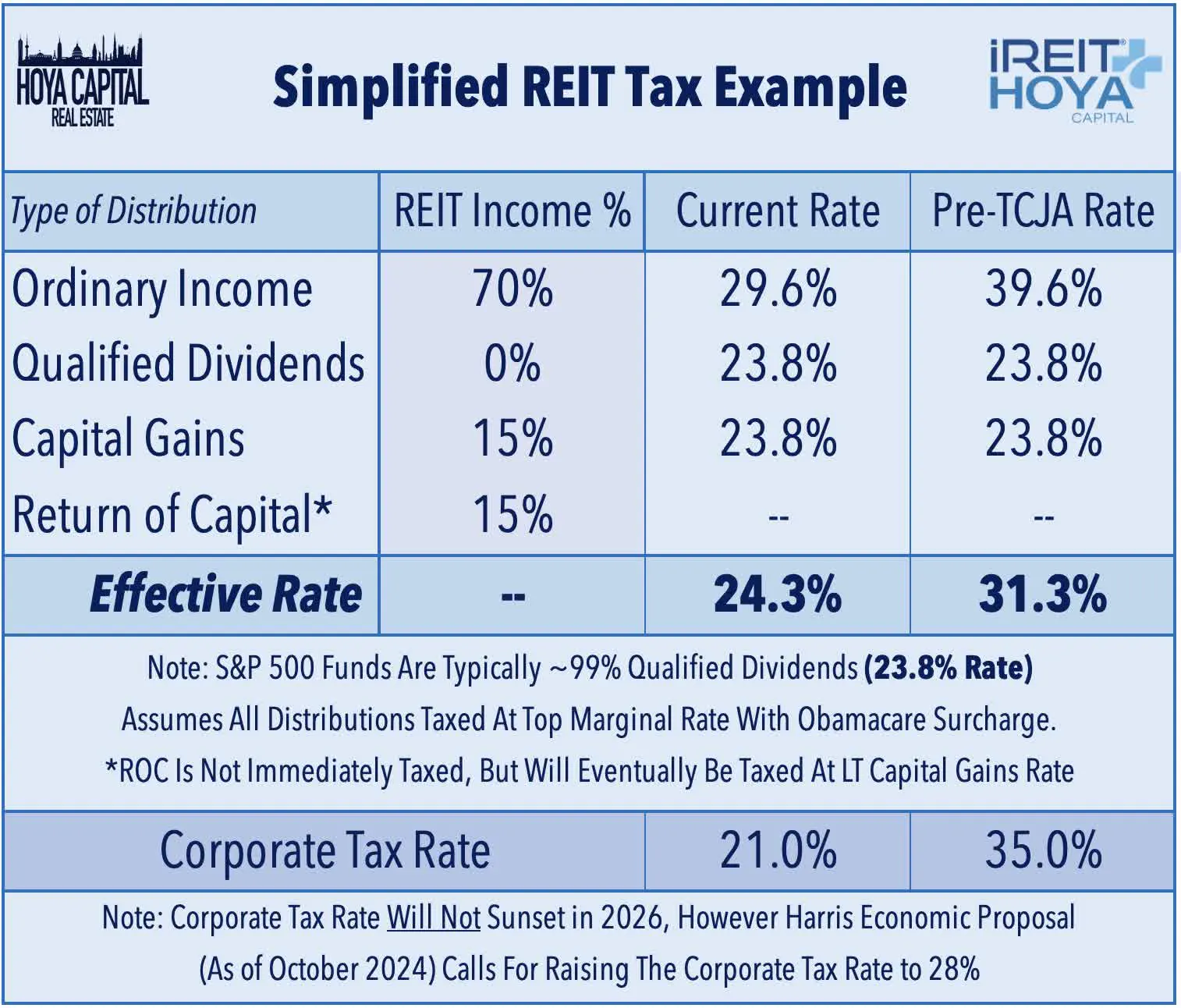
We're keyed in on these REITs' updated 2024 guidance, especially any changes in property-level fundamentals, which have remained surprisingly resilient throughout the Fed's rate hiking cycle, offsetting some of the drag on corporate-level profitability from higher interest expense. REITs are coming off a relatively strong second quarter in which 57 REITs (59%) raised their full-year FFO outlook, while 13 (14%) lowered - well above the historical second-quarter average "raise rate" of 40-45%. The third quarter has a slightly higher historical "raise rate" of around 50% as management teams have clearer full-year visibility and seek to impress in their final report of the calendar year. Given the proximity to the November Election, we're interested in commentary regarding any expected policy impacts on their particular sector or on the REIT sector at large. While REITs, as a whole, are not especially "politically sensitive," there are material tax implications for REIT investors. The 199A QBI deduction granted by the Tax Cut and Jobs Act - which has lowered tax rates on REIT dividends to levels to are essentially on-par with qualified dividends - is among the policies that are set to sunset at the end of 2025.
Dividend Policy - Expect Year-End Hikes
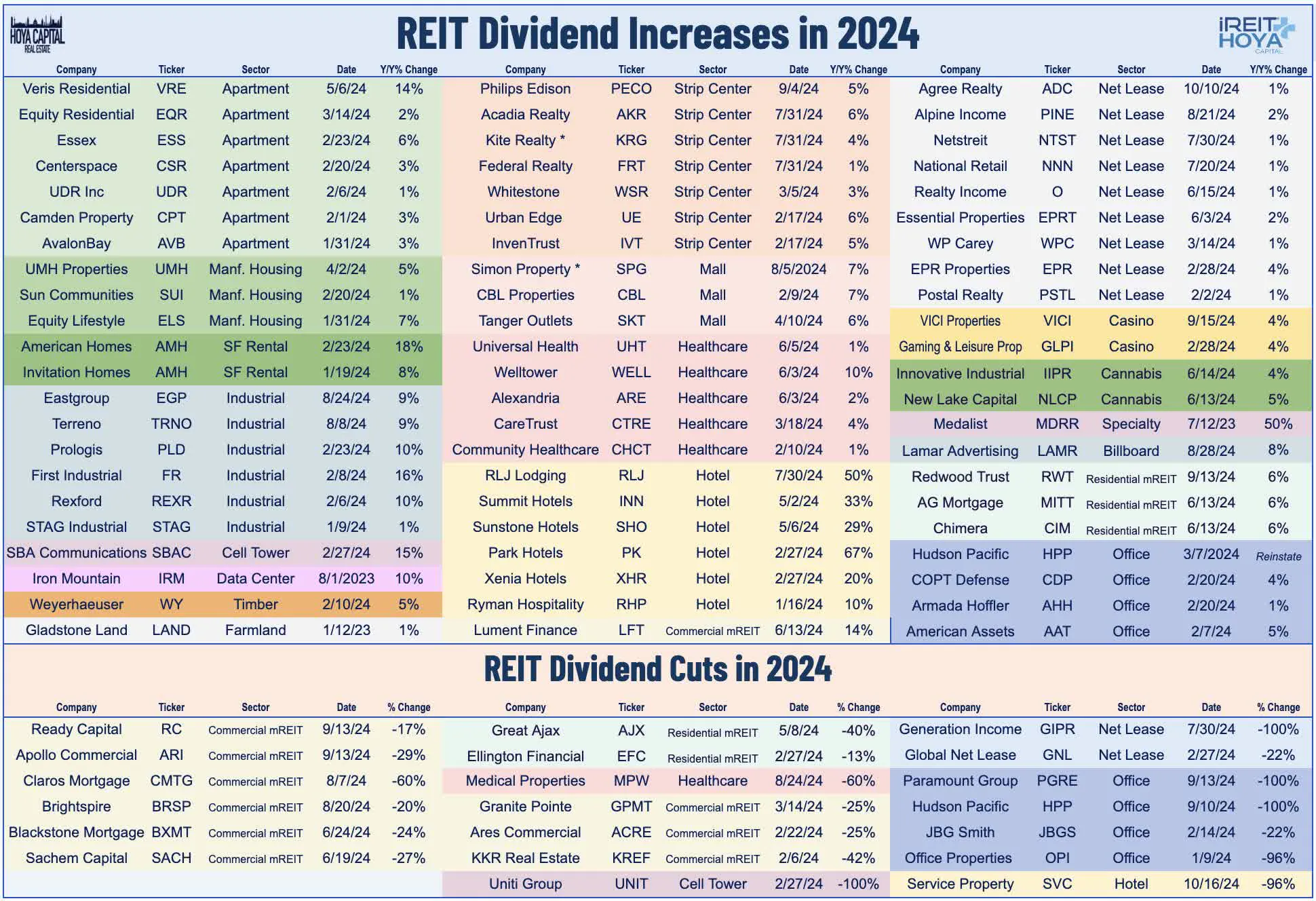
We're also keyed in on dividend commentary, given the typical trend of REIT dividend hikes in the final quarter of the year from REITs that have not yet raised their payout this year. We've seen 66 REITs raise their dividends so far this year, while 20 REITs have reduced their payouts. While sector-level dividend coverage ratios remain healthy, dividend commentary will remain a major focus for office and mortgage REITs - the sectors that have been responsible for essentially all the recent dividend cuts across the REIT sector over the past two years. We believe that the "bleeding" in these sectors from a dividend cut perspective is largely contained at this point, and in fact, foresee some dividend increases from office REITs over the next quarter or two, which we think would go a long way towards shoring up investor confidence.
Office & Hotel REIT Earnings Preview
Office
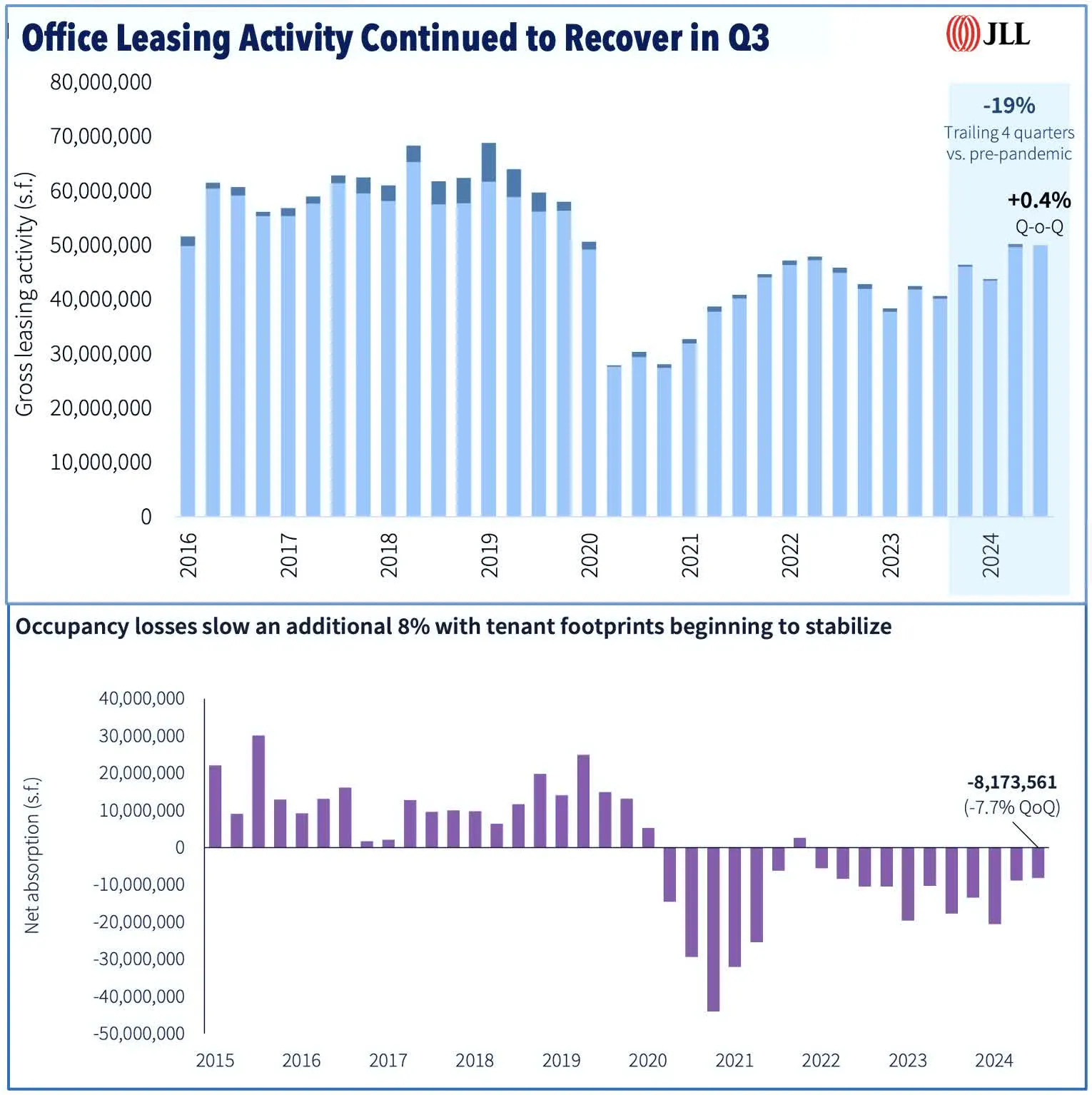
Beneath the universal pessimism on the office outlook, we've actually observed surprisingly positive green shoots for the office sector in recent months, helping to fuel a nearly 30% rally for these REITs over the past quarter. Brokerage firm Jones Lang LaSalle Inc. (JLL) released its quarterly office update last week, which showed more encouraging trends for the long-struggling office sector. Nationally, third-quarter leasing activity maintained strong momentum from the second quarter, growing 0.4% quarter-over-quarter to 50.4M SF. Leasing over the past six months reflects 86% of pre-pandemic activity levels. JLL reports that office market availability declined for the first time in over five years - an important milestone - citing a concurrent acceleration in leasing activity and the slowdown of new supply. JLL notes that a major factor in the recovery has been the reduction in supply from the combination of conversions and a near-shutdown in new development. Starts set another fresh all-time low in the third-quarter, while inventory removals have reached record volume for the fourth consecutive year. We continue to be focused primarily on leasing volumes and commentary on whether we've indeed seen the "bottom" on occupancy rates and FFO.
Hotel
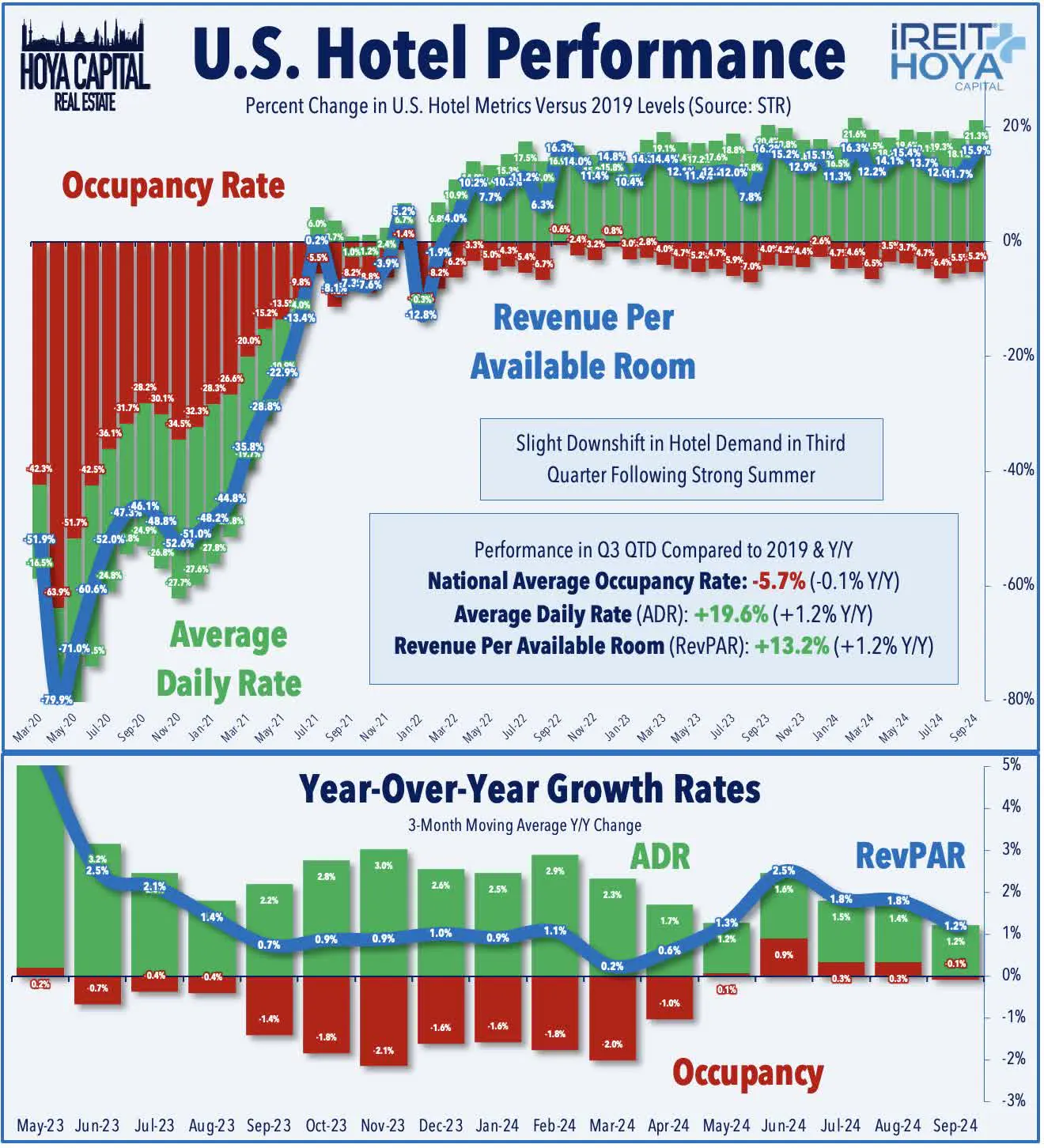
The U.S. hotel industry delivered a record-setting year of operating performance in 2023 as travel demand exceeded pre-pandemic levels by 5-10%, but after after a very strong start to 2024, we've observed some very slight moderation in travel demand in the third quarter across the various high-frequency metrics we track and from the handful of REIT business updates. TSA Checkpoint data shows that passenger throughput was roughly 2% above 2019 levels thus far in October - a slowdown from the 5% comparable increase in the first nine months of the year. Hotel data provider STR reports that industry-wide Revenue Per Available Room ("RevPAR") was 13% above 2019 levels in Q3 - roughly steady with the trends in Q2 - as still-solid pricing trends have offset some recent weakness in occupancy rates. Expectations have been reset lower for hotel REITs after a surprisingly downbeat second-quarter in which every hotel REIT lowered their full-year outlook for Revenue Per Available Room ("RevPAR"), with commentary indicating concern over a material year-end cooldown. Given that hotel demand has continued to hold-up surprisingly well in recent months despite slumping consumer confidence, hotel REITs are well-positioned to impress.
Residential Real Estate Earnings Preview
Apartments
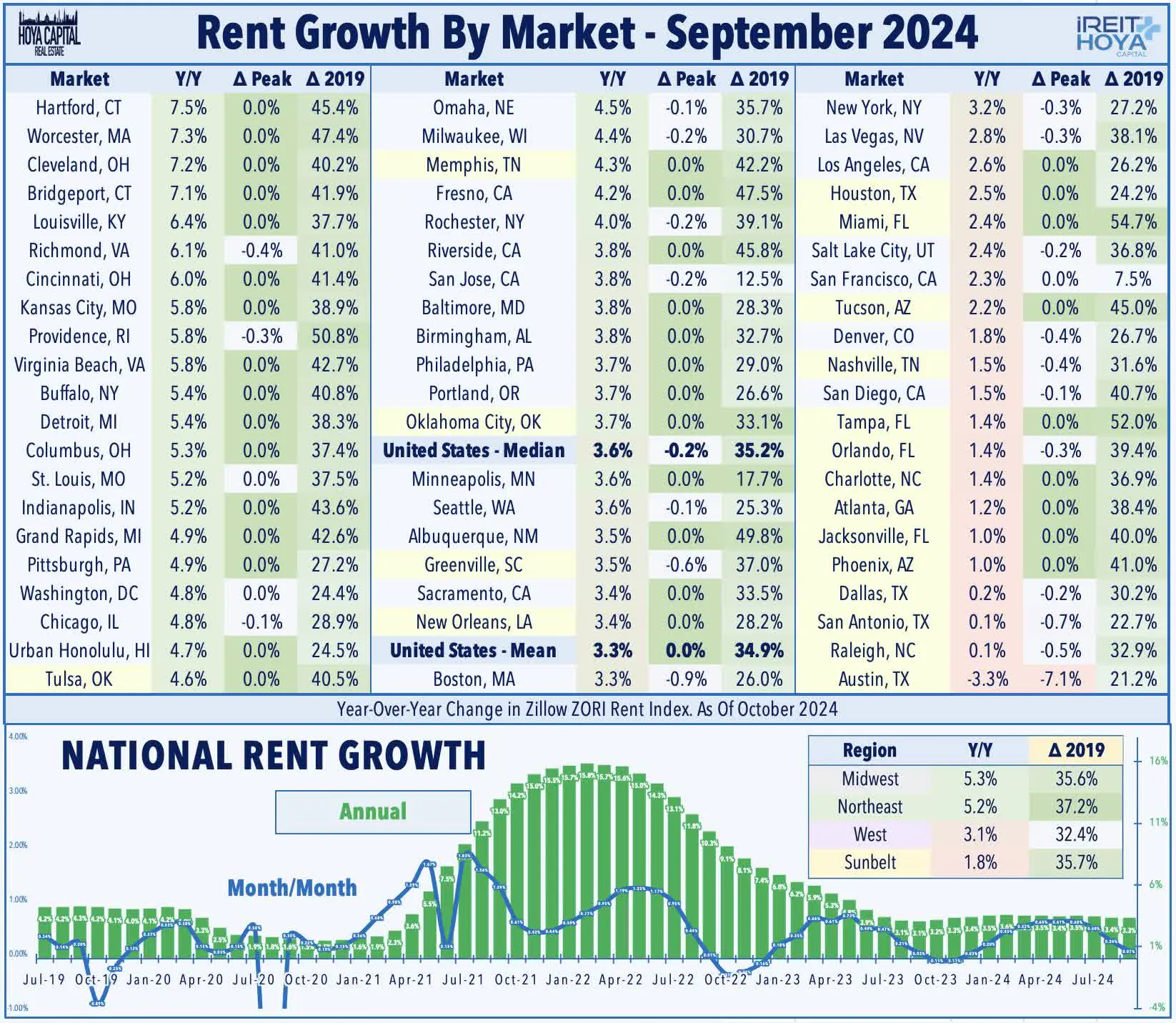
For multifamily, oversupply concerns have eased in recent months as new construction starts have slowed substantially while demand has been particularly robust. RealPage reported last week that apartment demand "again looked quite remarkable" in the third quarter, helping to offset a record quantity of new units hitting the market. The U.S. apartment market absorbed 193k units in the quarter - near historic highs - which helped to close the "delta" between supply and demand to the lowest point in two years. The booming demand comes at a critical time for the multifamily market, which has seen a record quantity of new units delivered - more than a half-million - over the past twelve months, with this pace expected to continue until early 2025 before moderating into 2026. The strong demand has also prevented a further deterioration in rental rates - especially on renewal leases. Zillow data shows that blended rent growth (new and renewed) has remained remarkably steady in the 3-4% range over the past 18 months - consistent with the "inflation plus 1-2%" target that's long been our forecast. That said, there remains a strong correlation between rent growth and supply levels over the past quarter, with high-supply cities - including Austin, Atlanta, and Dallas - continuing to see rents decline. We'll be closely watching rent growth metrics on new and renewed leases, commentary on supply conditions, and indications of any appetite for external growth.
Single-Family Rentals
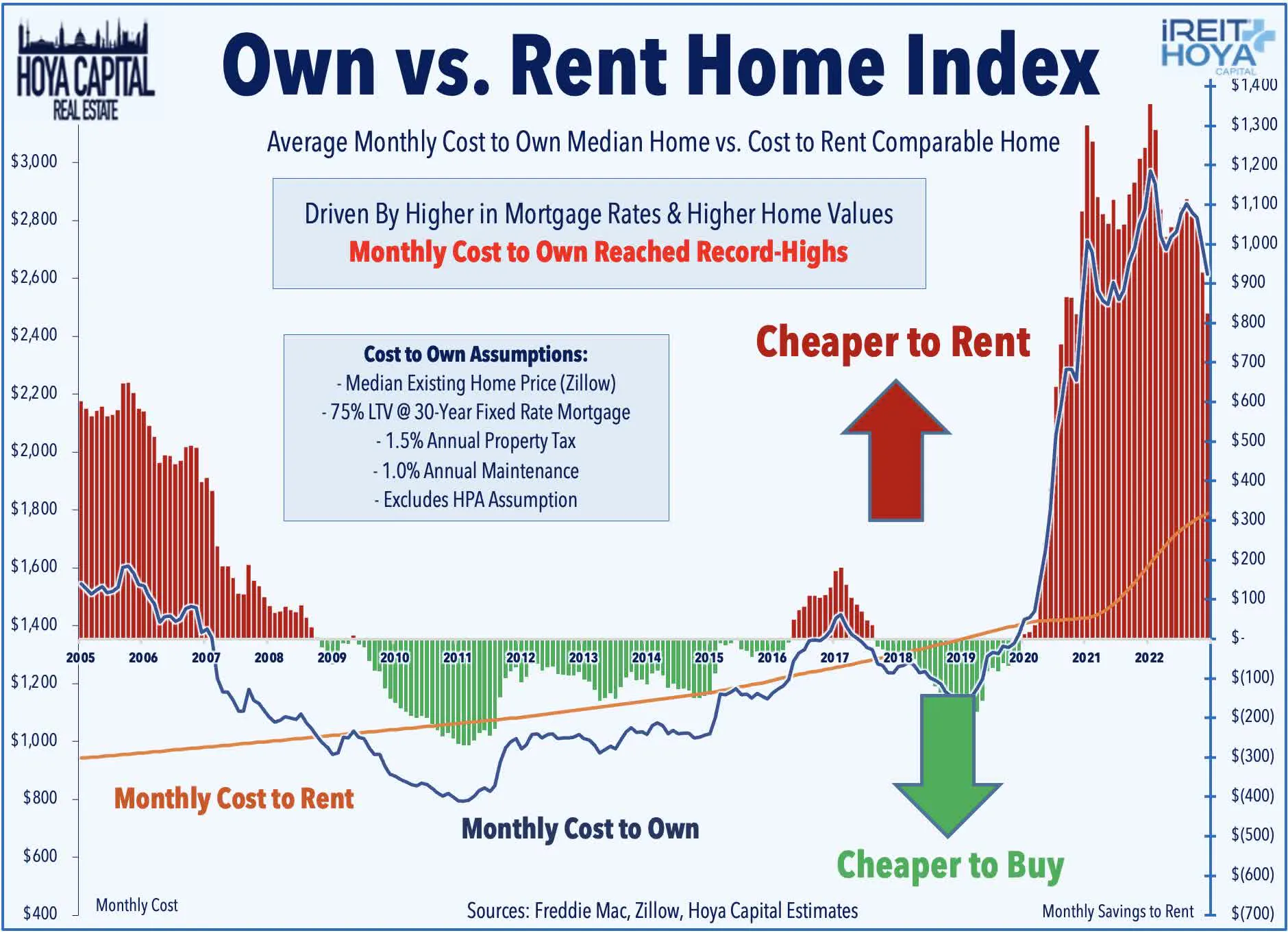
Supply growth has remained more contained on the single-family side, which has kept rent growth more buoyant throughout the rent cooldown. The latest CoreLogic report this week showed that SFR rents "continued to grow at a slow and steady pace" in recent months, posting a year-over-year gain of 2.4% in late Summer. Of note, the report showed that high-end rent growth (+2.9%) has significantly outpaced the rent growth seen in lower-rent units (-0.2%). The report also highlighted a similar regional disparity as that seen in the Zillow data, with Sunbelt rent growth lagging most coastal and Midwest markets. Seattle, New York, and DC topped annual SFR rent growth in the latest report, while rents in Austin and Phoenix were the weakest. The two SFR REIT portfolios are skewed towards the mid-to-upper tier of the market but also have a heavy presence in the Sunbelt. Expenses remain the "wild card" for these REITs - especially as it relates to insurance and property taxes. In addition to rent growth metrics, we're interested in commentary about these external growth prospects - specifically, whether these REITs are beginning to see any pockets of private-market distress that could be ripe for the picking - especially in light of the privatization of Tricon Residential by Blackstone earlier this year.
Homebuilders
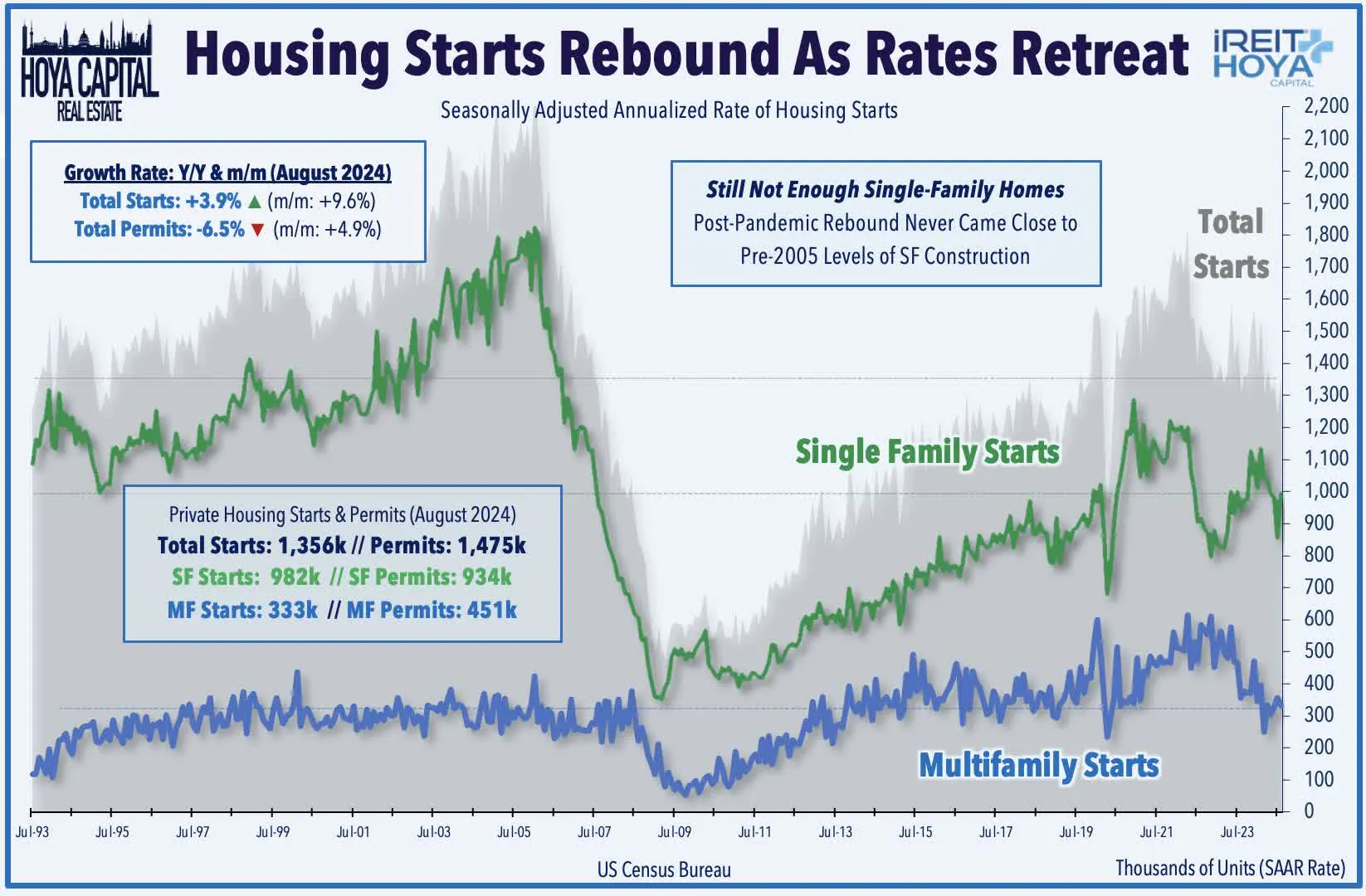
It's all about rates. Early this year, the U.S. homebuilding appeared poised to thaw from its deep freeze induced by historically aggressive monetary tightening, but the mid-year mortgage rate resurgence again pushed the upper limits on affordability for prospective buyers and prompted a pullback in speculative development. It remains the case, however, that higher mortgage rates have merely delayed - but not permanently altered - the existing secular fundamentals supporting the single-family market: a "lost decade" of single-family construction. These public builders have managed to sustain a relatively solid level of activity throughout this two-year deep freeze by gaining market share relative to their smaller competitors that lack the scale to sustainably compete in the ultra-competitive environment. Builders have a high bar to meet, however, following their incredible rally of nearly 90% in 2023 and further gains of 33% thus far in 2024. We're focused on net orders - expecting a modest positive inflection this quarter after roughly two years of year-over-year declines - along with cancellation rates, and gross margins. With builders no longer trading with deep discounts, further upside will require operational execution.
Storage
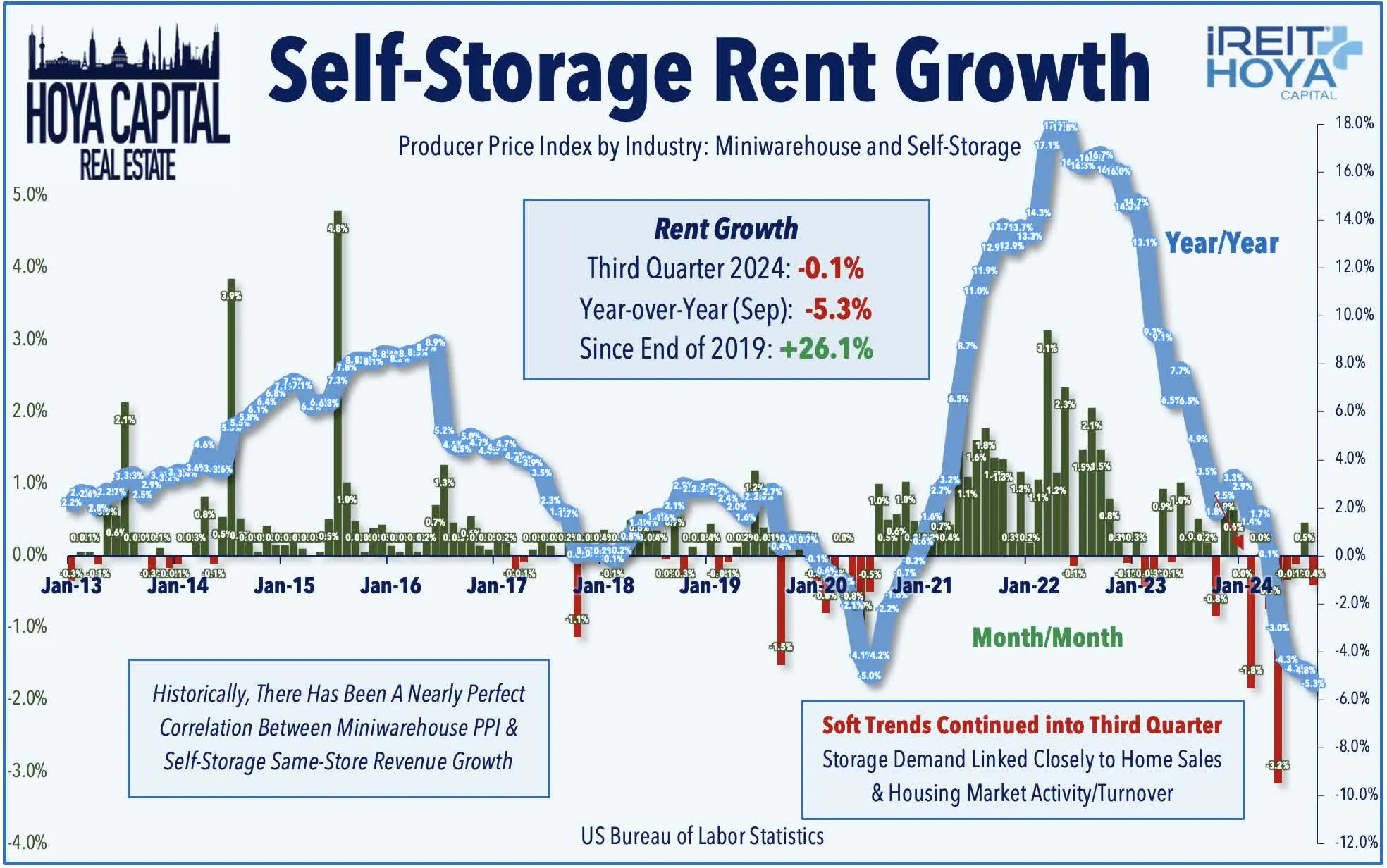
Self-storage demand is closely correlated with housing market turnover - existing home sales and apartment turnover rates - both of which have been at multi-decade lows over the past year. Results from self-storage REITs last quarter showed that soft fundamentals dragged into the second quarter and into July, as muted housing market activity and elevated supply growth have kept downward pressure on new lease rates. Muted move-out activity - and relatively buoyant low-single-digit rent growth on existing tenants - has helped to offset the considerable weakness in new lease rates, as all four storage REITs reported a ninth-straight quarter of negative "Street Rate" (new lease) spreads which has slowly started to bleed into the overall average rent metrics. Despite the soft results, optimism from the sudden dip in mortgage rates sparked optimism that a rebound in housing activity may be on the horizon. We're keyed-in on "Street Rates" and occupancy trends.
Tech and Industrial REITs Earnings Preview
Industrial
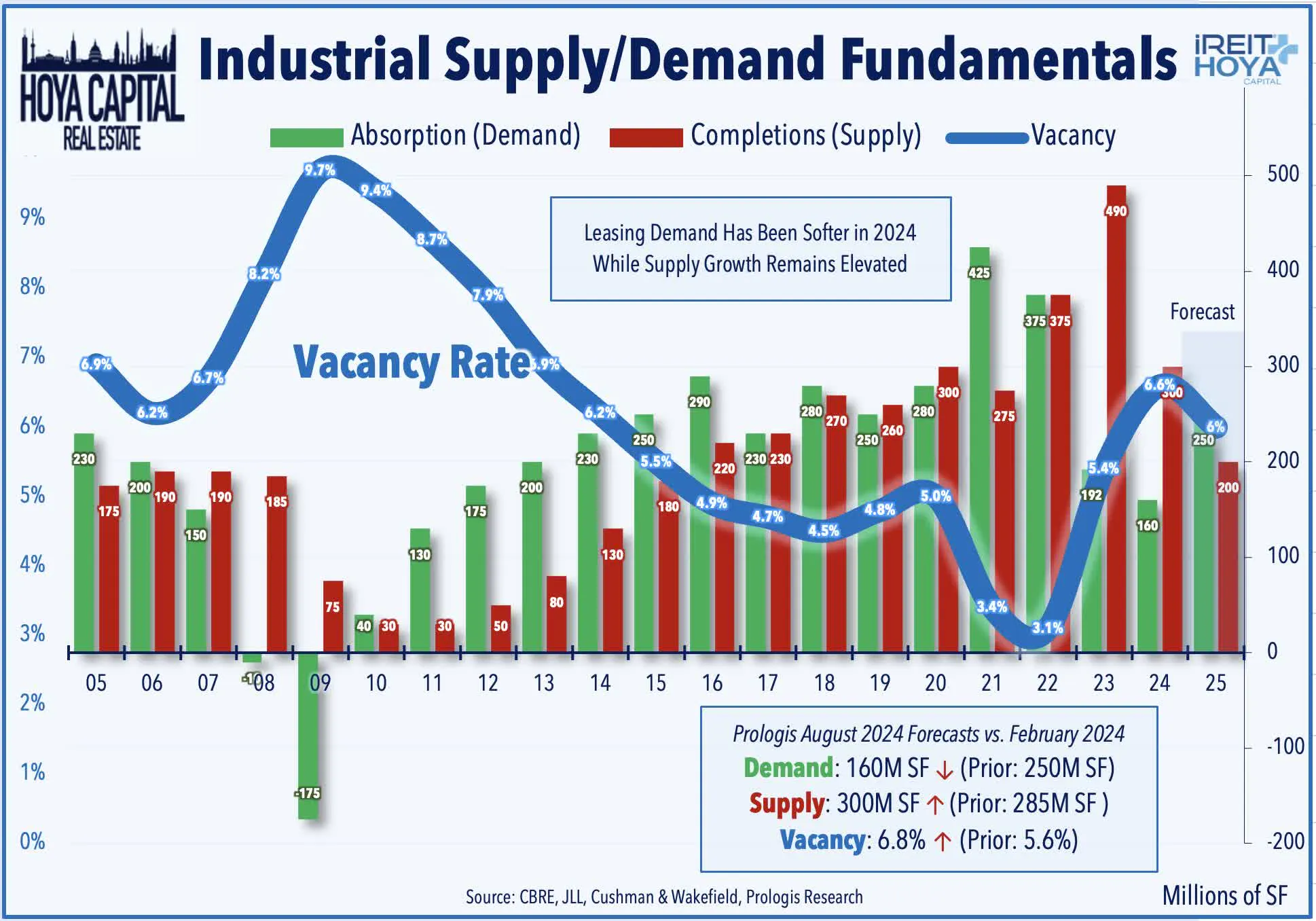
Among the surprising winners of last earnings season, industrial REITs are off to a mixed start to the third quarter. Prologis (PLD) - the largest logistics property owner in the nation - kicked off earnings season with a surprisingly solid report - while Sunbelt-focused First Industrial (FR) reported even stronger trends - but West Coast-focused Rexford (REXR) followed with a downbeat report later in the week. Prologis marginally raised its outlook for full-year Core FFO and reported solid leasing activity, achieving an impressive cash leasing spread of 44.1% - down slightly from 51.4% in Q2 - while noting that much of this rent slowdown in attributable to weakness in Southern California. Rexford - which focuses exclusively on this region - noted that Southern California market rents fell another 2.5% during the quarter and were roughly 7.5% lower from a year earlier, which resulted in a sharp cooldown in rent spreads to 26.7% in Q3 from 49.0% last quarter. While PLD reiterated its call that fundamentals are "bottoming," its updated macro outlook reflected expectations of soft fundamentals in the near-term across national logistics markets. Prologis downgraded its net absorption forecast this year to 160M SF - down from 165M last quarter - and revised up its supply forecast to 300M - up from 290M last quarter. Prologis now expects a market-wide vacancy rate of 6.8% - up from 6.6% previously. We'll be continuing to focus on rent spreads and leasing activity, and are also looking forward to the first earnings report from cold storage owner Lineage (LINE).
Cell Towers
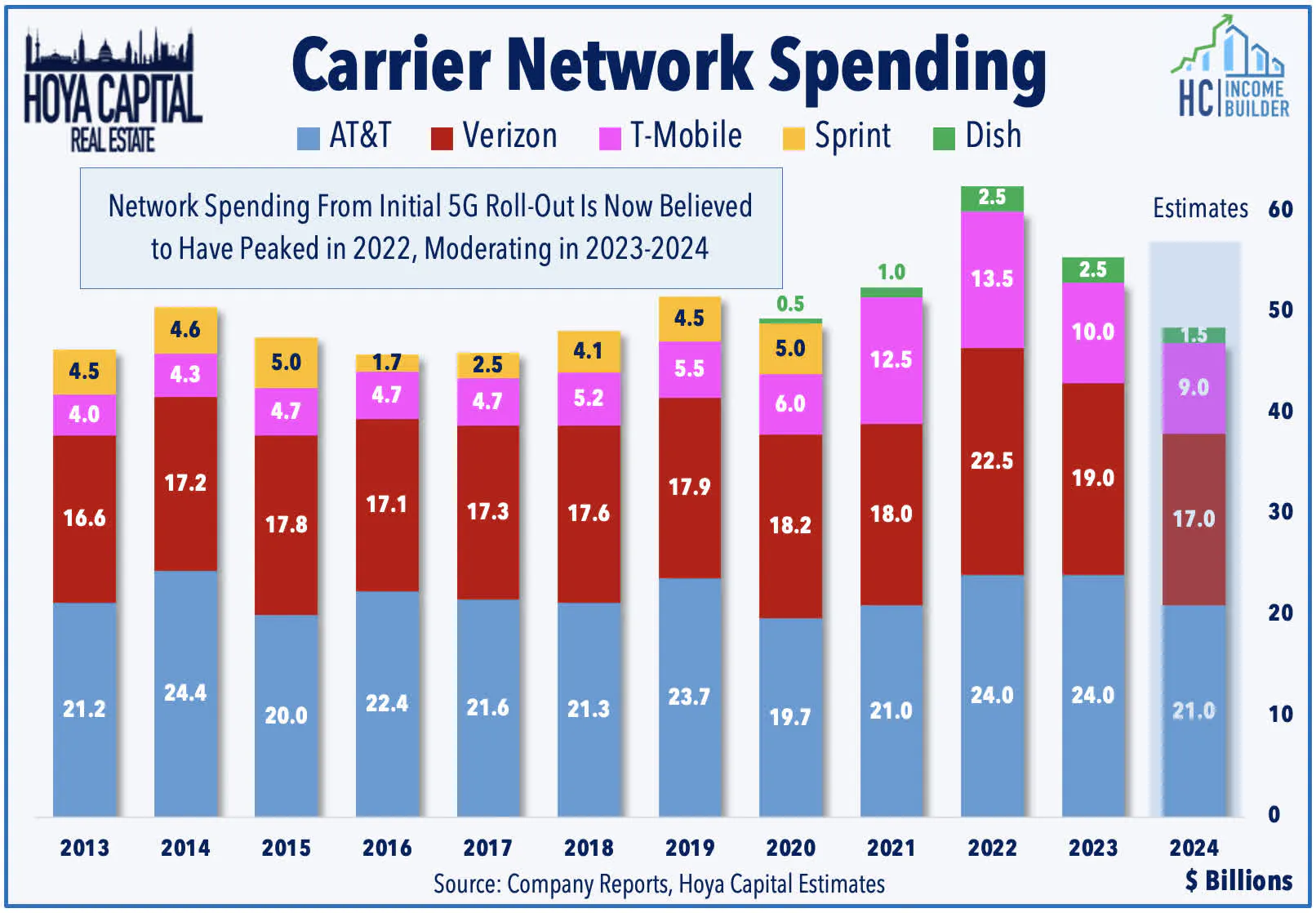
Cell Tower REITs have been the weakest-performing property sector since the start of 2022 - lagging even the battered office sector - amid a telecommunications industry-wide slump inflamed by tight monetary conditions. Cellular carriers have curbed their capital-intensive network expansion plans in recent quarters, following a significant wave of investment and tower equipment upgrades from 2019-2022 to deploy nationwide 5G networks. Crown Castle (CCI) kicked off the earnings slate this week with a solid report and maintained the full-year outlook. Commentary on carrier demand was status-quo, with CCI reiterating that demand is "steady state" following a significant decline in network spending last year. CCI did not comment on reports earlier this month that it could be nearing a deal to sell its fiber unit and potentially also its "small cell" unit, but did note that it trimmed its small-cell deployment plans by 7,000 nodes at "locations that had countless zoning and permitting delays or in high-cost markets that did not meet our investment parameters." American Tower (AMT) has also been in the midst of a strategic shake-up, having completed an exit from the Indian market earlier this year. We're focused on commentary on these strategy shifts and further commentary on expectations for network spending.
Data Center
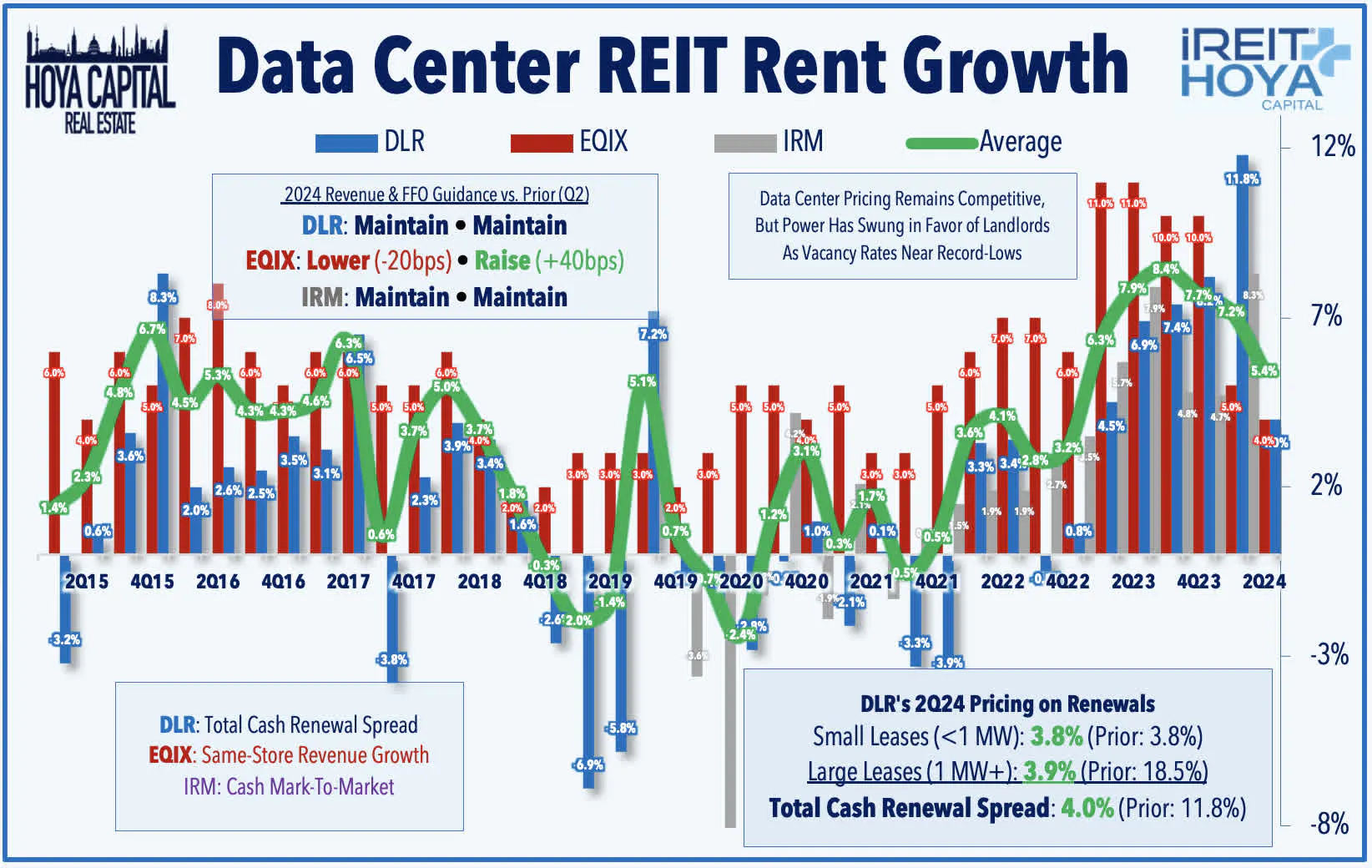
The top-performing property sector last year, Data Center REITs have continued their strong relative performance in 2024 as the AI boom continues to drive elevated leasing activity. JLL's latest report noted that "unsatiable demand" has driven vacancy rates to fresh record-lows. CBRE's recent report also noted that North American data center vacancy rates hit new lows across major markets, driven by robust absorption by public cloud providers and AI companies. Most importantly, the report notes that data center pricing is "significantly accelerating due to supply shortages and high demand." Average asking rates for a typical 250- to 500-kW requirement across all four featured North American markets surged by 20% year-over-year, the highest global increase, as supply shortages are increasingly driven by power constraints. Ironically, the improved competitive positioning of these REITs and the surge in rent growth over the past eighteen months came just as data center REITs became a trend "short" play. The now infamous short report from Chanos & Company in July 2022 came at the "bottom" of a half-decade-long slump in rental rates. As always, we'll also be keyed-in on renewal pricing trends and leasing volumes this quarter.
Healthcare REIT Earnings Preview
Senior Housing
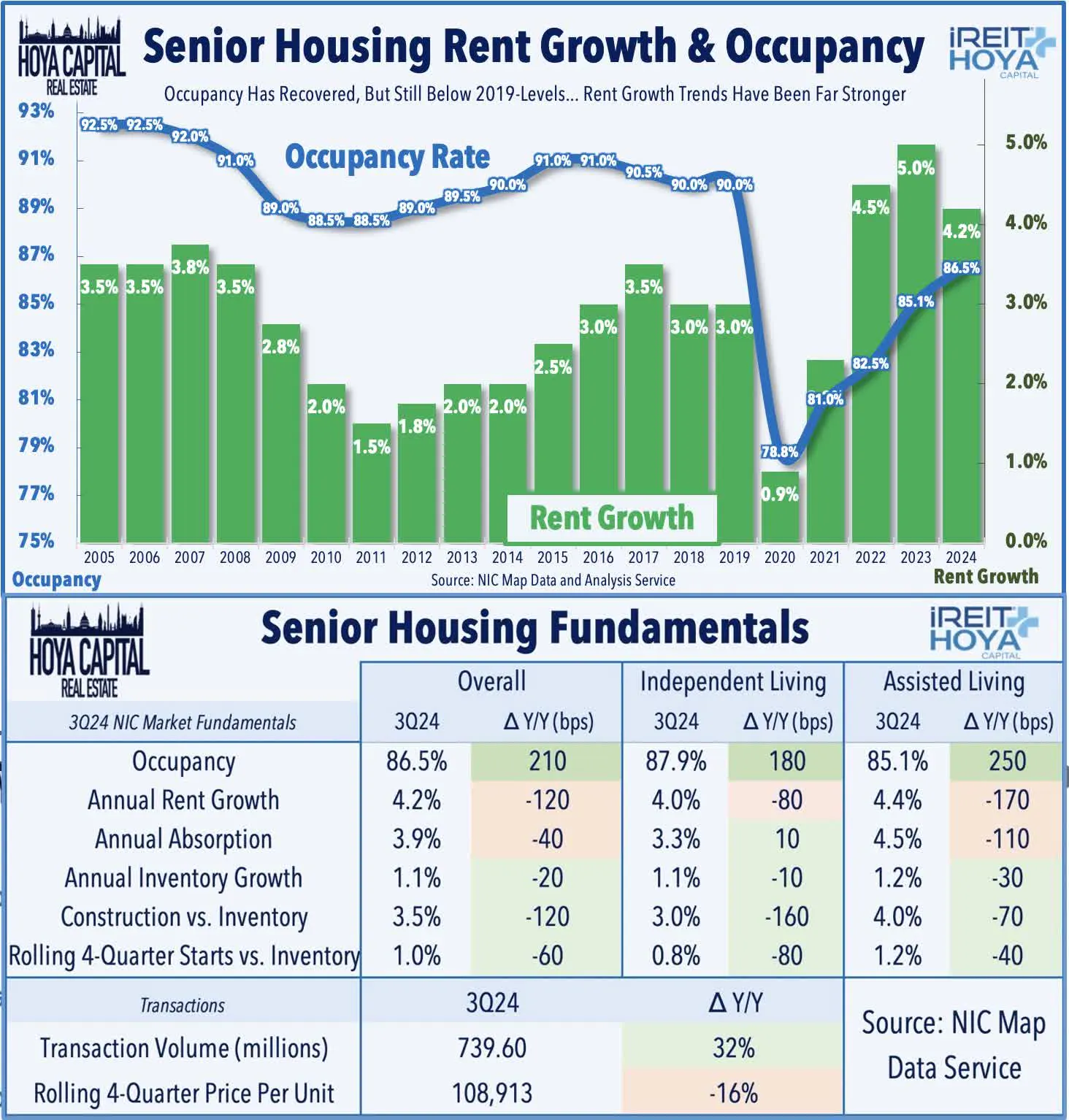
Continuing their strong performance from last year, Senior Housing and Skilled Nursing REITs have been among the leaders this year as recent data shows a continued recovery in occupancy rates alongside historically strong rent growth. Earlier this month, industry data provider NIC published its quarterly Market Fundamentals report, which showed that senior housing occupancy rates increased for the 13th consecutive quarter to 86.5%, which is 8.7 percentage points above its pandemic low of 77.8% in the second quarter of 2021. The skilled nursing occupancy rate, meanwhile, rose to 84.5% in the most recent quarter, up 9.8 percentage points from its pandemic low of 74.7%. Fueled by tailwinds from record-setting COLA adjustments in 2023, rent growth across both Senior Housing and Skilled Nursing facilities has remained historically strong in 2024, each rising by over 4%. Supply growth remains muted as well, with NIC noting that the rolling four-quarter average for construction starts sits at 1.0% of total inventory - the lowest since 2010. These tailwinds bode well for tenant financial health and rent coverage, which remains the primary focus for senior housing and skilled nursing REITs.
Medical Office
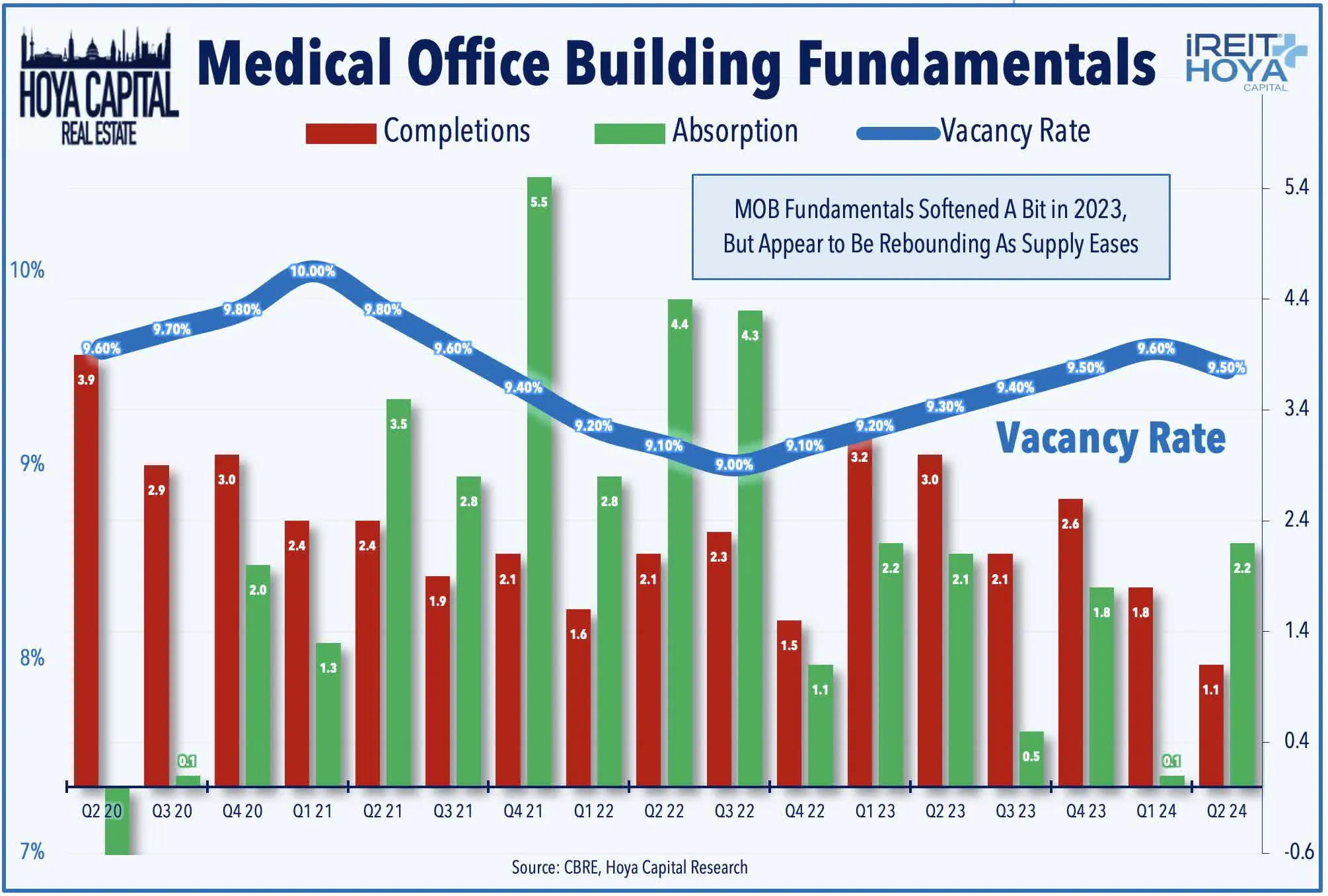
While their healthcare REIT peers in the senior housing space have surged this year, Medical office building ("MOB") REITs have remained one of the weakest-performing sub-sectors this year, and are now trading at average Price-to-FFO valuations that are below that of traditional office REITs. Despite being one of the most rate-sensitive segments, these REITs haven't yet enjoyed the valuation "bump" seen by their peers, which remains a bit head-scratching given the relatively steady property-level fundamentals. JLL's latest report published last quarter concludes, "[MOB] fundamentals remain strong, and construction starts remain slow, positioning medical outpatient buildings for increasing occupancy and rental rate growth, driving increased allocation from capital rotating from other asset classes." Despite steady demand, construction starts for MOBs have remained below pre-pandemic averages over the past three years. MOB REITs have a relatively low hurdle to meet this earnings season, and will be looking for integration progress on recent merger activity from the two largest MOB REITs.
Retail REITs Earnings Preview
Strip Centers
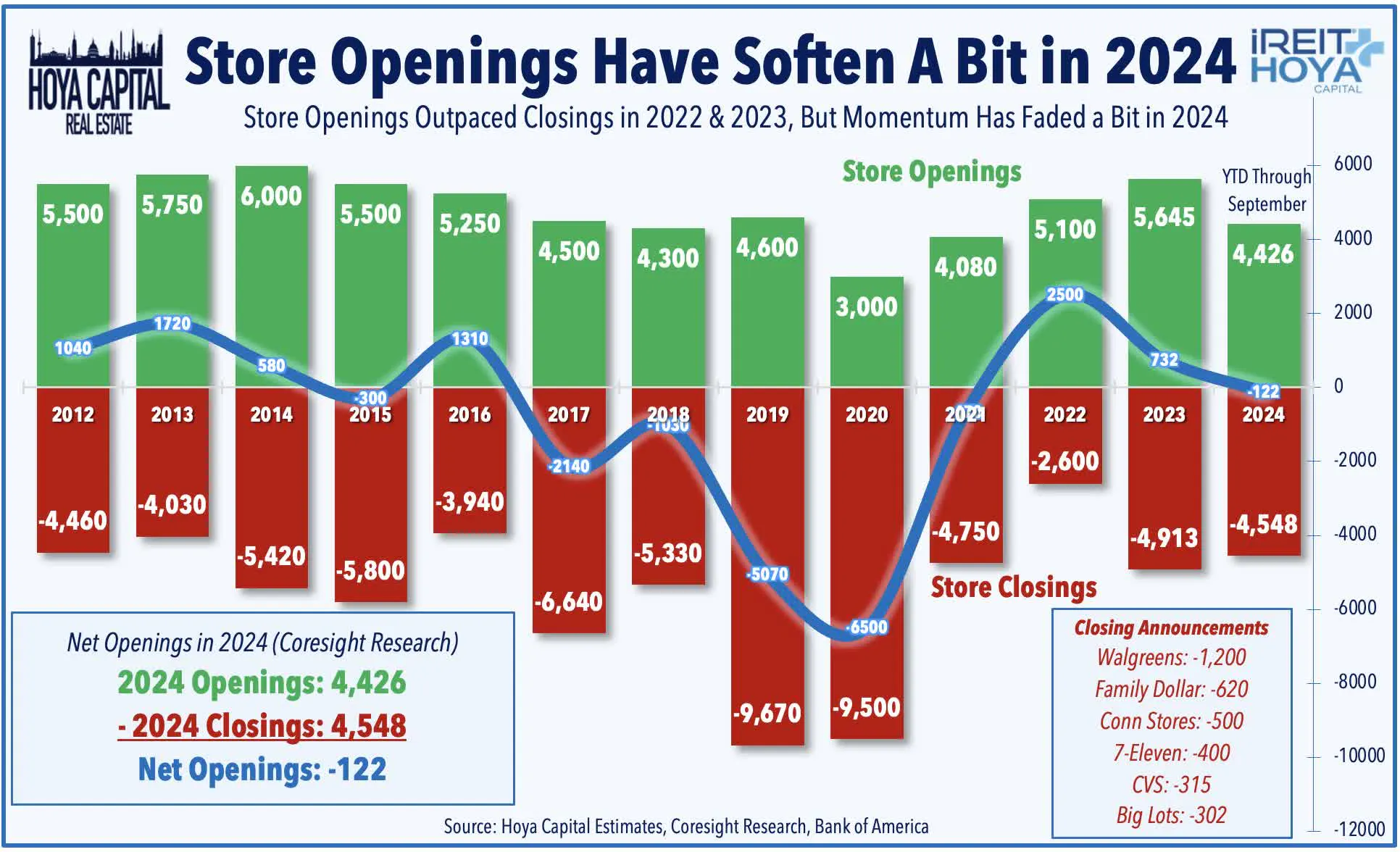
Retail REIT fundamentals improved materially over the past two years, as the combination of near-zero new development and positive net store openings has driven occupancy rates to record highs and allowed both Strip Center and Mall REITs to enjoy some long-awaited pricing power. After a strong start to the year for net store openings, however, the past few months have seen notably softer trends with a handful of bankruptcies and large-scale store reduction announcements. Tempering some of the recent retail optimism, the latest data from Coresight shows that the store closings are again outpacing store openings for the first time since mid-2021, driven by the bankruptcy of home goods retailer Conn's (OTC:CONNQ) along with announced store reductions from Family Dollar, CVS (CVS), Walgreens (WBA), Seven-11, and Big Lots (OTC:BIGGQ). We're keyed in on commentary discussing whether this recent wave of closings is merely a bump in the road or indicative of a broader pivot across the retail space. We'll be focused on leasing spreads and occupancy rate trends - which have been impressive of late.
Malls
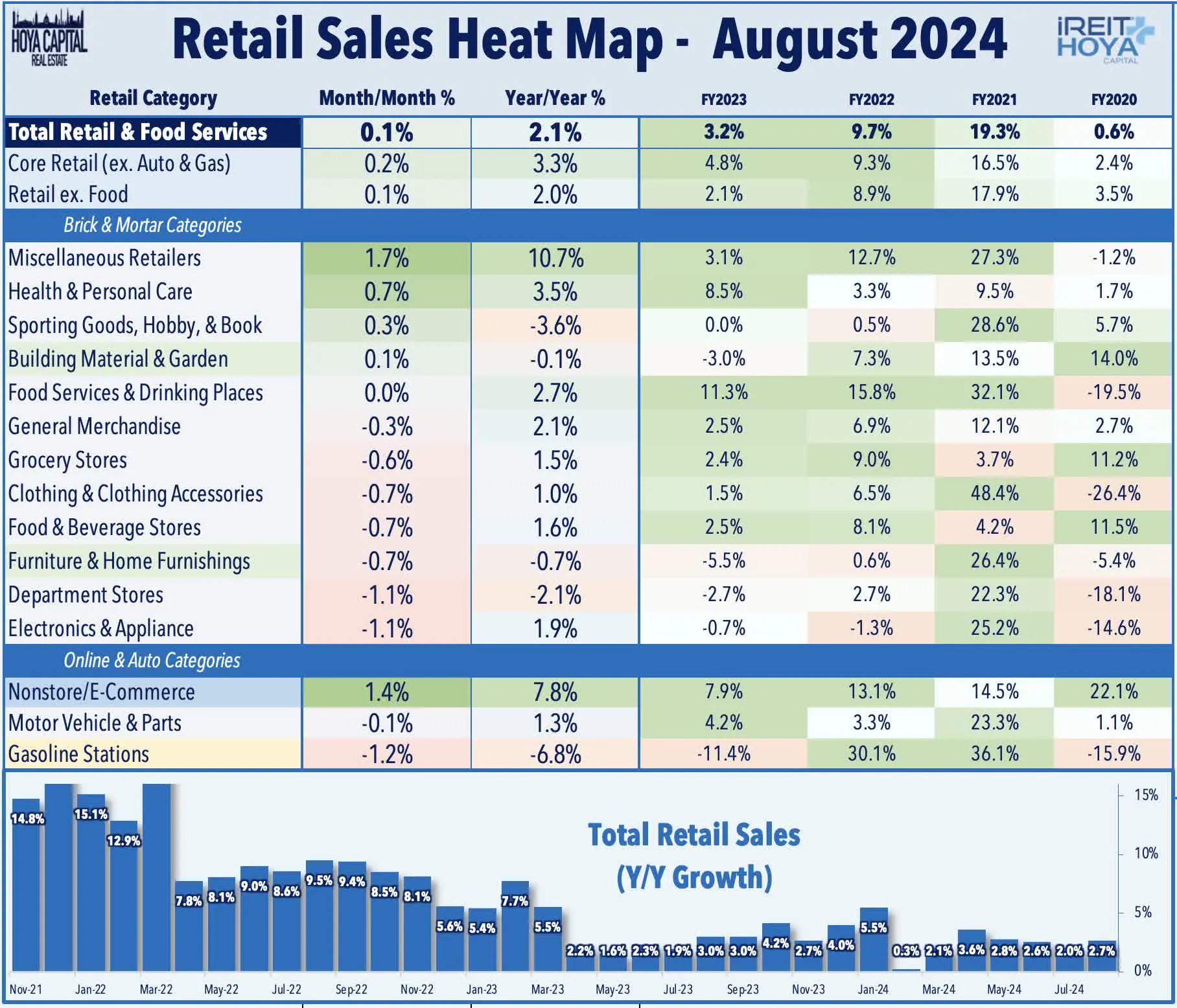
With distress across office markets seizing the headlines, Mall REITs are no longer the "Problem Child" of the REIT sector, particularly after weaker players and lower-tier malls closed shop. Following three years of rental rate and occupancy declines, the supply-demand dynamic has recently favored retail landlords, which has helped these stumbling mall REITs regain some footing and repair balance sheets. Traffic and sales levels at higher-end mall properties have been back at pre-pandemic levels since late 2023, and retail sales data indicates that consumers were still spending. Data this week showed that Retail Sales were stronger than expected in September, capping another quarter of solid, consumer-led economic growth fueled by a hardy labor market. Ahead of the all-important holiday season for mall-based retailers, we're focused on occupancy rates and renewal rent growth.
Net Lease
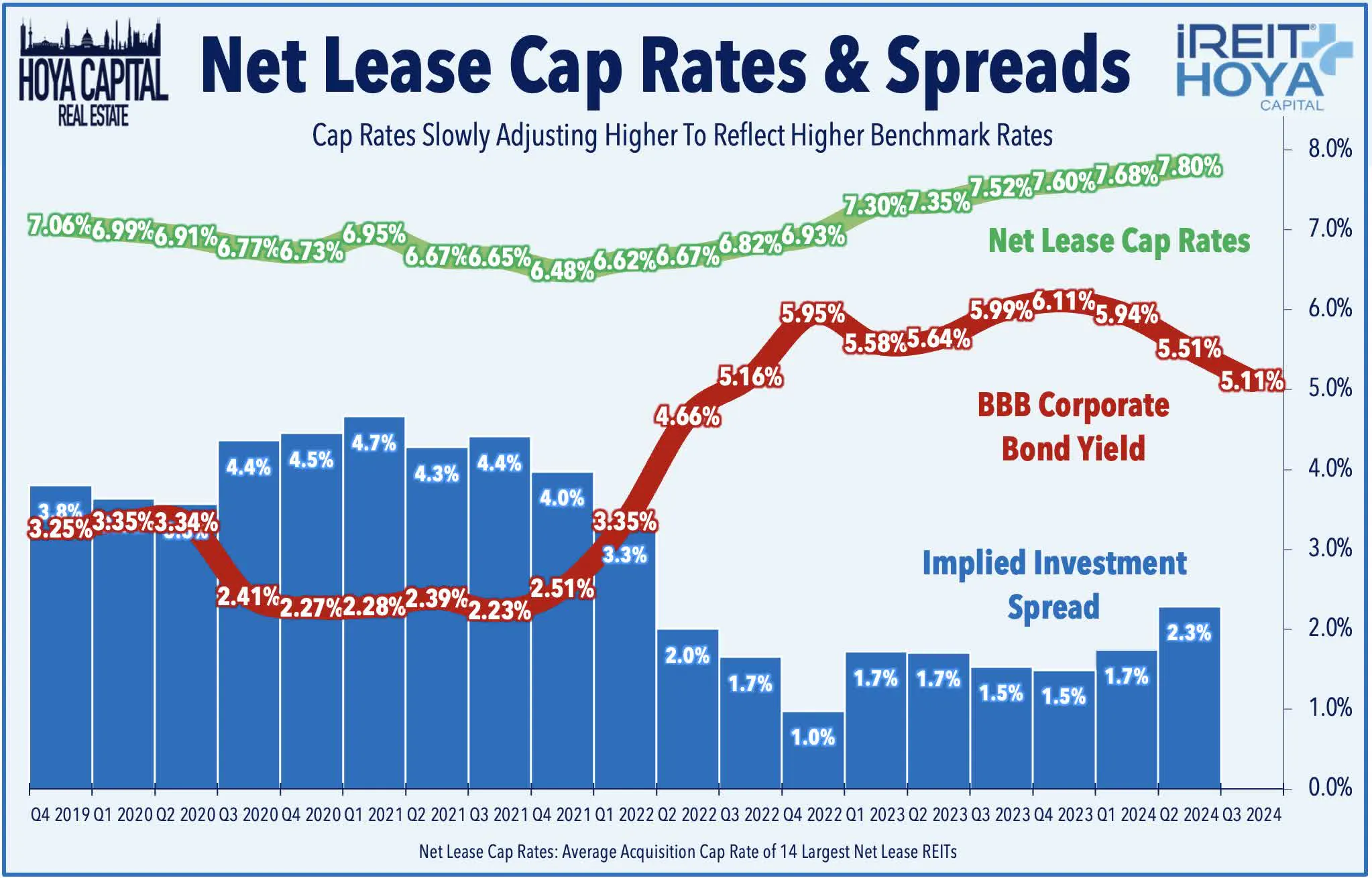
The most "bond-like" and interest-rate-sensitive property sectors, the pullback in benchmark rates has restored some positive vibes into the net lease sector. Thriving in the "lower forever" environment, the industry has been reluctant to acknowledge the higher-rate regime, keeping private-market values and cap rates surprisingly "sticky" and resulting in compressed investment spreads. Strong balance sheets and lack of variable rate debt exposure have positioned net lease REITs to be aggressors as over-levered private players seek an exit, but these REITs can afford to wait until the price is right. We're keyed in on commentary regarding cap rate movements in mid-2024 and whether the retreat in interest rates in Q3 - and subsequent uptick in early October - has changed the outlook for activity heading into 2025.
Mortgage REIT Earnings Preview
Mortgage REITs have stumbled since reporting surprisingly soft second-quarter results amid an otherwise favorable macro backdrop. There's no excuse for poor performance in the third quarter, given the historically strong performance of Mortgage-Backed Securities ("MBS") valuations during the quarter. The Residential iShares MBS ETF (MBB) - which tracks the un-levered performance of residential mortgage-backed securities ("RMBS") - posted total returns of 5.4% in Q3, one of its strongest quarters on record. The iShares Commercial MBS ETF (CMBS) - which tracks the un-levered performance of commercial mortgage-backed securities ("CMBS") - posted total returns of 5.1% in Q3, also among the strongest on record. RMBS and CMBS spreads tightened a bit during the quarter, while benchmark interest rates - as measured by the 10-Year Treasury Yield - ended the quarter sharply lower. Given this positive valuation backdrop, for residential mREITs, we expect an average Book Value Per Share ("BVPS") increase of 3-5% in the quarter, and for commercial mREITs, we expect a change of 1-3%.

Key Takeaways: Real Estate Earnings Preview
Real estate earnings season kicked off this week, and over the next month, we'll hear results from 175 equity REITs, 40 mortgage REITs, and dozens of housing industry companies. The sector with the most upside from easing interest rates, REITs rebounded sharply ahead of the Fed's "jumbo" rate cut, but have fluctuated in October amid changing rate expectations. Since we last heard from these REITs in July, notable incremental trends gleaned from recent industry data and commentary over the last three months include: 1) gradually recovering office fundamentals; 2) anchored housing market trends despite historically low activity levels; 3) sustained hotel and leisure demand; 4) cooling in (currently robust) retail fundamentals; and 5) stiffer disinflation headwinds in "goods-oriented" sectors (industrial, farmland, timber). Still trading at historically cheap levels compared to the S&P 500, REITs have a lot of ground to make up but will need to convince investors that premium valuations are warranted as broad commercial real estate fundamentals finally bottom-out. We'll provide real-time updates throughout earnings season in our Daily Recaps, Weekly Reports, and in the Chat Board.
About the Author
David Auerbach boasts over two decades of experience in the securities industry, specializing as an institutional trader with a focus on Real Estate Investment Trusts (REITs), Equity and Preferred stocks, MLPs, ETFs, and Closed End Funds.
Based in Dallas, TX throughout his entire career, David currently serves as the Chief Investment Officer for Hoya Capital, managing the Hoya Housing 100 ETF (Ticker: HOMZ) and The High Yield Dividend ETF (Ticker: RIET). Previously, David held the position of Managing Director at Armada ETF Advisors, the sub-advisor for the Residential REIT ETF (Ticker: HAUS) and The Private Real Estate Strategy via Liquid REITs ETF (Ticker: PRVT).
Additionally, he acts as a consultant with IRRealized, LLC, focusing on corporate access in the REIT industry. David's industry journey includes roles at World Equity Group, Esposito Securities, and Green Street Advisors where he got his start in the REIT industry.
At Esposito Securities, he played a crucial role in building the REIT/Real Estate platform and worked extensively with institutional investors, Equity REITs, and ETF issuers.
Throughout his career, David has been quoted by reputable publications such as Bloomberg, WSJ, Financial Times, REIT.com, and GlobeSt.com. He has also made notable appearances as a featured guest on networks like Yahoo Finance, TD Ameritrade, and Bloomberg.
David holds a BBA in Finance from the University of Texas at Austin (May 1999) and an MBA in Finance from Southern Methodist University (May 2005). He maintains FINRA Series 7, 24, 55, and 63 registrations.
In his leisure time, David is an avid traveler, often found crisscrossing the country in pursuit of attending as many Phish concerts as possible.
Disclaimer
Please note this article is for information purposes only and does not in any way constitute investment advice. It is essential that you seek advice from a registered financial professional prior to making any investment decision.
Segments
See all
Mentioned ETFs
No specific ETFs were tagged
Further reading
Latest ETF News
See all ETF news








 Advantages of ETFs over Mutual Funds1/6
Lower Costs
In this guide, we'll explore the advantages of ETFs over mutual funds, giving you valuable insights into why ETFs have gained significant popularity among investors like yourself.
Leveraged ETFs: Unlocking the Potential for Amplified Returns1/6
Understanding Leveraged ETFs
Explore leveraged ETFs: potential for amplified returns & risks. 5 ETFs to consider across equities, commodities & fixed income.
What is a Leveraged ETF?1/6
Introducing Leveraged and Inverse ETFs
In this guide, we'll dive into the world of leveraged ETFs, exploring their definition, mechanics, potential risks, and rewards.
Recent educational content

ETF Trends
ETF Industry KPIs July 13, 2026
This week’s KPI data overview highlights key metrics and trends shaping the ETF landscape.


First Look ETF
First Look ETF: Cash Deployment, Bond, and Hedged ETFs
In this season 6 episode of First Look ETF, Stephanie Stanton examines the latest ETF marketplace trends with NYSE and guests.

ETF Trends
ETF Industry KPIs July 6, 2026
This week’s KPI data overview highlights key metrics and trends shaping the ETF landscape.

Asset TV
The ETF Show - The Evolution of Leveraged & Inverse ETFs
Leveraged and inverse ETFs have exploded in popularity over the past decade capturing more assets as retail traders seek to capture volatility.

Browse all educational columns



The ETF Industry Is Evolving Fast
From AI infrastructure to active strategies, the ETF landscape is shifting. Share your perspective in the 7th Annual Global ETF Survey and get exclusive early access to the final report.