Open Now: The Global ETF Survey Take the Survey →



REIT Earnings in Focus: Can the Rally Hold?
The most important REIT season in years? Here's what we're watching.


Keep up with what matters in ETFs
Get timely ETF insights, market trends, and top ideas straight to your inbox.
Your newsletter subscriptions with us are subject to ETF Central's Privacy Policy and Terms and Conditions.
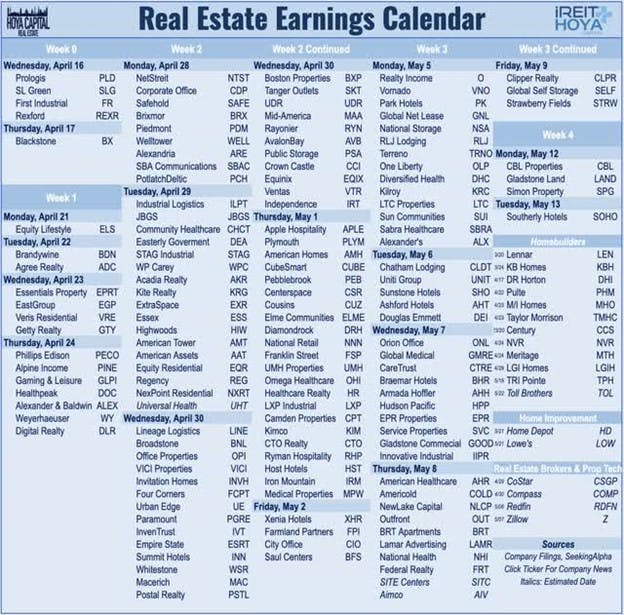
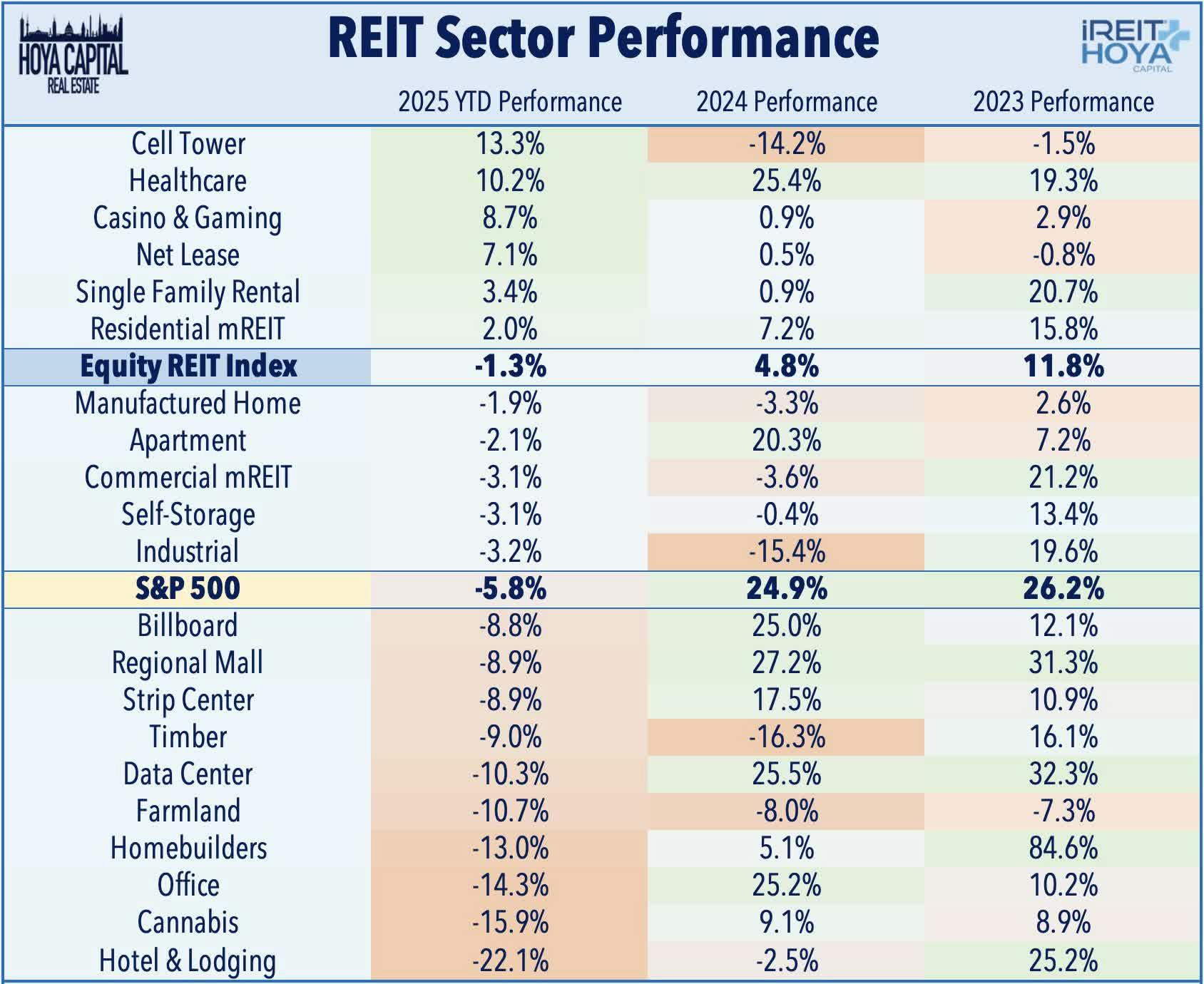
Real estate earnings season kicks into high-gear this week, and over the next month, we'll hear results from 175 equity REITs, 40 mortgage REITs, and dozens of housing industry companies. REITs enter peak earnings season with a bit of upside momentum, with the Equity REIT Index outperforming the S&P 500 by roughly eight percentage points since mid-January.
Notable favorable "green shoots" gleaned from recent data: 1) modest reacceleration in multifamily and single-family rents; 2) surprisingly resilient travel demand despite recession-level confidence; 3) relatively decent office leasing trends. Weaker trends include: 1) uptick in retailer distress following several robust years; 2) sluggish self-storage demand; 3) "pause" in logistics leasing amid tariff uncertainty; 4) data center "hyperscaler" pull-back. Below, we compiled the earnings calendar for equity REITs and homebuilders.
Largely immune from direct trade and tariff risks, REITs are coming back into favor after three years of historic underperformance - which had driven valuations to unusually "cheap" levels. Following a year-end tumble that lingered into early 2025 - as Treasury Yields ease from the cusp of two-decade highs. REITs accumulated historic levels of underperformance versus the S&P 500 during the Fed's hiking cycle - peaking at over 45 percentage points last July and roughly matching this level again last month - but have clawed back some of this gap over the past three months. Despite this modest recovery, REITs still trade at a historically wide discount to the S&P 500 on a Price-to-Earnings basis (P/FFO for REITs). As analyzed in our State of REIT Nation report, valuations - not fundamentals - are responsible for the vast majority of this underperformance, setting the stage for significant REIT outperformance in the quarters and years ahead as benchmark interest rates normalize.
We're keyed in on these REITs' updated 2025 outlook and what impact - if any - the tariff and recession uncertainty is factoring into their forecast. Given the short time gap between Q4 earnings season (which wrapped up in mid-March) and the start of Q1 earnings season (which began in mid-April), we'd generally expect fewer upside or downside revisions this quarter - but the extreme volatility of early April and related uncertainty does add some intrigue.
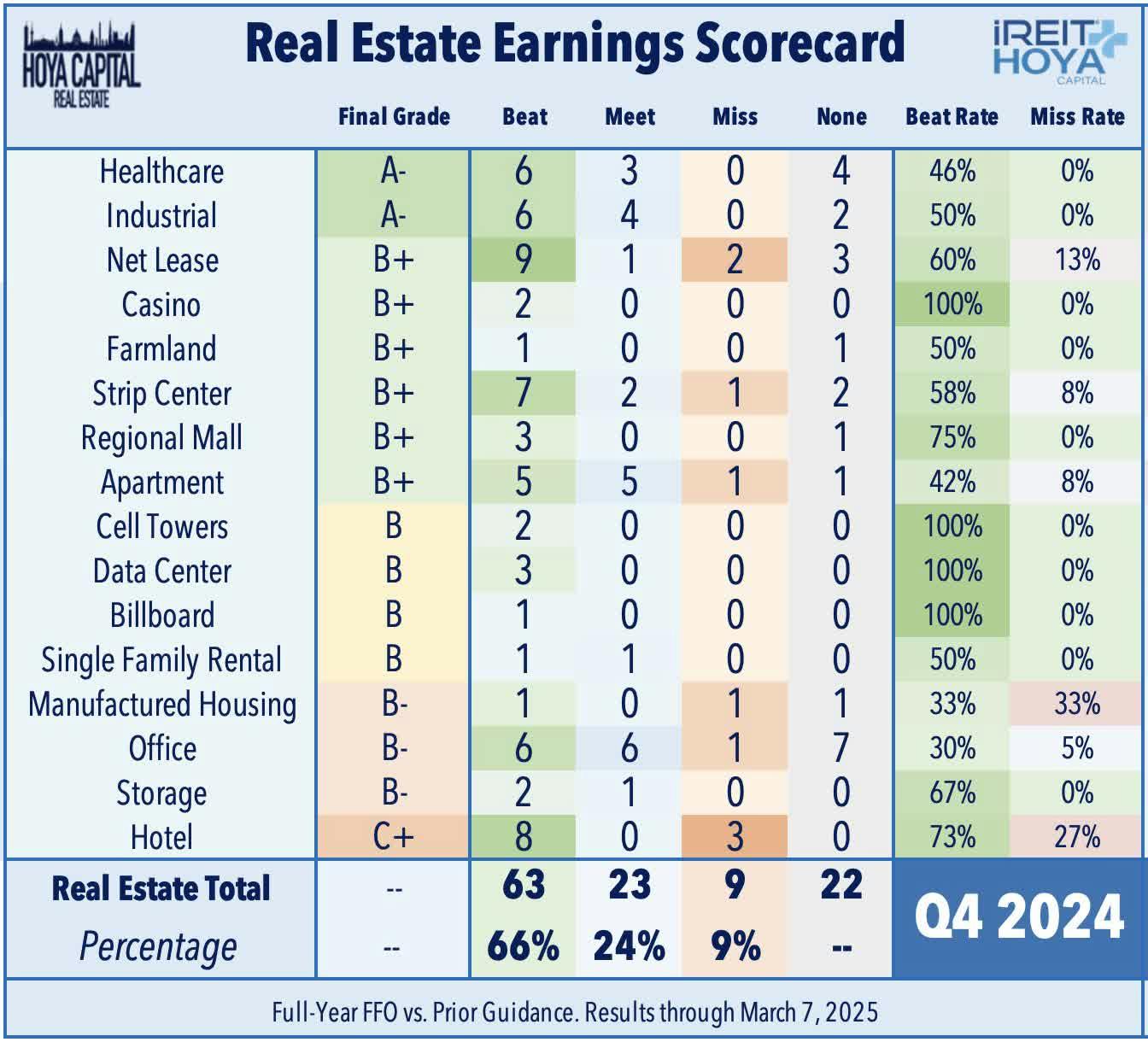
REITs are coming off a very strong Q4 earnings season in which 63 (66%) beat their most recent full-year outlook, while just 9 (9%) missed their outlook - well above the historical average "beat rate" for the fourth quarter of roughly 55%. Last earnings season, winners included Healthcare, Industrial, and Net Lease REITs. Results from other Residential REITs were mixed, as favorable expense trends were offset by rent growth deflation. Losers included Hotel, Self-Storage, and Office REITs.
Below, we discuss the major high-level themes and metrics we'll be watching across each of the real estate property sectors this earnings season. Our baseline forecast for this quarter is that 30% of REITs will raise their full-year FFO outlook, 65% will maintain their outlook, and 5% will lower their outlook - slightly below typical first-quarter average.
Like what you're reading?
Stay in the loop — get the latest ETF insights: trends, analysis, and expert picks.
Hotel & Office REIT Earnings Preview
Hotel
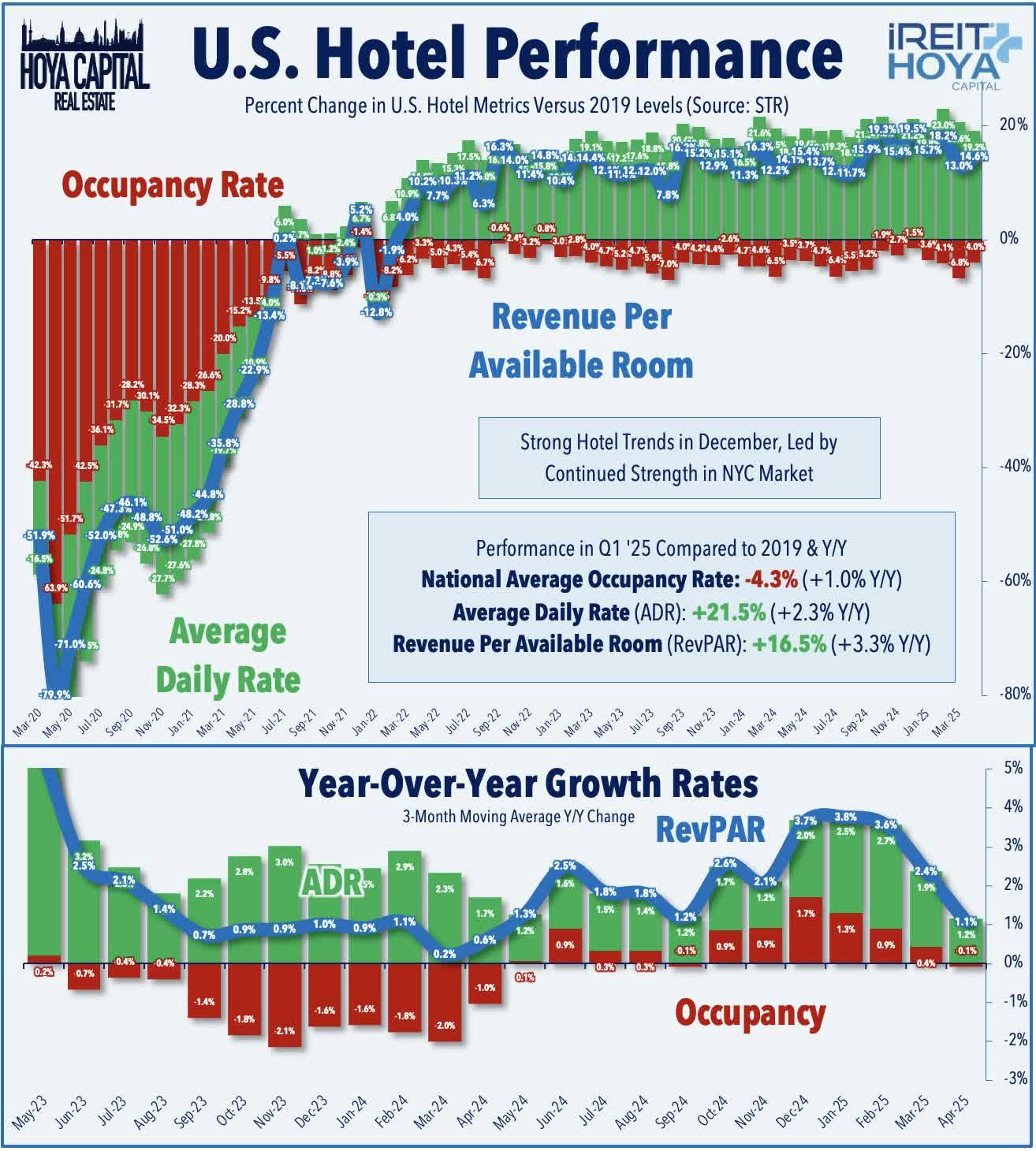
The most economically sensitive property sectors will be the most closely-watched this earnings season for insights into how consumers and businesses are responding to recent economic volatility. Despite the recession-level sentiment readings on Michigan Consumer Confidence and recent Business Sentiment surveys, along with a handful of airline incidents in early 2025 - recent high-frequency data indicates that travel demand has actually held up surprisingly well in recent months.
TSA Checkpoint data shows that passenger throughput has been 8% above 2019 levels in April - a modest reacceleration from February and March - but down slightly from the 14% comparable increase in January, which was the post-pandemic high. Hotel data provider STR reports that industry-wide Revenue Per Available Room ("RevPAR") was roughly 17% above 2019 levels in Q1 - up 3% from the record-setting Q1 of 2024 - as still-solid pricing trends have offset some recent weakness in occupancy rates.
Expectations have been reset lower for hotel REITs after three straight downbeat quarter in which essentially every hotel REIT lowered their full-year outlook for Revenue Per Available Room ("RevPAR"). Given that hotel demand has continued to hold up surprisingly well in recent months, we think hotel REITs are positioned for upside surprises.
Office
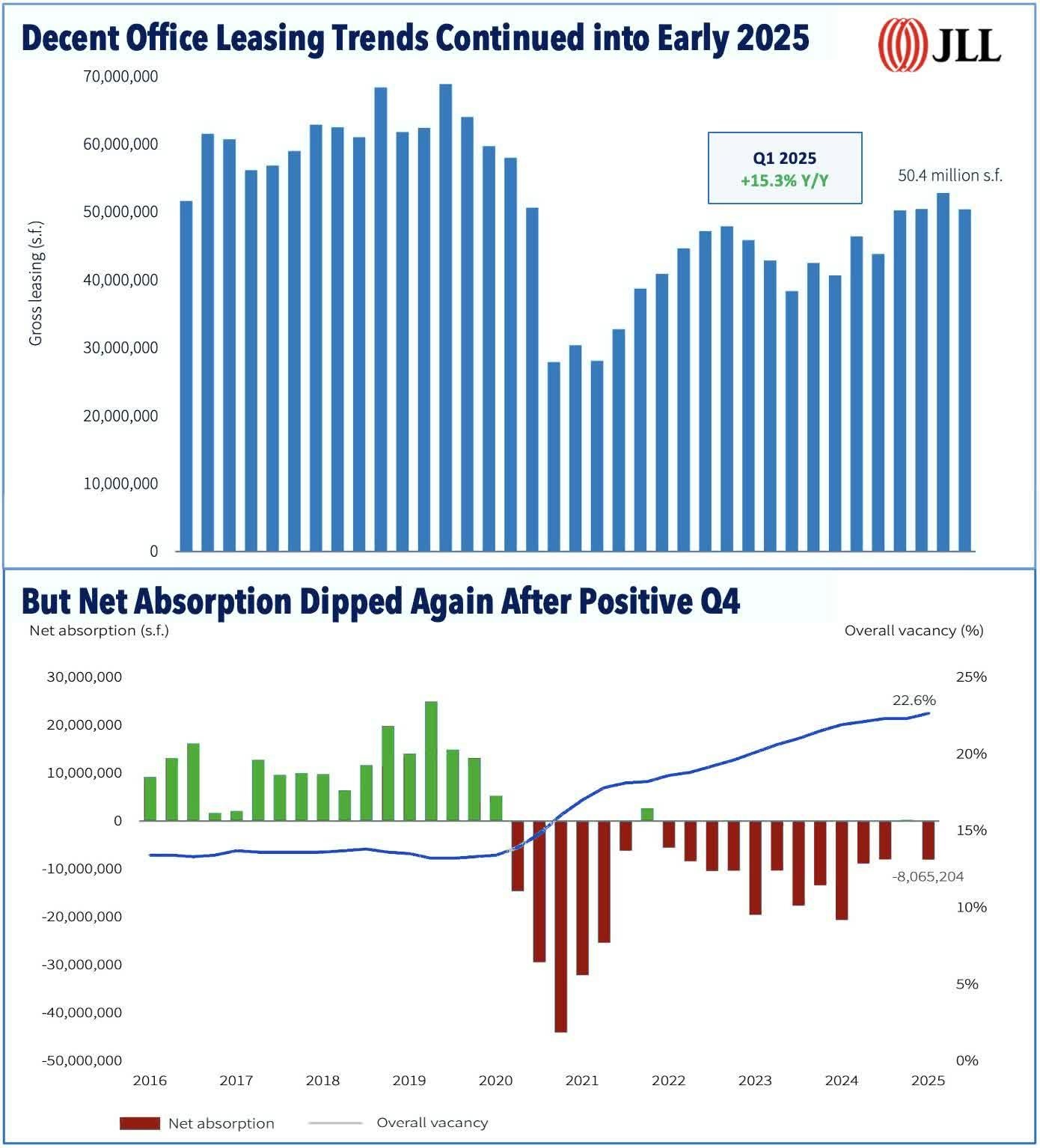
Beneath the universal pessimism on the office outlook, we've actually observed surprisingly positive green shoots for the office sector in recent quarters - helping to fuel a 25% rally for these REITs in 2024 - and the relatively positive "green shoots" have continued entering this earnings season. Brokerage firm Jones Lang LaSalle Inc. (JLL) released its quarterly office update last week, which showed moderately encouraging trends for the office sector after a surprisingly strong fourth quarter.
The report notes that leasing volume slowed moderately from post-pandemic highs in Q4, but reached 50.4M SF in Q1, up more than 15% compared to Q1 2024. Occupancy losses returned, however, as net absorption fell to -8.1M SF during the quarter, driven primarily by federal lease terminations. Supply growth has been essentially non-existent in recent quarters, however, as overall U.S. office inventory declined by more than 10M SF, as removals of over 15M SF far outpaced the 3.5M SF of new deliveries.
We continue to be focused primarily on leasing volumes, commentary on any recent changes in demand trends amid tariff uncertainty, and whether we've indeed finally seen the "bottom" on occupancy rates and FFO
Tech and Industrial REITs Earnings Preview
Industrial
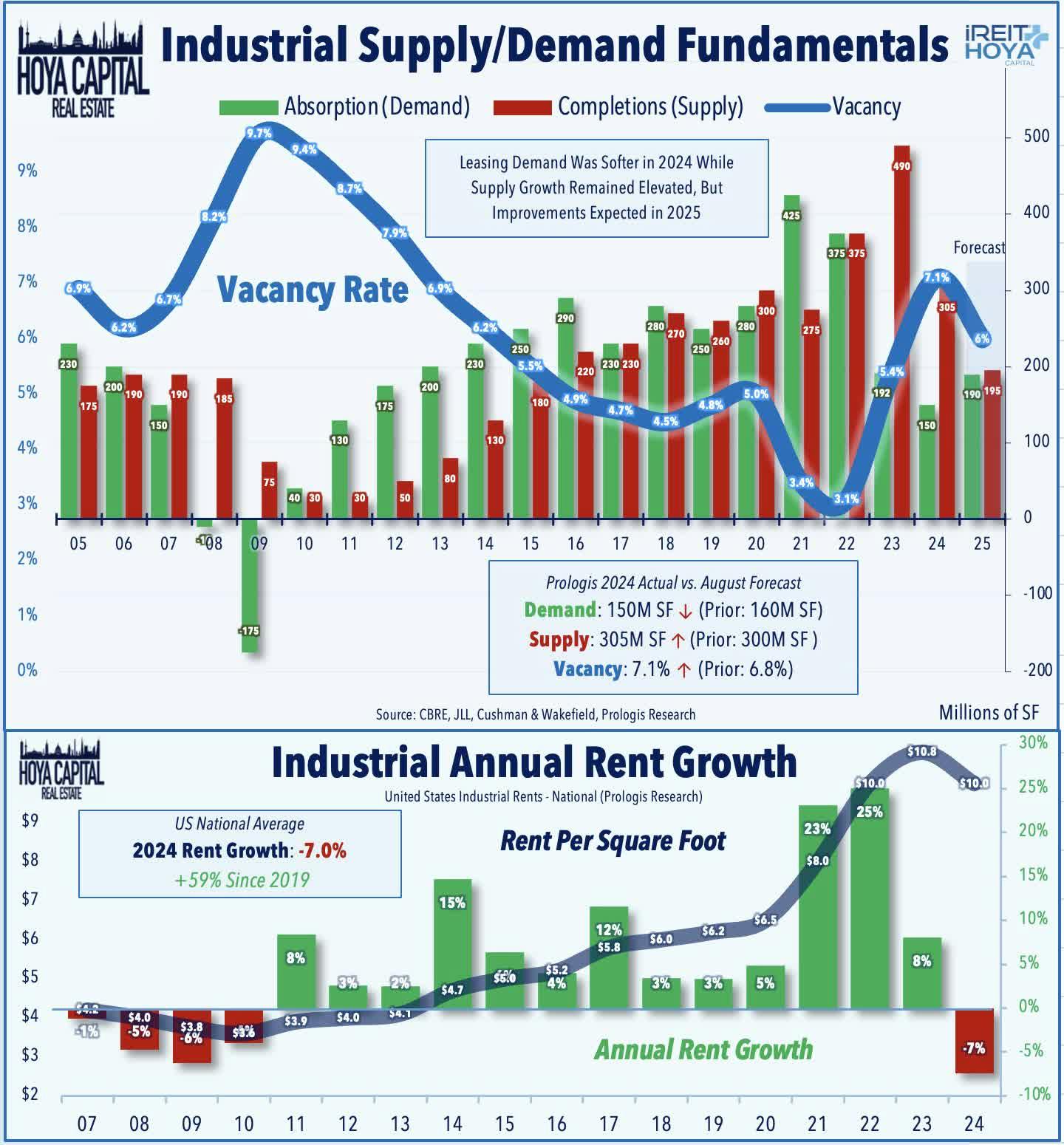
After getting slammed in the post-liberation day sell-off, industrial REITs have been among the better performers in recent weeks as the initial slate of results pushed back on the prevailing consensus that looming tariffs would materially impair demand for logistics space.
We've seen results from four industrial REITs already, three of which have maintained their outlook, while one raised its forecast. Sector stalwart Prologis (PLD) reported impressive leasing activity in its "exceptional" results, noting that PLD signed 58 million square feet of leases in Q1 - just shy of the company record of 60M SF last quarter.
EastGroup (EGP) raised its full-year FFO and NOI outlook and expressed optimism regarding the Trump Administration's approach to on-shore U.S. manufacturing, which would be "good news for EastGroup in a couple of ways," citing exposure to increased manufacturing production in Texas and a potential benefit from "near-shoring" in Mexico at the expense of China.
First Industrial (FR) maintained its forecast while posting strong cash rent increases of 42% - up from 41% in Q4. Southern California-focused Rexford (REXR) reported softer trends in its West Coast market - which are far more exposed to Chinese trade risk - but still maintained its full-year FFO outlook. For the balance of the reports, we're focused on rent spreads and leasing activity, and of course, on any and all tariff-related commentary.
Data Center
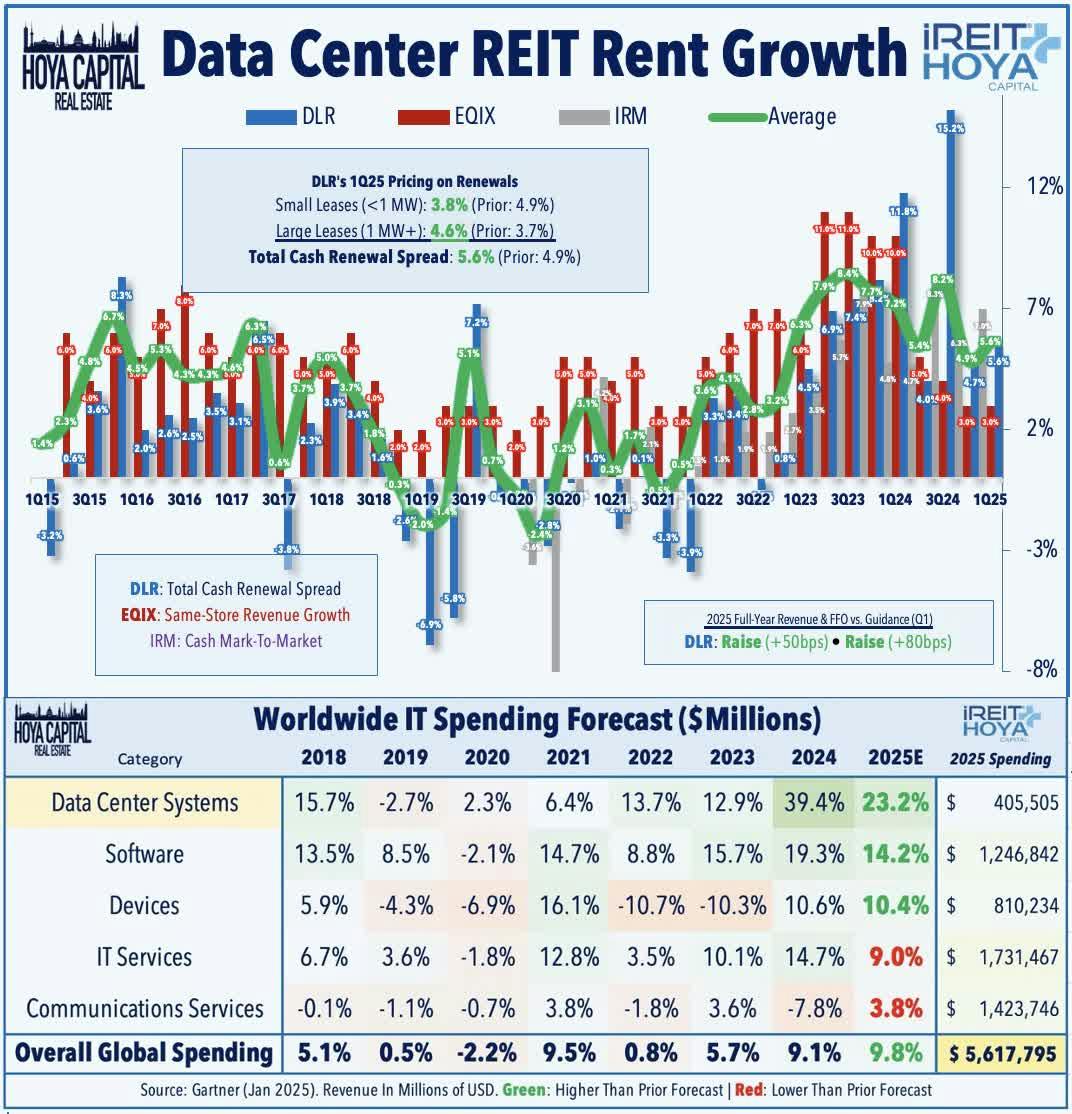
After coming under pressure last month on a series of reports indicating that the so-called cloud "hyperscalers" - Google, Amazon, Microsoft - are pausing some investments amid tariff uncertainty, data center REITs have been among the early winners of earnings season after results last week from Digital Realty (DLR) indicated that the AI-related tailwinds have offset the pullback on hyperscaler spending.
Digital Realty reported strong results, notching bookings representing $242M of incremental revenues, its third-strongest quarter on record and up from $100M last quarter, as very strong renewal bookings on smaller-scale enterprise leases (<1MW) helped to offset somewhat softer demand trends from larger hyperscalers (>1MW). Pricing was also surprisingly strong in Q1 following a moderation in late 2024, with DLR notching impressive cash rent increases of 5.6% on its renewals, up from 4.7% last quarter.
DLR notes average pricing topped $244/kW/month on these bookings - which set a new company record, and reported that AI accounted for two-thirds of Q1 bookings. Strong leasing activity lifted DLR's backlog to a record-high of $919M, which DLR notes, "enhance our visibility and predictability of earnings growth." Given an extra boost by FX adjustments this quarter, DLR boosted its full-year revenue growth outlook to 5.8% (up from 5.3% previously), raised its Core FFO growth outlook to 5.7% (up from 4.9% previously), and maintained its "same capital" cash NOI growth target at 4%.
For results from Equinix (EQIX) later this week, we'll be focused on leasing volumes and pricing and on commentary regarding any tariff impact.
Cell Towers
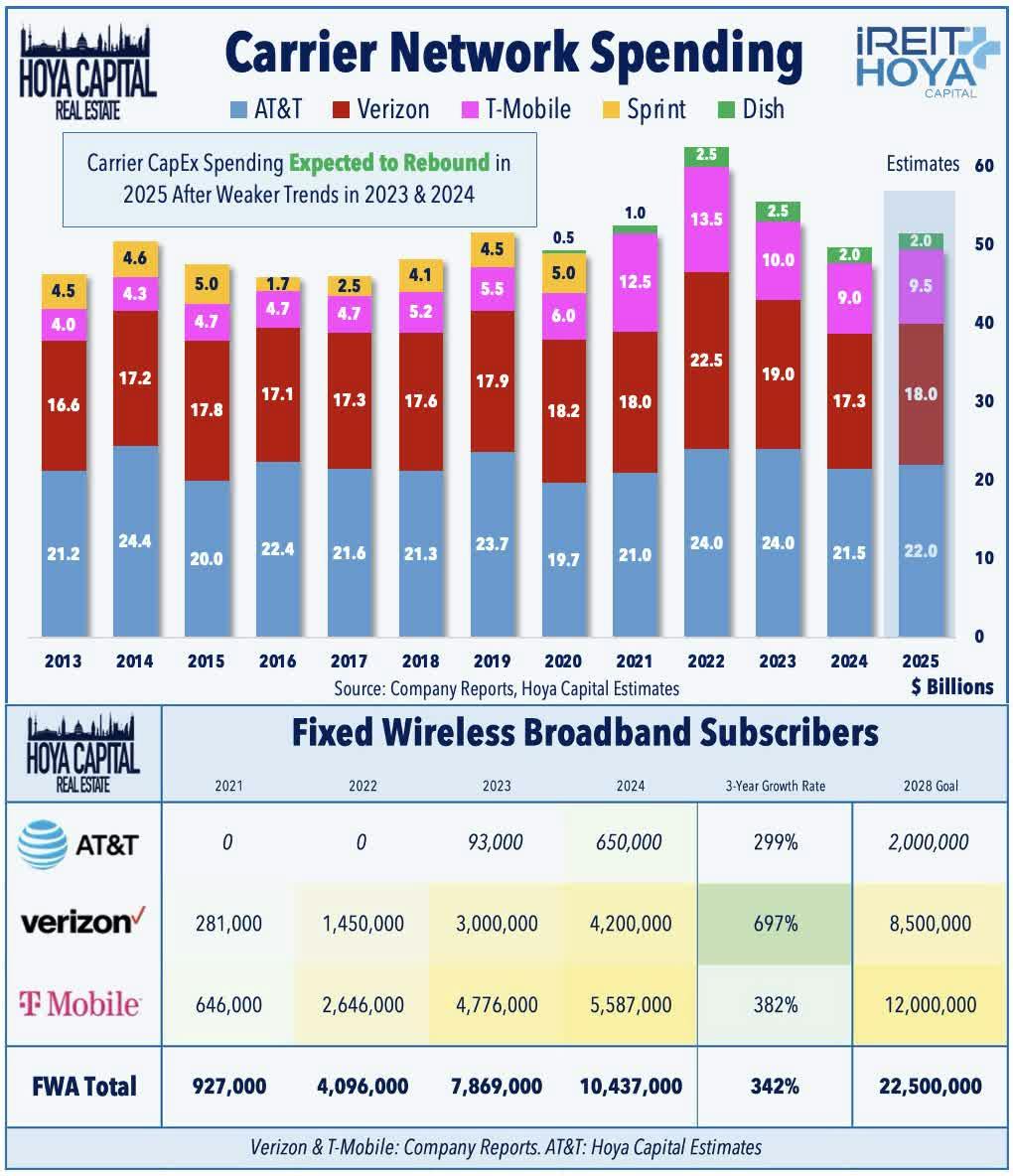
The weakest-performing property sector from 2022-2024 amid a telecommunications industry-wide slump that was inflamed by tight monetary conditions and new competition from satellite offerings, cell tower REITs have rebounded in 2025 on positive green-shoots regarding increased network investment from the trio of U.S. carriers. These cellular carriers curbed their capital-intensive network expansion plans in 2023 and 2024 following a significant wave of investment and tower equipment upgrades from 2019-2022 to deploy nationwide 5G networks.
Commentary from the major cellular carriers has provided some reasons for optimism this quarter, however, with industry-wide CapEx expected to re-accelerate in 2025. Robust demand for Fixed Wireless Broadband - which we've long viewed as the "killer app" for 5G - has prompted the major carriers to re-focus efforts on macro tower site deployment, which drives the "organic growth" for these tower REITs. Still, the shadow competition from the ever-improving service of Starlink cannot be ignored.
A seemingly impossible feat when initially discussed in the late 2010s, Starlink has deployed roughly 7,000 low-earth-orbit satellites in five years - each serving as a "mini cell tower" - providing blanket worldwide coverage. Macro cell towers aren't going away anytime soon, but Starlink has significantly altered the competitive dynamic in the telecom space.
Residential Real Estate Earnings Preview
Apartments
For multifamily, oversupply concerns have eased in recent months as new construction starts have slowed substantially while demand has been surprisingly robust. RealPage reports that apartment demand hit its highest level in nearly three years in the fourth-quarter and continued this momentum in early 2025 "as the supply wave crests."
The U.S. apartment market absorbed 138k units in the first quarter, while 116k were delivered - marking a second-straight quarter of a positive demand/supply imbalance after a stretch of oversupply beginning in mid-2022. U.S. occupancy averaged 95% in Q1 - continuing an uptrend since bottoming at 94% in December 2023 - while average effective asking apartment rents grew 0.8%, also up from recent lows in 2024.
The solid demand comes at a critical time for the multifamily market, which has seen a record quantity of new units delivered - more than a half-million - over the past twelve months, with this pace expected to begin to moderate.
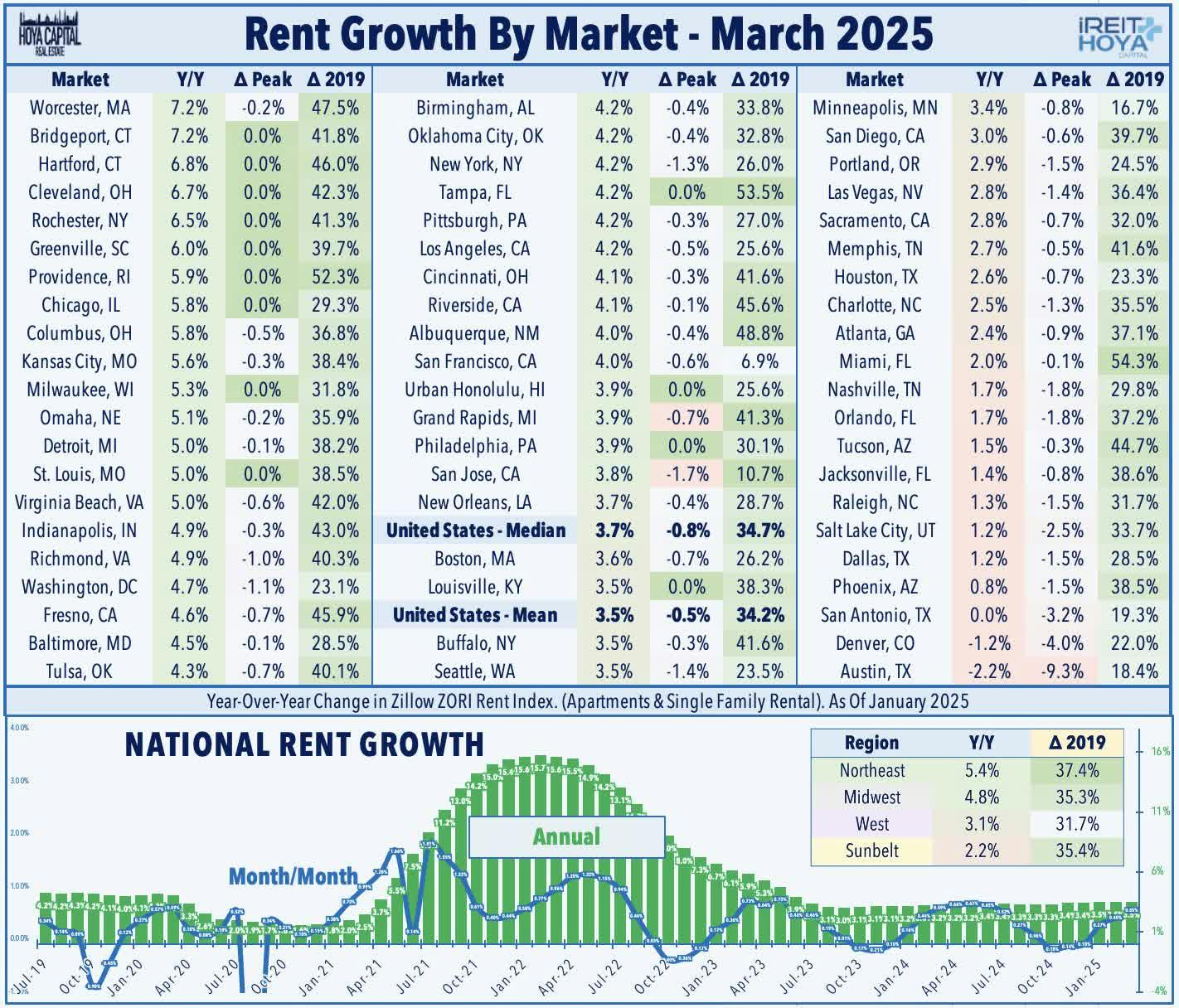
Zillow data shows that blended rent growth (new and renewed) has remained remarkably steady in the 3-4% range over the past 24 months - consistent with the "inflation plus 1-2%" target that's long been our forecast. We'll be closely watching rent growth metrics on new and renewed leases, and commentary the financial health of their renters.
Single-Family Rentals
Supply growth has remained more contained on the single-family side throughout the pandemic era, but SFRs have not been entirely immune to the supply pressure on the multifamily side.
After posting surprisingly buoyant mid-single-digit rent growth trends in 2023, CoreLogic reported that SFR rents slowed to 14-year lows in late 2024, rising about 1.5% year-over-year.
The latest report, however, shows some modest reacceleration in recent months, consistent with the trends seen in multifamily markets. The report also highlighted a similar regional disparity as that seen in the Zillow data, with Sunbelt rent growth lagging most coastal and Midwest markets. Seattle, New York, and DC topped annual SFR rent growth in the latest report, while rents in Austin and Phoenix were the weakest. The two SFR REIT portfolios are skewed towards the mid-to-upper tier of the market but also have a heavy presence in the Sunbelt.
Expenses remain the "wild card" for these REITs - especially as it relates to insurance and property taxes. In addition to rent growth metrics, we're interested in commentary about these external growth prospects - specifically, whether these REITs are beginning to see any pockets of private-market distress that could be ripe for the picking.
Storage
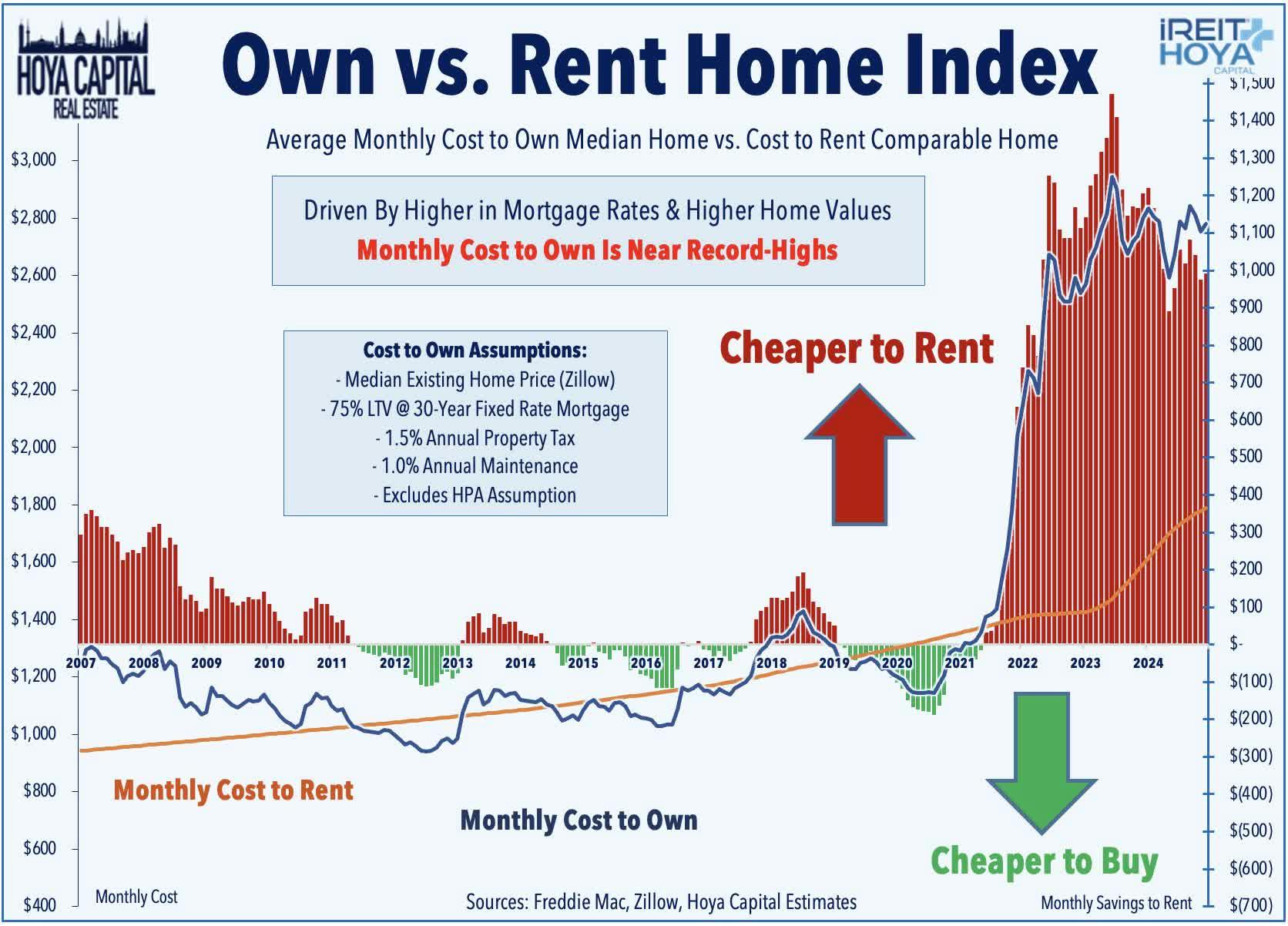
Self-storage demand is closely correlated with housing market turnover - existing home sales and apartment turnover rates - both of which have been around multi-decade lows over the past year.
Results from self-storage REITs last quarter showed that soft fundamentals dragged into the fourth quarter and into early 2025, as muted housing market activity and elevated supply growth have kept downward pressure on new lease rates.
Muted move-out activity - and relatively buoyant low-single-digit rent growth on existing tenants - has helped to offset the considerable weakness in new lease rates, as all four storage REITs reported a tenth-straight quarter of negative "Street Rate" (new lease) spreads which has slowly started to bleed into the overall average rent metrics. Soft trends appeared to continue into Q1, per recent higher-frequency data in the PPI report and online search trends.
We expect another downbeat quarter for self-storage REITs, but we're focused on commentary on whether supply headwinds will finally ease in 2025.

Healthcare REIT Earnings Preview
Senior Housing
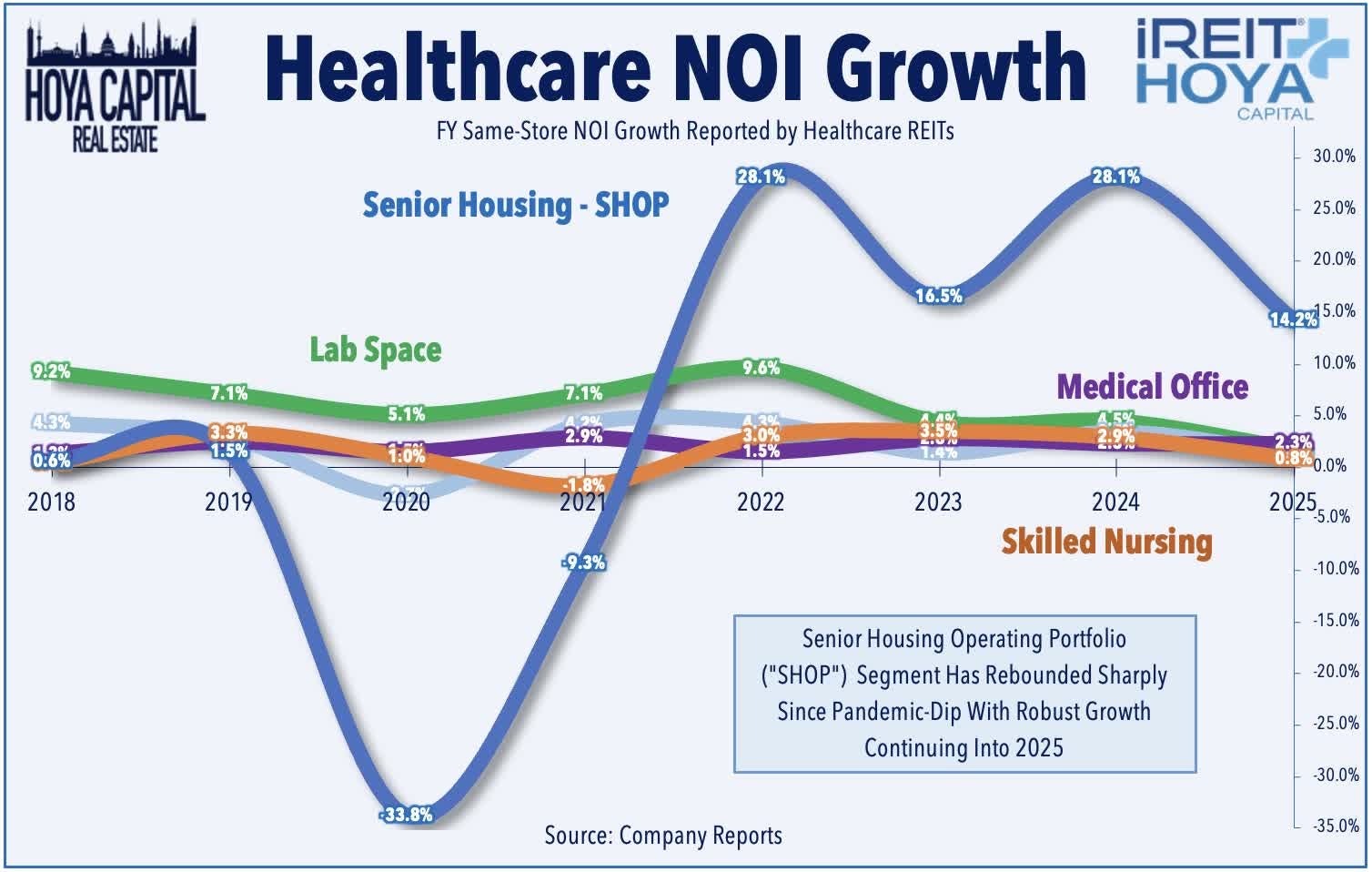
Continuing their strong performance from 2022 and 2023, Senior Housing and Skilled Nursing REITs were among the performance leaders in 2024 as recent data shows a continued recovery in occupancy rates alongside historically strong rent growth.
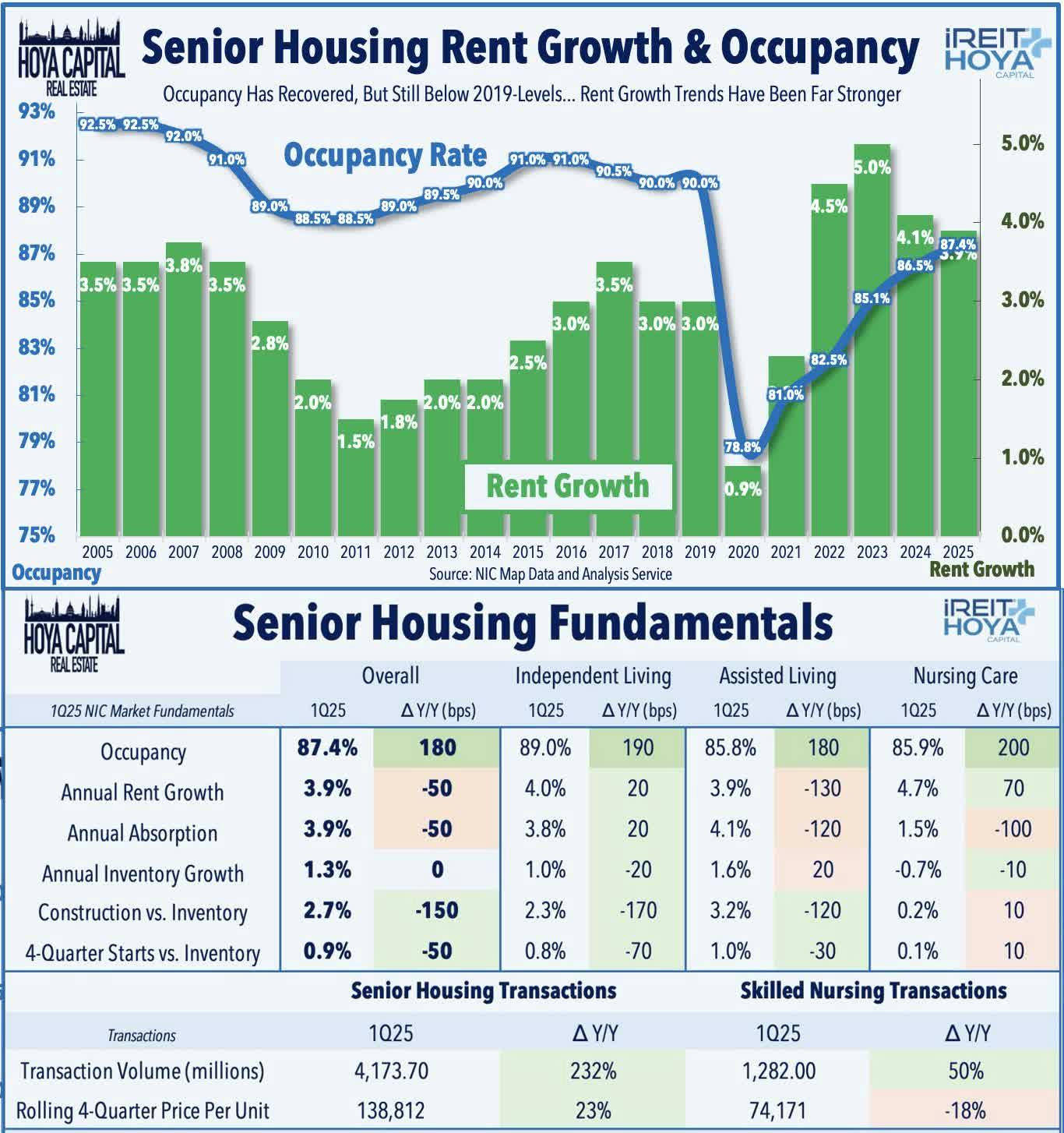
Industry data provider NIC published its quarterly Market Fundamentals report, which showed that senior housing occupancy rates increased for the 15th consecutive quarter to 87.4%, which is 9.6 percentage points above its pandemic low of 77.8% in the second quarter of 2021.
The skilled nursing occupancy rate, meanwhile, rose to 85.9% in the most recent quarter, up 11.2 percentage points from its pandemic low of 74.7%.
Fueled by tailwinds from record-setting COLA adjustments in 2023 and 2024, rent growth across both Senior Housing and Skilled Nursing facilities remained historically strong in 2024 - each rising by over 4% - and remained solid in early 2025 at 3.9% and 4.7%, respectively.
Supply growth remains muted as well, with NIC noting that the rolling four-quarter average for construction starts sits at 0.9% of total inventory - the lowest since 2010.
These tailwinds bode well for tenant financial health and rent coverage, which remains the primary focus for senior housing and skilled nursing REITs.
Medical Office
While their healthcare REIT peers in the senior housing space have surged over the past two years, medical office building ("MOB") REITs have remained one of the weakest-performing sub-sectors during this time, despite property-level fundamentals that are quite favorable.
JLL's latest report published last month concludes, "the MOB sector is experiencing significant growth as healthcare providers expand outpatient services." Citing strong demand and limited new supply, JLL notes that absorption for medical outpatient buildings accelerated in Q4 2024 to 19 million square feet, a 15% increase from the previous year.
JLL's report highlights broader demographic trends for the MOB space, forecasting that outpatient volumes in the U.S. are anticipated to grow 10.6% over the next five years, according to Advisory Board. Escalations for new leases in 2024 averaged 3%, according to JLL data, and with terms averaging 107 months for new leases.
Tenant financial health remains the key risk, however, given the ultra-slim operating margins seen across the health system industry, which averaged just 4.9% in December 2024 according to the Kaufman Hall Operating Margin Index. MOB REITs have a relatively low hurdle to meet this earnings season, and will be keyed-in on leasing velocity, tenant financial health, and the M&A outlook.
Retail REITs Earnings Preview
Strip Centers
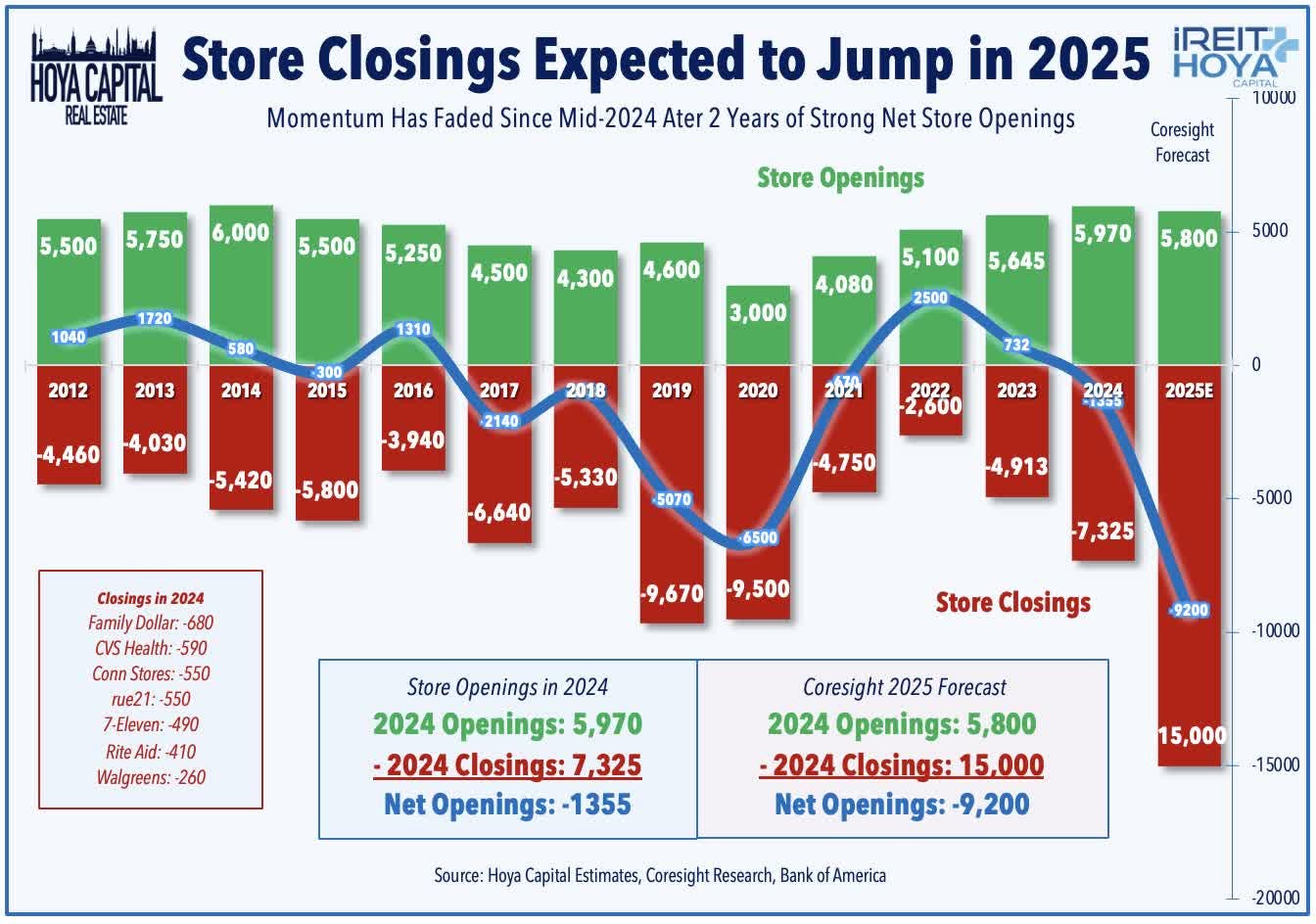
Following a historically strong period of store openings in 2022 and 2023 - which drove record-setting retail rent growth - we've observed a rather notable cooldown in retail demand trends amid a handful of bankruptcies and large-scale store reduction announcements.
Tempering the retail optimism, the latest data from Coresight shows that store closings outpaced openings in 2024 for the first time since 2021, and provided a strikingly pessimistic outlook for 2025.
Coresight forecasts that 15,000 stores will close in 2025 - the most on record - while store openings will remain steady at around 5k, resulting in a net loss of roughly 9,000 stores.
The jump in store closings has been driven by a handful of recent bankruptcies - including Party City, and Conn's - along with announced store reductions from Family Dollar, CVS (CVS), Walgreens (WBA), Seven-11, and Big Lots.
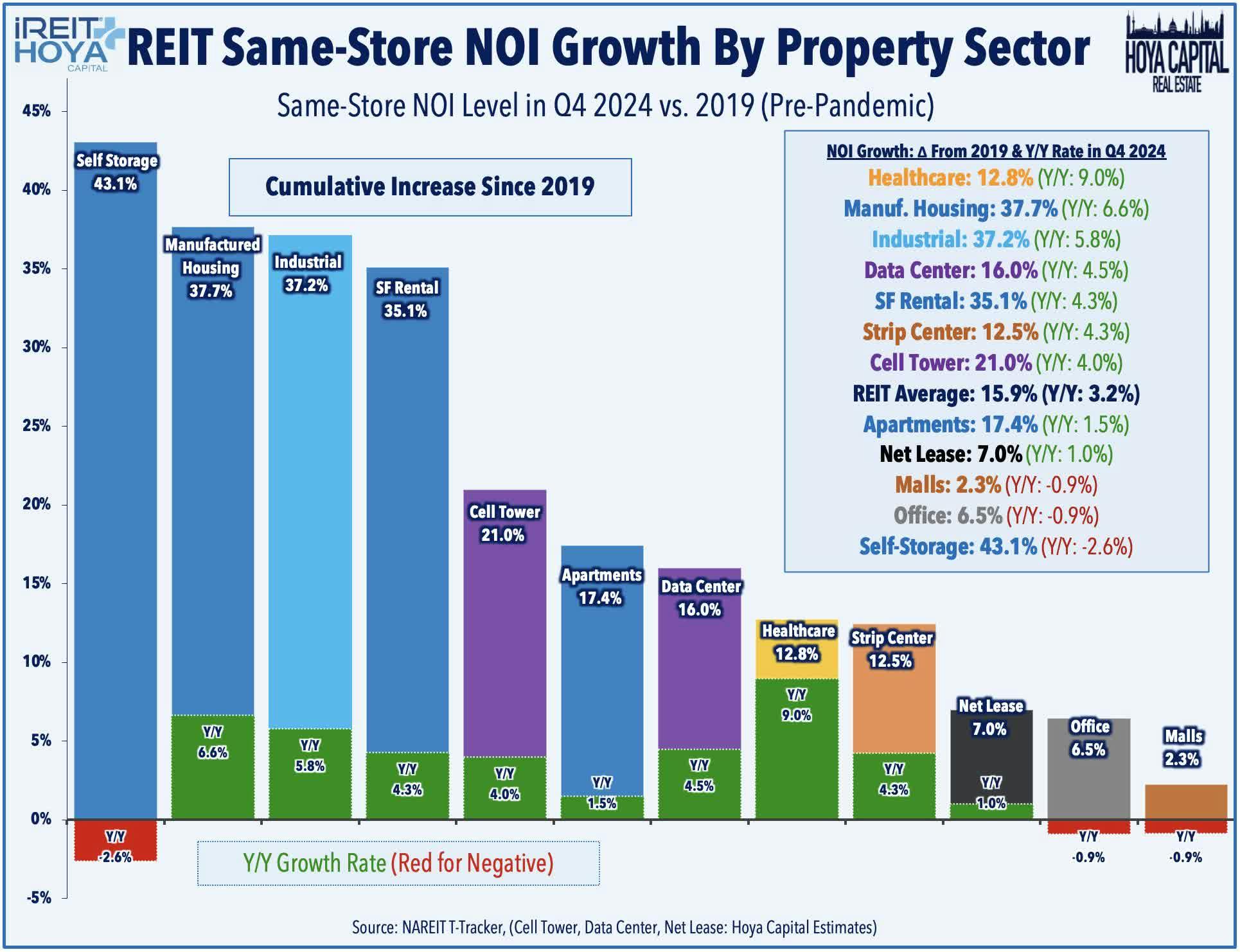
Retail REIT fundamentals had improved materially in 2023 and 2024, as the combination of near-zero new development and positive net store openings has driven occupancy rates to record highs and allowed both Strip Center and Mall REITs to enjoy some long-awaited pricing power.
We're keyed in on commentary discussing whether this recent wave of closings is merely a bump in the road or indicative of a broader pivot across the retail space. We'll be focused on leasing spreads and occupancy rate trends.
Malls
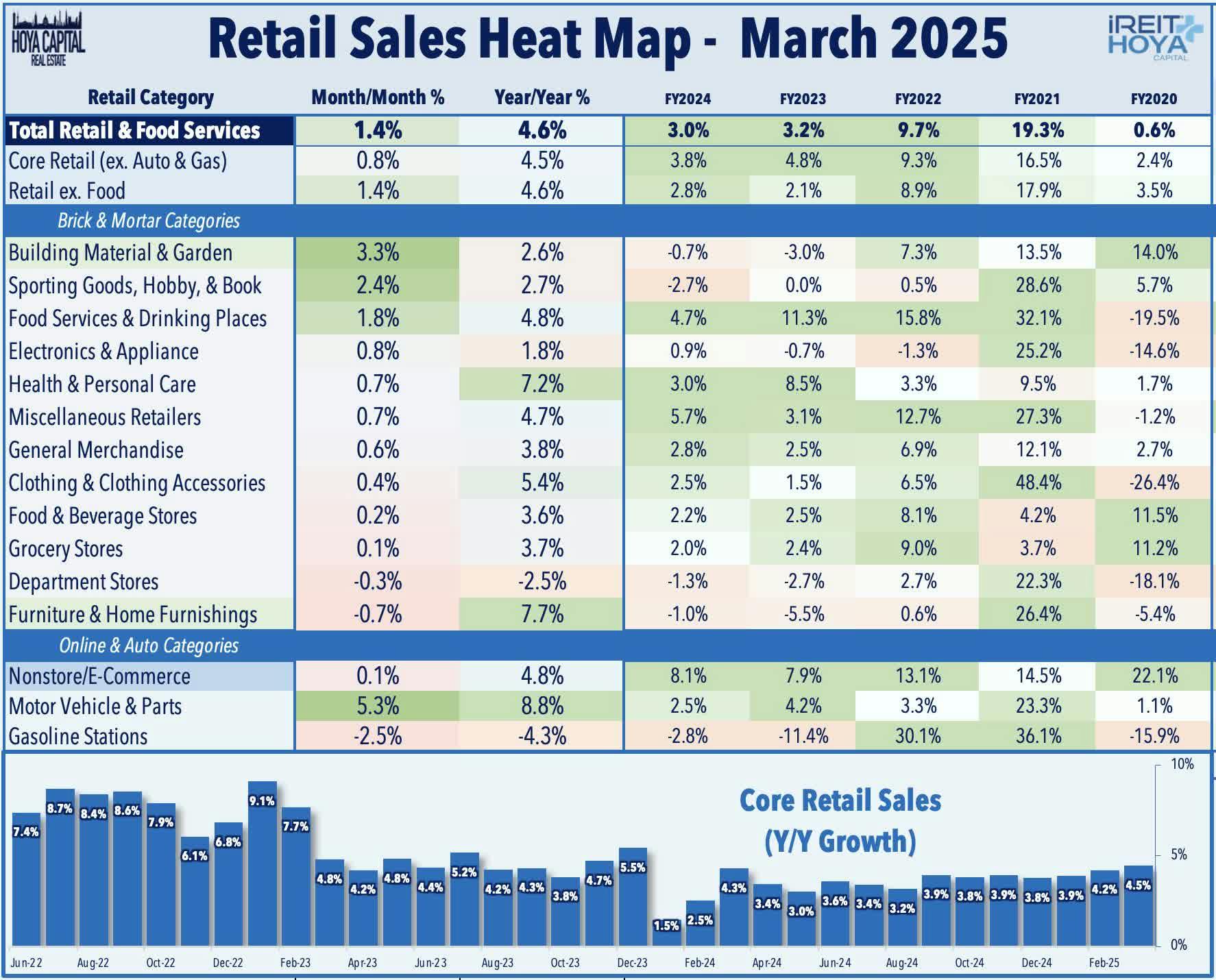
Mall REITs are no longer the "Problem Child" of the REIT sector - particularly after weaker players and lower-tier malls closed shop - but the recent jump in store closings has again raised some concern. A key look into the health of the U.S. consumer, Retail Sales data earlier this month week showed a surprising surge in March, with sales rising by the strongest monthly pace in over two years.
Total Retail Sales climbed 1.4% in March from the prior month and 4.6% from a year earlier, which was the strongest monthly and annual gain since January 2023. Likely reflecting some "front-running" of looming tariff hikes, consumers spent heavily at home improvement (+3.3%) and motor vehicle (+5.3%) retailers in March, offsetting a drag from the gasoline category (-2.5%) due to lower fuel prices. Core Retail Sales - which excludes auto and gas - posted a more modest monthly increase of 0.8%, but the year-over-year increase of 4.5% was the strongest since December 2023.
Clashing with the recent consumer sentiment survey showing GFC-levels of confidence, the report also showed surprising strength in some economically-sensitive categories that have no direct tariff impact - including restaurants & bars (+1.8%) and sporting goods & books (+2.4%) - raising questions over the applicability of recent "soft" survey data showing a historic plunge in consumer and business confidence.
Net Lease
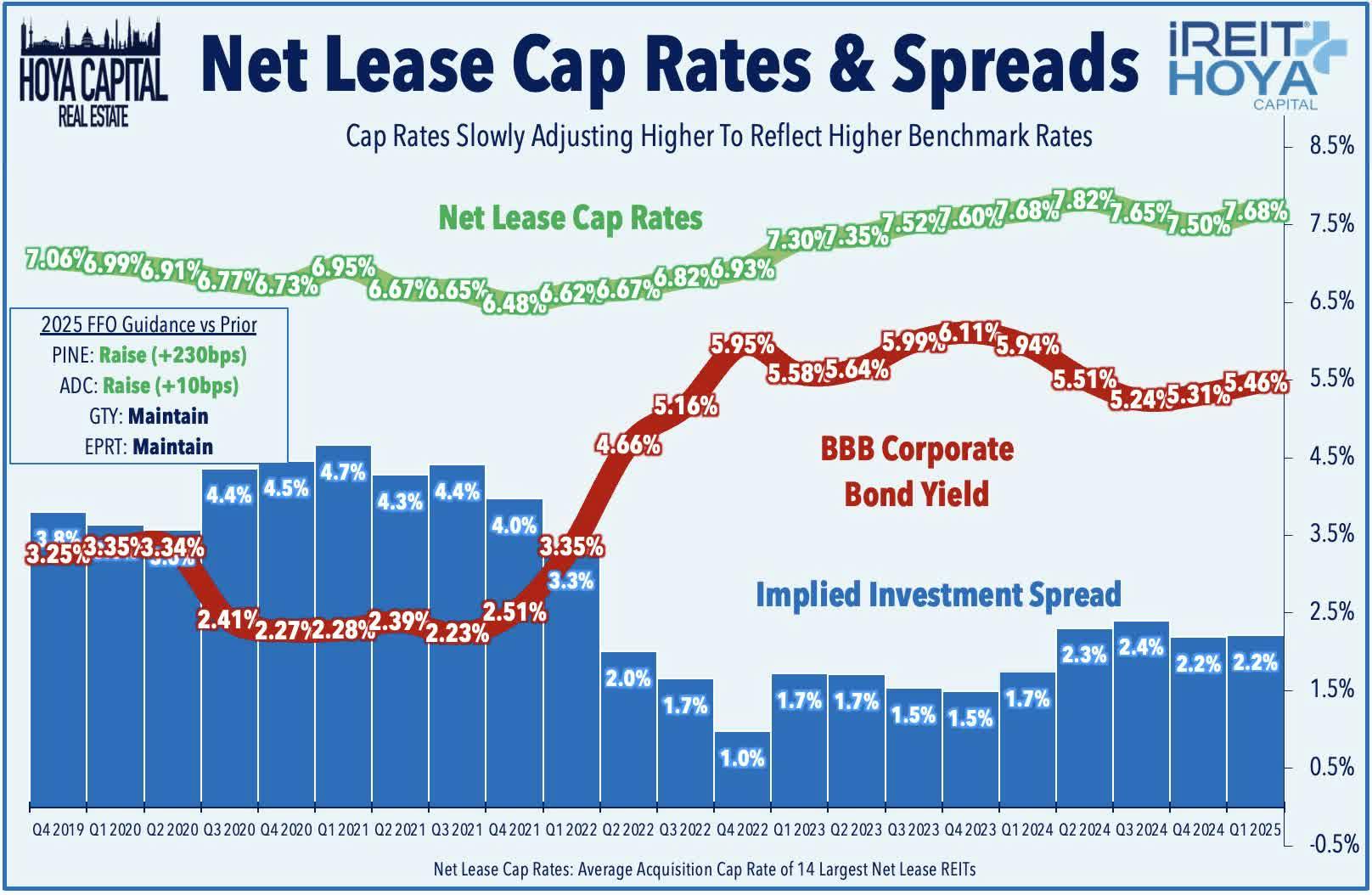
The most "bond-like" and interest-rate-sensitive property sectors, the pullback in benchmark rates has restored some positive vibes into the net lease sector. We've seen results from four net lease REITs thus far, with a pair raising their full-year outlook - Agree Realty (ADC) and Alpine Income (PINE) - and a pair maintaining their outlook - Getty Realty (GTY) and Essential Properties (EPRT).
Thriving in the "lower forever" environment, the industry has been reluctant to acknowledge the higher-rate regime, keeping private-market values and cap rates surprisingly "sticky" and resulting in compressed investment spreads, but we've seen some better investment spreads in recent quarters as private market cap rates tick higher.
Strong balance sheets and lack of variable rate debt exposure have positioned net lease REITs to be aggressors as over-levered private players seek an exit, but these REITs can afford to wait until the price is right.
We're keyed in on commentary regarding cap rate movements in early-2025 and whether the rebound in interest rates in Q1 - and subsequent downtick in recent weeks - has changed the outlook for acquisition activity in 2025.
Key Takeaways: Real Estate Earnings Preview
Real estate earnings season kicks into high-gear this week, and over the next month, we'll hear results from 175 equity REITs, 40 mortgage REITs, and dozens of housing industry companies.
REITs enter peak earnings season with a bit of upside momentum, with the Equity REIT Index outperforming the S&P 500 by roughly eight percentage points since mid-January. Largely immune from direct trade and tariff risks, REITs are coming back into favor after three years of historic underperformance, which had driven valuations to unusually "cheap" levels.
Notable favorable "green shoots" gleaned from recent data: 1) modest reacceleration in multifamily and single-family rents; 2) surprisingly resilient travel demand despite recession-level confidence; 3) relatively decent office leasing trends. Weaker trends include: 1) uptick in retailer distress following several robust years; 2) sluggish self-storage demand; 3) "pause" in logistics leasing amid tariff uncertainty; 4) data center "hyperscaler" pull-back.
We'll provide real-time updates throughout earnings season in our Daily Recaps, Weekly Reports, and in the Chat Board.
About the Author
David Auerbach boasts over two decades of experience in the securities industry, specializing as an institutional trader with a focus on Real Estate Investment Trusts (REITs), Equity and Preferred stocks, MLPs, ETFs, and Closed End Funds.
Based in Dallas, TX throughout his entire career, David currently serves as the Chief Investment Officer for Hoya Capital, managing the Hoya Housing 100 ETF (Ticker: HOMZ) and The High Yield Dividend ETF (Ticker: RIET). Previously, David held the position of Managing Director at Armada ETF Advisors, the sub-advisor for the Residential REIT ETF (Ticker: HAUS) and The Private Real Estate Strategy via Liquid REITs ETF (Ticker: PRVT).
Additionally, he acts as a consultant with IRRealized, LLC, focusing on corporate access in the REIT industry. David's industry journey includes roles at World Equity Group, Esposito Securities, and Green Street Advisors where he got his start in the REIT industry.
At Esposito Securities, he played a crucial role in building the REIT/Real Estate platform and worked extensively with institutional investors, Equity REITs, and ETF issuers.
Throughout his career, David has been quoted by reputable publications such as Bloomberg, WSJ, Financial Times, REIT.com, and GlobeSt.com. He has also made notable appearances as a featured guest on networks like Yahoo Finance, TD Ameritrade, and Bloomberg.
David holds a BBA in Finance from the University of Texas at Austin (May 1999) and an MBA in Finance from Southern Methodist University (May 2005). He maintains FINRA Series 7, 24, 55, and 63 registrations.
In his leisure time, David is an avid traveler, often found crisscrossing the country in pursuit of attending as many Phish concerts as possible.
Disclaimer
Please note this article is for information purposes only and does not in any way constitute investment advice. It is essential that you seek advice from a registered financial professional prior to making any investment decision.
Latest ETF News
See all ETF news








 Advantages of ETFs over Mutual Funds1/6
Lower Costs
In this guide, we'll explore the advantages of ETFs over mutual funds, giving you valuable insights into why ETFs have gained significant popularity among investors like yourself.
Leveraged ETFs: Unlocking the Potential for Amplified Returns1/6
Understanding Leveraged ETFs
Explore leveraged ETFs: potential for amplified returns & risks. 5 ETFs to consider across equities, commodities & fixed income.
What is a Leveraged ETF?1/6
Introducing Leveraged and Inverse ETFs
In this guide, we'll dive into the world of leveraged ETFs, exploring their definition, mechanics, potential risks, and rewards.
Recent educational content

ETF Trends
ETF Industry KPIs July 20, 2026
This week’s KPI data overview highlights key metrics and trends shaping the ETF landscape.

ETF Trends
ETF Industry KPIs July 13, 2026
This week’s KPI data overview highlights key metrics and trends shaping the ETF landscape.

First Look ETF
First Look ETF: Cash Deployment, Bond, and Hedged ETFs
In this season 6 episode of First Look ETF, Stephanie Stanton examines the latest ETF marketplace trends with NYSE and guests.

ETF Trends
ETF Industry KPIs July 6, 2026
This week’s KPI data overview highlights key metrics and trends shaping the ETF landscape.
Browse all educational columns



Active Trader Report: Use of Leveraged & Inverse ETFs Way Up
Direxion partnered with Compound Insights and Vanda to explore what’s driving the evolution of active trading — and how active traders are using leveraged and inverse funds across equities, single stocks, commodities, and volatility.