Ready-made ETF portfolios built for real investor needs. Explore now →



Real Estate Funds Plunge Again Amid Spike in Interest Rates
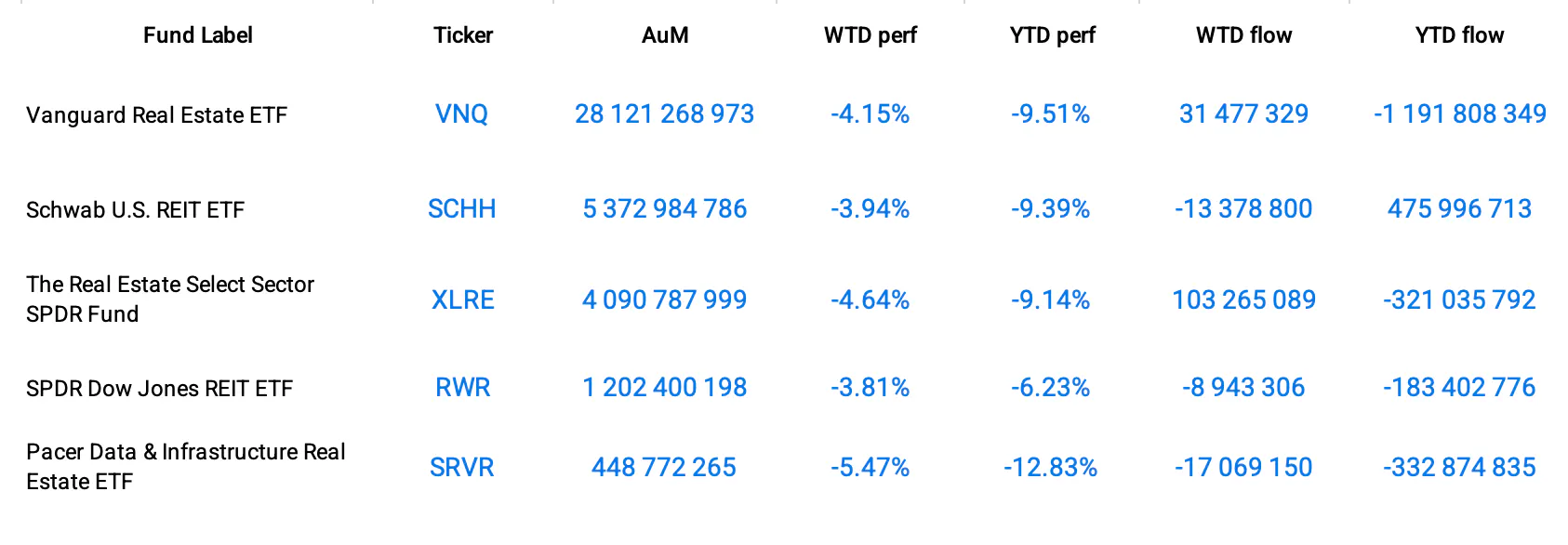
Real estate funds faced a turbulent week as surging 10-year Treasury bond yields sparked a 4.64% weekly sector decline, reminiscent of 2007, triggering widespread apprehension and impacting ETFs.


Keep up with what matters in ETFs
Get timely ETF insights, market trends, and top ideas straight to your inbox.
Your newsletter subscriptions with us are subject to ETF Central's Privacy Policy and Terms and Conditions.
It was a tough week for real estate funds following the sudden spike in Treasury bond yields. The yield on the 10-year Treasury bond surged to 4.93% from 4.63% - a level unseen since 2007, the year that saw the start of the subprime mortgage crisis. As a result, the real estate sector - already one of the worst performers within the S&P 500 index so far this year - plunged 4.64% over the week, bringing its year-to-date performance to -11.64%.
Memories of the financial crisis appear to have spooked investors, triggering a precipitous drop in sector-wide figures. ETFs related to real estate faced the brunt of these revived fears, recording a stark drop of 4.00% over the week.
Benchmarking indexes delivered similarly underwhelming performance with the FT Wilshire 5000 Real Estate Index suffering a fall of 4.00%. These negative trends would suggest a deep level of apprehension which is widespread and not just confined to niche markets or isolated assets.
Large funds were not immune to the industry-wide downturn either. The Vanguard Real Estate ETF (VNQ) witnessed its NAV contract by 4.15%, while even stalwarts like Schwab U.S. REIT ETF (SCHH) registered losses amounting to 3.94%.
This disconcerting slide in real estate-based investments brings into focus how vulnerable such markets can be when interest rates spike unexpectedly, despite geopolitical tensions.
Like what you're reading?
Stay in the loop — get the latest ETF insights: trends, analysis, and expert picks.
Segment Data: US Real Estate ETFs

Funds Specific Data: VNQ, SCHH, XLRE, RWR, SRVR
Please note this article is for information purposes only and does not in any way constitute investment advice. It is essential that you seek advice from a registered financial professional prior to making any investment decision.


Latest ETF News
See all ETF newsMoneyShow Chart of the Day 9/4/26: Don't Just Watch Oil. Watch THESE.


Chart of the Day 8/14/26: The Great "Hot Money" Migration

MoneyShow Chart of the Day 7/29/26: Now, THAT's What I Call Market Rotation!

MoneyShow Chart of the Day 7/16/26: Good News/Bad News on Inflation (and the Fed)




 Advantages of ETFs over Mutual Funds1/6
Lower Costs
In this guide, we'll explore the advantages of ETFs over mutual funds, giving you valuable insights into why ETFs have gained significant popularity among investors like yourself.
Leveraged ETFs: Unlocking the Potential for Amplified Returns1/6
Understanding Leveraged ETFs
Explore leveraged ETFs: potential for amplified returns & risks. 5 ETFs to consider across equities, commodities & fixed income.
What is a Leveraged ETF?1/6
Introducing Leveraged and Inverse ETFs
In this guide, we'll dive into the world of leveraged ETFs, exploring their definition, mechanics, potential risks, and rewards.
Recent educational content

ETF Trends
ETF Industry KPIs September 8, 2026
This week’s KPI data overview highlights key metrics and trends shaping the ETF landscape.

ETF Trends
ETF Industry KPIs August 31, 2026
This week’s KPI data overview highlights key metrics and trends shaping the ETF landscape.
ETF Trends
ETF Industry KPIs August 24, 2026
This week’s KPI data overview highlights key metrics and trends shaping the ETF landscape.
What’sTheFund
What's the Fund | Ocean Park Diversified Income ETF (DUKZ)
James St Aubin, Chief Investment Officer at Ocean Park Asset Management, discuss the DUKZ ETF, exposing investors to the whole spectrum of asset classes in the fixed income markets, through their rules-based process.

Browse all educational columns



Have you tried our ETF Compare tool?
Compare ETFs like a pro. Analyze fees, performance, exposure & holdings side-by-side.