Global ETF Survey Is Live! 600+ ETF Professionals Weigh In. See Results →



This Potential Change to the Vanguard Total Stock Market ETF (VTI) Is Setting off Alarm Bells
VTI is at risk of no longer being considered “diversified.” What does this mean for investors?


Keep up with what matters in ETFs
Get timely ETF insights, market trends, and top ideas straight to your inbox.
Your newsletter subscriptions with us are subject to ETF Central's Privacy Policy and Terms and Conditions.
The tech sector’s impressive run-up—both year-to-date and over the last decade—has brought significant potential changes to some of the largest passive index ETFs.
One of the most noteworthy is the $436 billion Vanguard Total Stock Market ETF
VTI is now at risk of being classified as “non-diversified" under the Investment Company Act of 1940, a shift that could be triggered by market movements or index rebalancing.
But what exactly does it mean for an ETF to be considered “non-diversified”? Should investors care? And most importantly, what can you do in response, if anything? Here’s my take on this developing issue.
Global ETF Survey 2026 is Live!
With 1,790 new products launched by July 2026, choosing is harder than ever. Our Global ETF Survey 2026, built on 620 professional investors and allocators, shows how active, fixed income, options-based and thematic ETFs are reshaping fund selection.
Diversified versus non-diversified
Under the Investment Company Act of 1940, a fund is considered “diversified” if no more than 25% of its assets are in positions of 5% or greater each.
As of December 5th, ETF Central data indicated that VTI had three holdings exceeding 5%: Apple (6.09%), Nvidia (5.79%), and Microsoft (5.63%), collectively making up 17.51% of the fund.
Therefore, additional market gains for these stocks, or for its next two largest holdings—Amazon (3.28%) and Meta (2.31%) could push VTI closer to that threshold.
If VTI were classified as non-diversified, the implications go beyond mere concentration risks in mega-cap growth stocks and tech sector exposure.
Institutional investors, particularly those governed by ERISA (the Employee Retirement Income Security Act), often have strict investment policies requiring holdings in diversified funds.
Losing its diversified status could impact VTI and its mutual fund counterpart, Vanguard Total Stock Market Index Fund Admiral Shares (VTSAX), a staple in many 401(k) plans.
Should investors care?
I’ll side with the Bogleheads here and say this issue is likely to be inconsequential over time.
VTI is still doing exactly what you’re paying it to do—replicating its benchmark, the CRSP US Total Market Index, with low tracking error and minimal fees. It’s staying true to the principles of passive investing, even if the broader market dynamics shift.
Part of being a passive investor means staying the course. And yes, that includes sticking with your investments even when “Mr. Market” gets loony and decides that tech stocks are worth more than everything else combined.
As of November 12, tech stocks made up a hefty 38.32% of VTI’s total weight, which might seem excessive, but it reflects current market realities. Do you really want to underweight the winners?
Ultimately, this is one of the trade-offs of market-cap weighting. In the long run, I think the benefits—low costs, low turnover, and efficient exposure—far outweigh the temporary drawbacks of sector concentration.
And if VTI ever gets truly lopsided, there’s no reason why Vanguard can’t adjust the index it tracks. After all, they’ve done it twice before.
VTI originally tracked the Dow Jones U.S. Total Stock Market Index (formerly the Dow Jones Wilshire 5000 Index) until April 22, 2005, and then the MSCI US Broad Market Index until June 2, 2013, before switching to its current benchmark. Vanguard has a history of making pragmatic changes when needed.
What if you disagree?
The beauty of ETF investing is that no matter your views, there’s likely an ETF that lets you express your thesis. If VTI’s growing concentration in mega-cap tech stocks makes you hesitant, here are some alternatives to consider.
The easiest solution is equal-weight U.S. equity exposure. The most popular option in this category is the Invesco S&P 500 Equal Weight ETF
For those who want active management, I like the Distillate U.S. Fundamental Stability & Value ETF
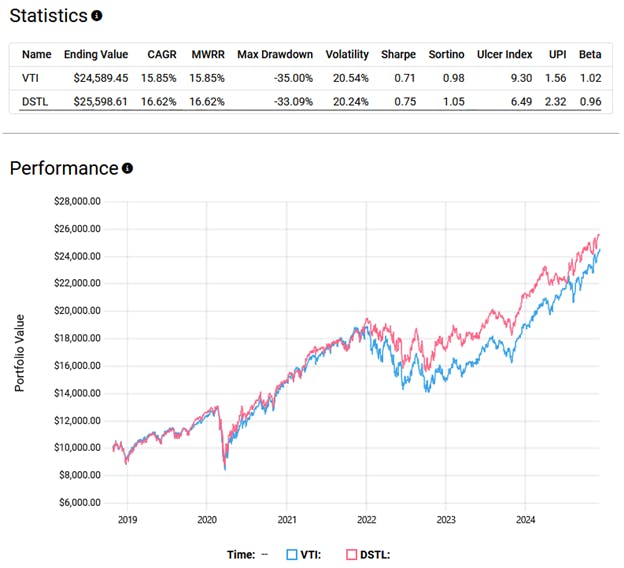
From October 24, 2018, to December 4, 2024, DSTL delivered an impressive 16.62% compound annual growth rate (CAGR), outperforming VTI at 15.85%. It also offered better risk-adjusted returns, with a Sharpe ratio of 0.75 compared to VTI’s 0.71.
Finally, there’s fundamental indexing, which designs and weights an index based on metrics other than market cap, such as earnings or dividends. For more information, check out Jeremy Siegel’s research, especially his book, “Stocks for the Long Run.”
My favorite in this space is the WisdomTree U.S. Quality Dividend Growth Fund
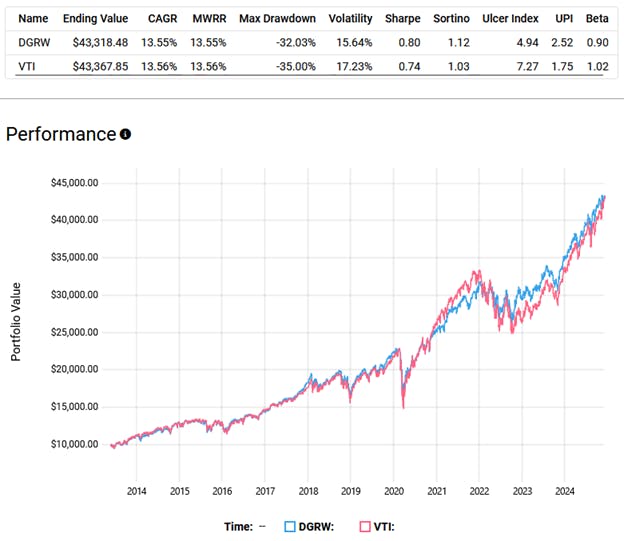
DGRW has matched VTI in total returns, with a CAGR of 13.55% vs. 13.66% from May 22, 2013, to December 4, 2024. However, it boasts better risk-adjusted returns, with a Sharpe ratio of 0.80 versus VTI’s 0.74.
Please note this article is for information purposes only and does not in any way constitute investment advice. It is essential that you seek advice from a registered financial professional prior to making any investment decision.
Latest ETF News
See all ETF newsBeyond Big Tech: The Increasing Specialization of AI ETFs

There's an ETF for That? Humanoid Robotics and Physical AI

How Some ETF Issuers Use Their Own Funds for Cash Management

These Public-Private ETFs Invest in Polymarket and Anduril

There's an ETF for That? Frontier Markets



 Advantages of ETFs over Mutual Funds1/6
Lower Costs
In this guide, we'll explore the advantages of ETFs over mutual funds, giving you valuable insights into why ETFs have gained significant popularity among investors like yourself.
Leveraged ETFs: Unlocking the Potential for Amplified Returns1/6
Understanding Leveraged ETFs
Explore leveraged ETFs: potential for amplified returns & risks. 5 ETFs to consider across equities, commodities & fixed income.
What is a Leveraged ETF?1/6
Introducing Leveraged and Inverse ETFs
In this guide, we'll dive into the world of leveraged ETFs, exploring their definition, mechanics, potential risks, and rewards.
Recent educational content

First Look ETF
First Look ETF: Income, International, and Cash Flow ETFs
In this season 6 episode of First Look ETF, Stephanie Stanton @etfguide examines the latest ETF marketplace trends with NYSE and guests.


ETF Trends
ETF Industry KPIs October 5, 2026
This week’s KPI data overview highlights key metrics and trends shaping the ETF landscape.

ETF Trends
ETF Industry KPIs September 28, 2026
This week’s KPI data overview highlights key metrics and trends shaping the ETF landscape.
ETF Trends
ETF Industry KPIs September 22, 2026
This week’s KPI data overview highlights key metrics and trends shaping the ETF landscape.