Global ETF Survey Is Live! 600+ ETF Professionals Weigh In. See Results →



Political Risk Isn’t Going Away: Build Resilient Portfolios with Calamos ETFs
Political risk is reshaping markets. Discover how Calamos’ Structured Protection ETFs offer downside defense and steady growth in today’s volatile world.

Keep up with what matters in ETFs
Get timely ETF insights, market trends, and top ideas straight to your inbox.
Your newsletter subscriptions with us are subject to ETF Central's Privacy Policy and Terms and Conditions.
There’s no official taxonomy for investment risk, but one useful way to think about it is by dividing it into compensated and uncompensated categories.
Compensated risks are the ones investors are paid to take. They’ve been studied and validated over decades of research and market data.
Think of credit risk, where high-yield bonds pay more than Treasurys to offset default probability. The same goes for size and value premiums—small-cap and cheaper “value” stocks have historically offered higher long-term returns to compensate for their volatility or cyclicality. These factors may fall in and out of favor, but they’re rooted in sound economic logic.
Uncompensated risks, on the other hand, don’t reward you for bearing them. You can’t expect a higher return simply for exposing your portfolio to them. They’re often systemic, meaning they can’t be diversified away entirely, but they can be mitigated or transferred.
Mitigation might mean increasing cash buffers, while transferring involves using tools like hedging to shift part of that risk to someone else. Neither is free (both tend to cap upside), but when the math of drawdowns tells you that avoiding a 10% loss is more powerful than earning a 10% gain, seasoned investors may find the trade-off worthwhile.
Of all the uncompensated risks that come and go, few loom as large as political risk. From tariff disputes and trade realignments to shifting fiscal priorities, it’s once again on the radar of institutional allocators, financial advisors and retail investors alike.
In the sections that follow, we’ll recap some of the most relevant examples and look at how Calamos Investments’ risk-first ETFs are designed to manage through them.
Global ETF Survey 2026 is Live!
With 1,790 new products launched by July 2026, choosing is harder than ever. Our Global ETF Survey 2026, built on 620 professional investors and allocators, shows how active, fixed income, options-based and thematic ETFs are reshaping fund selection.
The new face of political risk at home
When people hear “political risk,” they often picture an unstable emerging market — a government coup, a sudden nationalization of industry, or outright war disrupting trade routes and energy supply chains. But the truth is, political risk isn’t confined to unstable frontiers. It’s just as present, albeit in quieter and more insidious ways, within advanced economies.
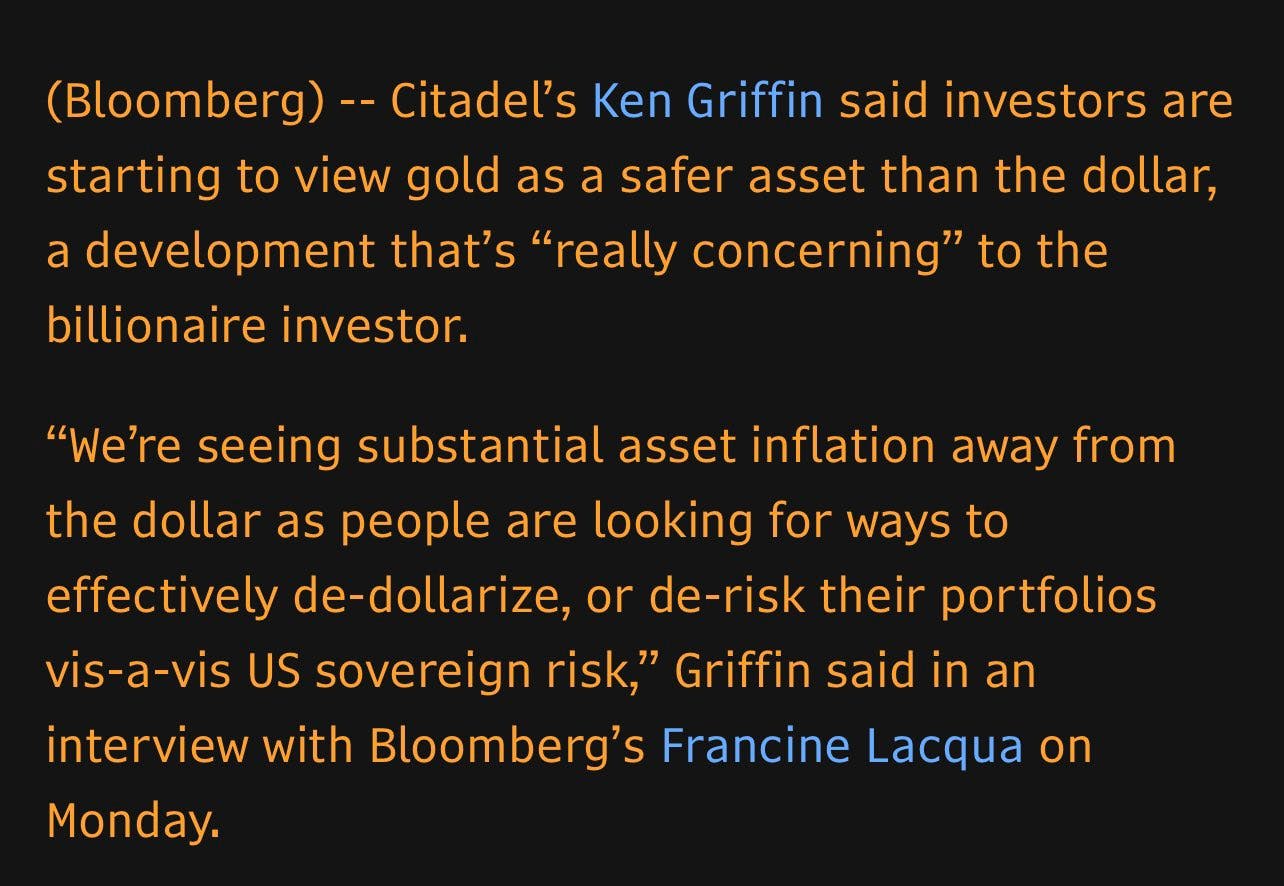
The U.S., for example, is increasingly showing symptoms of policy-driven instability — the kind that slowly erodes investor confidence rather than detonating it overnight. That’s what Citadel founder Ken Griffin was warning about when he told Bloomberg that investors are starting to view gold as a safer asset than the U.S. dollar. He called it “really concerning,” and he’s right.
Source: Bloomberg
For decades, the dollar has served as the world’s anchor — the benchmark against which every other asset is measured. The moment markets begin questioning that foundation, it signals not just inflationary pressure but a deeper crisis of trust in U.S. fiscal management and political stability.
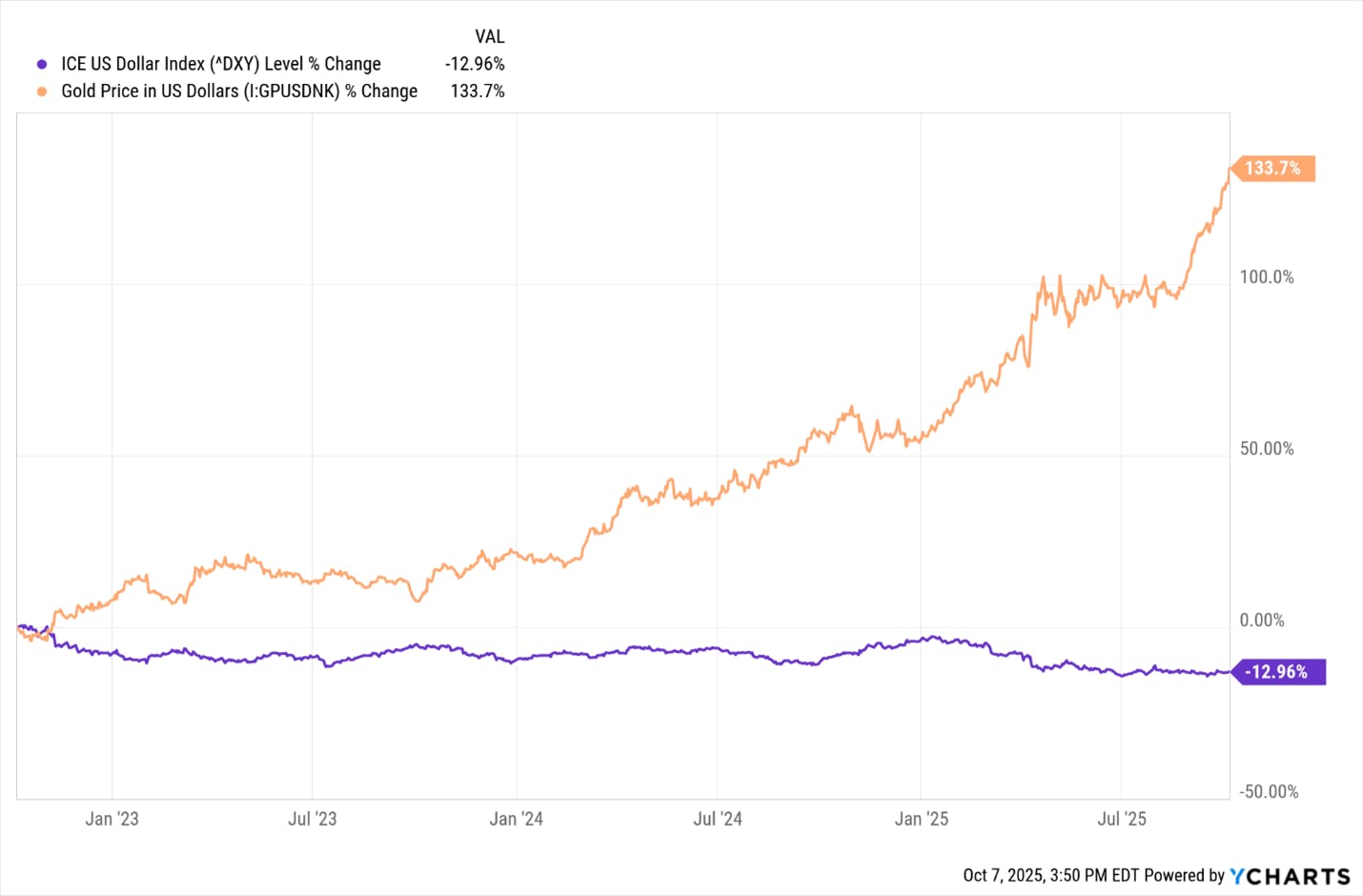
The next chart shows why that concern may be warranted. Since early 2023, the ICE U.S. Dollar Index (DXY) has fallen nearly 13%, while gold has surged over 130%. That’s a vote of no confidence. Investors aren’t merely hedging inflation anymore; they’re hedging the entire U.S. system of debt-backed currency.
Source: YCharts
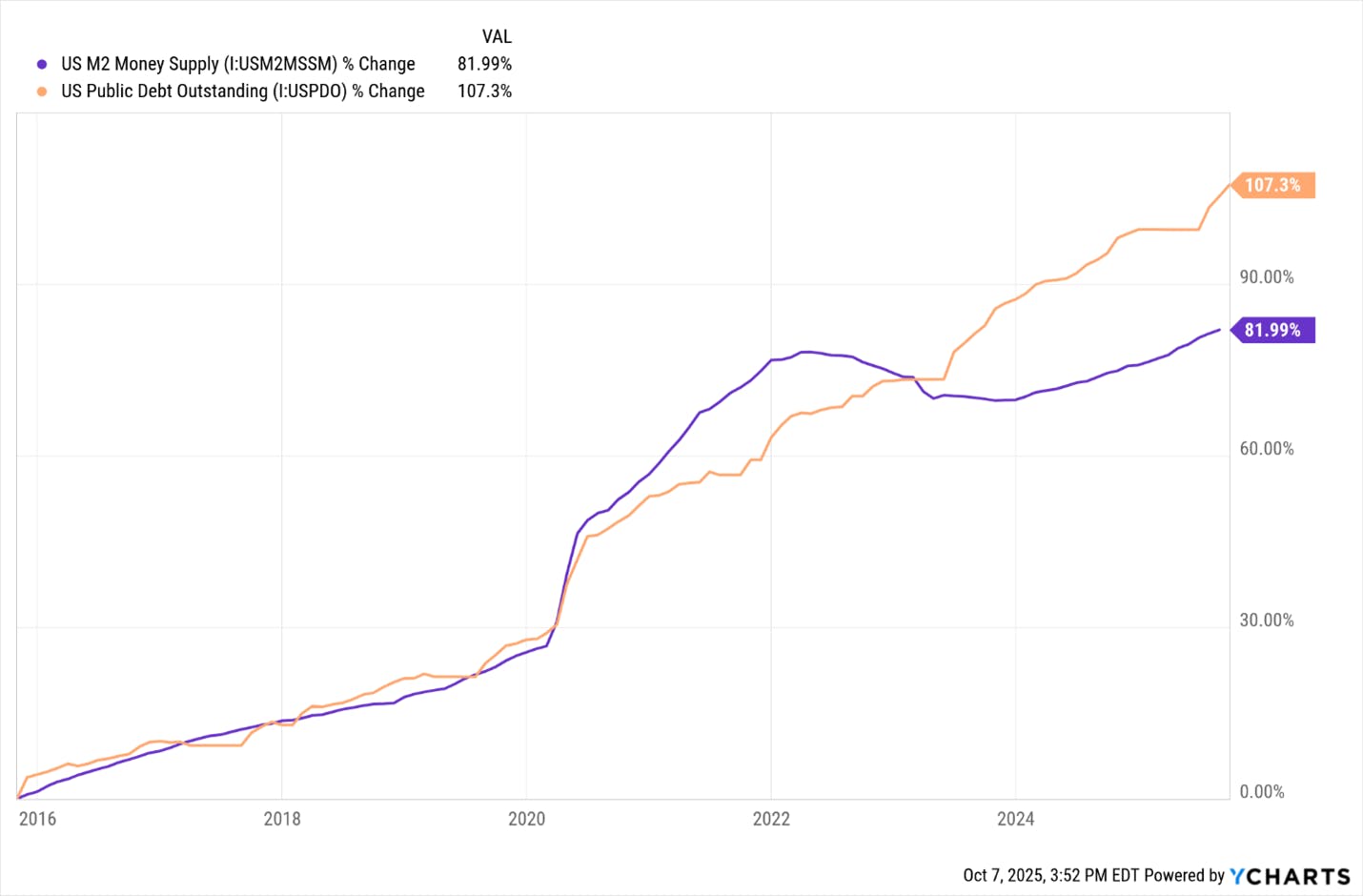
The following data on the current M2 money supply and public debt outstanding drives that point home. Over the past decade, the U.S. money supply has expanded nearly 82%, while public debt has climbed more than 107%.
Source: YCharts
This quiet, persistent debasement — the slow erosion of purchasing power — is one of the most pervasive, underappreciated political risks facing long-term investors. It doesn’t show up in volatility charts, but it eats away at real returns all the same.
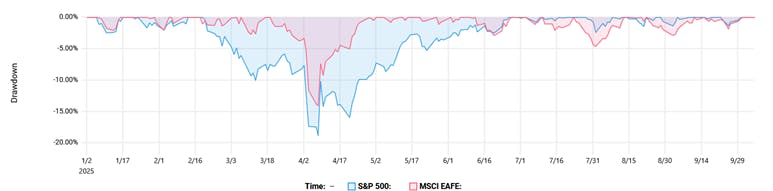
The last chart shows how quickly policy shocks can ripple through markets. During the “Liberation Day” tariff spree earlier this year, the S&P 500 saw drawdowns exceeding 15% within weeks. This was the U.S. government, once considered the bedrock of free-market capitalism, abruptly weaponizing trade policy.
Source: Testfolio.io
Although markets have since recovered, the episode exposed how fragile investor sentiment has become in the face of political intervention. And with more election-driven volatility ahead, it’s a reminder that political risk is no longer a foreign problem. It’s domestic and now structural.
Rating agencies have taken notice. Both Moody’s and Fitch explicitly cited these recurring political deadlocks in their decisions to downgrade U.S. sovereign credit from AAA to AA. That may sound like a minor technical adjustment, but symbolically it’s a formal acknowledgment that even the world’s largest economy is no longer being managed with the discipline or unity once assumed.
For investors, it’s a reminder that political dysfunction is not just background noise; it’s now a quantifiable source of risk affecting everything from Treasury yields to global asset allocation.
How Calamos ETFs can help
Calamos Investments has a lineup of Structured Protection ETFs, which use defined outcome periods—typically one year—to limit or even eliminate downside risk while still allowing participation in market upside up to a predetermined cap.
Each ETF provides exposure to major benchmarks like the S&P 500, Nasdaq-100, Russell 2000, and even Bitcoin, with monthly vintages. Because protection levels and upside caps are set at inception via an options-based collar, investors know exactly what their potential range of outcomes will be for that term, something traditional balanced portfolios can’t offer.
For investors who prefer a more hands-off approach, Calamos also offers a laddered solution: the Calamos S&P 500 Structured Alt Protection ETF
The result is consistent exposure to the S&P 500’s upside potential with built-in downside protection, a modern replacement for the 60/40 framework that recognizes today’s political, inflationary, and rate-driven realities. However, this structured protection framework is not limited to traditional equity benchmarks.
Calamos has also applied the same methodology to digital assets through the Calamos Laddered Bitcoin Structured Alt Protection ETF
CBOL holds an equal-weight allocation to Calamos Bitcoin Structured Alt Protection ETFs corresponding to quarterly vintages—January, April, July, and October.
By laddering these vintages, the ETF removes the need to time entry points and provides ongoing, evergreen exposure to bitcoin-linked outcomes with predefined risk parameters. The overlay itself follows a three-layer construction.
- A protection layer uses zero-coupon bonds that are designed to return par at maturity, establishing a defined floor for potential losses.
- An upside participation layer employs long call options to capture bitcoin price appreciation. At-the-money put options are used to establish 100% protection, while in-the-money put options can be used to create 80% or 90% protection profiles.
- Finally, a cap layer sells out-of-the-money call options to help finance the protection, which limits maximum upside over the outcome period.
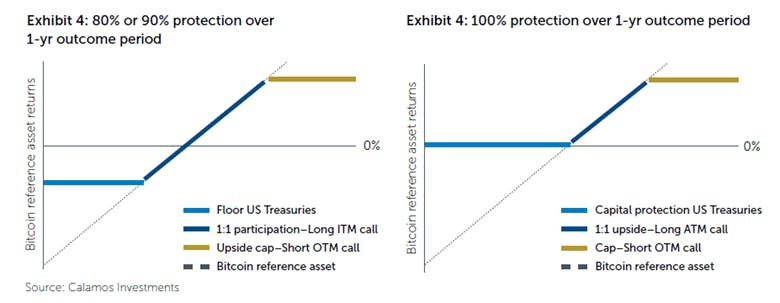
This structure allows investors to size bitcoin exposure deliberately rather than treating it as an all-or-nothing allocation. As a result, CBOL can be more easily integrated alongside equities, fixed income, and even gold within a diversified portfolio.
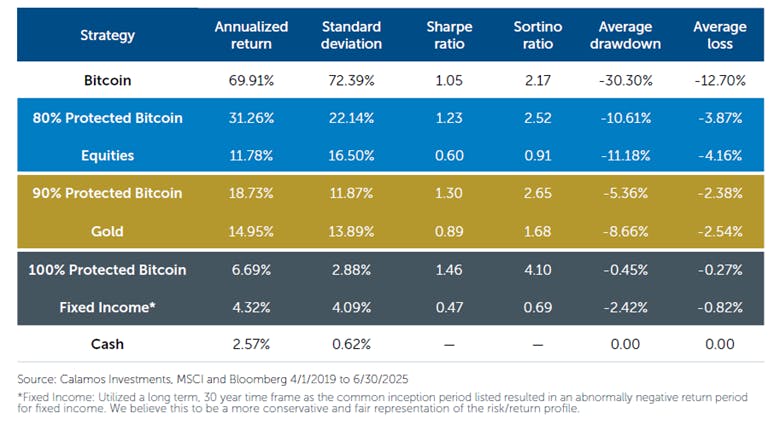
Instead of relying on correlations or behavioral discipline during drawdowns, the risk profile is defined upfront, making it clearer how bitcoin exposure fits within a broader asset allocation framework.
Please note that this article reflects the author’s personal views and does not represent the opinions of the publication or its affiliates. It is for informational purposes only and does not constitute investment advice. It is essential to seek guidance from a registered financial professional before making any investment decisions.
Latest ETF News
See all ETF newsBeyond Big Tech: The Increasing Specialization of AI ETFs

There's an ETF for That? Humanoid Robotics and Physical AI

How Some ETF Issuers Use Their Own Funds for Cash Management

These Public-Private ETFs Invest in Polymarket and Anduril

There's an ETF for That? Frontier Markets


 Advantages of ETFs over Mutual Funds1/6
Lower Costs
In this guide, we'll explore the advantages of ETFs over mutual funds, giving you valuable insights into why ETFs have gained significant popularity among investors like yourself.
Leveraged ETFs: Unlocking the Potential for Amplified Returns1/6
Understanding Leveraged ETFs
Explore leveraged ETFs: potential for amplified returns & risks. 5 ETFs to consider across equities, commodities & fixed income.
What is a Leveraged ETF?1/6
Introducing Leveraged and Inverse ETFs
In this guide, we'll dive into the world of leveraged ETFs, exploring their definition, mechanics, potential risks, and rewards.
Recent educational content
First Look ETF
First Look ETF: Income, International, and Cash Flow ETFs
In this season 6 episode of First Look ETF, Stephanie Stanton @etfguide examines the latest ETF marketplace trends with NYSE and guests.


ETF Trends
ETF Industry KPIs October 5, 2026
This week’s KPI data overview highlights key metrics and trends shaping the ETF landscape.

ETF Trends
ETF Industry KPIs September 28, 2026
This week’s KPI data overview highlights key metrics and trends shaping the ETF landscape.
ETF Trends
ETF Industry KPIs September 22, 2026
This week’s KPI data overview highlights key metrics and trends shaping the ETF landscape.