Open Now: The Global ETF Survey Take the Survey →



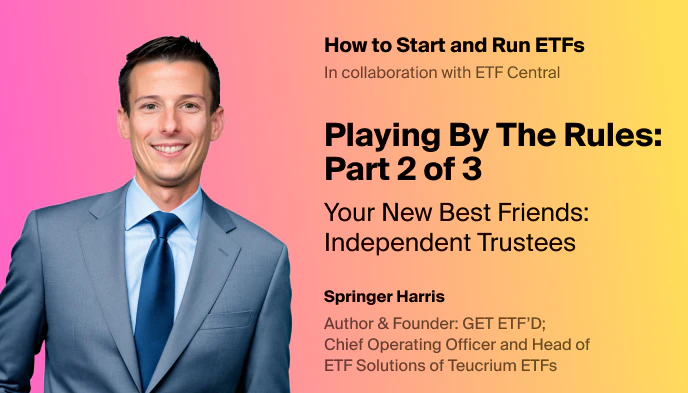
Playing By The Rules: Part 2 of 3 - Your New Best Friends: Independent Trustees
Think you control your ETF? Meet the real decision-makers: Independent Trustees.

Keep up with what matters in ETFs
Get timely ETF insights, market trends, and top ideas straight to your inbox.
Your newsletter subscriptions with us are subject to ETF Central's Privacy Policy and Terms and Conditions.
Welcome back to our three-part series on launching an Exchange-Traded Fund. In Part 1, we explored the key regulatory bodies and requirements you need to understand before launching an ETF.
Today, we're focusing on some individuals who will have more control over your ETF than anyone else—Independent Trustees. Stay tuned for Part 3, where we'll discuss ongoing compliance and operational excellence.
The SEC controls a lot about your ETF, but they're not big enough to cover absolutely every aspect. That's why, under the statutes governing registered investment companies, which include ETFs, it's required that every fund be a series of a trust. Among many other requirements, this trust must be governed by a board of trustees, the majority of whom are independent. This means they have absolutely no ties to the sponsor, advisor, or service providers to the ETF. Their sole job is to ensure that all decisions regarding the fund are made in the best interest of the shareholders and to be the first line of oversight over the advisors, sub-advisors, and any service providers to the fund.
Here's the hard truth: the independent trustees of the trust from which you launch your fund—regardless of whether it's your own proprietary trust, a multi-series trust, or a white-label trust—are in control of your fund, not you. You can't make many impactful decisions without the approval of the board. You'll need to present to them on a quarterly basis, and annually you'll need to reapply for your job as advisor.
Like what you're reading?
Stay in the loop — get the latest ETF insights: trends, analysis, and expert picks.
The Board of Trustees: Internal Oversight
One of the SEC's requirements is that ETFs have a Board of Trustees, also known as a board of directors, to oversee their operations and protect investors' interests. The board acts as an internal regulator, scrutinizing compliance programs, operational efficiency, and addressing any concerns that arise.
Key Responsibilities of the Board
- Independence: A majority of the board members must be independent, meaning they are not affiliated with the ETF's advisor or underwriter. This ensures impartial decision-making.
- Fiduciary Duty: Board members have a legal obligation to act in the best interests of the ETF and its shareholders, prioritizing the fund's success over personal interests.
- Oversight of Fund Management: The board reviews and approves the investment management agreement and ensures that the advisor adheres to the investment objectives and policies.
- Approval of Service Providers: Contracts with custodians, administrators, transfer agents, and distributors must be reviewed and approved by the board to ensure they serve the best interests of shareholders.
- Performance and Risk Monitoring: Regular reviews of the ETF's performance and risk management processes help the board oversee various investment, operational, and compliance risks.
- Compliance Oversight: The board is responsible for ensuring that the ETF complies with applicable securities laws and regulations. This includes reviewing and approving compliance policies and appointing a chief compliance officer.
Engaging with the Board
As an ETF executive, it's important to be comfortable presenting to the board because you're going to be doing it a lot—every quarter, in fact. Some quarters are easier than others. During the normal course of business, it's just about how the quarter went, whether there were any errors, how well you managed the fund against your stated index, and other performance reports. They will scrutinize your compliance programs and operational efficiency. You need to be able to speak to all parts of your business and ensure that you can communicate in a way that earns their confidence.
Annually, you'll need to go through the entire recertification process—which can feel like a mini-audit. But over time, you'll become more comfortable with the trustees overseeing your funds. Many people don't like this aspect of running an ETF. I happen to enjoy it. Here are some tips:
- Be Prepared: Familiarize yourself thoroughly with your ETF's prospectus and other key documents to answer any questions confidently.
- Communicate Clearly: Present information in a straightforward manner, avoiding jargon that might confuse board members.
- Consider Professional Assistance: Hiring a consultant or advisor experienced in board interactions can help you navigate presentations effectively.
The ETF Registration Process and Timeline
A huge job of the board is the certification of the initial advisory contract—that's where they let you launch your ETF and charge a management fee for doing so. This is where the SEC and the board start to overlap. You have to first draft your registration statement and get it on file with the SEC for review. This process generally takes 75 days once filed and will likely include 1-2 rounds of edits to satisfy the SEC. However, it's important to note that the SEC is not approving your ETF; they're simply asserting that you have followed all the rules for disclosure and that the documents are in good order to satisfy the disclosure to investors so they can understand the fund and the associated risks.
This registration statement, known as the prospectus, then informs the rest of the process. As you hire your service providers, you'll eventually reach the organizational board meeting where the board is actually in charge. They determine if each service provider is qualified, if their rates are in line, if you have everything in place that you need to be the advisor or sub-advisor, what you are allowed to charge, and ultimately how likely you are to run a successful fund. If you can satisfy all of their questions (and there are A LOT), then they approve your advisory contract and let you launch your fund.
This process can be incredibly arduous the first time, often overwhelming first-time entrants. That's why an ETF can be launched in 80-90 days by an experienced team—I have even launched them in an accelerated 60-day timeframe. It can often take 4-6 months or longer for a new entrant. I take the longer view below.
Steps and Timeline
Let's look at the steps and a timeline that can vary depending on the complexity of your fund:
- Engage Legal Counsel (Months 0-1): Start by hiring legal experts experienced in ETF registration to guide you through the process.
- Draft Key Documents (Months 1-2): Collaborate with your legal team to prepare the prospectus, Statement of Additional Information (SAI), and other required documents.
- File Initial Registration Statement (Months 2-3): Submit Form N-1A to the SEC, which includes the prospectus and SAI, initiating the regulatory review process.
- SEC Review and Response (Months 3-4): Address any comments or questions from the SEC promptly, making necessary amendments to your documents.
- Obtain Necessary Approvals (Months 4-5): Secure listing approval from an exchange such as NYSE or Nasdaq.
- Finalize Agreements with Service Providers (Months 5-6): Formalize relationships with custodians, fund administrators, auditors, and other service providers.
- Obtain SEC Effectiveness and Launch ETF (Month 6): Once the SEC declares your registration effective, you can launch your ETF and begin trading.
Essential Legal Documents
Preparing the necessary legal documents is a critical step in launching your ETF. Here's what you'll need:
- Prospectus: This document provides essential information about your ETF, including investment objectives, strategies, risks, fees, and performance. It's designed to give investors a clear understanding of what your ETF offers.
- Summary Prospectus: A condensed version of the prospectus, it highlights key information in a more accessible format.
- Statement of Additional Information (SAI): The SAI offers more in-depth information, such as detailed investment policies, portfolio holdings, management biographies, and tax information.
- Form N-1A: This SEC form combines the prospectus and SAI and must be filed to register your ETF.
- Fund Factsheet: While not a regulatory requirement, a factsheet is a valuable marketing tool that provides a snapshot of your ETF's performance, composition, and key metrics.
Considerations for Commodity ETFs
If you're planning to launch a commodity ETF, there are unique regulatory considerations:
- Registration Under the '33 Act or '40 Act: Commodity ETFs have historically registered under the Securities Act of 1933 because physical commodities and commodity futures aren't considered securities. With the ETF Rule, some commodity ETFs can now register under the Investment Company Act of 1940, provided they meet certain conditions.
This concludes Part 2 of our series on your new relationship with your trustees and building governance and legal foundations for your ETF. In the final installment, we'll explore ongoing compliance obligations, the importance of your website, and the role of technology in operational excellence. Stay tuned for Part 3.
Missed any part of this series? Catch up here.
About the Author
Springer Harris, author of "GET ETF'D: An Insider's Guide to Starting and Running an ETF," focuses on simplifying the complexities of launching and managing ETFs to empower entrepreneurs. He discusses the detailed processes and challenges of successfully introducing ETFs to the market in his writings. As Chief Operating Officer and Head of ETF Solutions at Teucrium ETFs, Springer has helped a broad spectrum of clients, from individuals to large asset managers, launch their ETFs efficiently. Connect with Springer on LinkedIn for more insights or help starting your ETF.
This concludes Part 1 of our series on navigating ETF regulatory requirements. In the next article, we'll delve into the roles and responsibilities of the Board of Trustees and explore the essential legal documents needed for ETF registration.
Please note this article is for information purposes only and does not in any way constitute investment advice. It is essential that you seek advice from a registered financial professional prior to making any investment decision.

Latest ETF News
See all ETF newsETF Creation Windows Matter More Than You Think


Why the Time of Day Matters When Trading an ETF

The Leveraged ETF Question Nobody Is Asking





 Advantages of ETFs over Mutual Funds1/6
Lower Costs
In this guide, we'll explore the advantages of ETFs over mutual funds, giving you valuable insights into why ETFs have gained significant popularity among investors like yourself.
Leveraged ETFs: Unlocking the Potential for Amplified Returns1/6
Understanding Leveraged ETFs
Explore leveraged ETFs: potential for amplified returns & risks. 5 ETFs to consider across equities, commodities & fixed income.
What is a Leveraged ETF?1/6
Introducing Leveraged and Inverse ETFs
In this guide, we'll dive into the world of leveraged ETFs, exploring their definition, mechanics, potential risks, and rewards.
Recent educational content
First Look ETF
First Look ETF: Cycle Aware Investing & Next-Gen Nicotine Shifts
In this season 6 episode of First Look ETF, Stephanie Stanton examines the latest ETF marketplace trends with NYSE and guests.


ETF Trends
ETF Industry KPIs August 10, 2026
This week’s KPI data overview highlights key metrics and trends shaping the ETF landscape.

ETF Trends
ETF Industry KPIs July 20, 2026
This week’s KPI data overview highlights key metrics and trends shaping the ETF landscape.
ETF Trends
ETF Industry KPIs July 13, 2026
This week’s KPI data overview highlights key metrics and trends shaping the ETF landscape.
Browse all educational columns



The ETF Industry Is Evolving Fast
From AI infrastructure to active strategies, the ETF landscape is shifting. Share your perspective in the 7th Annual Global ETF Survey and get exclusive early access to the final report.