Global ETF Survey Is Live! 600+ ETF Professionals Weigh In. See Results →



How to Pick the Right ETF for Your Self-Directed Retirement Account
Using a target-date ETF can greatly simplify your retirement portfolio. Here's how.


Keep up with what matters in ETFs
Get timely ETF insights, market trends, and top ideas straight to your inbox.
Your newsletter subscriptions with us are subject to ETF Central's Privacy Policy and Terms and Conditions.
Outside of a 401(k) plan, where your fund options are restricted to what your company admin has made available, you have the freedom to choose how your retirement portfolio is constructed when using a self-directed retirement account.
While some investors enjoy the granularity of selecting various ETFs to diversify their portfolios, others might prefer a simpler approach. While a robo-advisor is one option, sometimes the simplest solution is a target-date fund.
These funds offer a diversified portfolio of stocks and bonds, with varying allocations that deliver different levels of risk and return corresponding to various anticipated retirement dates. Historically available as mutual funds, these target-date solutions have been a staple in retirement planning.
However, you can now access target-date funds as ETFs. This offers the additional benefits of tax efficiency, trading flexibility, and lower fees typical of ETFs. Here's a look at how they work and how to pick the right one for your retirement planning needs.
Global ETF Survey 2026 is Live!
With 1,790 new products launched by July 2026, choosing is harder than ever. Our Global ETF Survey 2026, built on 620 professional investors and allocators, shows how active, fixed income, options-based and thematic ETFs are reshaping fund selection.
What is a target-date ETF?
A cornerstone of retirement planning is the "glidepath," which is essentially a function of risk and return versus your time horizon. Essentially, the glidepath suggests that the closer you are to retirement, the less volatility you should have in your investment portfolio.
Why is this important? Primarily because of the sequence of returns risk, which highlights the danger of encountering a market downturn close to when you plan to start withdrawing your retirement funds.
Such timing could significantly reduce the amount of capital available to support you through retirement, potentially jeopardizing your financial security.
This principle explains why younger investors typically assume a higher risk by allocating more of their portfolio to equities. They have the advantage of time, allowing them to weather poor market conditions and recover losses over the years. In contrast, those nearing retirement cannot afford this risk as they lack the time needed to recuperate from significant downturns.
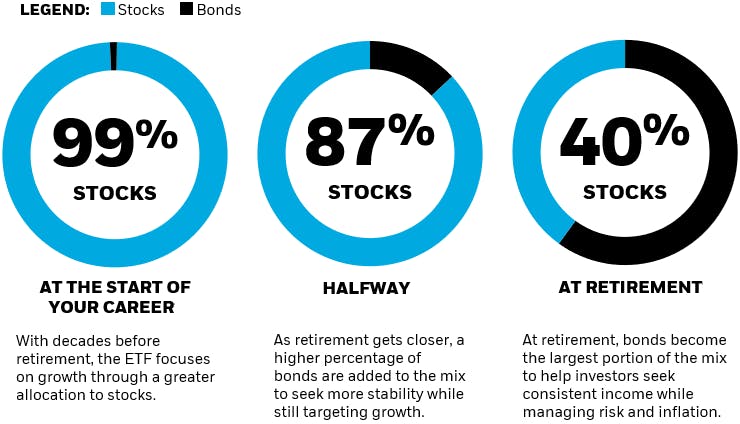
Target-date ETFs are designed based on these principles. Their asset allocation—the division between stocks and bonds—adjusts over time. As the target date approaches, typically the date of retirement, these funds shift from focusing on growth to prioritizing capital preservation and income.
This shift ensures that as investors near retirement, their investments become increasingly conservative, reducing exposure to potential market dips and focusing on stability and income generation.
Here's a handy chart from iShares that illustrates this glidepath adjustment over time in their target-date ETFs:
How to pick the right target-date ETF
The key to picking the right target-date ETF is quite straightforward and, as the name suggests, centers around the year you plan to retire. Simply identify the year you expect to retire and choose an ETF with a target date closest to that year.
For example, let's assume you're a 22-year-old who just graduated in 2024 and you've opened a Roth IRA. If you plan to retire at 65, that gives you a timeline of approximately 43 years until retirement, pointing to a target retirement year of 2067.
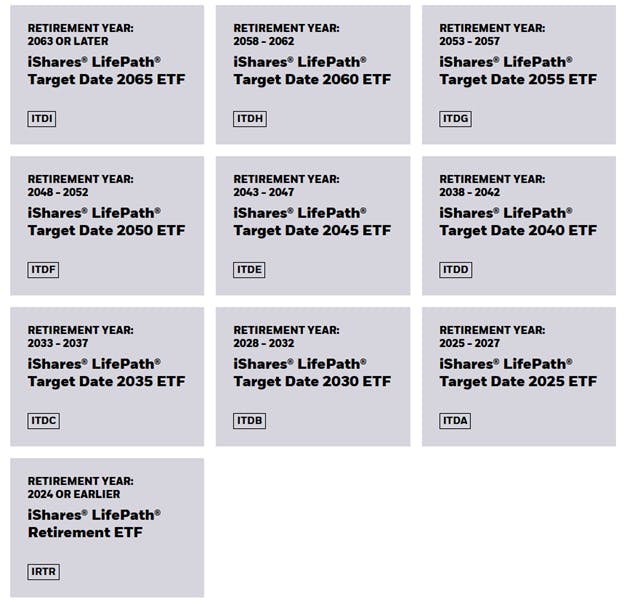
Since target-date ETFs are typically offered in five-year increments, you might not find one exactly for 2067. Instead, you would likely choose between a target-date ETF for 2065 or 2070, depending on whether you prefer to lean slightly more conservative (earlier date) or aggressive (later date).
The iShares LifePath series, for example, offers a range of target-date ETFs that cover a spectrum from those already in their retirement years to as far out as 2065.
What do these target date ETFs hold?
Let's take a closer look at the iShares LifePath Target Date 2045 ETF
Firstly, it's essential to recognize that ITDE operates as an "ETF of ETFs." This structure helps keep costs low and simplifies management. ITDE comprises 11 different iShares ETFs, collectively offering comprehensive exposure to global equities and fixed income markets.
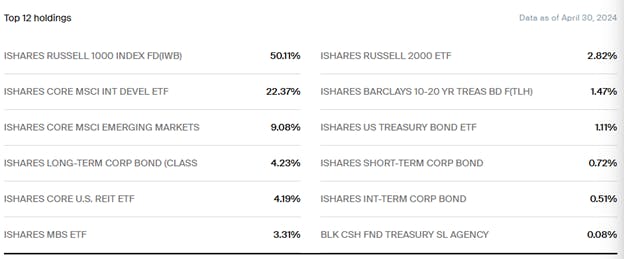
This broad coverage includes U.S. large and mid-cap stocks, international developed and emerging markets, U.S. REITs, mortgage-backed securities, U.S. small-cap stocks, and investment-grade corporate and various maturities of Treasury bonds.
Each of the underlying ETFs in ITDE is a low-cost, passively managed index fund with a solid track record and robust assets under management (AUM). Liquidity is also robust with a small bid-ask spread, as ITDE's liquidity hinges on its underlying assets, all of which are popular, heavily traded ETFs.
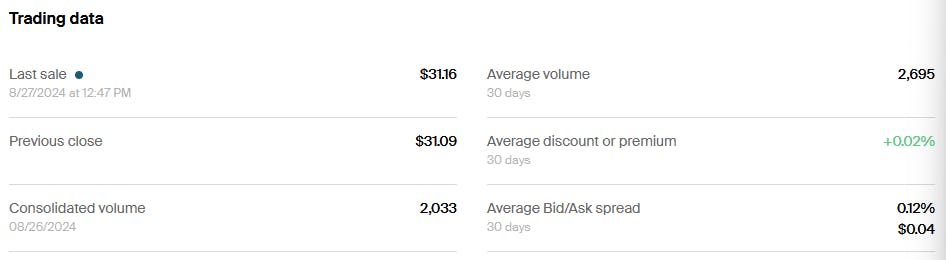
iShares manages ITDE's allocations, determining when rebalancing is necessary. As the target date nears, the fund's composition will shift to include more conservative investments, focusing increasingly on capital preservation and income.
This effective management comes at a cost of only a 0.11% expense ratio, which covers all fees of the underlying ETFs on a pro-rata basis. ITDE pays a 30-day SEC yield of 2.13% and makes annual distributions.
Please note this article is for information purposes only and does not in any way constitute investment advice. It is essential that you seek advice from a registered financial professional prior to making any investment decision.
Latest ETF News
See all ETF newsBeyond Big Tech: The Increasing Specialization of AI ETFs

There's an ETF for That? Humanoid Robotics and Physical AI

How Some ETF Issuers Use Their Own Funds for Cash Management

These Public-Private ETFs Invest in Polymarket and Anduril

There's an ETF for That? Frontier Markets



 Advantages of ETFs over Mutual Funds1/6
Lower Costs
In this guide, we'll explore the advantages of ETFs over mutual funds, giving you valuable insights into why ETFs have gained significant popularity among investors like yourself.
Leveraged ETFs: Unlocking the Potential for Amplified Returns1/6
Understanding Leveraged ETFs
Explore leveraged ETFs: potential for amplified returns & risks. 5 ETFs to consider across equities, commodities & fixed income.
What is a Leveraged ETF?1/6
Introducing Leveraged and Inverse ETFs
In this guide, we'll dive into the world of leveraged ETFs, exploring their definition, mechanics, potential risks, and rewards.
Recent educational content

First Look ETF
First Look ETF: Income, International, and Cash Flow ETFs
In this season 6 episode of First Look ETF, Stephanie Stanton @etfguide examines the latest ETF marketplace trends with NYSE and guests.


ETF Trends
ETF Industry KPIs October 5, 2026
This week’s KPI data overview highlights key metrics and trends shaping the ETF landscape.

ETF Trends
ETF Industry KPIs September 28, 2026
This week’s KPI data overview highlights key metrics and trends shaping the ETF landscape.
ETF Trends
ETF Industry KPIs September 22, 2026
This week’s KPI data overview highlights key metrics and trends shaping the ETF landscape.