Turn ETF ideas into real portfolios. Try the builder now →



Patent Activity: A Forward-Looking Way to Capture the AI Megatrend
By focusing on firms with meaningful AI-related patent activity, the Xtrackers Artificial Intelligence and Big Data ETF (XAIX) aims to capture the true drivers of the AI megatrend.


Keep up with what matters in ETFs
Get timely ETF insights, market trends, and top ideas straight to your inbox.
Your newsletter subscriptions with us are subject to ETF Central's Privacy Policy and Terms and Conditions.
One of the hardest parts of stock picking in the artificial intelligence (AI) equity space is the speed of innovation. Leadership can swing rapidly, and companies that look dominant one year can appear vulnerable the next.
Alphabet is a good example. When large language models first hit the mainstream in early 2024, the company faced heavy criticism for inaccurate historical depictions and unreliable outputs. At the time, the narrative suggested that Microsoft-backed OpenAI and ChatGPT had taken a commanding lead.
That view has shifted. Year to date, Alphabet has become one of the strongest performers in the S&P 500, returning 66.9% as of December 9. What changed was not a marketing cycle, but meaningful innovation that re-established Alphabet as a formidable competitor in the AI ecosystem.
Alphabet introduced its seventh-generation Tensor Processing Unit, a specialized AI accelerator chip designed to handle training and inference at significantly higher efficiency. It also released Gemini v3, an upgraded multimodal AI model that earned broad praise for its speed, accuracy, and general capabilities.
Episodes like this show how difficult it is for investors—and by extension ETF issuers—to accurately capture the AI megatrend. Cast the net too wide and a portfolio begins to resemble a Nasdaq 100 closet indexing clone. Cast it too narrowly and you risk missing comeback stories driven by genuine technological breakthroughs.
One way to address this challenge is to use a forward-looking index methodology that screens for AI-related patent activity. Patents offer a real-time window into where companies are allocating research capital and what innovations they are preparing to commercialize. Here is how that approach works in practice, and how one ETF from Xtrackers puts it into action.
Global ETF Survey 2026 is Live!
With 1,790 new products launched by July 2026, choosing is harder than ever. Our Global ETF Survey 2026, built on 620 professional investors and allocators, shows how active, fixed income, options-based and thematic ETFs are reshaping fund selection.
Forward versus backwards looking screens
Many thematic ETFs struggle with the same core limitation: they depend heavily on backward-looking financial data. Whether the strategy is active or passive, the usual process focuses on revenue disclosure, analyst forecasts, or management commentary to gauge whether a company is “AI-related.”
Active managers may lean on fundamental research, looking for evidence of AI-driven earnings potential, business-model relevance, or strategic focus. Passive ETFs use rules-based parameters that often capture similar traits but apply them more consistently and transparently.
The issue is that none of these approaches naturally solves the forward-looking problem: by the time financial results show up in the data, the innovation cycle has already moved on.
A more forward-facing screen requires a different lens, which is why patent activity matters. Patents reflect what companies are building before those efforts show up in revenue or market share. They offer early evidence of commercial intent and technical capability, which is especially relevant in AI where product cycles move faster than reporting periods.
The Nasdaq Global Artificial Intelligence and Big Data Index incorporates this idea to structure its universe. It begins by identifying companies that have filed patents tied to core AI technologies such as deep learning, natural language processing, image and speech recognition, cloud infrastructure, cybersecurity, and big-data systems.
This starting universe includes more than 1,700 companies globally. From there, the methodology filters to companies whose filings show direct and repeated engagement with AI and big-data innovation, reducing the list to roughly 700 with meaningful relevance. Additional criteria narrow the final index to fewer than 100 names.
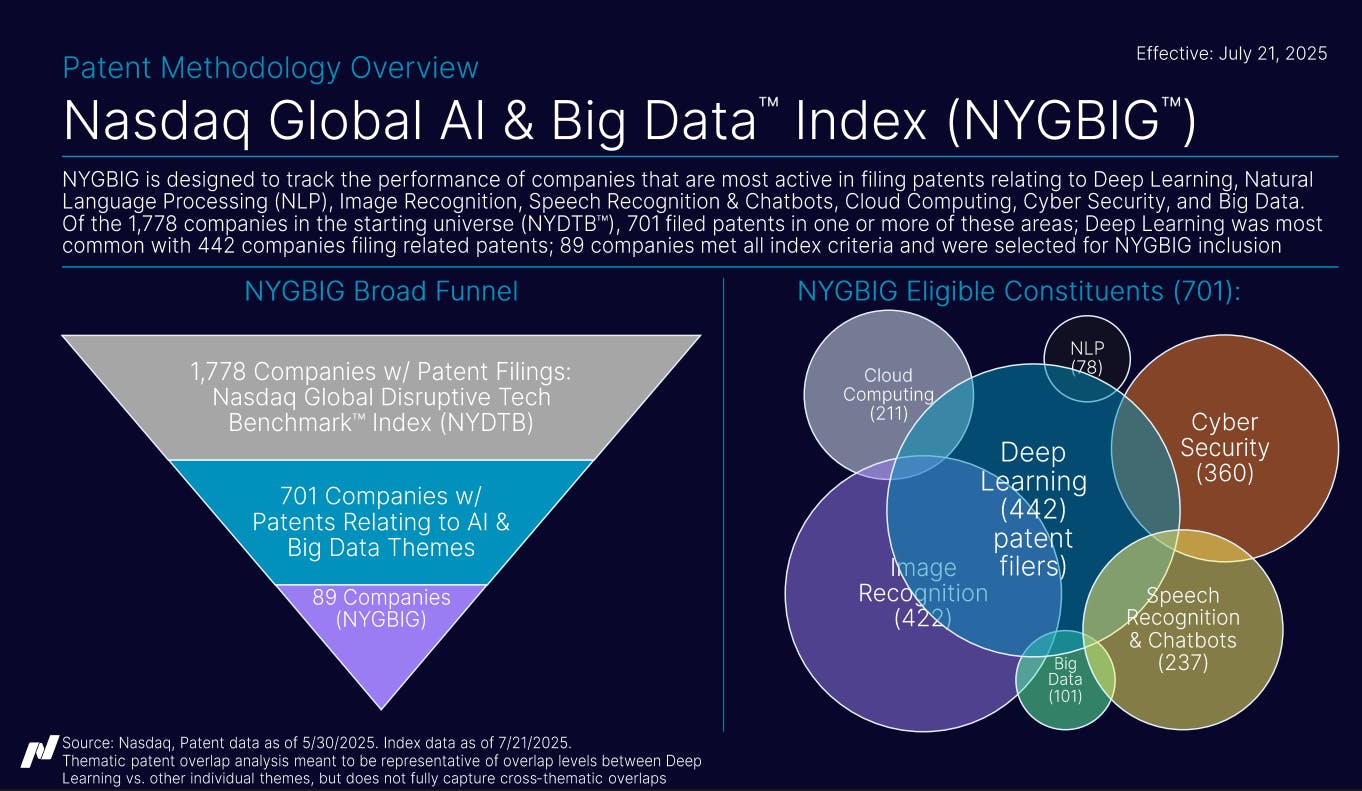
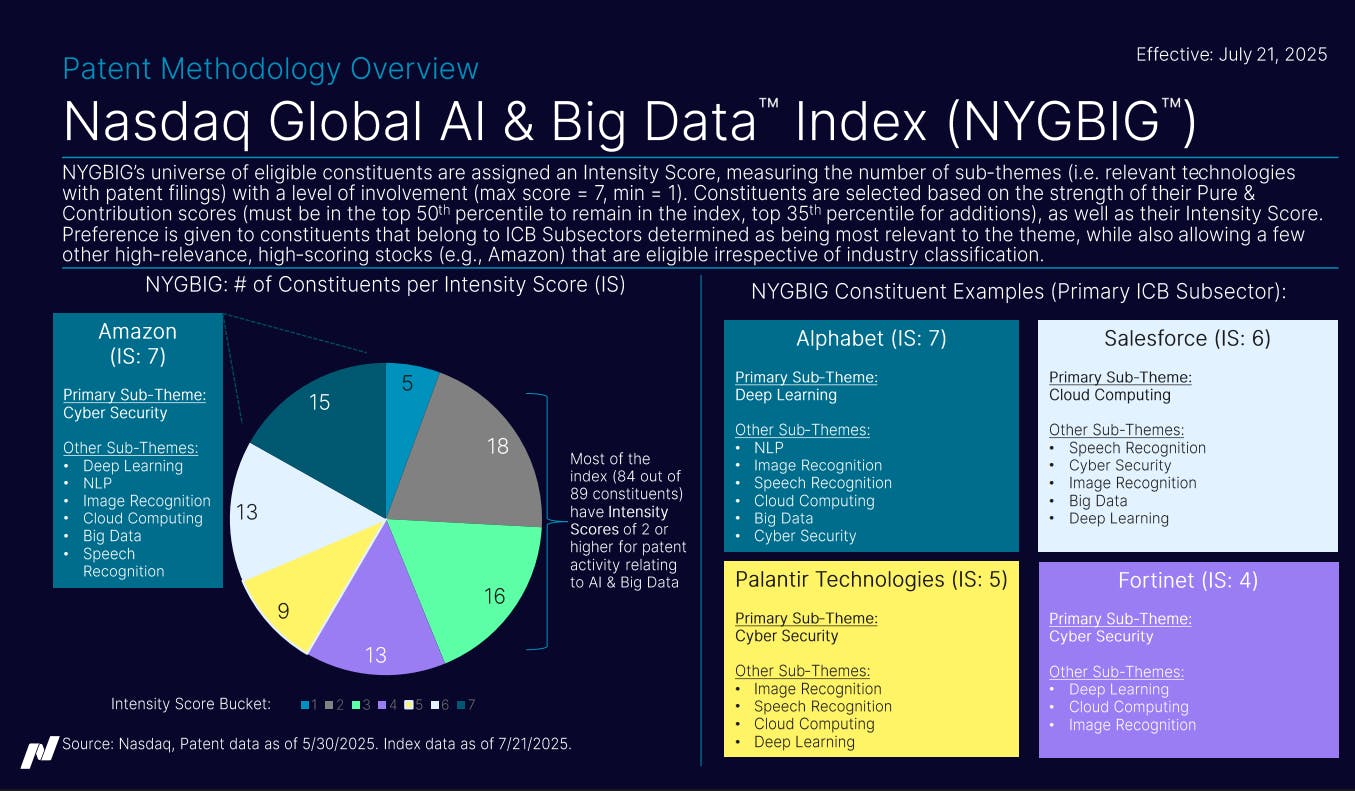
Central to this selection is an “intensity score,” which evaluates how many AI-related technological areas a company is actively patenting. Firms with broader, deeper patent engagement score higher, which helps differentiate true innovators (like Alphabet) from companies with incidental filings.
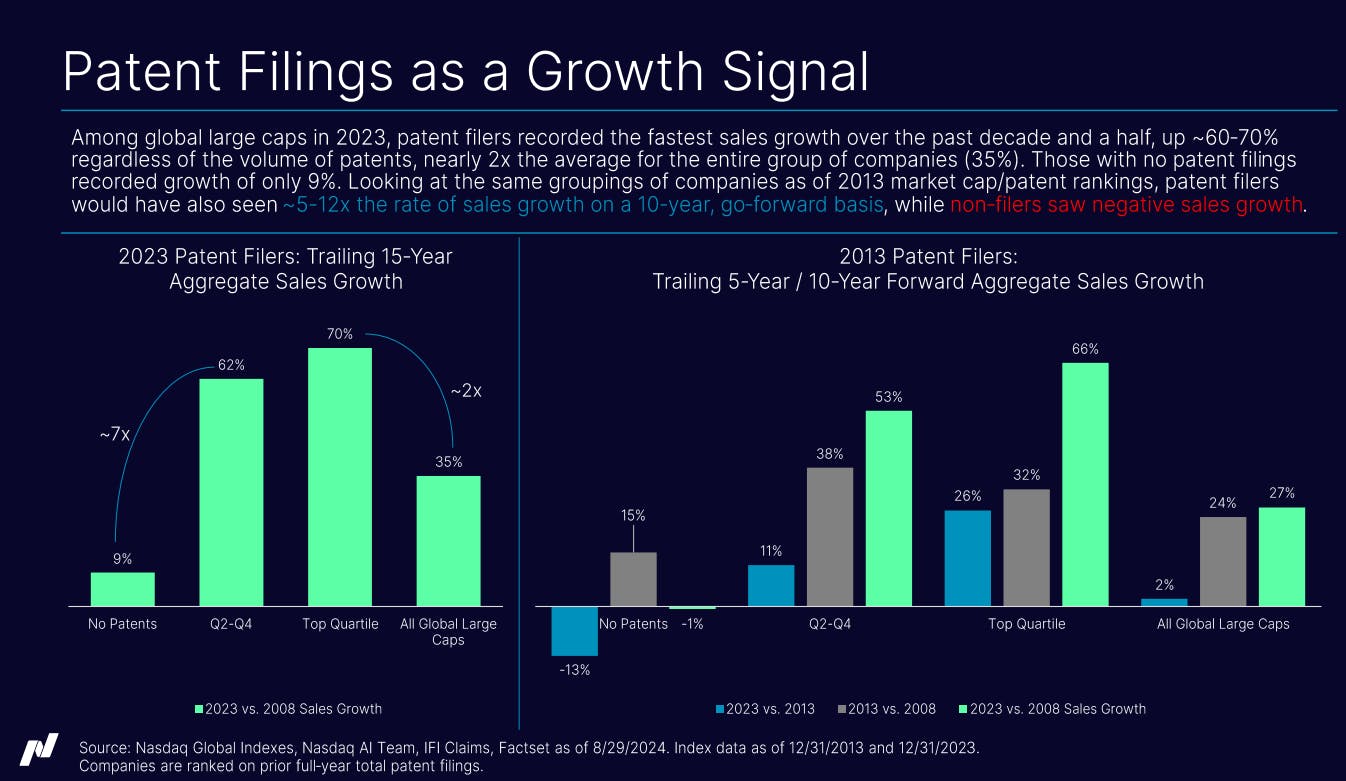
Patent data is useful not only as an indicator of innovation, but also as a signal of potential business performance. Historical analysis shows that companies active in patent filings have delivered materially stronger long-term sales growth than companies that did not file at all.
A similar pattern emerges when looking at R&D intensity: companies that consistently allocate capital to research tend to outperform both firms that underinvest and those that spend nothing. These patterns reflect a basic truth: firms that commit to innovation usually gain competitive advantages that compound over time.
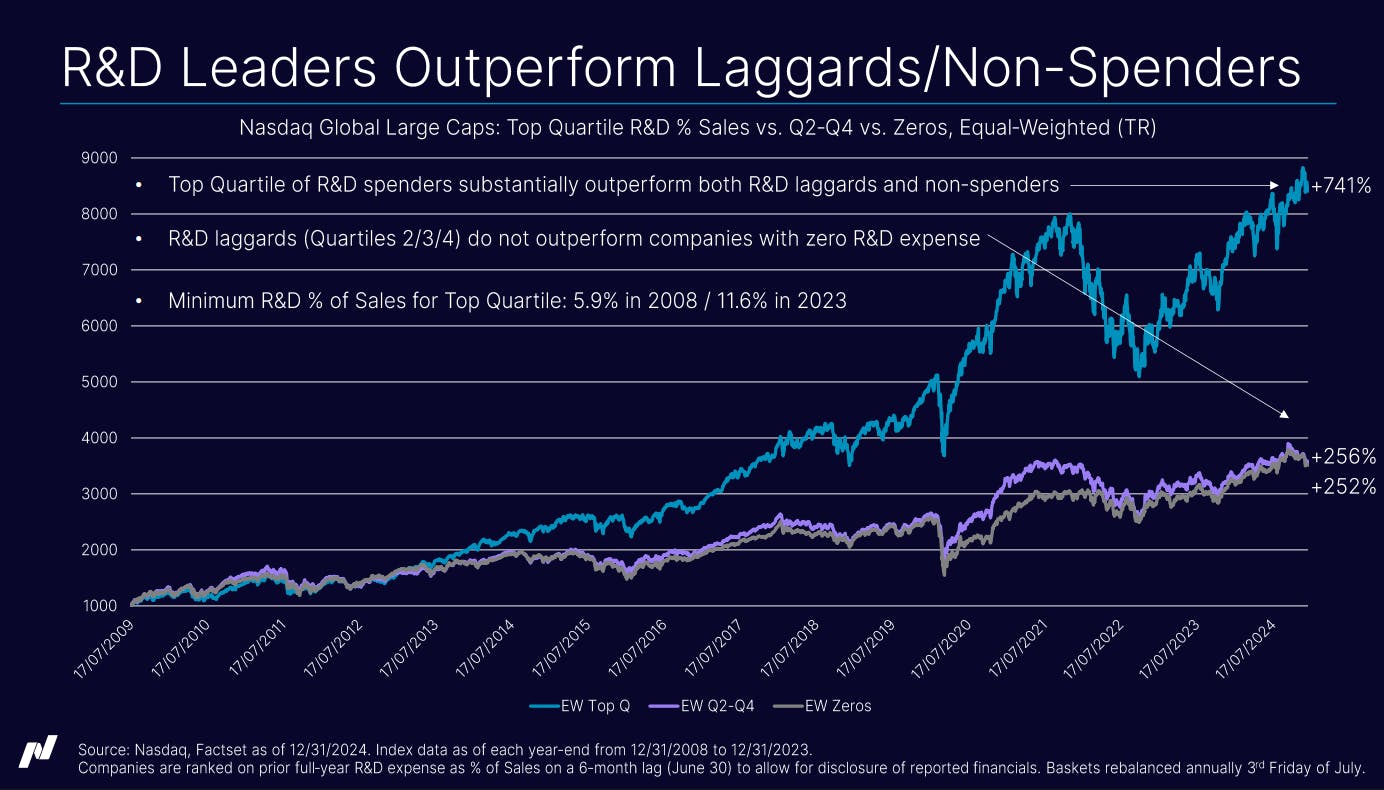
This combination of patent involvement, R&D focus, and multi-technology engagement makes patent-based screening a more dynamic approach to capturing the AI megatrend. Instead of relying solely on trailing fundamentals or broad thematic labels, it targets companies investing in the technologies that will shape the next generation of AI applications.
Finally, because the methodology narrows from a wide list of potential candidates to a concentrated set of firms with demonstrated innovation depth, it helps avoid two common problems in thematic ETF design: drifting too close to a large-cap growth index, or being so narrow that you miss major comeback stories driven by new breakthroughs.
The AI ETF to put patent screening in play
This patent-based methodology is the foundation behind the benchmark powering the Xtrackers Artificial Intelligence and Big Data ETF
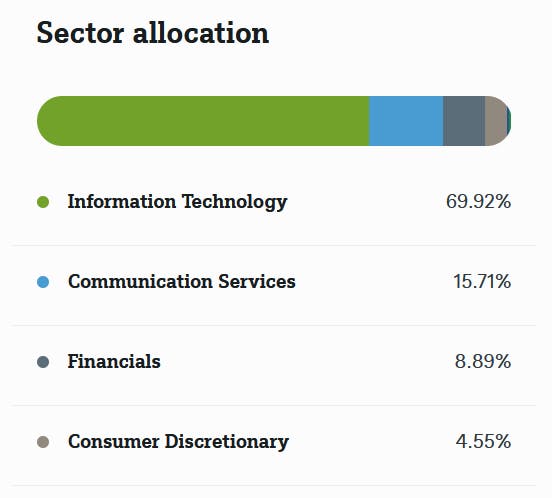
The resulting portfolio has a clear innovation tilt. Technology companies make up 69.92% of the ETF, which is expected given the capital intensity and compute demands of AI development. Communications services follow at 15.71%, reflecting the importance of cloud platforms, search engines, and digital infrastructure in deploying AI at scale.
One notable difference compared to many AI-themed ETFs is XAIX’s 8.89% allocation to financials. Several leading banks are now among the most active patent filers in AI, using machine learning for fraud detection, risk modelling, workflow automation, and next-generation customer interfaces. This gives XAIX exposure to a segment of AI adoption that most thematic ETFs miss.
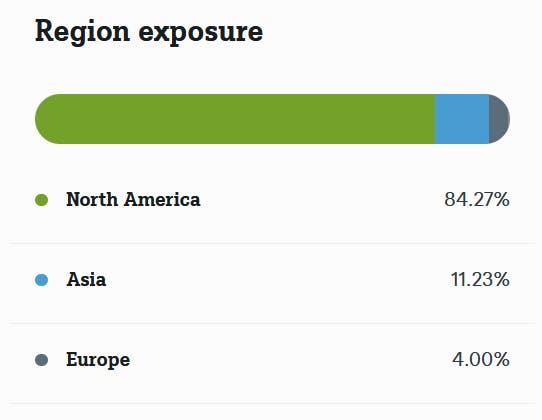
Another distinguishing feature is XAIX’s global reach. While the United States is at the center of the current AI boom, limiting exposure only to U.S. equities risks overlooking major innovators elsewhere.
XAIX includes 11.2% in Asian equities, with holdings such as Samsung Electronics, a global leader in memory chips and semiconductor design, and SK Hynix, a key supplier of high-performance DRAM and NAND essential for AI training workloads. These companies play foundational roles in the supply chain that enables the largest AI models to function.
The benchmark’s earlier example of Alphabet also comes into play here. The index assigned Alphabet one of the highest AI “intensity scores,” reflecting its broad engagement across multiple AI technologies. Combined with its recent outperformance, Alphabet now sits as XAIX’s largest position at 7.06%.
However, the ETF’s methodology remains disciplined: during each semi-annual rebalance, any overweight position is trimmed back to a 4.5% cap, which helps limit concentration risk as leaders rally.
XAIX is also built with cost efficiency in mind. With an expense ratio of 0.35%, it ranks among the most competitively priced AI ETFs in the market, according to ETF Central’s screening tool.
And while XAIX only debuted in the U.S. on August 2, 2024, the UCITS version of the strategy has been operating in Europe since January 29, 2019, where it has returned 21.2% annualized since inception and grown to $7 billion in AUM, making it one of the biggest AI ETFs globally.
Together, these features give XAIX a differentiated profile: global in scope, innovation-weighted, forward-looking in methodology, and priced for long-term adoption.
Please note this article is for information purposes only and does not in any way constitute investment advice. It is essential that you seek advice from a registered financial professional prior to making any investment decision.
Segments
See all
Mentioned ETFs
No specific ETFs were tagged

Latest ETF News
See all ETF newsBeyond Big Tech: The Increasing Specialization of AI ETFs

There's an ETF for That? Humanoid Robotics and Physical AI

How Some ETF Issuers Use Their Own Funds for Cash Management

These Public-Private ETFs Invest in Polymarket and Anduril

There's an ETF for That? Frontier Markets



 Advantages of ETFs over Mutual Funds1/6
Lower Costs
In this guide, we'll explore the advantages of ETFs over mutual funds, giving you valuable insights into why ETFs have gained significant popularity among investors like yourself.
Leveraged ETFs: Unlocking the Potential for Amplified Returns1/6
Understanding Leveraged ETFs
Explore leveraged ETFs: potential for amplified returns & risks. 5 ETFs to consider across equities, commodities & fixed income.
What is a Leveraged ETF?1/6
Introducing Leveraged and Inverse ETFs
In this guide, we'll dive into the world of leveraged ETFs, exploring their definition, mechanics, potential risks, and rewards.
Recent educational content
First Look ETF
First Look ETF: Income, International, and Cash Flow ETFs
In this season 6 episode of First Look ETF, Stephanie Stanton @etfguide examines the latest ETF marketplace trends with NYSE and guests.


ETF Trends
ETF Industry KPIs October 5, 2026
This week’s KPI data overview highlights key metrics and trends shaping the ETF landscape.

ETF Trends
ETF Industry KPIs September 28, 2026
This week’s KPI data overview highlights key metrics and trends shaping the ETF landscape.
ETF Trends
ETF Industry KPIs September 22, 2026
This week’s KPI data overview highlights key metrics and trends shaping the ETF landscape.