ETF model portfolios designed for real investor needs. Discover →



Options-Based ETFs as Fixed-Income Alternatives: What Investors Should Know
Options-based ETFs can deliver income and downside protection, but investors should understand how they differ income before using them as bond substitutes.


Keep up with what matters in ETFs
Get timely ETF insights, market trends, and top ideas straight to your inbox.
Your newsletter subscriptions with us are subject to ETF Central's Privacy Policy and Terms and Conditions.
Fixed income has traditionally served a straightforward role in a diversified portfolio: generating income and reducing volatility. Increasingly, however, ETF issuers are using options to pursue those objectives through different means. Perhaps the clearest example is the emergence of box spread ETFs.
Funds such as the Calamos Tax-Aware Collateral ETF
Tax efficiency, however, is only one example of where options-based ETFs may be able to substitute for a traditional fixed-income allocation. In my view, there are at least two other situations where they deserve consideration. The first is enhancing portfolio income beyond what conventional bond ETFs currently offer. The second is using options strategies to provide downside protection.
Here are two examples of options-based ETFs that illustrate how these strategies can complement, and in some cases potentially replace, a bond sleeve with less duration and credit risk.
Like what you're reading?
Stay in the loop — get the latest ETF insights: trends, analysis, and expert picks.
Higher Income Without Extending Duration or Lowering Credit Quality
This is one of those situations where investors are trying to have their lunch and eat it too. The goal is straightforward: retain the relatively low net asset value (NAV) volatility of a Treasury bill portfolio while earning more than the current federal funds rate of 3.50% to 3.75%.
Of course, there is no free lunch. To earn more income, you have to take on additional risk. The interesting part about options-based ETFs is that they let investors choose how that risk is introduced, rather than simply extending duration or lowering credit quality.
A good example is the NEOS Enhanced Income 1-3 Month T-Bill ETF
A put spread involves simultaneously selling one put option while purchasing another put option with a lower strike price. The premiums received generate additional income, while the purchased put helps cap potential losses. The trade-off is that the strategy still assumes equity market risk. During a sharp selloff, the strategy can experience meaningful drawdowns.
That dynamic is evident when comparing CSHI's NAV with the Bloomberg 1-3 Month Treasury Bill Index since the fund's launch. For much of its history, CSHI maintained a noticeable lead over simply rolling Treasury bills. During periods of market stress, however, including the April 2025 tariff-driven selloff, that excess return narrowed as losses from the put spread strategy materialized.
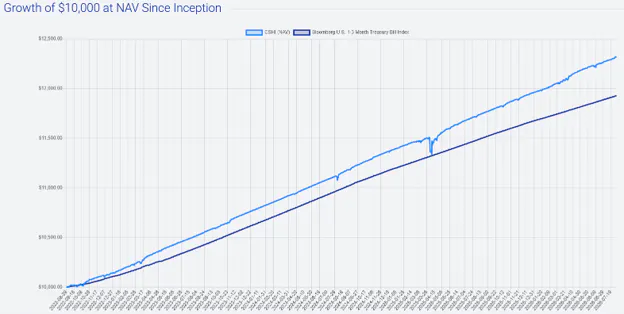
Source: NEOS Investments
In other words, CSHI isn't creating additional income out of thin air. Rather than accepting more interest rate risk through longer-duration bonds or more credit risk through lower-quality issuers, investors are accepting equity downside risk in exchange for higher income.
Based on the most recent distribution, CSHI offers an annualized distribution rate of approximately 4.7%. That comes at the cost of a higher 0.38% expense ratio, well above a traditional Treasury bill ETF.
Downside Protection with Less Duration and Credit Risk
One of the biggest lessons from 2022 was that bonds don't always provide the protection investors expect. As central banks aggressively raised interest rates to combat inflation, even high-quality bond portfolios suffered historically large losses as rising yields pushed bond prices lower.
A different weakness surfaced during the March 2020 COVID-19 selloff. Even investment-grade bond ETFs experienced periods of severe liquidity stress, with many corporate bond funds briefly trading at meaningful discounts to their underlying net asset values (NAVs) as credit markets temporarily froze.
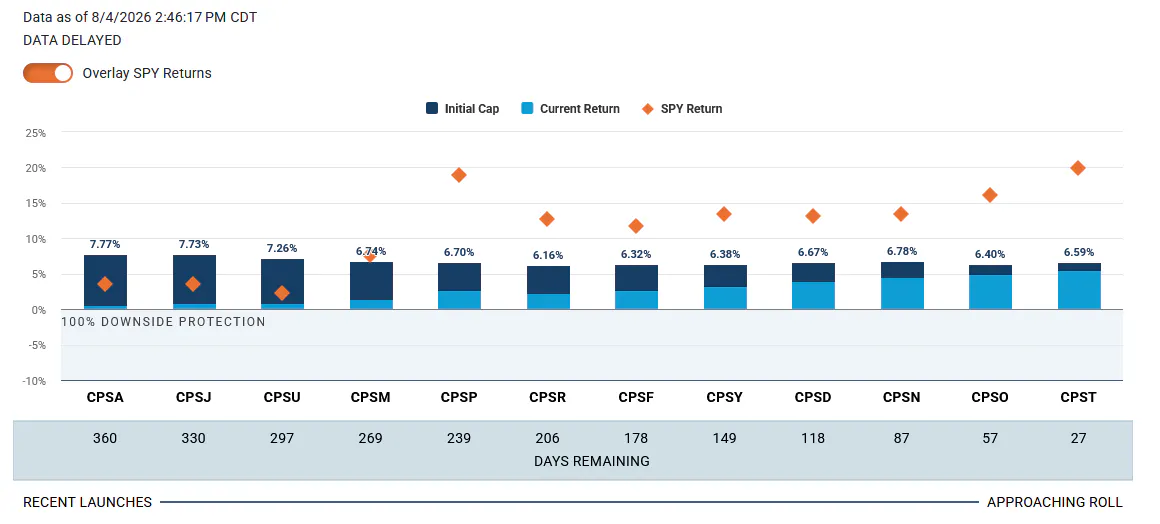
One alternative is to replace some of those risks with options. A good example is the Calamos Laddered S&P 500 Structured Alt Protection ETF
Each underlying ETF uses a collar strategy consisting of a long put option combined with a short call option to provide 100% point-to-point downside protection over a one-year outcome period. In exchange for that protection, investors agree to an upside cap.
Source: Calamos Investments
By holding twelve overlapping outcome periods simultaneously, CPSL smooths returns across time. The trade-off is that the protection is no longer mathematically identical to owning a single buffered ETF from beginning to end. Even so, the laddered structure has produced relatively low realized volatility and significantly reduced drawdowns, while avoiding many of the timing decisions investors otherwise face.
Importantly, the risks being assumed are fundamentally different from those of traditional bonds. CPSL has essentially no duration risk because it does not own fixed-income securities. It also avoids credit risk because there are no corporate bonds in the portfolio. That creates an interesting use case.
With CPSL, investors are using options to deliberately compress the range of potential market outcomes. The result is a defensive allocation whose performance is not driven by interest rates or credit spreads. There is also a tax advantage because the strategy has not paid regular distributions.
The trade-off, once again, is cost. CPSL charges a relatively high 0.79% expense ratio, reflecting the complexity of implementing and maintaining the laddered options strategy.
Please note this article is for information purposes only and does not in any way constitute investment advice. It is essential that you seek advice from a registered financial professional prior to making any investment decision.
Latest ETF News
See all ETF newsThese Public-Private ETFs Invest in Polymarket and Anduril

There's an ETF for That? Frontier Markets

10-Year Treasury Yield Hits 5%: Which Bond ETFs Offer the Most Direct Exposure?

ETF comparison: NEOS S&P 500 High Income ETF (SPYI) Versus Goldman Sachs S&P 500 Premium Income ETF (GPIX)




 Advantages of ETFs over Mutual Funds1/6
Lower Costs
In this guide, we'll explore the advantages of ETFs over mutual funds, giving you valuable insights into why ETFs have gained significant popularity among investors like yourself.
Leveraged ETFs: Unlocking the Potential for Amplified Returns1/6
Understanding Leveraged ETFs
Explore leveraged ETFs: potential for amplified returns & risks. 5 ETFs to consider across equities, commodities & fixed income.
What is a Leveraged ETF?1/6
Introducing Leveraged and Inverse ETFs
In this guide, we'll dive into the world of leveraged ETFs, exploring their definition, mechanics, potential risks, and rewards.
Recent educational content

ETF Trends
ETF Industry KPIs October 5, 2026
This week’s KPI data overview highlights key metrics and trends shaping the ETF landscape.

ETF Trends
ETF Industry KPIs September 28, 2026
This week’s KPI data overview highlights key metrics and trends shaping the ETF landscape.
ETF Trends
ETF Industry KPIs September 22, 2026
This week’s KPI data overview highlights key metrics and trends shaping the ETF landscape.
First Look ETF
First Look ETF: Income, Corporate Arbitrage, and Growth and Value Investing
First Look ETF September 2026: iCapital, Mast Investments and North Square unpack new ETFs targeting monthly income, merger arbitrage and complementary growth and value exposure.

Browse all educational columns



Expert-Built ETF Portfolios, All in One Place
Don’t start from scratch. Discover ready-made ETF portfolios built by professionals to match different goals, timelines, and market views. Use them as inspiration or as a starting point for your own allocation.