Open Now: The Global ETF Survey Take the Survey →



NYSE MAC Desk - Weekly Recap
Weekly market update straight from the trading floor. Hear from NYSE's Senior Market Strategist, Michael Reinking, on the market.


Keep up with what matters in ETFs
Get timely ETF insights, market trends, and top ideas straight to your inbox.
Your newsletter subscriptions with us are subject to ETF Central's Privacy Policy and Terms and Conditions.
STRAIGHT FROM THE TRADING FLOOR
DOW 29,590 (-486), S&P 500 3,693 (-65), Russell 2000 1,680 (-43), NYSE FANG+ 4,789 (-101), ICE Brent Crude $86.65/barrel (-$3.81), Gold $1,652/oz (-$29), Bitcoin ~18.8k (-480)
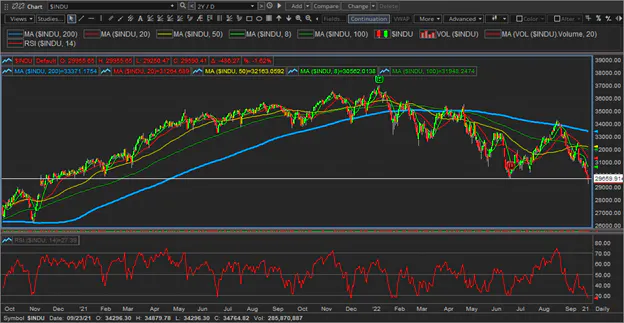
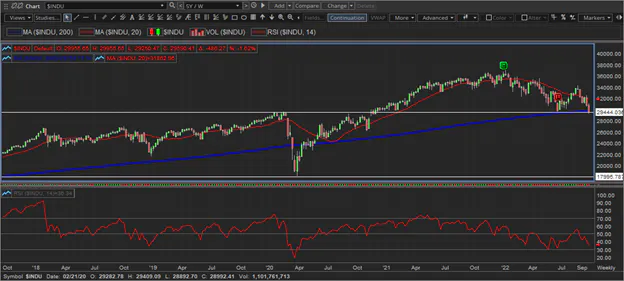
Taking a cue from Chair Powell's new communication style I'd say this week was - U-G-L-Y (sticking with the 80's classic movie references). Last week we highlighted the negative seasonal trends in the week following September expiration and unfortunately that came to pass with the S&P 500 now closing lower in 26 of the last 33 years. Some of that Powell predicted "pain" has now been inflicted on financial markets with the S&P 500 closing lower by >3% in four of the five weeks since the Jackson Hole address. The S&P 500 followed up a 4.8% decline last week with a 4.6% on the way to testing the June lows today before a modest bounce into the close. Today the Dow Jones Industrial Average closed below its June low joining the DJ Transportation Index which broke that level last week. The index also officially crossed the 20% "bear market" threshold for the first time.
Central banks were at the center of this week's declines, but the big issue is really uncertainty. Geopolitical tensions continue to mount in Ukraine with the Russian referendums and threats of nuclear weapons, the US/China rhetoric continues to deteriorate and there is an election in Italy this weekend which could shake up the bloc - but these aren't the issues that markets seem to be concerned with at the moment.
That uncertainty really comes back to global monetary policy. This week there were over 10 central bank rate decisions with most hiking rates aggressively but at the center of that, is the Federal Reserve. Markets had been recalibrating Fed expectations aggressively since Powell's address a couple of weeks ago. The release of this week's Summary of Economic Projections showed members of the committee expected rate increases to exceed even those adjusted market expectations suggesting an additional 125bps of rate hikes over the next two meetings. The Chairman continued his new direct and unwavering communication saying that the committee will move to a restrictive rate and stay there until inflation is convincingly moving lower, which will cause a period of below trend growth and job losses.
You may be thinking that messaging seems pretty straightforward. It is. However, the uncertainty piece that I referred to is understanding where the ultimate destination is. Within the Dots it is apparent that officials are split between 4.5%, 4.75% and 5%, but this seems to be a moving target. Chair Powell suggested that we were just getting "into the very lowest level of what might be restrictive". However, when discussing the SEP he essentially said these are our estimates but this "will evolve over time and I think we'll just have to see how that goes" which was like Thornton Mellon checking conditions before trying to pull off the Triple Lindy. So, long gone are the hopes of a pivot. This originally evolved into hopes of a pause, but this too seems to be off in 2023. The uncertainty is really where does it stop. The prospect for much higher rates, increases the range of potential economic outcomes.
The Fed had gotten behind the curve and one can argue that the market led them to this reset. They are now trying to get ahead of the curve, but they weren't the only central bank in this situation. This was widely a global problem, with a few exceptions. However, given the importance of the Federal Reserve and the USD this causing broader implications. Other central banks are now being forced to try and keep pace with the US or see their currencies devalued further. The strong dollar does have some positive impacts on domestic inflation but this weighs on the rest of the globe as it becomes more expensive to service US-denominated debt and purchase goods/commodities. Volatility in currency markets has been surging and is raising concerns that something could break ala 1997. This week Japan did announce that it would intervene to stem currency weakness, but it is difficult to see this working without the BOJ changing its uber accommodative policy stance.
The reset of interest rates flows through asset classes and with investors not confident with where it stops it becomes difficult to value other assets. This is part of the issue for equities. Valuations have been resetting and with the added economic uncertainty the range of potential outcomes for corporate earnings also widens. So, you're forcing investors to guess on both sides of the equation with both those variables being pressured lower.
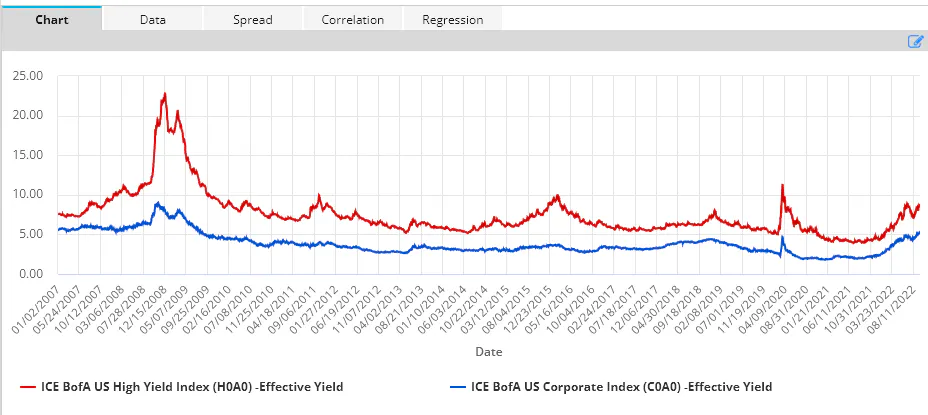
Unfortunately, I'm not done yet as there are a couple of other issues that have come to the fore front this week. First, it seems like TINA has been buried - RIP. Over the last year I've discussed one of the prevailing mantras over the last decade which was "Don't Fight the Fed". This leads into the second mantra since the GFC, as central banks kept rates low while steadily pumping stimulus into the global economy, "There Is No Alternative". In the global hunt for yield this made equities the most attractive asset. With the 2yr Treasury now above 4% for the first time since 2007 that is no longer the case. Corporate bond yields are now also offering returns not seen in a long time.
The last two issues I'll touch on are what have historically been the exit ramps for weakness within equity markets - fiscal and monetary policy. Earlier this year I said I expected that the Fed stance would likely ebb and flow with moves in equity markets. We saw the stance soften a bit over the summer as markets were getting hit hard. However, in August as things went too far and financial conditions began to ease, working against what the Fed was trying achieve, Chair Powell dropped the hammer. In years passed the Fed has been able to reverse course to save the day aka the "Fed Put". However, with inflation that put has joined TINA or at least the strike price has been lowered significantly.
The other exit ramp has been fiscal stimulus. Governments adding stimulus in this environment works against what their central bank "brethren" are trying to do as this adds to inflationary pressures. While we have seen some limited stimulus announcements made in the US this dynamic was full on display today with the UK announcing sweeping tax cuts and subsidies. This was met with a swift response by markets sending the GBP sharply lower, down 3.5% verse the USD and yields up sharply with the 5/10yr yields up 50bps/35bps today alone.
I know this is gloomy picture but in the words of Hyman Roth, "This is the business we've chosen."
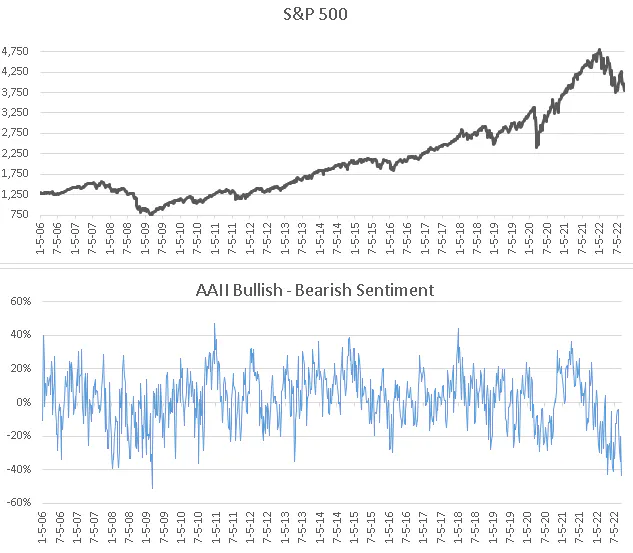
There aren't many positives to point to but I'll try to give you a few. Positioning and sentiment remain at extreme levels (see Chart 1) and short-term momentum indicators are also starting to getting to extreme levels.
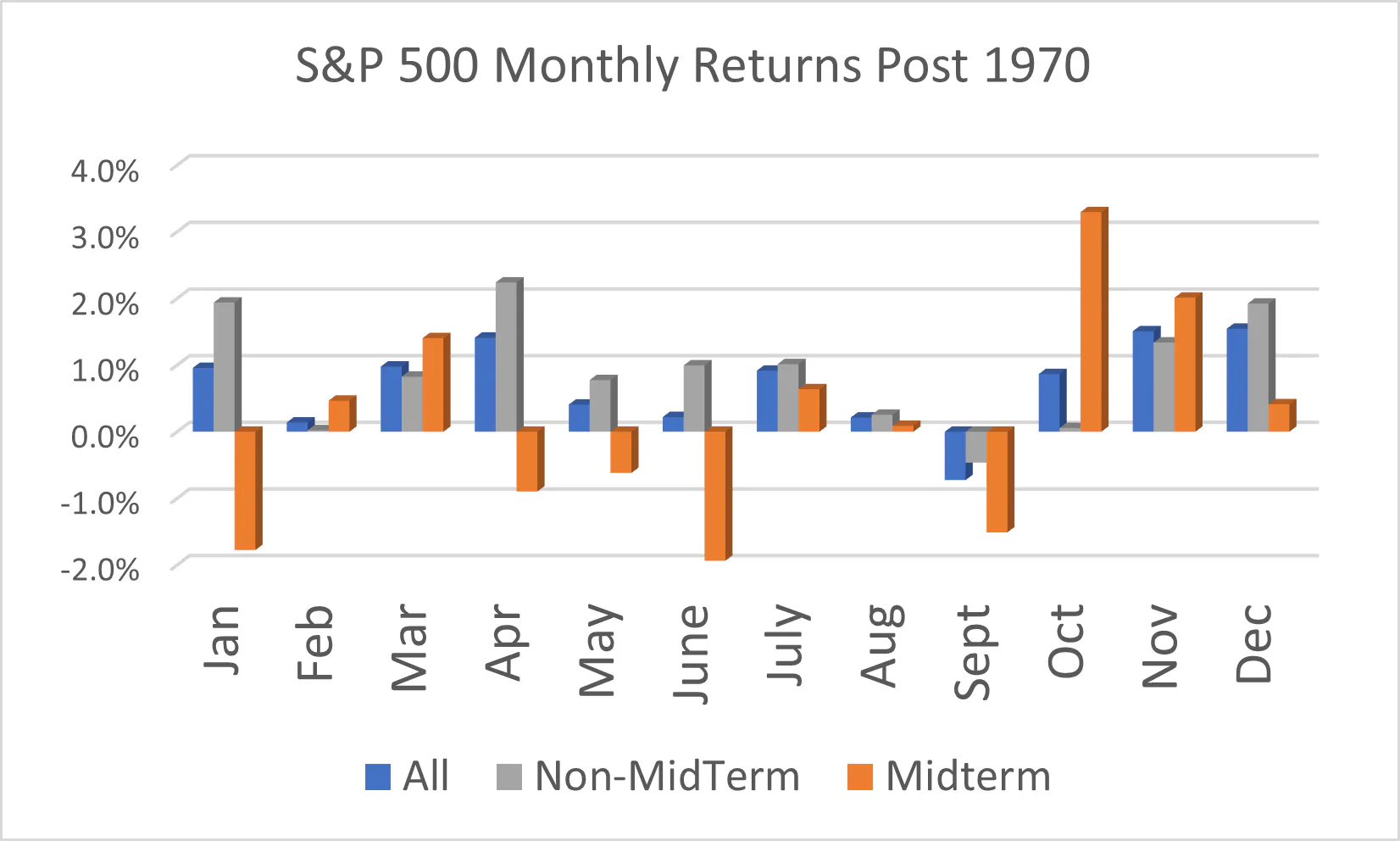
We are in the midst of a very negative short term seasonal patterns but that improves in the coming months especially in mid-term election years.
We have seen some pre-announcements but the broader corporate commentary has been more sanguine than the current market narrative. This has lowered expectations ahead of earnings season which kicks off in earnest in a couple of weeks.
The US economy has continued to show resilience (see today's PMIs and labor market data). In the current environment that can easily be added to the other side of the equation as the Fed clearly wants to see demand softening before pulling back. Some of the leading indicators of inflation are showing signs of easing though this will take time to flow through the data. The weakness in commodities and oil should ultimately help on the inflation side of things and provide some relief to consumers.
The ETF Industry Is Evolving Fast
From AI infrastructure to active strategies, the ETF landscape is shifting. Share your perspective in the 7th Annual Global ETF Survey and get exclusive early access to the final report.
Sectors/Asset Classes
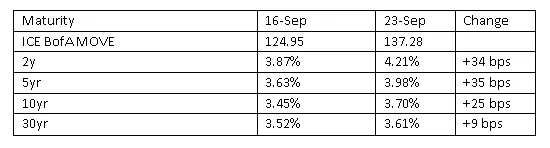
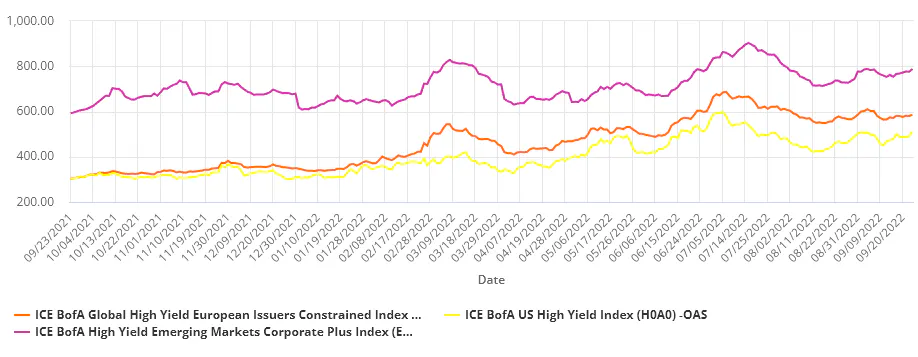
Yields moved sharply higher again this week. I'd argue corporate credit actually held up pretty well with spreads not widening significantly. This will be important to watch in the coming days.
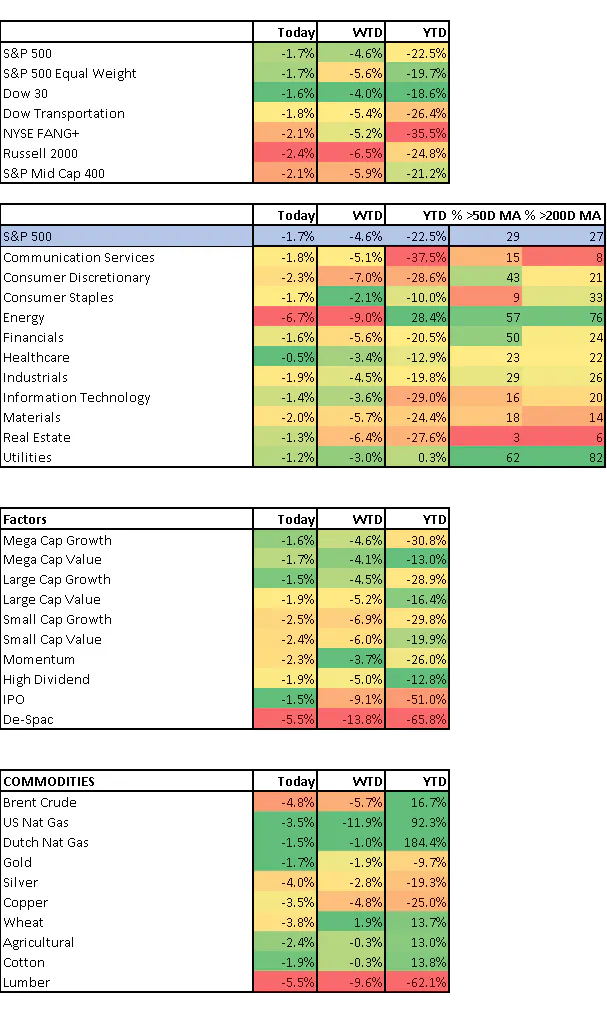
Within equity markets there was really no where to hide this week with only 14 S&P components ending the week higher while >50 lost between 10% - 20%. Energy got hit the hardest with today's drawdown brining losses to ~9%. There was some modest outperformance in defensive sectors like consumer staples and healthcare.
The Technicals Still Matter -
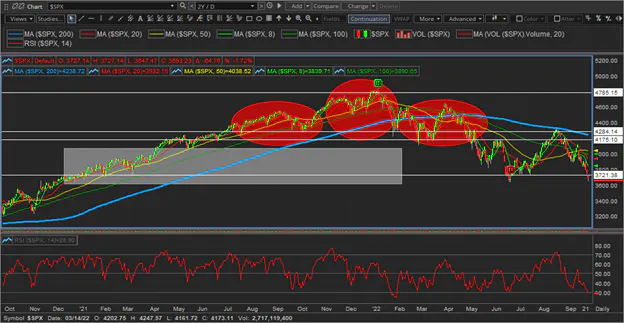
To start the week the S&P traded in a pretty tight range but was never able to reclaim 3,900 before trading sharply lower following the FOMC decision. The index did break other support levels on the way to testing the June lows today. The move lower has been swift and momentum has picked up to the downside with RSI hitting extreme levels (<30). This typically is a sign of exhaustion and could lead to a tradeable bounce. There was a little bit of a bottoming tail today, just like last week but once again not putting a lot of weight on that as it was a logical spot to try and get a little bounce. It does feel like we will need to undercut these lows first and the backdrop doesn't feel like one where you want to be a hero.
Levels to watch to the down side:
> 3,636 June lows
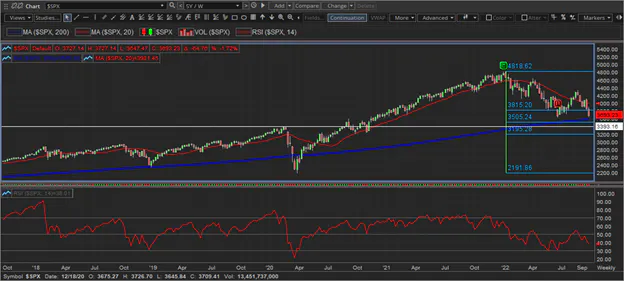
> 3,585 200W moving average
> 3,505 50% Fibonacci Retracement of pandemic rally and level we broke out from post 2020 elections
> 3,400 High prior to Covid selloff
Upside
> 3,815 38.2% Fib.
> 3,900 this week's high and the declining 20d (~3,930)
Last week
The S&P 500 completely engulfed last week's range to the downside just like it did last week in the opposite direction. I will say that this type of action is typical as markets try to hash out bottoms. While we did break 3,900 and last week's low we did hold 3,815 which is the 38.2% Fibonacci Retracement of the post-pandemic rally. There was a little bit of a bottoming tail today but I'm not taking a lot of comfort from that. Things feeling a little dicey ahead of next week's big catalyst.
Adding Dow this did make a new YTD low today but this never got quite as extended on the upside
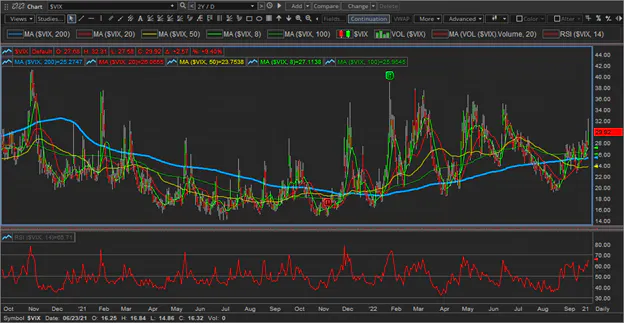
Considering the backdrop the VIX has remained reasonably well contained there is a belief that is because positioning is so light and hence investors are not reaching for protection. It did break above recent highs this week ~28. Starting to see a little bit of stress in the futures market but it is not extreme. It does feel like we could get a volatility swell here.
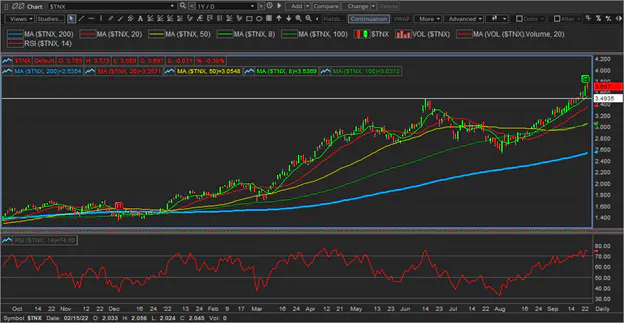
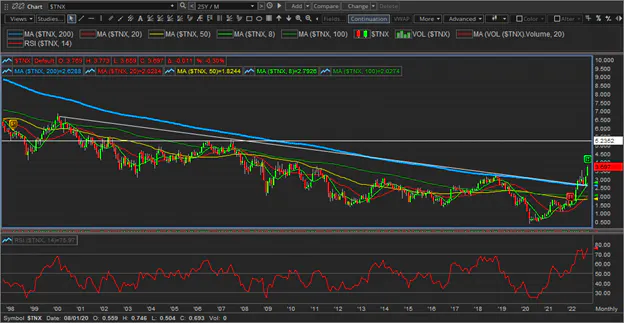
10yr it was all over after the break of 3.5%.
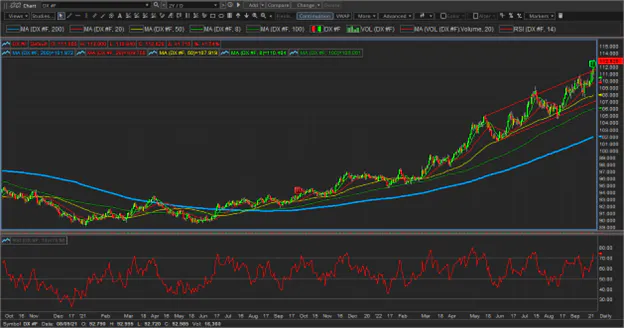
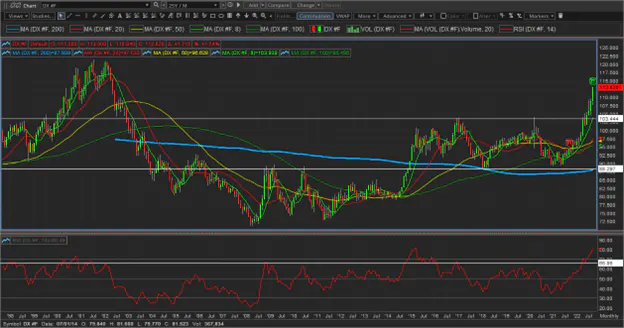
USD - The uptrend has remained in place with the explosion higher in the back half of the week. This is a big area of concern from a macro perspective. This are still some negative divergences brewing on a shorter-term basis.
However, as we've highlighted on a long term basis this was an important move higher in March and then the full breakout in June. The long term target on that range break was to 118 and we've gone about 2/3 of the way there. On a monthly chart this is getting to extreme levels (RSI just under 80).
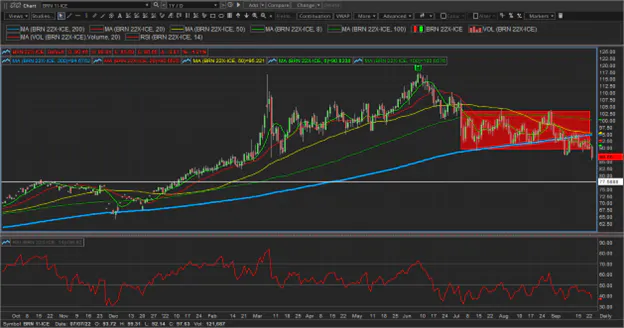
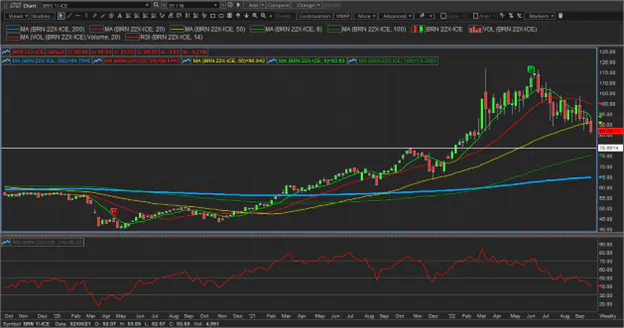
ICE Brent - After the inside week last week this failed at the 200d and finally broke to the downside. Initial targets on this break are to high 70's.
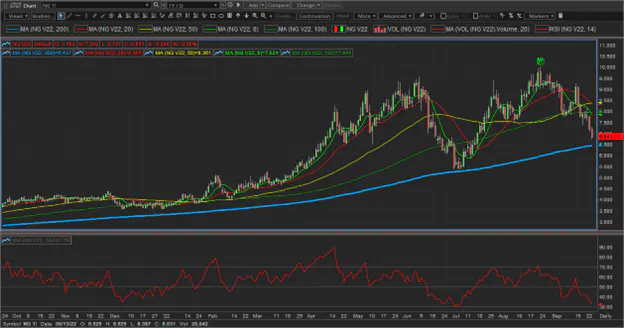
Nat Gas - This broke the key 7.50 level yesterday on inventory data and has accelerated lower. First target 200d ~6.43.
Last week
This couldn't have played out any better. There was a sharp rally Wednesday into the 20d which was completely engulfed the next day. Today this broke the 50d and has H&S pattern with a neckline ~7.50. Measured move on a break below would be to 5. First target 200d ~6.40.
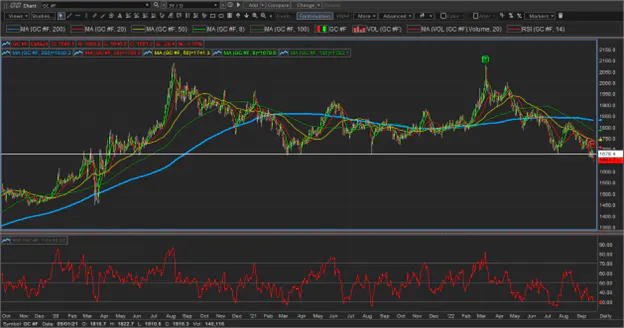
Gold - Just to adding back this week with the break of the key 1,675 level. This is not displaying the old flight to safety or inflation hedge characteristics as it has just become a dollar proxy. Look for 1,600 on the break here could potentially lead to much bigger move.
What’s on Tap Next Week
As a reminder Rosh Hashanah begins on Sunday, shanah tovah, to those who celebrate. Next week will continue to be about central bank commentary and economic data. Q3 earnings are starting to trickle in. Nike and Micron both report on Thursday and given the global scope will be closely watched. Fed speakers will come out of the woodwork though I don't think there is much they will want to clean up coming out of the meeting. The highlights will likely be Bullard on Wednesday and Williams/Brainard on Friday. Next week's Treasury auctions will also get attention after the recent jump in yields with ~$123B of 2/5/7 years coming to market. Economic data will include consumer confidence, durable/capital goods orders and housing data early in the week. However, Friday is the big day with China PMIs, Eurozone CPI and US personal income/spending and PCE, the Fed's preferred gauge of inflation. Friday is also month and quarter end. Hopefully the movie theme at least got a couple of chuckles or smiles. That's All Folks! Enjoy the weekend!

Latest ETF News
See all ETF newsMoneyShow Chart of the Day 7/16/26: Good News/Bad News on Inflation (and the Fed)


MoneyShow Chart of the Day 7/1/26: The H1 Scorecard – and What Comes Next

MoneyShow Chart of the Day 6/22/26: Are World Cup Videos Helping US Companies Clean Up?

MoneyShow Chart of the Day 6/3/26: AI. AI. AI. (And a Handful of Other Stocks, Too)




 Advantages of ETFs over Mutual Funds1/6
Lower Costs
In this guide, we'll explore the advantages of ETFs over mutual funds, giving you valuable insights into why ETFs have gained significant popularity among investors like yourself.
Leveraged ETFs: Unlocking the Potential for Amplified Returns1/6
Understanding Leveraged ETFs
Explore leveraged ETFs: potential for amplified returns & risks. 5 ETFs to consider across equities, commodities & fixed income.
What is a Leveraged ETF?1/6
Introducing Leveraged and Inverse ETFs
In this guide, we'll dive into the world of leveraged ETFs, exploring their definition, mechanics, potential risks, and rewards.
Recent educational content

ETF Trends
ETF Industry KPIs July 13, 2026
This week’s KPI data overview highlights key metrics and trends shaping the ETF landscape.


First Look ETF
First Look ETF: Cash Deployment, Bond, and Hedged ETFs
In this season 6 episode of First Look ETF, Stephanie Stanton examines the latest ETF marketplace trends with NYSE and guests.

ETF Trends
ETF Industry KPIs July 6, 2026
This week’s KPI data overview highlights key metrics and trends shaping the ETF landscape.
Asset TV
The ETF Show - The Evolution of Leveraged & Inverse ETFs
Leveraged and inverse ETFs have exploded in popularity over the past decade capturing more assets as retail traders seek to capture volatility.

Browse all educational columns



The ETF Industry Is Evolving Fast
From AI infrastructure to active strategies, the ETF landscape is shifting. Share your perspective in the 7th Annual Global ETF Survey and get exclusive early access to the final report.