Keep tabs on your favorite ETFs with a personalized weekly tracker. Create a Watchlist now →



The Newer, Smarter Way to Reduce S&P 500 Concentration Risk with ETFs
The Xtrackers S&P 500 Diversified Sector Weight ETF (SPXD) offers an affordable and streamlined advantage over do-it-yourself sector investing or equal-weight alternatives.


Keep up with what matters in ETFs
Get timely ETF insights, market trends, and top ideas straight to your inbox.
Your newsletter subscriptions with us are subject to ETF Central's Privacy Policy and Terms and Conditions.
The S&P 500 hit fresh all-time highs in August 2025, topping out at 6,441.86. But behind the headlines, some experts are warning about mounting concentration risk.
Because the S&P 500 Index uses a float-adjusted market cap weighting methodology, where bigger companies count for more by design, the top 10 stocks now represent 38% of the benchmark. NVIDIA alone accounts for 8.1%.
Sector concentration is also an issue. About 34% of the S&P 500 is in technology stocks. And that doesn’t include tech-adjacent giants like Amazon and Tesla in consumer discretionary, or Alphabet and Meta Platforms in communications.
ETFs can help you manage this kind of top-heavy exposure, but not all solutions are created equal. Equal-weighting individual stocks or sectors may seem like a fix, but both have serious limitations.
In this piece, we’ll walk through the limitations of traditional ETF solutions for addressing concentration risk and introduce an ETF from Xtrackers that could offer a more affordable and streamlined alternative.
Like what you're reading?
Stay in the loop — get the latest ETF insights: trends, analysis, and expert picks.
Using Sector ETFs
Many ETF providers, especially State Street and Vanguard, offer sector-specific ETFs corresponding to the 11 global industry classification standard (GICS) sectors: communication services, consumer discretionary, consumer staples, energy, financials, health care, industrials, information technology, materials, real estate, and utilities.
State Street’s lineup tracks the “Select Sector” indices, which draw only from S&P 500 constituents and apply market cap weighting within each sector. In other words, each fund owns the largest companies in its sector based on float-adjusted market capitalization.
Investors could build a sector-neutral version of the S&P 500 by allocating equally (about 9.1% each) to all 11 Select Sector SPDR ETFs and rebalancing quarterly. This method keeps any one sector from dominating the portfolio while still giving more weight to the largest companies within each sector.
However, this approach has historically been inefficient. From June 19, 2018, to August 11, 2025, a backtest of this equal-weight sector portfolio with quarterly rebalancing underperformed the SPDR S&P 500 ETF Trust
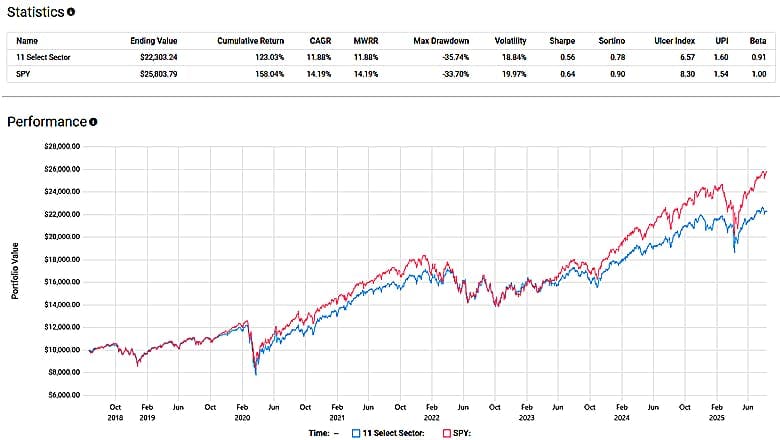
Equal-weight Select Sector portfolio vs SPY (Date range: June 19, 2018, to August 11, 2025)
This doesn’t even account for transaction costs. Between bid-ask spreads, trading fees, and the effort involved in managing 11 positions four times a year, rebalancing friction can take a significant bite out of returns.
Bottom line: constructing a balanced, sector-neutral S&P 500 portfolio using 11 Select Sector ETFs is possible, but it hasn’t been the most efficient or effective route historically.
Using Equal Weight ETFs
Another approach that’s more streamlined than juggling sector ETFs is to use an equal weight ETF for the S&P 500, such as the Invesco S&P 500 Equal Weight ETF
Unlike the sector-based strategy, which balances sectors and weights companies within by market cap, RSP ignores sector weightings altogether and simply resets all holdings to equal weight every quarter.
While sector distribution isn’t perfectly uniform, it’s far more balanced than the standard S&P 500. Right now, industrials and financials lead with weights of about 16% and 15%, respectively, with tech coming in third at 14%.
That balance comes with trade-offs. A backtest from April 30, 2015, to August 11, 2025, shows RSP slightly underperforming SPY on both a total return and risk-adjusted basis. Two structural challenges possibly contribute to this.
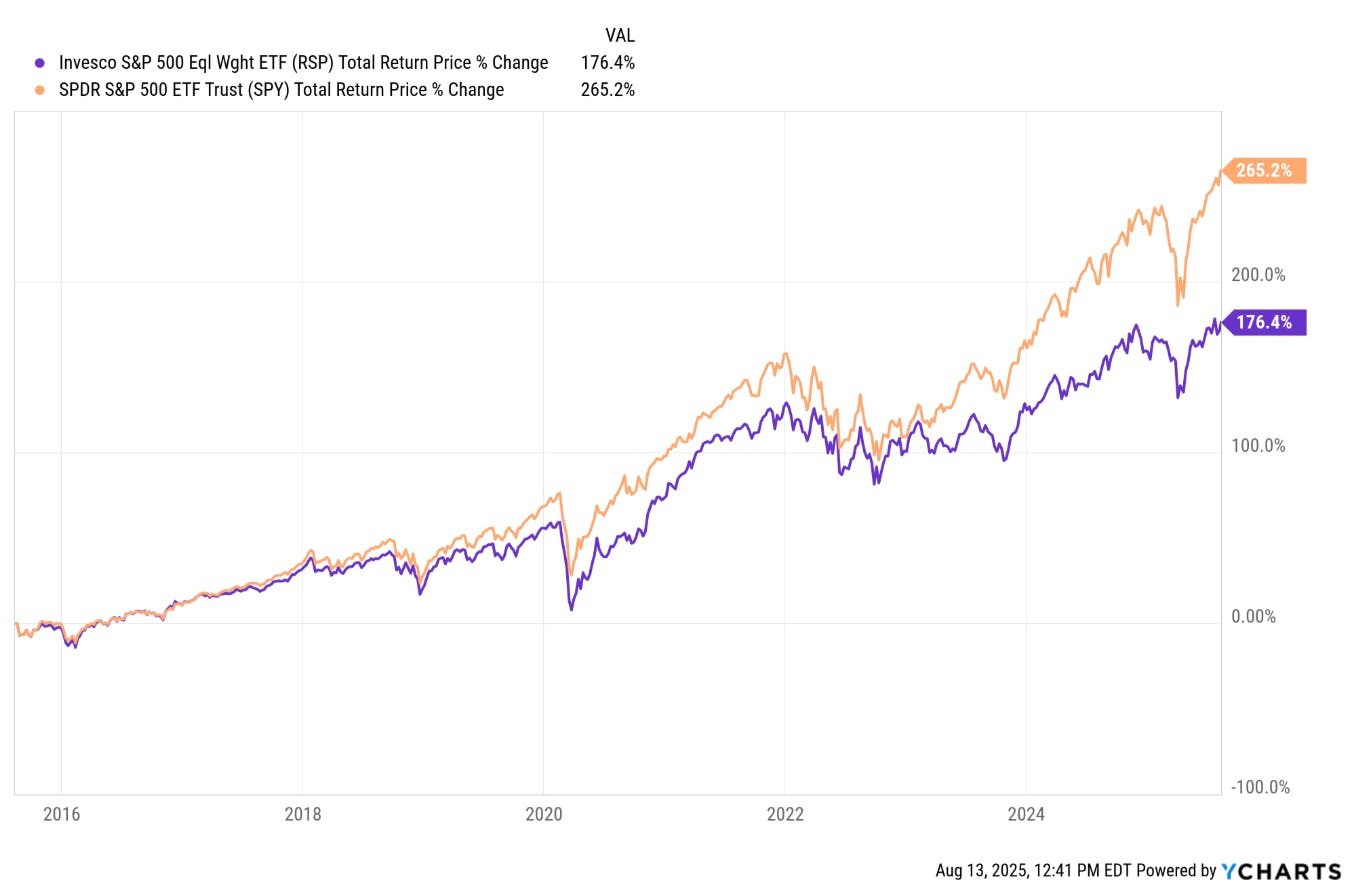
RSP vs SPY (Date Range: April 30, 2015, to August 11, 2025)
First, RSP doesn’t allow the top performers to keep compounding. Market cap-weighted ETFs reward winners by letting them grow larger in the index. In contrast, RSP trims these holdings every quarter back to 0.2%, which limits the benefits of long-term outperformance.
Second, fees are a drag. RSP charges a 0.25% expense ratio, which is more than double SPY’s and significantly higher than ultra-low-cost S&P 500 ETFs from Vanguard and iShares. This is due to a combination of licensing fees and higher transaction costs from the turnover. That fee difference persists year after year and adds up over time.
Bottom line: RSP is a decent one-ticker solution for addressing concentration risk, but its 0.25% fee is actually higher than the average expense ratio you'd pay by equally weighting the 11 Select Sector ETFs.
How SPXD Combines the Best of Both Worlds
The two approaches covered earlier (using sector ETFs or an equal weight S&P 500 ETF) are functional but fairly blunt tools. They address concentration risk, but neither is especially precise or efficient.
When you're trying to solve an investment problem, it often pays to look beyond the biggest issuers and the most established products. Some of the most thoughtful solutions come from newer ETFs built by firms seeking to innovate and deliver unique solutions with a fresh perspective.
The Xtrackers S&P 500 Diversified Sector Weight ETF
SPXD tracks the S&P 500 Diversified Sector Weight Index, which applies Syntax’s Functional Information System (FIS®) to categorize companies based on their revenue sources rather than traditional labels.
The methodology starts by assigning equal weight to each primary sector. It then repeats the equal-weighting process at each level of the hierarchy down to sub-sectors and business activities.
From there, companies are weighted within each business activity based on how much of their revenue is derived from that specific line of business. For companies with multiple revenue streams, the fund adds up their weights across each applicable category.
For example, under the FIS taxonomy, Amazon is classified in both the Information and Food sectors, reflecting its mix of e-commerce, cloud services, and grocery operations. Disney spans an even wider range, appearing in the Information, Financials, Food, and Consumer Products and Services sectors due to its diverse activities across media, streaming, theme parks, merchandise, and related businesses. This approach helps capture the diversified nature of large, multi-segment companies.
The end result is a sector allocation that’s far less top-heavy than the traditional S&P 500, and a portfolio that avoids the extreme concentration of market-cap weighting without flattening everything equally to minuscule allocations like RSP.
SPXD’s portfolio currently spreads weight more evenly across sectors compared to the S&P 500, with its largest position, Berkshire Hathaway Class B, at 3.62%, followed by Abbott Laboratories at 1.79% and Jabil at 1.70%. Other notable holdings include Microsoft, Procter & Gamble, Costco, and Disney, each hovering around the 1%–1.5% range, with no single stock dominating the fund.
By contrast, SPY is far more top-heavy, with its largest holding, NVIDIA, making up 8.21% of the portfolio. The top 10 SPY holdings, which also include Microsoft, Apple, Amazon, Meta, Broadcom, Alphabet’s two share classes, Tesla, and Berkshire Hathaway account for roughly 38% of total weight, highlighting the concentration risk SPXD is designed to mitigate.
Finally, SPXD also solves key problems from the earlier strategies. Unlike building a portfolio of 11 sector ETFs, SPXD packages everything into a single ticker that rebalances automatically. And compared to RSP, SPXD is significantly cheaper. It charges just 0.09% annually, less than half the 0.25% fee on RSP, and only one basis point more than the average Select Sector ETF.
For investors, SPXD offers a smart and affordable way to tackle S&P 500 concentration risk. There are plenty of tools out there, and keeping an open mind can help you find better ones.
Please note that this article reflects the author’s personal views and does not represent the opinions of the publication or its affiliates. It is for informational purposes only and does not constitute investment advice. It is essential to seek guidance from a registered financial professional before making any investment decisions.
Segments
See all
Mentioned ETFs
No specific ETFs were tagged

Latest ETF News
See all ETF newsCould Water ETFs Be the Next AI Bottleneck Trade?

What is a Boomer Candy ETF?

ETF Comparison: NEOS Nasdaq-100 High Income ETF (QQQI) Versus Goldman Sachs Nasdaq-100 Premium Income ETF (GPIQ)





 Advantages of ETFs over Mutual Funds1/6
Lower Costs
In this guide, we'll explore the advantages of ETFs over mutual funds, giving you valuable insights into why ETFs have gained significant popularity among investors like yourself.
Leveraged ETFs: Unlocking the Potential for Amplified Returns1/6
Understanding Leveraged ETFs
Explore leveraged ETFs: potential for amplified returns & risks. 5 ETFs to consider across equities, commodities & fixed income.
What is a Leveraged ETF?1/6
Introducing Leveraged and Inverse ETFs
In this guide, we'll dive into the world of leveraged ETFs, exploring their definition, mechanics, potential risks, and rewards.
Recent educational content

ETF Trends
ETF Industry KPIs September 8, 2026
This week’s KPI data overview highlights key metrics and trends shaping the ETF landscape.

ETF Trends
ETF Industry KPIs August 31, 2026
This week’s KPI data overview highlights key metrics and trends shaping the ETF landscape.
ETF Trends
ETF Industry KPIs August 24, 2026
This week’s KPI data overview highlights key metrics and trends shaping the ETF landscape.
What’sTheFund
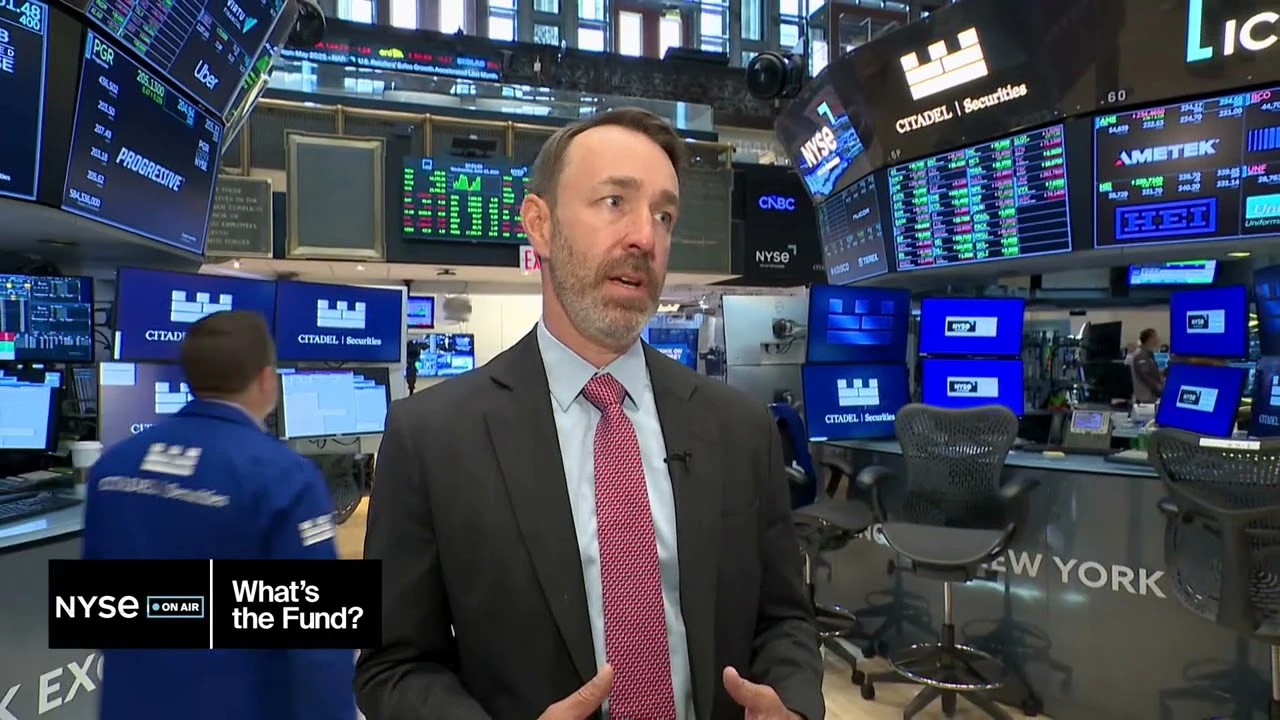
What's the Fund | Ocean Park Diversified Income ETF (DUKZ)
James St Aubin, Chief Investment Officer at Ocean Park Asset Management, discuss the DUKZ ETF, exposing investors to the whole spectrum of asset classes in the fixed income markets, through their rules-based process.

Browse all educational columns



Expert-Built ETF Portfolios, All in One Place
Don’t start from scratch. Discover ready-made ETF portfolios built by professionals to match different goals, timelines, and market views. Use them as inspiration or as a starting point for your own allocation.