Global ETF Survey Is Live! 600+ ETF Professionals Weigh In. See Results →



Navigating Nasdaq-100 Volatility in 2026: Alternative Strategies with Income, Protection, and Upside Potential
Looking ahead to 2026, numerous challenges could spur Nasdaq-100® volatility.


Keep up with what matters in ETFs
Get timely ETF insights, market trends, and top ideas straight to your inbox.
Your newsletter subscriptions with us are subject to ETF Central's Privacy Policy and Terms and Conditions.
Looking ahead to 2026, numerous challenges could spur Nasdaq-100® volatility. Many investors may be wondering whether to reduce their allocation but don’t want to miss out if strong performance continues. Fortunately, Calamos offers three alternative strategies that provide exposure while reducing downside risk.
Global ETF Survey 2026 is Live!
With 1,790 new products launched by July 2026, choosing is harder than ever. Our Global ETF Survey 2026, built on 620 professional investors and allocators, shows how active, fixed income, options-based and thematic ETFs are reshaping fund selection.
Challenge 1: Central Bank Policy and Interest Rates Whiplash
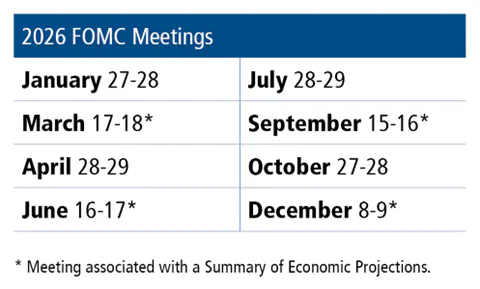
- Fed uncertainty: Markets expect a shift from tightening to cutting, but the timing and magnitude remain uncertain, especially if inflation proves sticky and triggers choppy prices.
- Global rate divergence: Diverging monetary policies (such as the BOJ tightening or the ECB’s stance) can fuel currency shifts, like a yen unwind, impacting Nasdaq exposure.
Potential Solution: Access high autocallable yield tied to a Nasdaq-100-based index.
Calamos Nasdaq® Autocallable Income ETF (Ticker: CAIQ) seeks to deliver high, stable income tied to equity market performance, rather than traditional fixed income factors like credit or duration.
CAIQ provides investors exposure to a portfolio of 52+ autocallables, each with similar terms and whose coupon payments and principal at maturity are tied to the MerQube Nasdaq-100 Vol Advantage Autocallable Index—a benchmark optimized specifically for autocallable strategies.
Investors receive monthly income potential typically greater than traditional fixed income. The trade-off: severe market downturns could interrupt coupon payments or, in worst cases, result in principal loss. As of January 5, 2026, the weighted average coupon of the portfolio’s 54 laddered autocallables was 17.89%, which was significantly higher than investment-grade bonds.
This is illustrated in the chart below. Coupons are paid (light blue dash) so long as the underlying reference index is above the -30% barrier*, and principal is only at risk if the reference index falls below -30% at maturity.
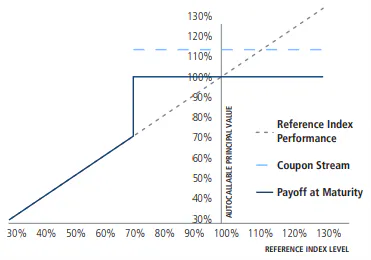
Source: Calamos Investments LLC. For illustrative purposes only. Not representative of any investment product. Past performance is no guarantee of future results. Although an autocallable is designed to incur no loss if the reference index is above the maturity barrier at expiration, the interim value of an autocallable will fluctuate as it is continually marked to current reference index prices.
*70% of the value of the Underlying Reference Index as at the date it is included in the Index Portfolio.
Challenge 2: Risk Management versus FOMO
The examples below illustrate two sharply different hypothetical choices using very different assets. They are not investment recommendations—only a setup for a third potential approach using CANQ.
- Play It Safe:
Investor A likes the return potential of the Nasdaq‑100 but fears its volatility. He goes fully risk‑off and buys a one‑year CD at ~4%. The Nasdaq‑100 then posts another strong, double‑digit year—echoing 2025—leaving him frustrated by missed upside. - Go Long:
Investor B sees the same upside drivers—procyclical policy and solid earnings—and accepts the volatility. She buys a Nasdaq‑100 ETF. The index ends the year down, and she regrets not choosing a CD instead.
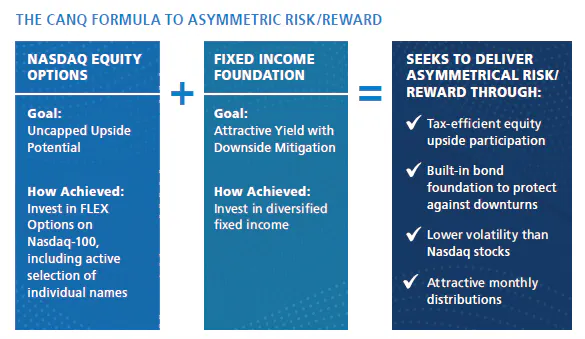
Potential Solution: Seek uncapped Nasdaq‑100 upside while reducing equity drawdowns through bond diversification and earning steady monthly income.
The Calamos Nasdaq® Equity & Income ETF (CANQ) leverages decades of expertise in alternatives, risk management, and options. Through FLEX® Options, the fund provides tax‑efficient exposure to leading Nasdaq‑100 companies with the goal of capturing unlimited upside. Its active fixed‑income sleeve seeks to limit downside and deliver monthly income above cash yields.
CANQ’s distribution yield was 6.29% as of December 31, 2025.
Challenge 3: AI Market Dynamics and Valuation Risks
- AI exuberance vs bubble: While AI spending continues to fuel Nasdaq gains, there’s growing concern about overheating valuations, the sustainability of returns, and exorbitant debt to fund the buildout.
- Earnings surprises: If AI-related firms fall short on profitability or adoption expectations, volatility may spike as analysts and investors adjust forecasts.
Potential Solution: Calamos Nasdaq-100 Structured Protection ETFs aim to deliver Nasdaq-100® upside to a cap and 100% capital protection should the index crater.
Calamos Nasdaq-100 Structured Protection ETFs are designed to match the positive price return of the Nasdaq-100® up to a defined cap while protecting against 100% of losses over a one-year period (before fees and expenses).
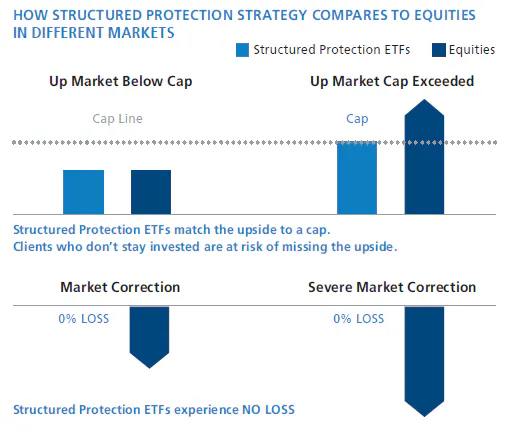
For illustrative purposes only. Not representative of any investment product. Past performance is no guarantee of future results.
Summary
The elevated sensitivity of the Nasdaq-100 to technology, policy changes, and macroeconomic dynamics means it’s particularly susceptible to volatility in 2026. Key watchpoints include Fed rhetoric, AI earnings versus expectations, geopolitical flashpoints, election uncertainty, and broader risk appetite.
However, completely derisking from the Nasdaq-100 could be an unforced error if stocks in the index continue to ride higher.
For investors who would like to participate in the index but prefer a more conservative risk profile—retirees being one demographic that comes to mind—one or more of Calamos’ three alternative solutions deserve consideration.
Visit ETF Investment Opportunities | Calamos Investments to learn more about our alternative Nasdaq-100 solutions and complete lineup of ETFs or contact us at 866.363.9219
Before investing, carefully consider the Fund’s investment objectives, risks, charges and expenses. Please see the prospectus and summary prospectus containing this and other information, which can be obtained by calling 1-866-363-9219. Read it carefully before investing.
An investment in the Fund is subject to risks, and you could lose money on your investment in the Fund. There can be no assurance that the Fund will achieve its investment objective. Your investment in the Fund is not a deposit in a bank and is not insured or guaranteed by the Federal Deposit Insurance Corporation (FDIC) or any other government agency. The risks associated with an investment in the Fund can increase during times of significant market volatility. The Fund also has specific principal risks, which are described below. More detailed information regarding these risks can be found in the Fund’s prospectus.
The principal risks of investing in the Calamos Autocallable Income ETF include: autocallable structure risk, contingent income risk, early redemption risk, barrier risk, authorized participant concentration risk, calculation methodology risk, cash holdings risk, correlation risk, costs of buying and selling fund shares, counterparty risk, credit risk, derivatives risk, equity securities risk, index risk, interest rate risk, investment in a subsidiary, laddered portfolio risk, liquidity risk, market maker risk, market risk, new fund risk, non-diversification risk, premium-discount risk, secondary market trading risk, swap agreement risk, tax risk, trading issues risk, valuation risk, and volatility target index risk.
Autocallable Structure Risk: The Fund’s returns are correlated to the performance of a synthetic portfolio of autocallable notes tracked by the Laddered Autocall Index. Autocallable notes have specific structural features that may be unfamiliar to many investors.
Contingent Income Risk: Coupon payments from the Autocalls are not guaranteed and will not be made if the Underlying Index falls below the Coupon Barrier on observation dates. This means the Fund may generate significantly less income than anticipated during market downturns.
Early Redemption Risk: Autocalls in the Portfolio may be called before their scheduled maturity if the Underlying Reference Index reaches or exceeds the Autocall Barrier on observation dates. This automatic early redemption could force reinvestment of that portion of the portfolio at lower rates if market yields have declined.
Barrier Risk: If the Underlying Reference Index falls below the Protection Level Barrier at the maturity of an Autocall in the Portfolio, that portion of the Portfolio will be fully exposed to the negative performance of the Underlying Reference Index from its initial level. This conditional protection creates a binary outcome that can result in sudden, significant losses if barriers are breached.
The MerQube Nasdaq-100 Vol Advantage Autocallable Index is designed to reflect the collective performance of a theoretical portfolio of 52 to 260 synthetic Autocallables arranged in a laddered structure with staggered entry points with similar fixed parameters (the “Parameters”) as described below within the section entitled “Autocallable Index Portfolio Characteristics”.
Risks of investing in the Calamos Nasdaq® Equity & Income ETF include risks associated with: Authorized Participant Concentration Risk: Only an Authorized Participant may engage in creation or redemption transactions directly with the Fund, and none of those Authorized Participants is obligated to engage in creation and/or redemption transactions; Debt Securities Risk: Debt securities are subject to various risks, including interest rate risk, credit risk and default risk; Equity Securities Risk: The securities markets are volatile, and the market prices of the Fund’s securities may decline generally; FLEX Options Risk: The Fund may invest in FLEX Options issued and guaranteed for settlement by The Options Clearing Corporation ("OCC"). FLEX Options are customized option contracts that trade on an exchange but provide investors with the ability to customize key contract terms like strike price, style and expiration date while achieving price discovery in competitive, transparent auctions markets and avoiding the counterparty exposure of over-the-counter options positions; High Yield Risk: High yield securities and unrated securities of similar credit quality (commonly known as “junk bonds”) are subject to greater levels of credit and liquidity risks; LEAPS® Options Risk: The Fund’s investments in options contracts may include long-term equity anticipation securities known as LEAPS Options. LEAPS Options are long-term exchange-traded call options that allow holders the opportunity to participate in the underlying securities’ appreciation in excess of a specified strike price without receiving payments equivalent to any cash dividends declared on the underlying securities; Liquidity Risk: In the event that trading in the underlying FLEX Options is limited or absent, the value of the Fund’s FLEX Options may decrease; Market Maker Risk: If the Fund has lower average daily trading volumes, it may rely on a small number of third-party market makers to provide a market for the purchase and sale of Fund Shares; Market Risk: The risk that the securities markets will increase or decrease in value is considered risk and applies any security; New Fund Risk: The Fund is a recently organized investment company with a limited operating history; Non-Diversification Risk: The Fund is classified as “nondiversified” under the 1940 Act; Options Risk: The Fund’s ability to close out its position as a purchaser or seller of an over-the-counter or exchange-listed put or call option is dependent, in part, upon the liquidity of the option market; Other Investment Companies (including ETFs) Risk: The Fund may invest in the securities of other investment companies to the extent that such investments are consistent with the Fund’s investment objective and the policies are permissible under the 1940 Act. The Nasdaq-100 Index® is a stock market index made up of equity securities issued by 100 of the largest non-financial companies listed on the Nasdaq stock exchange. It is a modified capitalization-weighted index. The Nasdaq-100 Top 30 Hybrid Income Index® tracks the performance of a systematic strategy of purchasing long call options on the 30 largest stocks in the Nasdaq-100® Index combined with a Fixed Income ETF.
There are no assurances the Nasdaq-100 Structured Protection ETFs will be successful in providing the sought-after protection. The outcomes that the Fund(s) seeks to provide may only be realized if you are holding shares on the first day of the outcome period and continue to hold them on the last day of the outcome period, approximately one year. There is no guarantee that the outcomes will be realized or that the Fund(s) will achieve its investment objective. If the outcome Value, any appreciation of the Fund(s) by virtue of increases in the underlying ETF since the commencement of the outcome period will not be protected by the sought-after protection, and an investor could experience losses until the underlying ETF returns to the original price at the commencement of the outcome period. Fund shareholders are subject to an upside return cap (the “Cap”) that represents the maximum percentage return an investor can achieve from an investment in the fund(s) for the outcome period, before fees and expenses. If the outcome period has begun and the Fund(s) have increased in value to a level near to the Cap, an investor purchasing at that price has little or no ability to achieve gains but remains vulnerable to downside risks. Additionally, the Cap may rise or fall from one outcome period to the next. The Cap, and the Fund(s) position relative to it, should be considered before investing in the Fund(s). The Fund(s) website, www.calamos.com, provides important Fund information as well information relating to the potential outcomes of an investment in the Fund(s) on a daily basis. The Fund(s) are designed to provide point-to-point exposure to the price return of the reference asset via a basket of Flex Options. As a result, the ETFs are not expected to move directly in line with the reference asset during the interim period. Investors purchasing shares after an outcome period has begun may experience very different results than fund’s investment objective. Initial outcome periods are approximately 1-year beginning on the fund’s inception date. Following the initial outcome period, each subsequent outcome period will begin on the first day of the month the fund was incepted. After the conclusion of an outcome period, another will begin.
Nasdaq®, Nasdaq-100®, Nasdaq-100 Index® and Nasdaq-100 Top 30 Hybrid Income Index® are registered trademarks of Nasdaq, Inc. (which with its affiliates is referred to as the “Corporations”) and are licensed for use by Calamos Advisors LLC. The Fund has not been passed on by the Corporations as to their legality or suitability. The Fund is not issued, endorsed, sold, or promoted by the Corporations. THE CORPORATIONS MAKE NO WARRANTIES AND BEAR NO LIABILITY WITH RESPECT TO THE FUND(S).
Distribution yield is calculated by annualizing the Fund’s most recent distribution paid and dividing by the Fund’s NAV as of the date of the period presented. Distributions may include interest and/or dividend income that represents the income accrued by the Fund during the period and are not guaranteed. Distribution Yield is based on distributions made in the past and therefore may not be reflective of the Fund’s current portfolio.
Calamos Financial Services LLC, Distributor
© 2026 Calamos Investments LLC. All Rights Reserved. Calamos® and Calamos Investments® are registered trademarks of Calamos Investments LLC.


Latest ETF News
See all ETF newsWhat To Watch This REIT Earnings Season - Q3 2026



Your ETF Is a Tool. Investors Will Decide How to Use It.


How Much ETF Infrastructure Do You Really Need?





 Advantages of ETFs over Mutual Funds1/6
Lower Costs
In this guide, we'll explore the advantages of ETFs over mutual funds, giving you valuable insights into why ETFs have gained significant popularity among investors like yourself.
Leveraged ETFs: Unlocking the Potential for Amplified Returns1/6
Understanding Leveraged ETFs
Explore leveraged ETFs: potential for amplified returns & risks. 5 ETFs to consider across equities, commodities & fixed income.
What is a Leveraged ETF?1/6
Introducing Leveraged and Inverse ETFs
In this guide, we'll dive into the world of leveraged ETFs, exploring their definition, mechanics, potential risks, and rewards.
Recent educational content
First Look ETF
First Look ETF: Income, International, and Cash Flow ETFs
In this season 6 episode of First Look ETF, Stephanie Stanton @etfguide examines the latest ETF marketplace trends with NYSE and guests.


ETF Trends
ETF Industry KPIs October 5, 2026
This week’s KPI data overview highlights key metrics and trends shaping the ETF landscape.

ETF Trends
ETF Industry KPIs September 28, 2026
This week’s KPI data overview highlights key metrics and trends shaping the ETF landscape.
ETF Trends
ETF Industry KPIs September 22, 2026
This week’s KPI data overview highlights key metrics and trends shaping the ETF landscape.