Global ETF Survey Is Live! 600+ ETF Professionals Weigh In. See Results →



Natixis Investment Managers Launches LSGR ETF: Profiling the GES Team's Winning Investment Approach
The recently launched Natixis Loomis Sayles Focused Growth ETF leverages the investment philosophy of the Loomis Sayles Growth Equity Strategies (GES) team.


Keep up with what matters in ETFs
Get timely ETF insights, market trends, and top ideas straight to your inbox.
Your newsletter subscriptions with us are subject to ETF Central's Privacy Policy and Terms and Conditions.
Recently, Natixis Investment Managers launched a new ETF, the Natixis Loomis Sayles Focused Growth ETF (Ticker: LSGR), which is being sub-advised by Loomis Sayles and managed by portfolio manager Aziz V. Hamzaogullari, Chief Investment Officer and Founder of the Loomis Sayles Growth Equity Strategies (GES) Team. The GES Team has garnered much success over the years, as they currently manage $65.3 billion, as of June 2023, in assets under management across a suite of growth equity products.
This article will highlight the investment approach utilized by the GES Team and interrelate it with the strategy employed for the Natixis Loomis Sayles Focused Growth ETF.
Global ETF Survey 2026 is Live!
With 1,790 new products launched by July 2026, choosing is harder than ever. Our Global ETF Survey 2026, built on 620 professional investors and allocators, shows how active, fixed income, options-based and thematic ETFs are reshaping fund selection.
GES’s Alpha Thesis
As active managers, the GES team takes a long-term, private equity approach to investing. By utilizing a proprietary bottom-up research framework, the team is able to invest in a few high-quality businesses with sustainable competitive advantages and profitable growth when they trade at a discount to their estimate of intrinsic value. The GES Team believes these discounts arise from pricing anomalies that occur periodically due to behavioral biases, such as herding, overconfidence, or loss aversion; when said anomalies do occur, capitalizing on these opportunities requires a disciplined process and a patient temperament.
The GES Alpha thesis represents the team’s fundamental belief regarding the most effective way to generate alpha and leverages their understanding of persistent anomalies that create asset mispricing. The following chart details the key tenets of their thesis and the investment decision making process that can be linked to performance outcomes within their growth equity strategies.
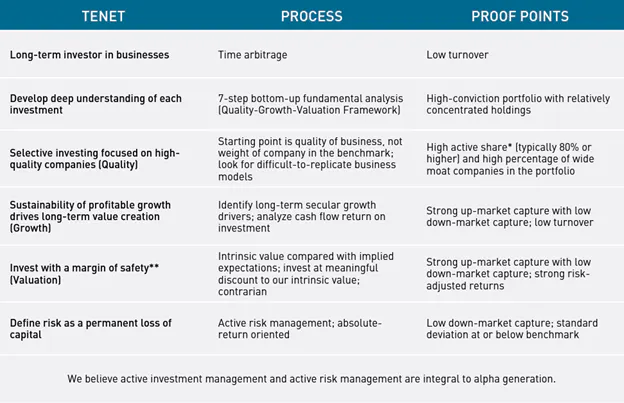
Source: LOOMIS SAYLES GROWTH EQUITY ALPHA THESIS: SEEKING RISK-ADJUSTED EXCESS RETURNS
Expounding on each tenet
Long-Term Investor in Businesses
Short-termism has become a prevalent attribute of the current investor psyche. This behavior is further fueled by the constant, ubiquitous stream of financial news and information. The long-term perspective employed by the GES Team allows them to capture value from secular growth as well as capitalize on the stock market’s shortsightedness through a process called time arbitrage.
Investors too focused on the short term end up overreacting to company and economic information that may not materially impact long-term intrinsic value. As such, the team believes that noisy stock prices will converge toward fundamentally driven intrinsic value over time. Therefore, they seek to identify intrinsic value and through time arbitrage to exploit the long-term differential between this value and the market's current perception.
Develop a Deep Understanding of Each Investment
The team’s proprietary seven-step research framework is the cornerstone of their investment decision-making process and drives security selection. Actively managed portfolios should differ from their benchmarks and reflect expectations that diverge from consensus. Thus, the research framework helps to determine whether the team’s views differ from the consensus, and if so, why. Furthermore, the disciplined decision-making process instilled by the framework counters potentially irrational, herd-like and reflexive investing behavior.
Selective Investing Focused on High-quality Businesses
A quality business—one with a wide economic moat—can sustain and even extend its competitive advantages so that its profitable growth opportunities are not eroded by competition. The GES Team’s Quality-Growth-Valuation investment process begins with the art of trying to identify high-quality companies—those with unique, difficult-to-replicate business models and sustainable competitive advantages; to do this effectively, they evaluate the entire global value chain and profit pool to help discern the companies they believe will be structural winners and losers over the long term.
Sustainability of Profitable Growth Drives Long-Term Value Creation
The team’s systematic approach to measuring a company’s growth prospects begins with quantifying the total size of the market into which they can sell their goods and services as well as their current market share. An evaluation of the profit pool allows the GES Team to identify those businesses they believe are best positioned to capture and retain a larger share. Additional evaluation regarding a company’s pricing power and competitive advantage period is done to assess the sustainability of the company’s growth rate into the future.
It should be noted that cash flow returns on invested capital is given special emphasis within the evaluation of companies, as generating profitable growth is necessary in order to increase shareholder value.
Invest with a Margin of Safety
Investing with a margin of safety requires not only a disciplined understanding of a company’s intrinsic value, but a clear recognition of what the market price implies about consensus expectations for that company’s value. The GES Team creates a margin of safety by investing at a purchase price that is meaningfully discounted to their estimate of a company’s intrinsic value. When buying a business, they require at least a 2:1 anticipated upside-to downside, reward-to-risk opportunity, and typically more. Holding all else equal, the larger the discount between market price and their estimate of intrinsic value, the greater they view the margin of safety.
Define Risk as a Permanent Loss of Capital
The GES Team takes an absolute-return approach to investing and seeks to actively manage downside risk. To do this effectively, the team believes in diversifying the business drivers to which portfolio holdings are exposed. Through bottom-up valuation analysis for each company, the primary business growth driver that has the largest impact on their estimate of its intrinsic value is identified. The team then seeks to invest in business drivers that are imperfectly correlated because the positive impact of one may offset the negative impact of another.
The Natixis Loomis Sayles Focused Growth ETF
The Natixis Loomis Sayles Focused Growth ETF will reflect the tenets of the GES Alpha Thesis, as the investment strategy employed by the ETF will be based on the Large Cap Growth institutional mandate being managed by Loomis Sayles. Gleaned from the factsheet of the institutional mandate factsheet are specific characteristics that one can expect to occur within the ETF solution, namely:
- Low Turnover. Based on the institutional mandate’s history, turnover has been 12.5% (annualized) since inception.
- High Active Share, typically greater than 80%. Active share indicates the proportion of the portfolio’s holdings (by market value) that are different than the benchmark. A higher active share indicates a larger difference between the benchmark and the portfolio.
- High Conviction and Highly Concentrated Portfolio. The portfolio will hold approximately 30 to 40 stocks, with the top 10 holdings typically representing 40% to 50% of the portfolio.
- Benchmark: Russell 1000® Growth Index
For investors interested in growth focused equity solution that utilizes an investment process aimed at identifying companies capable of establishing and maintaining competitive advantages that will foster sustainable growth over varying market cycles, this solution is worthy of consideration based on the expertise of the sub-advising firm and portfolio manager.
Please note this article is for information purposes only and does not in any way constitute investment advice. It is essential that you seek advice from a registered financial professional prior to making any investment decision.
Segments
See all
Mentioned ETFs
Further reading
Latest ETF News
See all ETF news
Beyond TLT: Treasury ETFs For the Long Duration Trade


MoneyShow Chart of the Day 9/30/26: Are Hyperscalers the New "Sovereigns?"


Which Fixed-Income ETFs Benefit from Rising Interest Rates?




 Advantages of ETFs over Mutual Funds1/6
Lower Costs
In this guide, we'll explore the advantages of ETFs over mutual funds, giving you valuable insights into why ETFs have gained significant popularity among investors like yourself.
Leveraged ETFs: Unlocking the Potential for Amplified Returns1/6
Understanding Leveraged ETFs
Explore leveraged ETFs: potential for amplified returns & risks. 5 ETFs to consider across equities, commodities & fixed income.
What is a Leveraged ETF?1/6
Introducing Leveraged and Inverse ETFs
In this guide, we'll dive into the world of leveraged ETFs, exploring their definition, mechanics, potential risks, and rewards.
Recent educational content
First Look ETF
First Look ETF: Income, International, and Cash Flow ETFs
In this season 6 episode of First Look ETF, Stephanie Stanton @etfguide examines the latest ETF marketplace trends with NYSE and guests.


ETF Trends
ETF Industry KPIs October 5, 2026
This week’s KPI data overview highlights key metrics and trends shaping the ETF landscape.

ETF Trends
ETF Industry KPIs September 28, 2026
This week’s KPI data overview highlights key metrics and trends shaping the ETF landscape.
ETF Trends
ETF Industry KPIs September 22, 2026
This week’s KPI data overview highlights key metrics and trends shaping the ETF landscape.