Keep tabs on your favorite ETFs with a personalized weekly tracker. Create a Watchlist now →



Morgan Stanley’s Bitcoin ETF Is Just the Start of a Bigger Play
The ETF is the first step, the real play is pulling crypto into the heart of finance.

Keep up with what matters in ETFs
Get timely ETF insights, market trends, and top ideas straight to your inbox.
Your newsletter subscriptions with us are subject to ETF Central's Privacy Policy and Terms and Conditions.
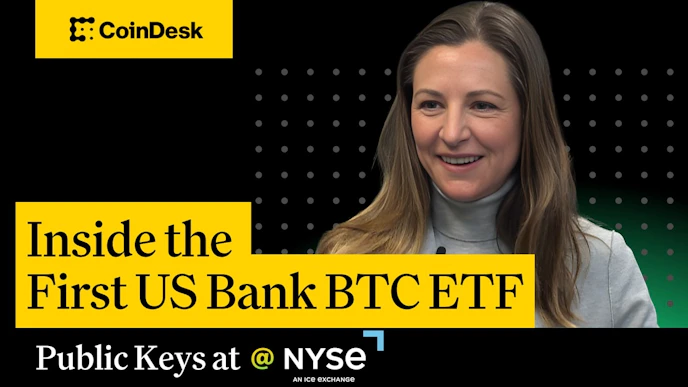
On Public Keys, host Jennifer Sanasie sits down with Amy Oldenburg, Morgan Stanley's Head of Digital Asset Strategy, to break down the bank’s historic spot Bitcoin ETF launch, why crypto and traditional finance are converging faster than expected, and how new products like Ethereum and Solana ETFs fit into the bigger strategy.
Plus, her take on investor demand, tokenization, and what a 24/7, all-in-one financial future could actually look like.
Like what you're reading?
Stay in the loop — get the latest ETF insights: trends, analysis, and expert picks.
Why Bitcoin, and Why Now?
Starting with Bitcoin was not a bold gamble. It was the obvious first step. Oldenburg framed it simply. If you are entering a new asset class, you start with the majors.
Bitcoin leads in demand, liquidity, and familiarity. From there, Morgan Stanley is already eyeing expansion into Ethereum and Solana through additional ETF filings.
But the strategy goes beyond ticking boxes. The firm is building multiple entry points for investors. Some clients prefer direct exposure through spot trading. Others are more comfortable with exchange traded products that fit neatly into traditional portfolios.
So Morgan Stanley is offering both. Spot crypto trading is being rolled out through its E-Trade platform, while ETFs provide a more familiar wrapper for cautious investors.
The Real Story Is Convergence
One of the most interesting developments is not the ETF itself but what is happening around it.
The U.S. Securities and Exchange Commission has allowed in-kind transfers of crypto into ETFs. That might sound technical, but it points to something bigger. The lines between crypto native platforms and traditional finance are starting to blur.
Clients are no longer choosing one world over the other. They are moving assets between them.
Oldenburg highlighted this shift as a key driver. Traditional financial institutions can offer services like custody, tax optimization, and structured products at a scale that crypto native platforms have not yet matched. That creates a natural pull.
In other words, crypto is not replacing Wall Street. It is merging with it.
Investors Are Getting Smarter, but There’s Work to Do
Despite the momentum, Oldenburg was candid about where the market stands. Most assets under management in crypto products are still tied to passive exposure. Investors are largely buying and holding.
That leaves a lot of room for growth.
Active strategies, tax managed products, and multi asset portfolios are still underdeveloped in the crypto space. These are staples in traditional finance, and their absence in crypto represents both a gap and an opportunity.
Education is another hurdle. Understanding the underlying value of digital assets is still a work in progress for many investors. The demand is there, but sophistication is still catching up.
Timing Matters More Than You Think
Interestingly, Oldenburg pointed out that Bitcoin’s price today is roughly where it was when the first wave of ETFs launched in 2024.
That creates a unique setup. Investors who missed the first wave may feel they have a second chance. At the same time, those already invested might reassess their positions, especially if they can take advantage of tax strategies or shift into more efficient products.
This is where Morgan Stanley sees opportunity. Not just in attracting new capital, but in helping existing investors reposition.
Tokenization and the 24/7 Future
If ETFs are step one, tokenization is step two.
Morgan Stanley is exploring tokenized money market funds, stablecoins, and eventually tokenized versions of a wide range of assets. The goal is straightforward. Build a financial system that operates around the clock, just like the rest of modern life.
Oldenburg connected this to a broader trend. Everything else we do is already 24/7. Shopping, communication, entertainment. Finance is one of the last major systems still bound by traditional hours.
That is changing.
But the infrastructure is not fully there yet. Many institutions, including Morgan Stanley itself, are still building the systems needed to support these new forms of assets.
A Brand Play with Strategic Depth
Morgan Stanley does not typically launch ETFs under its own name. So why do it now?
Trust.
In a market still viewed as volatile and, at times, opaque, the Morgan Stanley brand carries weight. Being the first major global systemically important bank to issue a crypto ETP adds another layer of credibility.
It is also a strategic move. The firm is positioning itself as a bridge between crypto native wealth and traditional financial services.
And that bridge is valuable. The crypto ecosystem represents trillions in assets, much of it sitting outside the traditional financial system.
Chasing Two Opportunities at Once
Oldenburg described the strategy as “all of the above,” and that feels accurate.
On one side, there is a new client base. Crypto wealthy investors who need financial services. On the other, there is a massive infrastructure overhaul underway.
Morgan Stanley is not choosing between them. It is pursuing both.
That dual approach could be the real differentiator. While some firms focus on products and others on infrastructure, Morgan Stanley is trying to build the entire pipeline.
The Endgame: One Financial Dashboard
If you zoom out, the vision becomes clear.
A single platform where clients can see everything. Crypto holdings, cash, traditional investments, all in one place. Accessible anytime.
Oldenburg even hinted at a future where AI agents manage portfolios in the background, optimizing allocations without constant human input.
It sounds futuristic, but the pieces are already coming together.
The ETF launch is just one of them.
Please note this article is for information purposes only and does not in any way constitute investment advice. It is essential that you seek advice from a registered financial professional prior to making any investment decision.


Latest ETF News
See all ETF news






 Advantages of ETFs over Mutual Funds1/6
Lower Costs
In this guide, we'll explore the advantages of ETFs over mutual funds, giving you valuable insights into why ETFs have gained significant popularity among investors like yourself.
Leveraged ETFs: Unlocking the Potential for Amplified Returns1/6
Understanding Leveraged ETFs
Explore leveraged ETFs: potential for amplified returns & risks. 5 ETFs to consider across equities, commodities & fixed income.
What is a Leveraged ETF?1/6
Introducing Leveraged and Inverse ETFs
In this guide, we'll dive into the world of leveraged ETFs, exploring their definition, mechanics, potential risks, and rewards.
Recent educational content

First Look ETF
First Look ETF: Income, International, and Cash Flow ETFs
In this season 6 episode of First Look ETF, Stephanie Stanton @etfguide examines the latest ETF marketplace trends with NYSE and guests.


ETF Trends
ETF Industry KPIs October 5, 2026
This week’s KPI data overview highlights key metrics and trends shaping the ETF landscape.

ETF Trends
ETF Industry KPIs September 28, 2026
This week’s KPI data overview highlights key metrics and trends shaping the ETF landscape.
ETF Trends
ETF Industry KPIs September 22, 2026
This week’s KPI data overview highlights key metrics and trends shaping the ETF landscape.
Browse all educational columns



ETFs’ Next Act: From Access to Selection
With 1,790 new products launched by July 2026, choosing is harder than ever. Our Global ETF Survey 2026, built on 620 professional investors and allocators, shows how active, fixed income, options-based and thematic ETFs are reshaping fund selection.