Turn ETF ideas into real portfolios. Try the builder now →



MoneyShow Chart of the Day 8/27/2025: The Smaller They are, The Harder They Rally
Small caps are turning size into an advantage and the charts prove it.


Keep up with what matters in ETFs
Get timely ETF insights, market trends, and top ideas straight to your inbox.
Your newsletter subscriptions with us are subject to ETF Central's Privacy Policy and Terms and Conditions.
Forget that outdated maxim “The bigger they are, the harder they fall.” In this market, it’s more like “The smaller they are, the harder they RALLY!”
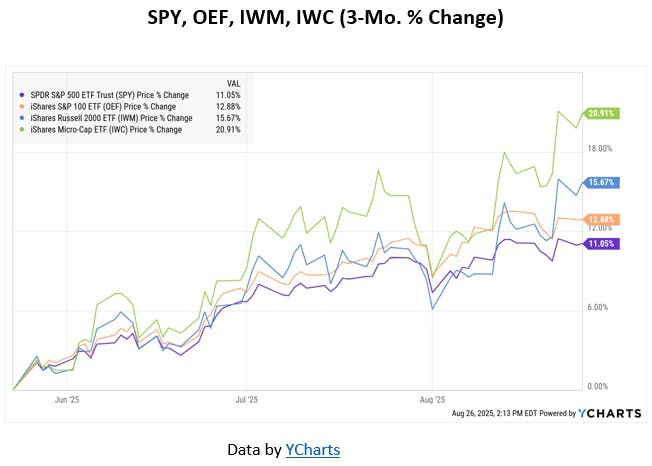
Just look at the MoneyShow Chart of the Day. It compares the three-month performance of the SPDR S&P 500 ETF (SPY), the iShares S&P 100 ETF (OEF), the iShares Russell 2000 ETF (IWM), and the iShares Micro-Cap ETF (IWC).
Like what you're reading?
Stay in the loop — get the latest ETF insights: trends, analysis, and expert picks.
SPY, OEF, IWM, IWC (3-Mo. % Change)
Data by YCharts
You know the SPY. As for the OEF, it tracks the 100 largest-capitalization companies in the S&P 500 – with an average market cap of $891 billion, according to Morningstar. The comparable market cap figure is just $2.58 billion for IWM, and only $568 million for IWC.
So, what does the chart make clear? Despite their pint-sized market caps, smaller stocks are now leading the way!
While the OEF is up a respectable 12.8% year-to-date...the IWM is up 15.6%...and the IWC is up 20.9%. OEF is still “winning” on a year-to-date basis. But the performance gap is shrinking quickly.
What’s driving the action? Part of it is investors looking for new leadership after focusing on big-cap tech for so long. But the Federal Reserve is a key factor, too. All else being equal, Fed rate cuts/cheaper money tend to help smaller cap stocks more than large cap ones.
Bottom line: If you’re looking for new places to invest, don’t think big. Think SMALL!
If you want to get more articles and chart analysis from MoneyShow, subscribe to our Top Pros’ Top Picks newsletter here
Please note: This is syndicated content and reflects the author’s personal views. It does not represent the opinions of this publication or its affiliates. The article is for informational purposes only and does not constitute investment advice. Always consult a registered financial professional before making any investment decisions.
Mentioned ETFs
Further reading

Latest ETF News
See all ETF newsMoneyShow Chart of the Day 9/4/26: Don't Just Watch Oil. Watch THESE.

Chart of the Day 8/14/26: The Great "Hot Money" Migration

MoneyShow Chart of the Day 7/29/26: Now, THAT's What I Call Market Rotation!

MoneyShow Chart of the Day 7/16/26: Good News/Bad News on Inflation (and the Fed)




 Advantages of ETFs over Mutual Funds1/6
Lower Costs
In this guide, we'll explore the advantages of ETFs over mutual funds, giving you valuable insights into why ETFs have gained significant popularity among investors like yourself.
Leveraged ETFs: Unlocking the Potential for Amplified Returns1/6
Understanding Leveraged ETFs
Explore leveraged ETFs: potential for amplified returns & risks. 5 ETFs to consider across equities, commodities & fixed income.
What is a Leveraged ETF?1/6
Introducing Leveraged and Inverse ETFs
In this guide, we'll dive into the world of leveraged ETFs, exploring their definition, mechanics, potential risks, and rewards.
Recent educational content

ETF Trends
ETF Industry KPIs September 14, 2026
This week’s KPI data overview highlights key metrics and trends shaping the ETF landscape.

ETF Trends
ETF Industry KPIs September 8, 2026
This week’s KPI data overview highlights key metrics and trends shaping the ETF landscape.
ETF Trends
ETF Industry KPIs August 31, 2026
This week’s KPI data overview highlights key metrics and trends shaping the ETF landscape.
ETF Trends
ETF Industry KPIs August 24, 2026
This week’s KPI data overview highlights key metrics and trends shaping the ETF landscape.
Browse all educational columns



Build and Analyze Your ETF Portfolio Like a Pro
Create your own ETF portfolio in minutes and instantly see allocations, exposures, performance, and risk. Visualize diversification across asset classes, regions, and sectors. Stress-test ideas, compare benchmarks, and refine your strategy with professional-grade analytics.