Open Now: The Global ETF Survey Take the Survey →



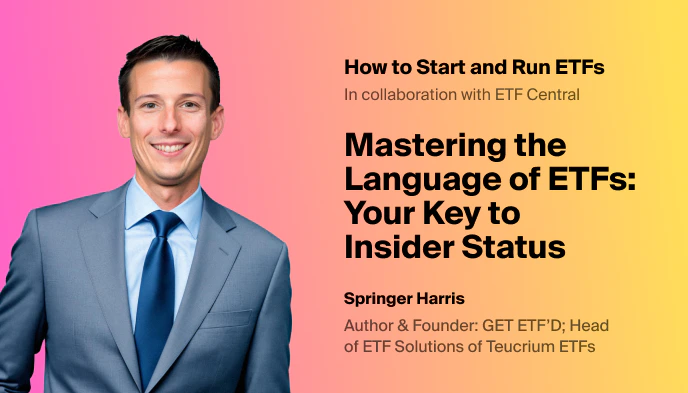
Mastering the Language of ETFs: Your Key to Insider Status
Don't let ETF jargon hold you back. Master the language of exchange-traded funds and open doors to new possibilities. Boost your confidence and forge valuable industry relationships.

Keep up with what matters in ETFs
Get timely ETF insights, market trends, and top ideas straight to your inbox.
Your newsletter subscriptions with us are subject to ETF Central's Privacy Policy and Terms and Conditions.
Many people find it difficult to enter and navigate the world of exchange-traded funds. This is primarily based on a single principle: language. Knowing the terminology is crucial in any specialized industry. It defines who's in and who's out, shaping your future opportunities.
I am on the board of our local hospital and trust me, the other board members and guests can tell instantly that I am an outsider in the healthcare industry. I'm not going to lie; that can cause a certain level of anxiety and discomfort.
In my consulting work, I've seen the same thing. Many asset managers stumble over ETF jargon and are hesitant to ask questions. Not because they lack confidence but because they're unfamiliar with the language of ETFs.
Knowing the correct terminology boosts your confidence, enabling you to initiate discussions, ask pertinent questions, and forge meaningful industry relationships. Let's get straight to the essentials.
Here are the key terms you need to know.
Like what you're reading?
Stay in the loop — get the latest ETF insights: trends, analysis, and expert picks.
Net Asset Value
The Net Asset Value (NAV) represents the underlying value of the ETF on a per-share basis. The fund's administrator calculates the NAV at the end of each trading day by taking the value of the fund's underlying assets minus liabilities and dividing it by the total number of shares outstanding.
Moreover, NAV is a metric for assessing an ETF's performance. Investors can determine how effectively a fund is performing by comparing its NAV to its benchmark index and determining whether the ETF is providing the desired exposure to a specific market segment or investment strategy.
Authorized Participants (APs) use the NAV to determine the appropriate basket of securities to exchange for ETF shares during the creation process and the value of the securities to be received when redeeming ETF shares. This process helps ensure that investors transact at a fair price.
Creation and Redemption Process
The creation and redemption process sets ETFs apart from other investment vehicles. This mechanism allows for the ongoing issuance and redemption of shares, which creates a frictionless response to investor demand and ensures the fund's shares remain liquid and easily tradable.
Authorized Participants (APs), defined below, play an essential role in the creation and redemption process. In the case of creation, APs exchange a basket of the fund's underlying securities for ETF shares, effectively increasing the number of available shares in the market. Conversely, in the case of redemption, APs exchange ETF shares for the underlying securities to reduce the number of shares in circulation.
This process facilitates continuous adjustment of the ETF's supply and helps keep its market price in line with its NAV. By arbitraging any discrepancies between the market price and the NAV, APs help ensure that the ETF's price remains reflective of the value of its underlying assets.
Authorized Participants
APs are typically large financial institutions, such as banks or broker-dealers, who enter into contractual agreements with ETF issuers to facilitate the creation and redemption of ETF shares.
APs also play a role in the secondary market by providing liquidity for ETF shares. They often act as, or partner with, market makers to quote bid and ask prices for ETF shares and facilitate trades between buyers and sellers. This activity helps reduce bid-ask spreads, minimizes price discrepancies, and enables efficient trading for investors. In other words, Authorized Participants are key to ensuring the fund's liquidity and market efficiency.
'40 Act & '33 Act
Often referred to as the '40 Act and the '33 Act, these are shorthand references to The Investment Company Act of 1940 and the Securities Act of 1933. They are legislation governing the ETF industry in the United States. The '40 Act focuses on the structure and operations of investment companies in regard to registration, management, and operations. In contrast, the '33 Act regulates registration, prospectus disclosure, and ongoing reporting obligations for securities issuers.
Compliance with both acts is essential for issuers to launch and maintain a successful ETF business. By adhering to the provisions of both the '40 Act and the '33 Act, ETF issuers operate transparently and within regulatory bounds, fostering investor confidence and promoting market efficiency.
Passive vs. Active ETFs
Active and passive ETFs represent distinct investment management approaches, each with their own benefits. Passive ETFs aim to replicate the performance of a specific index or benchmark and provide investors with returns similar to those of their chosen market segment. These ETFs generally have lower expense ratios due to the reduced need for active portfolio management, which makes them an attractive, cost-efficient option for investors seeking broad market exposure.
Active ETFs, however, are managed by professionals who strive to outperform benchmarks or meet investment goals. Due to the additional resources and expertise required for active management, active ETFs often have higher expense ratios than passive ETFs. These ETFs may appeal to investors seeking potentially higher returns or targeted exposure to specific investment strategies or themes.
Tracking Error
Tracking error is a measure of how closely an ETF's performance aligns with its benchmark index. A lower tracking error indicates that the ETF is closely replicating the performance of its index, while a higher tracking error suggests a deviation from the benchmark. Tracking error can result from various factors, including differences in the ETF's portfolio composition, fees and expenses, and the impact of portfolio rebalancing.
An ETF with a consistently low tracking error is more attractive to investors than a fund with erratic deviations from the benchmark, even if the average tracking error is similar. To achieve this, ETF issuers must employ robust portfolio management practices, such as regular rebalancing, efficient trading strategies, and sophisticated technology for optimal portfolio construction.
Expense Ratio
The expense ratio represents the annual cost of owning the fund. This cost is traditionally expressed as a percentage of the fund's average net assets. It includes various fees and expenses associated with managing the ETF, such as administrative costs and other operational expenses. It does not include trading costs, such as brokerage commissions or bid-ask spreads, which are incurred when buying or selling ETF shares on the secondary market.
One of the reasons ETFs have gained popularity is due to their typically lower expense ratios than traditional mutual funds. A lower expense ratio is generally more attractive to investors as the lower overall costs result in a higher net return on investment. This cost advantage can be especially significant for long-term investors, as even slight differences in fees can considerably impact investment performance over time.
When starting an ETF, the fund's expenses should be managed carefully, as this can influence how attractive the ETF is to investors and affect its overall competitiveness in the market. This may involve negotiating favorable fee arrangements with service providers, implementing cost-efficient operational practices, and leveraging economies of scale to reduce expenses as the ETF grows.
Insider Status
This is just an introduction to the extensive terminology associated with ETFs. Understanding the language of ETFs is critical; that's why it is a significant part of the Certified ETF (CETF) exam and its study materials. I also emphasize the importance of terminology in my book, GET ETF'D, by creating the only industry-specific glossary that contains more than 100 detailed terms and definitions.
Mastering these will position you to engage more effectively with industry insiders. But to truly connect with seasoned professionals in the ETF industry, you must know the history of ETFs, their origins, and their development. By understanding the key events that have shaped the industry, you'll be equipped for meaningful discussions.
Next week, we are going to move past the basics and "Find Your Sweet Spot."
About the Author
Springer Harris, author of "GET ETF'D: An Insider's Guide to Starting and Running an ETF," focuses on simplifying the complexities of launching and managing ETFs to empower entrepreneurs. He discusses the detailed processes and challenges of successfully introducing ETFs to the market in his writings. As Chief Operating Officer and Head of ETF Solutions at Teucrium ETFs, Springer has helped a broad spectrum of clients, from individuals to large asset managers, launch their ETFs efficiently. Connect with Springer on LinkedIn for more insights or help starting your ETF.
Please note this article is for information purposes only and does not in any way constitute investment advice. It is essential that you seek advice from a registered financial professional prior to making any investment decision.

Latest ETF News
See all ETF newsHow Covered Call ETFs Evolved Through the Years


There's an ETF for That? Funds with a Social Impact

Can Gold Miner ETFs Be a Better Alternative to Leveraged Gold ETFs?

Options-Based ETFs as Fixed-Income Alternatives: What Investors Should Know




 Advantages of ETFs over Mutual Funds1/6
Lower Costs
In this guide, we'll explore the advantages of ETFs over mutual funds, giving you valuable insights into why ETFs have gained significant popularity among investors like yourself.
Leveraged ETFs: Unlocking the Potential for Amplified Returns1/6
Understanding Leveraged ETFs
Explore leveraged ETFs: potential for amplified returns & risks. 5 ETFs to consider across equities, commodities & fixed income.
What is a Leveraged ETF?1/6
Introducing Leveraged and Inverse ETFs
In this guide, we'll dive into the world of leveraged ETFs, exploring their definition, mechanics, potential risks, and rewards.
Recent educational content

First Look ETF
First Look ETF: Cycle Aware Investing & Next-Gen Nicotine Shifts
In this season 6 episode of First Look ETF, Stephanie Stanton examines the latest ETF marketplace trends with NYSE and guests.


ETF Trends
ETF Industry KPIs August 10, 2026
This week’s KPI data overview highlights key metrics and trends shaping the ETF landscape.

ETF Trends
ETF Industry KPIs July 20, 2026
This week’s KPI data overview highlights key metrics and trends shaping the ETF landscape.
ETF Trends
ETF Industry KPIs July 13, 2026
This week’s KPI data overview highlights key metrics and trends shaping the ETF landscape.
Browse all educational columns



Expert-Built ETF Portfolios, All in One Place
Don’t start from scratch. Discover ready-made ETF portfolios built by professionals to match different goals, timelines, and market views. Use them as inspiration or as a starting point for your own allocation.