ETF model portfolios designed for real investor needs. Discover →



How to Make Room for Gold in Your ETF Portfolio
Want to allocate to gold but run out of room? These two WisdomTree ETFs can help.


Keep up with what matters in ETFs
Get timely ETF insights, market trends, and top ideas straight to your inbox.
Your newsletter subscriptions with us are subject to ETF Central's Privacy Policy and Terms and Conditions.
Gold's spot price has been hitting new highs in 2024, capturing the attention of investors and advisors alike. However, the true value of gold in an investment portfolio extends beyond its potential for high returns.
Gold is particularly valued for its consistently low correlation with both stocks and bonds, making it a staple for those focused on balancing risk and return rather than chasing the latest hot asset classes.
This low correlation with traditional financial assets makes gold a valuable diversification tool, helping to stabilize investment portfolios during periods of market volatility and economic uncertainty.
Today, we'll examine the reasons behind gold's unique market behavior and highlight how specific ETFs can facilitate efficient inclusion of gold in your portfolio, even when it seems there's no room left for additional allocations.
Like what you're reading?
Stay in the loop — get the latest ETF insights: trends, analysis, and expert picks.
Why allocate to gold?
Allocating a portion of your investment portfolio to gold can significantly enhance its overall performance and stability, as evidenced by a long-term backtest from 1986 to the present.
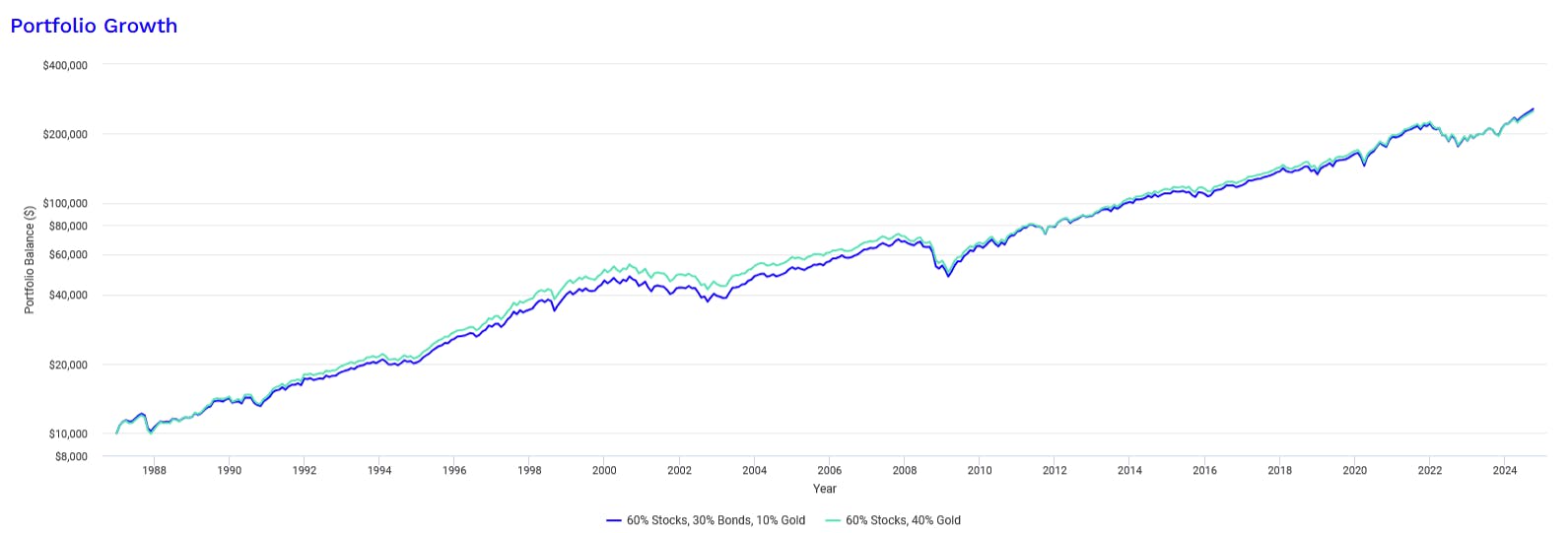
This analysis compares two portfolios: one consisting of 60% stocks, 30% bonds, and 10% gold, and another with 60% stocks and 40% bonds. Here's a summary of their performance:
- The portfolio including gold ended with $255,659, slightly outperforming the $249,918 of the portfolio without gold.
- Both portfolios exhibited similar annualized returns (CAGR) with 8.97% for the diversified portfolio versus 8.90% for the stocks and bonds only.
- The inclusion of gold resulted in a nearly identical standard deviation, highlighting that risk was not significantly increased.
- Similarly, both portfolios had nearly the same Sharpe ratio, indicating that the addition of gold did not detract from risk-adjusted returns.
The key advantage of including gold lies in its low correlation with traditional financial assets. Gold's correlation coefficient with U.S. stocks stands at exactly 0 and with U.S. bonds at 0.19.
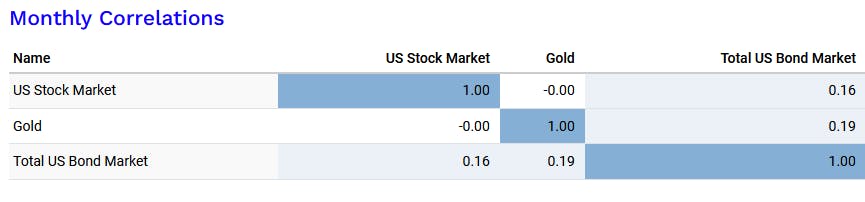
This lack of correlation, combined with gold's inherent volatility, is beneficial according to modern portfolio theory. It suggests that adding gold can enhance portfolio diversification, reducing overall risk without sacrificing returns.
In years like 2022, when stocks and bonds fell in tandem, having an allocation to an uncorrelated asset like gold proved crucial. It helped reduce overall portfolio drawdowns, showcasing gold's role as a protective asset during market downturns.
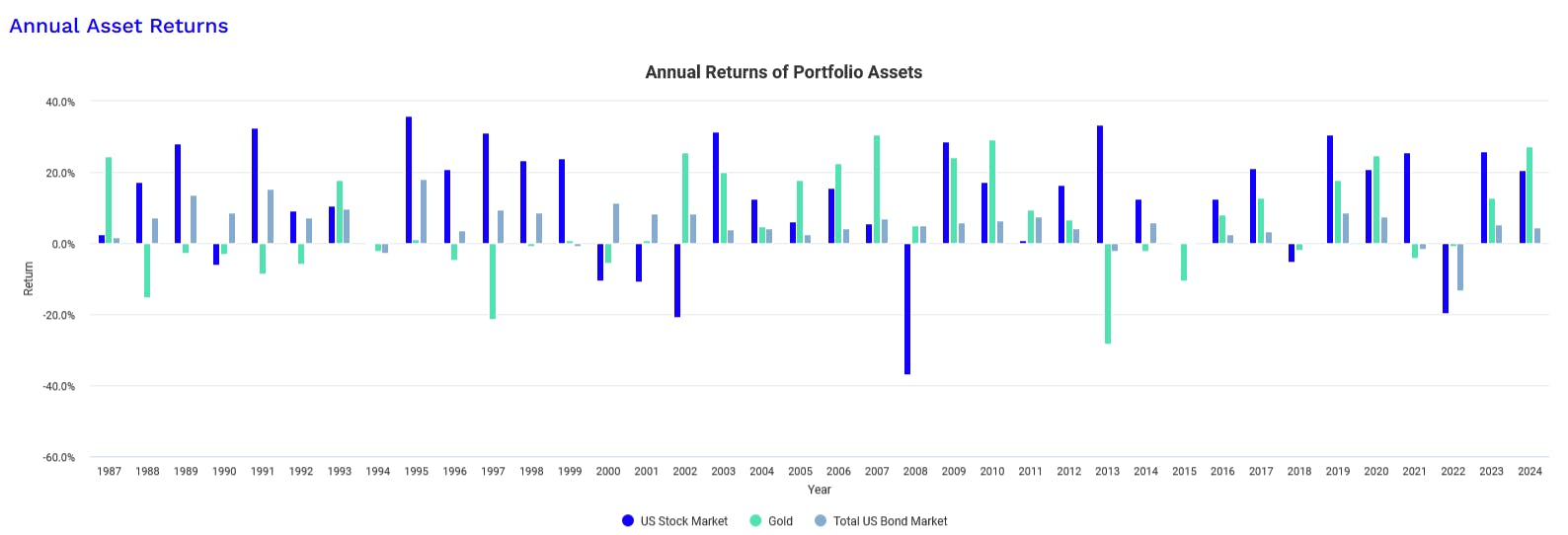
Rebalancing this allocation quarterly ensures that the portfolio maintains its intended risk exposure and capitalizes on the rebalancing bonus, further optimizing returns.
Why does gold behave like this?
Gold behaves distinctly within an investment portfolio due to its unique risk factors, which differ fundamentally from those of stocks and bonds.
Equity investments are influenced by variations in earnings growth, dividends, buybacks, and investor sentiment, which determine stock prices and their volatility.
These investments are sensitive to both macroeconomic changes and company-specific developments, tying their performance closely to the broader economic environment and the fortunes of individual companies.
Bond investments, meanwhile, hinge on factors like credit quality, duration, interest rate changes, and the solvency of issuers. Bonds are particularly sensitive to interest rate movements, with their prices inversely related to rate changes, and to the financial health of bond issuers, impacting their return profiles based on perceived risk.
Gold, on the other hand, operates under a different set of influences that set it apart as an asset class. It is often considered a hedge against inflation, as its price tends to rise when the cost-of-living increases.
The policies of central banks, which can involve significant purchases or sales of gold, also play a crucial role in determining its price. Additionally, during times of geopolitical unrest, gold is frequently sought as a 'safe haven' due to its enduring value.
Currency fluctuations also impact gold prices, particularly movements in the U.S. dollar, as gold becomes more attractive to international buyers when the dollar weakens. Furthermore, gold's supply is tightly controlled and slow to change, with new mine developments taking years to begin production, affecting its availability and market price.
Due to these factors, gold's risk profile has little overlap with those of stocks and bonds. Adding gold to a portfolio, therefore, can enhance its resilience by providing a hedge against risks that traditional financial assets do not cover.
How to gain gold exposure efficiently
Navigating the complexities of asset allocation often involves finding space for additional, uncorrelated assets like gold, which can enhance portfolio diversification without requiring significant capital commitment.
To address this challenge, WisdomTree offers two innovative ETFs that use the embedded leverage of futures to deliver efficient gold exposure.
The first ETF, the WisdomTree Efficient Gold Plus Equity Strategy Fund
However, the remaining $10 isn't just left idle; it's held in short-term money market securities earning the T-bill rate and used as collateral for gold futures contracts. This arrangement provides 9x notional leverage, giving the ETF an effective 90% exposure to gold.
The end result is that GDE offers simultaneous exposure to both 90% equity and 90% gold, totaling 1.8x leverage. This high degree of exposure is achieved with a modest 0.2% expense ratio.
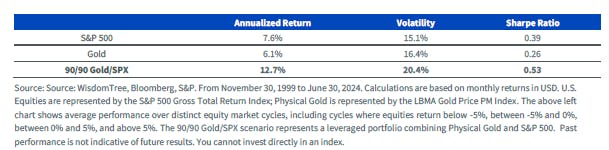
Its utility extends beyond just standalone use; it's particularly valuable for freeing up room within broader portfolios. For example, allocating 60% of your portfolio to GDE results in 54% exposure to both stocks and gold, leaving 40% of your portfolio available for other assets such as bonds, real estate, or trend-following strategies.
Another option from WisdomTree is the Efficient Gold Plus Gold Miners Strategy Fund
Instead of large-cap stocks, the $90 in this ETF is invested in gold miners, enhancing exposure to the gold industry while maintaining the same $10 allocation as collateral for gold futures. GDMN carries a slightly higher expense ratio of 0.45% due to its specialized focus.
Please note this article is for information purposes only and does not in any way constitute investment advice. It is essential that you seek advice from a registered financial professional prior to making any investment decision.
Segments
See all
Mentioned ETFs
Further reading
Latest ETF News
See all ETF news10-Year Treasury Yield Hits 5%: Which Bond ETFs Offer the Most Direct Exposure?

ETF comparison: NEOS S&P 500 High Income ETF (SPYI) Versus Goldman Sachs S&P 500 Premium Income ETF (GPIX)

There’s an ETF for That? Investing Like University Endowments

Could Water ETFs Be the Next AI Bottleneck Trade?

What is a Boomer Candy ETF?



 Advantages of ETFs over Mutual Funds1/6
Lower Costs
In this guide, we'll explore the advantages of ETFs over mutual funds, giving you valuable insights into why ETFs have gained significant popularity among investors like yourself.
Leveraged ETFs: Unlocking the Potential for Amplified Returns1/6
Understanding Leveraged ETFs
Explore leveraged ETFs: potential for amplified returns & risks. 5 ETFs to consider across equities, commodities & fixed income.
What is a Leveraged ETF?1/6
Introducing Leveraged and Inverse ETFs
In this guide, we'll dive into the world of leveraged ETFs, exploring their definition, mechanics, potential risks, and rewards.
Recent educational content

ETF Trends
ETF Industry KPIs September 14, 2026
This week’s KPI data overview highlights key metrics and trends shaping the ETF landscape.

ETF Trends
ETF Industry KPIs September 8, 2026
This week’s KPI data overview highlights key metrics and trends shaping the ETF landscape.
ETF Trends
ETF Industry KPIs August 31, 2026
This week’s KPI data overview highlights key metrics and trends shaping the ETF landscape.
ETF Trends
ETF Industry KPIs August 24, 2026
This week’s KPI data overview highlights key metrics and trends shaping the ETF landscape.
Browse all educational columns



Build and Analyze Your ETF Portfolio Like a Pro
Create your own ETF portfolio in minutes and instantly see allocations, exposures, performance, and risk. Visualize diversification across asset classes, regions, and sectors. Stress-test ideas, compare benchmarks, and refine your strategy with professional-grade analytics.