Ready-made ETF portfolios built for real investor needs. Explore now →



Long-Dated Treasuries No Longer Considered a Safe Haven
Strong retail sales data and concerns of tighter monetary policy led to a sharp spike in government bond yields, causing significant losses in long-term government and corporate bonds, impacting ETFs.


Keep up with what matters in ETFs
Get timely ETF insights, market trends, and top ideas straight to your inbox.
Your newsletter subscriptions with us are subject to ETF Central's Privacy Policy and Terms and Conditions.
The past week was marked by a sudden and sharp spike in government bond yields following the release of stronger-than-expected retail sales data on October 17. Further compounding matters, Jerome Powell has suggested that above-average growth, or an excessively strong labour market, might require a further tightening of monetary policy.
The yield on the 10-year US Treasury hit 5% for the first time since July 2007, before closing at 4.93%, up 30 basis points for the week. The 20-year US Treasury yield touched 5.30%, while the yield for the 30-year bond spiked to 5.09%. These fluctuations have led investors to question whether long-dated treasuries still represent a safe haven given the dramatic flattening of the U.S. yield curve since the end of June, exposing holders of long-dated government bonds to significant losses.
The repercussions of these recent shifts have been felt across various segments of the bond market. Long-term government bonds dropped by 4.89%, while their corporate counterparts saw losses amounting to approximately 4.21%.
The Wilshire Bond Index wasn’t immune either, recording a loss of around 2.28% over the course of this week alone.
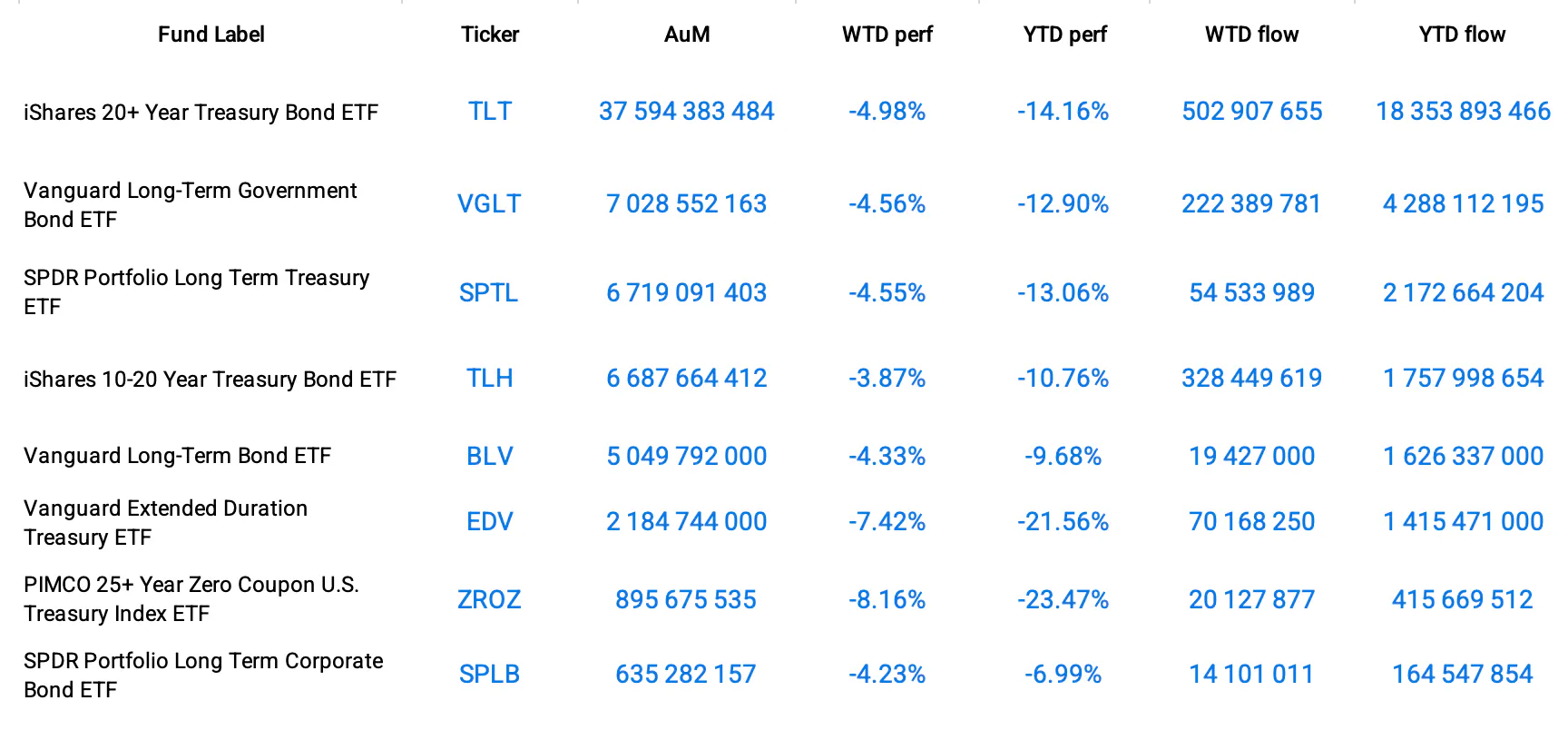
Such dynamic shifts have had a significant impact on ETFs focused primarily on longer maturities. Notably, iShares 20+ Year Treasury Bond ETF - managing more than $37 billion worth in assets – experienced a significant decline with losses amounting to 4.98%.
Get data on 14,000+ ETFs
Access Trackinsight's reliable and comprehensive data with 500M+ points on 14,000+ ETFs.
Segment Data: Long Term Government Bonds, Long Term IG Corporate Bonds

Index Data

Funds Specific Data: TLT, VGLT, SPLT, TLH, BLV, EDV, ZROZ, SPLB
Please note this article is for information purposes only and does not in any way constitute investment advice. It is essential that you seek advice from a registered financial professional prior to making any investment decision.

Latest ETF News
See all ETF newsMoneyShow Chart of the Day 9/4/26: Don't Just Watch Oil. Watch THESE.


Chart of the Day 8/14/26: The Great "Hot Money" Migration

MoneyShow Chart of the Day 7/29/26: Now, THAT's What I Call Market Rotation!

MoneyShow Chart of the Day 7/16/26: Good News/Bad News on Inflation (and the Fed)




 Advantages of ETFs over Mutual Funds1/6
Lower Costs
In this guide, we'll explore the advantages of ETFs over mutual funds, giving you valuable insights into why ETFs have gained significant popularity among investors like yourself.
Leveraged ETFs: Unlocking the Potential for Amplified Returns1/6
Understanding Leveraged ETFs
Explore leveraged ETFs: potential for amplified returns & risks. 5 ETFs to consider across equities, commodities & fixed income.
What is a Leveraged ETF?1/6
Introducing Leveraged and Inverse ETFs
In this guide, we'll dive into the world of leveraged ETFs, exploring their definition, mechanics, potential risks, and rewards.
Recent educational content

ETF Trends
ETF Industry KPIs September 8, 2026
This week’s KPI data overview highlights key metrics and trends shaping the ETF landscape.

ETF Trends
ETF Industry KPIs August 31, 2026
This week’s KPI data overview highlights key metrics and trends shaping the ETF landscape.
ETF Trends
ETF Industry KPIs August 24, 2026
This week’s KPI data overview highlights key metrics and trends shaping the ETF landscape.
What’sTheFund
What's the Fund | Ocean Park Diversified Income ETF (DUKZ)
James St Aubin, Chief Investment Officer at Ocean Park Asset Management, discuss the DUKZ ETF, exposing investors to the whole spectrum of asset classes in the fixed income markets, through their rules-based process.

Browse all educational columns



Active Trader Report: Use of Leveraged & Inverse ETFs Way Up
Direxion partnered with Compound Insights and Vanda to explore what’s driving the evolution of active trading — and how active traders are using leveraged and inverse funds across equities, single stocks, commodities, and volatility.