Open Now: The Global ETF Survey Take the Survey →



KraneShares and Rockefeller Launch the KraneShares Rockefeller Ocean Engagement ETF
The newly launched solution focuses on the meaningful investment opportunities within the blue economy.


Keep up with what matters in ETFs
Get timely ETF insights, market trends, and top ideas straight to your inbox.
Your newsletter subscriptions with us are subject to ETF Central's Privacy Policy and Terms and Conditions.
Though the ocean covers approximately 70 percent of the earth’s surface, the commercial and investment opportunities are still unfolding. The recently launched KraneShares Rockefeller Ocean Engagement ETF (Ticker:KSEA) aims to provide investors with exposure to the "blue economy", a subset of the ocean economy that focuses on sustainable solutions that have ocean-positive benefits. The ETF will be sub-advised by Rockefeller Asset Management, a division of Rockefeller Capital Management, which brings engagement, sustainability, and thematic investing capabilities. Rockefeller Asset Management has 30 years of experience investing in global markets and long-standing partnerships with leading non-profit organizations for ocean conservation, including the Ocean Foundation and World Resources Institute.
Get data on 14,000+ ETFs
Access Trackinsight's reliable and comprehensive data with 500M+ points on 14,000+ ETFs.
A look at the Ocean Economy
The Organization for Economic Co-operation and Development (OECD) defines the ocean economy as the sum of the economic activities of ocean-based industries, together with the assets, goods and services provided by marine ecosystems. Economic activity in the ocean is diverse and rapidly expanding, driven primarily by developments in global population, economic growth, trade and rising income levels, climate and environment, and technology. As data from the OECD’s Ocean Economy Database suggests, the ocean economy’s output in 2010 was $1.5 trillion, or approximately 2.5% of world gross value added (GVA). Looking to 2030, many ocean‑based industries have the potential to outperform the growth of the global economy as a whole, both in terms of value added and employment. The projections suggest that between 2010 and 2030 on a “business‑as‑usual” scenario basis, the ocean economy could more than double its contribution to global value added, reaching over 3 trillion USD.
The blue economy defined
The blue economy is generally understood to be a long-term strategy aimed at supporting sustainable and equitable economic growth through ocean-related sectors and activities. The blue economy concept seeks to promote economic growth, social inclusion, and the preservation or improvement of livelihoods while at the same time ensuring environmental sustainability of the oceans and coastal areas.
Simply put, the blue economy moves beyond business as usual to consider economic development and ocean health as compatible propositions, with growth initiatives centered around reducing carbon emissions and pollution, enhancing energy efficiency, and harnessing the power of the ocean for equitable sustainable development for all.
The KSEA strategy
As a globally oriented solution, the KraneShares Rockefeller Ocean Engagement ETF provides investors with broad-based exposure to companies that have beneficial exposure to oceanic commercial activities. The fund’s exposure will include companies from sectors such as aquaculture, commercial fishing, waste management, renewable energy, and logistics.
In identifying companies suitable for the fund, the manager begins with the MSCI All Country World Index, then filters based on three key ocean themes: Pollution Prevention, Carbon Transition, Ocean Conservation, and associated sub-themes. Identified opportunities are evaluated through Rockefeller Asset Management’s proprietary investment process, which looks at the fundamentals and the engagement opportunities that can be had with said companies. As part of this process, the firm leverages its network of industry experts and scientific collaborators to gather insight on companies that meet their investment criteria.
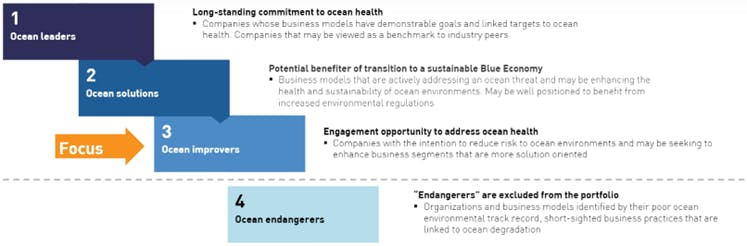
Once the manager identifies companies that meet their investment criteria and have the potential meaningful shareholder engagement, they are grouped into three categories critical to ocean health and the blue economy: Ocean Leaders, Ocean Solutions, and Ocean Improvers; the latter offers the biggest potential for engagement opportunities. As shown from the illustration below the fund will focus primarily on companies classified as ocean improvers, as they have the greatest potential for change and value appreciation over time.
Conclusion: The KSEA Value Proposition
The thematic focus of the KraneShares Rockefeller Ocean Engagement makes it a truly unique solution, as it provides prospective investors with an investment solution dedicated to both current and future oceanic commercial activities. As referenced earlier, while current economic output from ocean-related activities is sizable, it is expected to grow materially in the future.
The fund’s focus on the blue economy concept and what it espouses, highlights the ESG angle innate to the ETF. For sustainability focused investors who desire to dedicate their monies towards investments that also work towards bettering the environment, this ETF is worth considering as an inclusion in one’s portfolio.
Please note this article is for information purposes only and does not in any way constitute investment advice. It is essential that you seek advice from a registered financial professional prior to making any investment decision.
Segments
See all
No specific market segments were tagged
Mentioned ETFs
No specific ETFs were tagged
Further reading


Latest ETF News
See all ETF newsMoneyShow Chart of the Day 7/16/26: Good News/Bad News on Inflation (and the Fed)


MoneyShow Chart of the Day 7/1/26: The H1 Scorecard – and What Comes Next

MoneyShow Chart of the Day 6/22/26: Are World Cup Videos Helping US Companies Clean Up?

MoneyShow Chart of the Day 6/3/26: AI. AI. AI. (And a Handful of Other Stocks, Too)




 Advantages of ETFs over Mutual Funds1/6
Lower Costs
In this guide, we'll explore the advantages of ETFs over mutual funds, giving you valuable insights into why ETFs have gained significant popularity among investors like yourself.
Leveraged ETFs: Unlocking the Potential for Amplified Returns1/6
Understanding Leveraged ETFs
Explore leveraged ETFs: potential for amplified returns & risks. 5 ETFs to consider across equities, commodities & fixed income.
What is a Leveraged ETF?1/6
Introducing Leveraged and Inverse ETFs
In this guide, we'll dive into the world of leveraged ETFs, exploring their definition, mechanics, potential risks, and rewards.
Recent educational content

ETF Trends
ETF Industry KPIs July 20, 2026
This week’s KPI data overview highlights key metrics and trends shaping the ETF landscape.

ETF Trends
ETF Industry KPIs July 13, 2026
This week’s KPI data overview highlights key metrics and trends shaping the ETF landscape.

First Look ETF
First Look ETF: Cash Deployment, Bond, and Hedged ETFs
In this season 6 episode of First Look ETF, Stephanie Stanton examines the latest ETF marketplace trends with NYSE and guests.

ETF Trends
ETF Industry KPIs July 6, 2026
This week’s KPI data overview highlights key metrics and trends shaping the ETF landscape.
Browse all educational columns



The ETF Industry Is Evolving Fast
From AI infrastructure to active strategies, the ETF landscape is shifting. Share your perspective in the 7th Annual Global ETF Survey and get exclusive early access to the final report.