From idea to ETF portfolio in minutes. Build yours now →



JPST and JPIE: A Modern Approach to Active, Risk-Managed Fixed-Income
2022 was the worst-ever year for bonds, and uncertainty prevails in 2023 as inflation concerns persist and central banks remain committed to hiking rates at a historically fast pace.


Keep up with what matters in ETFs
Get timely ETF insights, market trends, and top ideas straight to your inbox.
Your newsletter subscriptions with us are subject to ETF Central's Privacy Policy and Terms and Conditions.
These historically high losses for bond investors and benchmarks underscore the renewed importance of risk-managed income, one that considers both the effects of duration and credit quality based on the prevailing market conditions.
Hence, the expertise inherent to an active approach to fixed-income ETF investing, as seen with the JPMorgan Ultra-Short Income ETF (JPST) and the JPMorgan Income ETF (JPIE) can benefit investors navigating this challenging landscape.
Like what you're reading?
Stay in the loop — get the latest ETF insights: trends, analysis, and expert picks.
Adaptiveness to different investor objectives
In 2022, the supposed "safety" of bond index ETFs proved illusory as many experienced drawdowns as deep as equities in the wake of high inflation, and the foreseeable rate hikes from the Federal Reserve.
Not all fixed-income investors subscribe to the "buy and hold for 25 years" mentality – some have mandates to manage risk or produce higher than average income. In such cases, the strict, index-based replication approach of passive bond ETFs can be either woefully inadequate or overly broad.
For example, an income investor seeking a higher-yielding bond ETF doesn't need the high allocation of AAA rated Treasurys found in an aggregate index bond ETF. Similarly, an investor concerned about rising rates doesn't need the intermediate duration of an aggregate bond index ETF. Sometimes, the "one-size-fits-all" approach just doesn't work.
In contrast, JPST and JPIE can satisfy a range of different investor objectives by investing across debt markets in an unconstrained approach, pivoting based on prevailing market conditions. Their actively managed nature allows for tactical shifts in allocation, which allows for flexibility in the face of a rapidly evolving fixed-income environment.
For example, a risk-averse investor might consider JPST, which focuses on short-term, investment-grade bonds with low interest rate risk. Conversely, an income-seeking investor might prefer JPIE, which targets higher-yielding bonds across various geographies, sectors, and credit qualities while still managing duration and credit risk effectively.
Therefore, one of the key advantages of both JPST and JPIE over index bond ETFs is their ability to provide attractive, consistent monthly income. In short, both ETFs offer investors an appealing alternative for generating income while effectively managing risk. Still, they each play a distinct role, which we will examine below.
The benefits of short duration investing
Short duration fixed-income ETFs like JPST, offer several benefits. First, they have lower interest rate risk, meaning they are less sensitive to changes in interest rates. This is important for investors who want to preserve capital during periods of rising interest rates.
Second, they can benefit from an inverted yield curve, which occurs when short-term interest rates are higher than long-term interest rates. In such a scenario, investors in short-duration bonds can earn higher yields without taking on additional risk.
JPST actively manages both credit and duration exposure to deliver attractive risk-adjusted returns. The fund's management team continuously assesses the credit quality of the underlying bonds and adjusts the portfolio's duration to changing market conditions.
Especially during periods of rising interest rates, short-duration bond ETFs like JPST can fulfil two simultaneous objectives: providing lower interest rate risk than longer-duration bond funds, while still offering a higher yield than money market funds.
For example, as of April 30th, 2023, JPST has managed to capture 111% of the yield of the benchmark Bloomberg U.S. Aggregate Bond Index, while only being exposed to 12% of the index's duration. This could be seen as a positive attribute for investors who want a better yield without substantially increasing their exposure to interest rate risk.
Additionally, JPST boasts competitive pricing with an expense ratio of 0.18% compared to its fund peer group, which is attractively priced for an actively managed ETF, making it a cost-effective choice for investors compared to more expensive mutual fund alternatives.
The benefits of going out of the curve
Unconstrained bond ETFs like JPIE can change allocations and holdings based on prevailing market conditions, such as changes in credit spreads, yield curve fluctuations, and country or sector ratings changes. This flexibility allows the fund to capitalize on opportunities across the fixed-income spectrum, resulting in potentially higher returns for investors.
JPIE's actively managed strategy uses a framework that incorporates considerations for quantitative tightening, rate hikes, tighter financial conditions, and a responsive Federal Reserve. This approach enables the ETF to adapt its investment strategy to a changing economic environment, providing investors with a more dynamic fixed income holding.
As opposed to the usual assortment of Treasurys, agency bonds, agency mortgage-backed securities, and investment-grade corporate bonds held by aggregate index bond ETF, JPIE is free to seek additional sources of uncorrelated risk/return from assets like emerging market currency debt, high-yield corporate bonds, and commercial mortgage-backed securities.
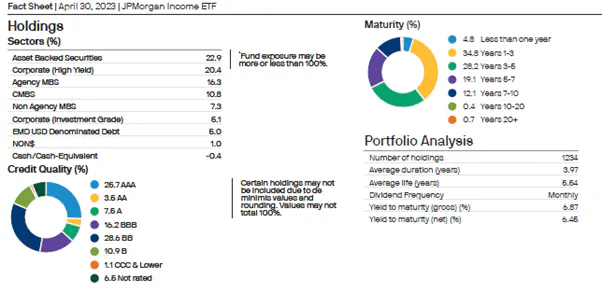
Source: JPIE Factsheet
By implementing these additional assets and dynamically adjusting their allocations as market conditions change, JPIE manages to deliver an attractive 6.45% net yield to maturity as of April 30th, 2023, while keeping duration low at 3.97 years. This comes at a reasonable 0.42% expense ratio.
A higher responsivity to risk management
Perhaps the most attractive features of actively managed fixed-income ETFs like JPST and JPIE are their higher responsivity to risk management and ability to effectively navigate challenging market conditions.
JPST and JPIE can actively manage their credit and duration exposure, offering a more adaptive approach to market shifts. For example, when credit conditions deteriorate or interest rates rise, these funds can adjust their holdings dynamically to minimize potential losses and capitalize on new opportunities.
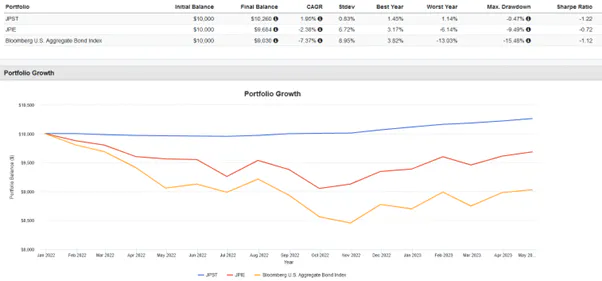
This ability to pivot has helped both ETFs maintain a more stable performance compared to their passive counterparts. An overview of their current portfolio holdings and metrics, such as yield-to-maturity (YTM), duration, and credit quality, showcases their well-balanced and diversified investment strategies.
Don't discount active bond strategies
In conclusion, actively managed fixed-income ETFs like JPST and JPIE present a modern approach to bond investing in an uncertain market environment. They are designed to adapt to different investor objectives, offering both short duration and unconstrained strategies to navigate changing market conditions. With a higher responsivity to risk management, these funds have proven resilient during times of market stress, like those experienced in 2022.
The ETFs' competitive pricing, with low expense ratios compared to their peers, further underscores their appeal to investors seeking cost-effective investment solutions. The experienced portfolio management team behind these ETFs has also played a crucial role in their success, leveraging their combined decades of expertise to make informed decisions in a rapidly changing market.
By providing attractive and consistent monthly income without the duration risk of aggregate bond index ETFs, JPST and JPIE serve as compelling options for investors seeking higher income and greater stability in an increasingly complex fixed-income market landscape.
Sponsored by J.P. Morgan Asset Management.
Topics
See all
Mentioned ETFs
No specific ETFs were tagged
Further reading
Latest ETF News
See all ETF newsCould Water ETFs Be the Next AI Bottleneck Trade?


What is a Boomer Candy ETF?

ETF Comparison: NEOS Nasdaq-100 High Income ETF (QQQI) Versus Goldman Sachs Nasdaq-100 Premium Income ETF (GPIQ)





 Advantages of ETFs over Mutual Funds1/6
Lower Costs
In this guide, we'll explore the advantages of ETFs over mutual funds, giving you valuable insights into why ETFs have gained significant popularity among investors like yourself.
Leveraged ETFs: Unlocking the Potential for Amplified Returns1/6
Understanding Leveraged ETFs
Explore leveraged ETFs: potential for amplified returns & risks. 5 ETFs to consider across equities, commodities & fixed income.
What is a Leveraged ETF?1/6
Introducing Leveraged and Inverse ETFs
In this guide, we'll dive into the world of leveraged ETFs, exploring their definition, mechanics, potential risks, and rewards.
Recent educational content

ETF Trends
ETF Industry KPIs September 8, 2026
This week’s KPI data overview highlights key metrics and trends shaping the ETF landscape.

ETF Trends
ETF Industry KPIs August 31, 2026
This week’s KPI data overview highlights key metrics and trends shaping the ETF landscape.
ETF Trends
ETF Industry KPIs August 24, 2026
This week’s KPI data overview highlights key metrics and trends shaping the ETF landscape.

What’sTheFund
What's the Fund | Ocean Park Diversified Income ETF (DUKZ)
James St Aubin, Chief Investment Officer at Ocean Park Asset Management, discuss the DUKZ ETF, exposing investors to the whole spectrum of asset classes in the fixed income markets, through their rules-based process.

Browse all educational columns



Build and Analyze Your ETF Portfolio Like a Pro
Create your own ETF portfolio in minutes and instantly see allocations, exposures, performance, and risk. Visualize diversification across asset classes, regions, and sectors. Stress-test ideas, compare benchmarks, and refine your strategy with professional-grade analytics.