Turn ETF ideas into real portfolios. Try the builder now →



Japan's Equity Markets Have Flipped the Script: Here's Why

Keep up with what matters in ETFs
Get timely ETF insights, market trends, and top ideas straight to your inbox.
Your newsletter subscriptions with us are subject to ETF Central's Privacy Policy and Terms and Conditions.
When long-term investors tout the merits of a buy-and-hold strategy, the Japanese stock market is a common counterexample presented. The Nikkei reached its all-time high following a dizzying real estate bubble in 1989 and hasn’t been back since. Over the past three decades, Japanese stocks have produced an average annualized return below zero.
All the while, the Bank of Japan (BOJ) has maintained a rock-bottom interest rate policy to stimulate growth, but it hasn’t been enough to do the trick. Lack of population growth and the number of lumbering, cash-heavy companies in the Nikkei have been enough to counterbalance the BOJ’s encouragement.
Yet, it’s this sleepy status quo that makes Japan so intriguing today. Even after climbing roughly 30 percent so far in 2023, the country’s equity markets are priced favorably relative to other highly-developed nations while some compelling catalysts enter the fold. More importantly, these key drivers may have staying power.
Like what you're reading?
Stay in the loop — get the latest ETF insights: trends, analysis, and expert picks.
A Catalyst Emerges
The Tokyo Stock Exchange (TSE) has signaled it’s time for Japanese executives to reinvest in their businesses and talent or face consequences. The TSE has announced a major reform that could have widespread effects on the Japanese stock market.
The reform outlines exchange inclusion requirements that pressure Japanese companies currently trading at a price-to-book below 1x to disclose specific plans and policies for improvement. Considering about half of the companies on this exchange trade at market values below their book values, the reform could be profound.
To fully appreciate the potential capital at play, consider that on average, 19.36 percent of the market cap of the MSCI Japan Index is constituted of cash. Compare this to just 5.69 percent of companies included in the S&P 500 Index.
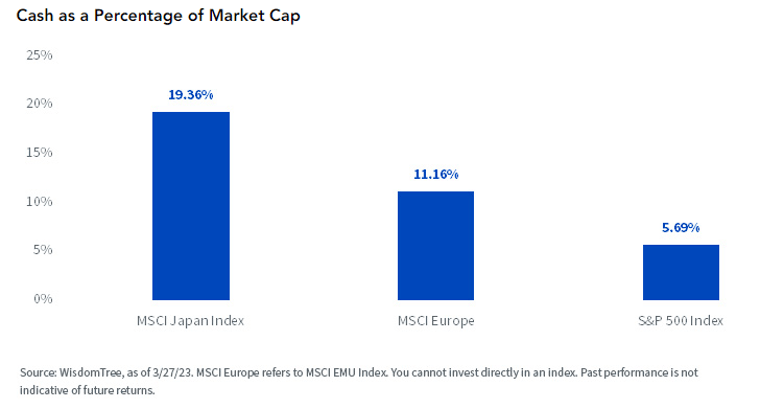
Strategies for improvement are likely to include meaningful business investment and welcomed corporate actions, like dividends and stock buy-backs. These prospects could have immediate, direct benefits to shareholders.
Companies that are unable to meet the TSE’s stipulations by 2025 will be labeled as “securities under supervision.” Even more gravely, non-conforming securities will be threatened with delisting thereafter. It’s too soon to say if this will result in real action or is just bold talk, but it’s a major catalyst that has reinvigorated the Japanese equity markets. It could change how Japanese business leaders make decisions for years to come.
A Backdoor to Chinese Trade
Investing in Japanese equities may be a way to access backdoor exposure to East Asian growth while under-weighting geopolitical risk. Although Japan is generally aligned with the United States, it is a major G7 country that has managed to avoid entanglement in the Russia and Ukraine conflict. This is critical, because Japan is an export-focused country with a neighboring gorilla of a trade partner: China.
The plunge of the yen has also been a bullish development for Japanese exporters. As of July 11, 2023, the USD/JPY pair traded in the 141 range, one of the weaker levels for the yen in the past five years. The currency’s descent has made Japanese exporters even more competitive versus both American and Chinese rivals.
TINA Is Alive in Japan
Within Japanese borders, equities remain the only game in town. Unlike most other major central banks that were forced to hike rates to tame unruly inflation, the Bank of Japan has maintained short-term negative rates and a 10-year yield below 50 basis points as of July 11, 2023. Put simply, investors aren’t rewarded for holding Japanese government or corporate debt.
Meanwhile, Japanese equities trade at a valuation of just 14.6 times forward price-to-earnings. For a relative comparison, the S&P 500 Index trades at a multiple of nearly 19 times forward price-to-earnings.
This places the earnings yield of Japanese equity markets at 6.84%, cushioning the spread over 10-year Japanese government bonds to a comfortable 642 basis points. With equity risk premiums like this, it’s hard to make an argument that bonds are a viable alternative to stocks within the country’s borders.
Not to mention, divergent monetary policy by the BOJ has steered the country around other financial strains that western nations with tighter stances are experiencing. No regional banks have been forced to walk the duration plank in Japan, nor does a potential commercial real estate crisis loom large in the country’s future.
Japan’s workforce is all but back to pre-covid business as usual – at desks, in an office – while business leaders in developed western nations fumble through return-to-work negotiations with employees. With the world three years out from the start of the pandemic, these discussions seem to be happening on borrowed time. Vacancies and defaults within the commercial real estate sector could have spillover effects into the U.S. equity and debt markets that are yet to be seen.
Actionable Idea: WisdomTree Japan Hedged Equity Fund
WisdomTree Japan Hedged Equity Fund (ticker: DXJ) is a rules-based ETF that’s managed to match the WisdomTree Japan Hedged Equity Index. The strategy systematically selects the stocks of Japanese dividend-paying companies that are export-oriented. Many holdings have trade exposure to China.
To be included in the portfolio, companies must be incorporated in Japan and derive less than 80 percent of their revenue from domestic sources. This tilts the basket of stocks toward companies with a more diversified, global revenue base that’s not solely reliant on what occurs within Japan’s borders.
The strategy is hedged against a weakening yen relative to the dollar. When the yen falls in value, the portfolio is designed to outperform a comparable unhedged strategy. If the yen strengthens relative to the dollar, it’s expected to have lower returns than an equivalent unhedged investment. Notably, with 2023’s interest rate differential between the United States and Japan, the carry earned from hedging the yen has approached a positive 5% a year in 2023.
This fund was launched in 2006, and we believe its results are noteworthy. As of June 30, 2023, WisdomTree Japan Hedged Equity Fund ranks in the top ten percent of funds in the US Japan Stock Morningstar category over 1-, 3-, 5-, and 10-year timeframes*. Investors allocating a portion of their portfolio to Japanese stocks should strongly consider this ETF in their research.
Important Information:
For definitions of terms in the article, please visit the glossary.
* DXJ has an overall Morningstar rating of 5 stars based on risk-adjusted returns in the Japan Stock category which includes 33 Funds.
Morningstar, Inc. All Rights Reserved. The information herein: (1) is proprietary to Morningstar and/or its content providers; (2) may not be copied or distributed; and (3) is not warranted to be accurate, complete or timely. Neither Morningstar nor its content providers are responsible for any damages or losses arising from any use of this information.
The Morningstar Rating™ for funds, or "star rating", is calculated for managed products (including mutual funds, variable annuity and variable life subaccounts, exchange-traded funds, closed-end funds, and separate accounts) with at least a three-year history. Exchange-traded funds and open-ended mutual funds are considered a single population for comparative purposes. It is calculated based on a Morningstar Risk-Adjusted Return measure that accounts for variation in a managed product's monthly excess performance, placing more emphasis on downward variations and rewarding consistent performance. The top 10% of products in each product category receive 5 stars, the next 22.5% receive 4 stars, the next 35% receive 3 stars, the next 22.5% receive 2 stars, and the bottom 10% receive 1 star. The Overall Morningstar Rating for a managed product is derived from a weighted average of the performance figures associated with its three-, five-, and 10-year (if applicable) Morningstar Rating metrics. The weights are: 100% threeyear rating for 36-59 months of total returns, 60% five-year rating/40% three-year rating for 60-119 months of total returns, and 50% 10-year rating/30% five-year rating/20% three-year rating for 120 or more months of total returns. While the 10-year overall star rating formula seems to give the most weight to the 10-year period, the most recent three-year period actually has the greatest impact because it is included in all three rating periods.
There are risks associated with investing, including possible loss of principal. Foreign investing involves special risks, such as risk of loss from currency fluctuation or political or economic uncertainty. The Fund focuses its investments in Japan, thereby increasing the impact of events and developments in Japan that can adversely affect performance. Investments in currency involve additional special risks, such as credit risk, interest rate fluctuations, derivative investments which can be volatile and may be less liquid than other securities, and more sensitive to the effect of varied economic conditions. As this Fund can have a high concentration in some issuers, the Fund can be adversely impacted by changes affecting those issuers. Due to the investment strategy of this Fund it may make higher capital gain distributions than other ETFs. Dividends are not guaranteed, and a company currently paying dividends may cease paying dividends at any time. Please read the Fund’s prospectus for specific details regarding the Fund’s risk profile.
Investors should carefully consider the investment objectives, risks, charges and expenses of the Funds before investing. To obtain a prospectus containing this and other important information, please call 866.909.9473, or visit WisdomTree.com/investments to view or download a prospectus. Investors should read the prospectus carefully before investing.
WisdomTree Funds are distributed by Foreside Fund Services, LLC.
Latest ETF News
See all ETF newsThere's an ETF for That? Humanoid Robotics and Physical AI


How Some ETF Issuers Use Their Own Funds for Cash Management

These Public-Private ETFs Invest in Polymarket and Anduril

There's an ETF for That? Frontier Markets




 Advantages of ETFs over Mutual Funds1/6
Lower Costs
In this guide, we'll explore the advantages of ETFs over mutual funds, giving you valuable insights into why ETFs have gained significant popularity among investors like yourself.
Leveraged ETFs: Unlocking the Potential for Amplified Returns1/6
Understanding Leveraged ETFs
Explore leveraged ETFs: potential for amplified returns & risks. 5 ETFs to consider across equities, commodities & fixed income.
What is a Leveraged ETF?1/6
Introducing Leveraged and Inverse ETFs
In this guide, we'll dive into the world of leveraged ETFs, exploring their definition, mechanics, potential risks, and rewards.
Recent educational content

ETF Trends
ETF Industry KPIs October 5, 2026
This week’s KPI data overview highlights key metrics and trends shaping the ETF landscape.

ETF Trends
ETF Industry KPIs September 28, 2026
This week’s KPI data overview highlights key metrics and trends shaping the ETF landscape.
ETF Trends
ETF Industry KPIs September 22, 2026
This week’s KPI data overview highlights key metrics and trends shaping the ETF landscape.

First Look ETF
First Look ETF: Income, Corporate Arbitrage, and Growth and Value Investing
First Look ETF September 2026: iCapital, Mast Investments and North Square unpack new ETFs targeting monthly income, merger arbitrage and complementary growth and value exposure.

Browse all educational columns



Have you tried our ETF Compare tool?
Compare ETFs like a pro. Analyze fees, performance, exposure & holdings side-by-side.