Open Now: The Global ETF Survey Take the Survey →



Is an "Anti-ESG" thematic ETF possible?
This might either be a brilliant contrarian idea, or an ethically terrible investment.


Keep up with what matters in ETFs
Get timely ETF insights, market trends, and top ideas straight to your inbox.
Your newsletter subscriptions with us are subject to ETF Central's Privacy Policy and Terms and Conditions.
ESG, or environmental, social, and governance investing has become highly popular in recent years. There's no exact accepted definition of what ESG investing entails due to the myriad of scoring systems out there, but it generally involves influencing positive change through investment decisions. Practically, this means not investing in controversial sectors that cause disproportionate social harm.
I won't get into whether ESG investing works (both in terms of superior risk-adjusted returns and actual social impact) but it's certainly caught the attention of many. Today, ESG considerations are growing popular with inflows to ESG-centric ETFs increasing significantly in recent years, assets under management (AUM) soaring, and ever-increasing numbers of new funds debuting.
All this got me thinking: can I be a contrarian and create an "Anti-ESG" ETF? Which stocks will it include? What would its performance look like?
The ETF Industry Is Evolving Fast
From AI infrastructure to active strategies, the ETF landscape is shifting. Share your perspective in the 7th Annual Global ETF Survey and get exclusive early access to the final report.
Constructing the Anti-ESG Index
I'm not a fund manager, so the process of filing a proper prospectus is beyond me. Quite simply, I opted for an equal-weight mixture of the top three large-cap U.S. listed companies in the tobacco, firearms, alcohol, and energy sectors, respectively.
Note that my criteria for what constituted an "Anti-ESG" company were not really scientific or quantitative at all. It was based simply on what many existing ESG indexes exclude from consideration. The current roster is:
- Energy: Chevron (CVX), Exxon Mobil (XOM), and Occidental Petroleum (OXY).
- Tobacco: Phillip Morris International (PM), British American Tobacco (BTI), and Altria Group (MO).
- Alcohol: Brown-Forman Corporation (BF.B), Constellation Brands (STZ), and Diageo (DEO).
- Firearms: Ammo Inc. (POWW), Smith & Wesson Brands Inc. (SWBI), and Sturm Ruger & Company Inc. (RGR).
I had IndexOne create an index here, which is updated in live time. Let's give it the ticker "$AESG." As of writing (August 4th, 2022), $AESG is actually up 9.75%, compared to the -13.44% loss suffered by the S&P 500 and the -16.52% loss suffered by the Vanguard ESG US Stock ETF (ESGV). To quote Borat: "great success!"
Backtesting historical performance
Before I claimed victory, I wanted to see if this goofy rationale for constructing an index held up in the past compared to say, the S&P 500. I constructed an equal-weighted portfolio of the aforementioned stocks, with annual rebalancing and all dividends reinvested and got the following results:
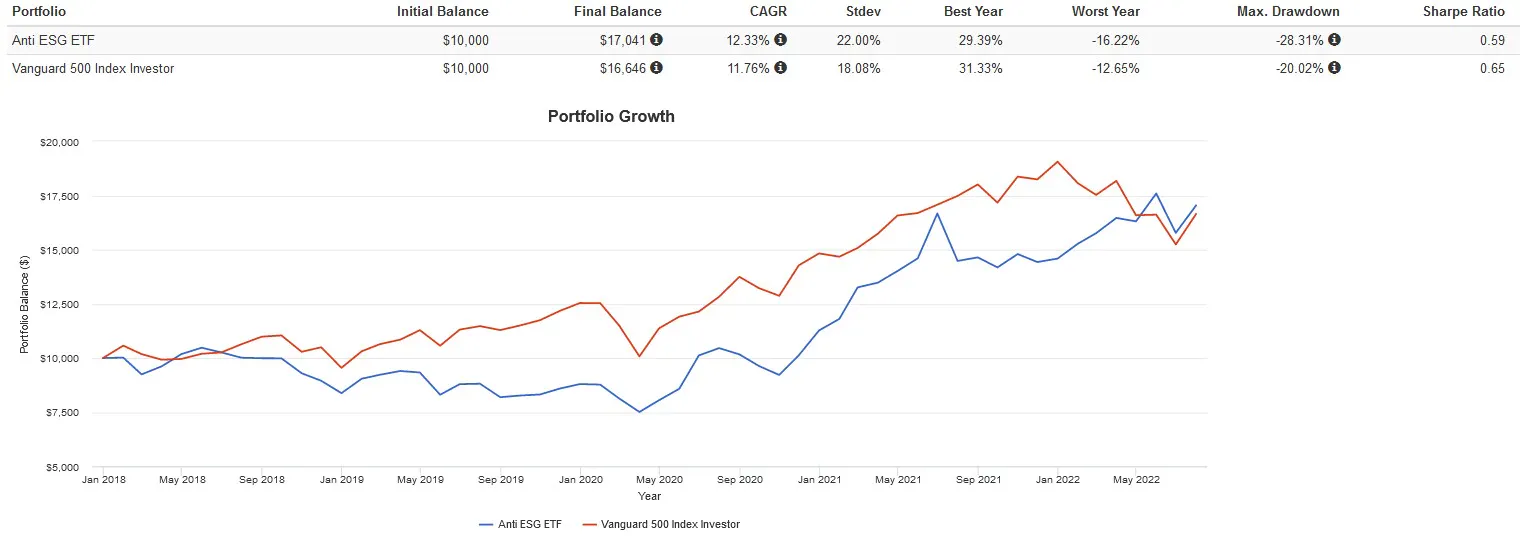
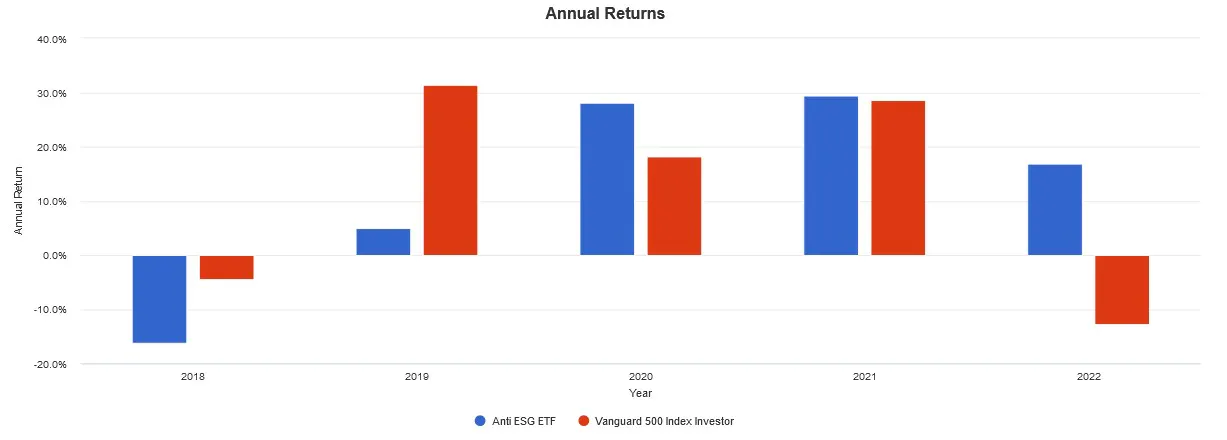
So, from 2018 to the present, $AESG beat the S&P 500 in terms of CAGR, but took on far more volatility, for an overall poorer risk-adjusted return.
Interestingly enough, $AESG strongly outperformed in 2022, perhaps pointing to the counter-cyclical nature of many of its holdings. In particular, energy stocks rallied due to inflation and elevated commodity prices, comprising much of the portfolio's sources of risk and return.
Here's what the exposures of $AESG in terms of risk/return, market cap, geography, and sector look like.

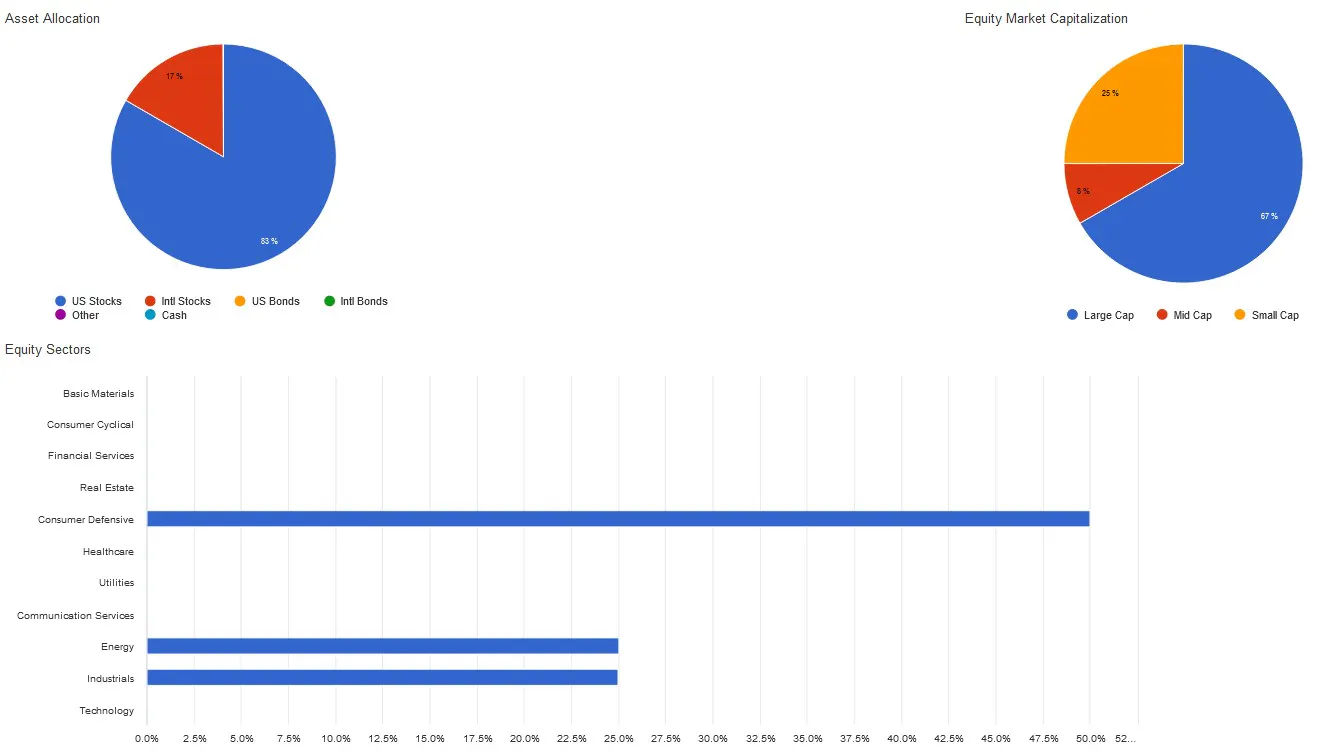
Contributions to risk and return had energy and firearms stocks accounting for more. We see a large overweight to large-caps, with small-caps coming in second. Most of the stocks were U.S. based, with some international. The only sectors represented were consumer defense, energy, and industrials. $AESG is not a diversified fund at all.
A return to sensibility
In all seriousness, buying stocks according to an "Anti-ESG" theme is not a good idea, simply because it's grounded less in quantitative rigor than wishful thinking and hastily drawn inferences. This is an issue with some thematic funds today, with more and more ETFs tracking dubious, speculative themes. The point of this example isn't to discredit ESG – rather, it's to illustrate the need for caution when selecting investments.
Investing solely based on the name of an ETF or its general objective isn't a good strategy for ensuring long-term success. Investors should carefully examine the underlying holdings of an ETF, its risk factor exposures, and the assumptions underlying the fund manager's strategy, then ask themselves if they're capable of explaining the fund to a stranger. If not, consider sticking to a simple, transparent, and straightforward index fund.
Segments
See all
No specific market segments were tagged
Mentioned ETFs
Further reading

Latest ETF News
See all ETF newsHow Investors can Maximize Tax Efficiency with Income ETFs

Trump Accounts: Here's Which ETFs You Can Invest In

The Two Best Types of Fixed-Income ETFs For Managing Cash

ETF Comparison: Roundhill Generative AI & Technology ETF Versus iShares A.I. Innovation and Tech Active ETF




 Advantages of ETFs over Mutual Funds1/6
Lower Costs
In this guide, we'll explore the advantages of ETFs over mutual funds, giving you valuable insights into why ETFs have gained significant popularity among investors like yourself.
Leveraged ETFs: Unlocking the Potential for Amplified Returns1/6
Understanding Leveraged ETFs
Explore leveraged ETFs: potential for amplified returns & risks. 5 ETFs to consider across equities, commodities & fixed income.
What is a Leveraged ETF?1/6
Introducing Leveraged and Inverse ETFs
In this guide, we'll dive into the world of leveraged ETFs, exploring their definition, mechanics, potential risks, and rewards.
Recent educational content

ETF Trends
ETF Industry KPIs July 20, 2026
This week’s KPI data overview highlights key metrics and trends shaping the ETF landscape.

ETF Trends
ETF Industry KPIs July 13, 2026
This week’s KPI data overview highlights key metrics and trends shaping the ETF landscape.
First Look ETF
First Look ETF: Cash Deployment, Bond, and Hedged ETFs
In this season 6 episode of First Look ETF, Stephanie Stanton examines the latest ETF marketplace trends with NYSE and guests.

ETF Trends
ETF Industry KPIs July 6, 2026
This week’s KPI data overview highlights key metrics and trends shaping the ETF landscape.
Browse all educational columns



The ETF Industry Is Evolving Fast
From AI infrastructure to active strategies, the ETF landscape is shifting. Share your perspective in the 7th Annual Global ETF Survey and get exclusive early access to the final report.