Open Now: The Global ETF Survey Take the Survey →



Investing in Carbon Credits with COtwo Advisors Physical European Carbon Allowance Trust
CTWO will allow investors to beneficially participate in the EU Emissions Trading System, the world’s largest carbon market.


Keep up with what matters in ETFs
Get timely ETF insights, market trends, and top ideas straight to your inbox.
Your newsletter subscriptions with us are subject to ETF Central's Privacy Policy and Terms and Conditions.
When climate change, specifically the reduction of greenhouse gas emissions is discussed, the conversation naturally gravitates towards renewable energy. While renewable energy development is one avenue through which climate change can be combated, it is not the only pathway. This article will focus on the popularization of carbon credits and their ability to incentivize companies to reduce their carbon footprint. Carbon credits have also caught the attention of many asset managers, who have begun utilizing them as the basis for new ETFs; the soon-to-be-launched COtwo Advisors Physical European Carbon Allowance Trust is such a solution and will be profiled in this piece.
The ETF Industry Is Evolving Fast
From AI infrastructure to active strategies, the ETF landscape is shifting. Share your perspective in the 7th Annual Global ETF Survey and get exclusive early access to the final report.
The Carbon Credits Ecosystem
Carbon credits, also known as carbon offsets/allowances, are governmental permits that allow the owner to emit a certain amount of carbon dioxide or other greenhouse gases. One credit permits the emission of one ton of carbon dioxide or the equivalent in other greenhouse gases. Because the emissions output of individual companies differs, carbon markets allow investors and corporations to trade any unneeded credits to another company that needs them.
When it comes to the sale of carbon credits within the carbon marketplace, there are two significant, but separate markets to choose from, (i) one is a regulated market, set by “cap-and-trade” regulations at the regional and state levels, while the other (ii) is a voluntary market where businesses and individuals buy credits (of their own accord) to offset their carbon emissions.
Regarding the regulated market, each company operating under a cap-and-trade program is issued a certain number of carbon credits each year. Some of these companies produce fewer emissions than the number of credits they’re allotted, giving them a surplus of carbon credits. Alternatively, companies that produce more emissions than the number of credits they receive each year are looking to purchase carbon credits to offset their emissions because they must.
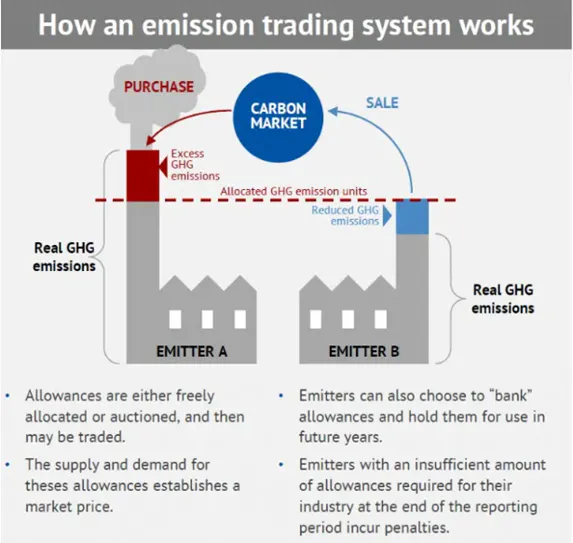
Differentiating between the European & American Carbon Marketplace
The European Union Emissions Trading System (“EU ETS”) is a “cap and trade” system that caps the total volume of greenhouse gas emissions (“GHG”) from installations and aircraft operators responsible for around 40% of European Union (“EU”) GHG emissions. The EU ETS is administered by the EU Commission, which issues a predefined amount of EU Carbon Emission Allowances (“EUAs”) through auctions or free allocation. EUAs entitle the holder to emit one ton of carbon dioxide equivalent or other GHG. Entities covered by the EU ETS are required to surrender sufficient EUAs each year to cover all their emissions for the previous year.
In 2012, EU ETS operations were centralized into a single EU registry operated by the EU Commission (the “Union Registry”), which covers all countries participating in the EU ETS. The Union Registry is an online database that holds accounts for all entities covered by the EU ETS as well as for participants not covered under the EU ETS. An account must be opened in the Union Registry in order to transact in EUAs and the Union Registry is at all times responsible for holding the EUAs. The EU ETS is the largest cap and trade system in the world and covers more than 11,000 power stations and industrial plants in 31 countries, and flights between airports of participating countries.
The other main venue for carbon trading is the cap-and-trade system that California shares with Quebec, known as the Western Climate Initiative. It is a tenth the size of Europe’s market but is increasingly attractive to traders because it tends to be less volatile. The volatility attributed to the European market began in mid-2017 when EU policymakers agreed to sharply reduce the number of available credits. That has pushed up prices and allowed the carbon market to help fulfill its purpose of punishing excess polluters. With the market set up to constrict credit supply, prices should rise further still.
Intercontinental Exchange, which hosts European and U.S. emissions trading, says the number of participants trading both European and North American carbon markets grew by 85% from 2017 to 2020.
Carbon Credits as an Investment
As an investment vehicle, carbon credits have become more prominent in recent years as prices in Europe’s regulated market have risen. As illustrated by the historical performance of the Solactive European Carbon Credit Market Index, there has been significant growth in the past three years.
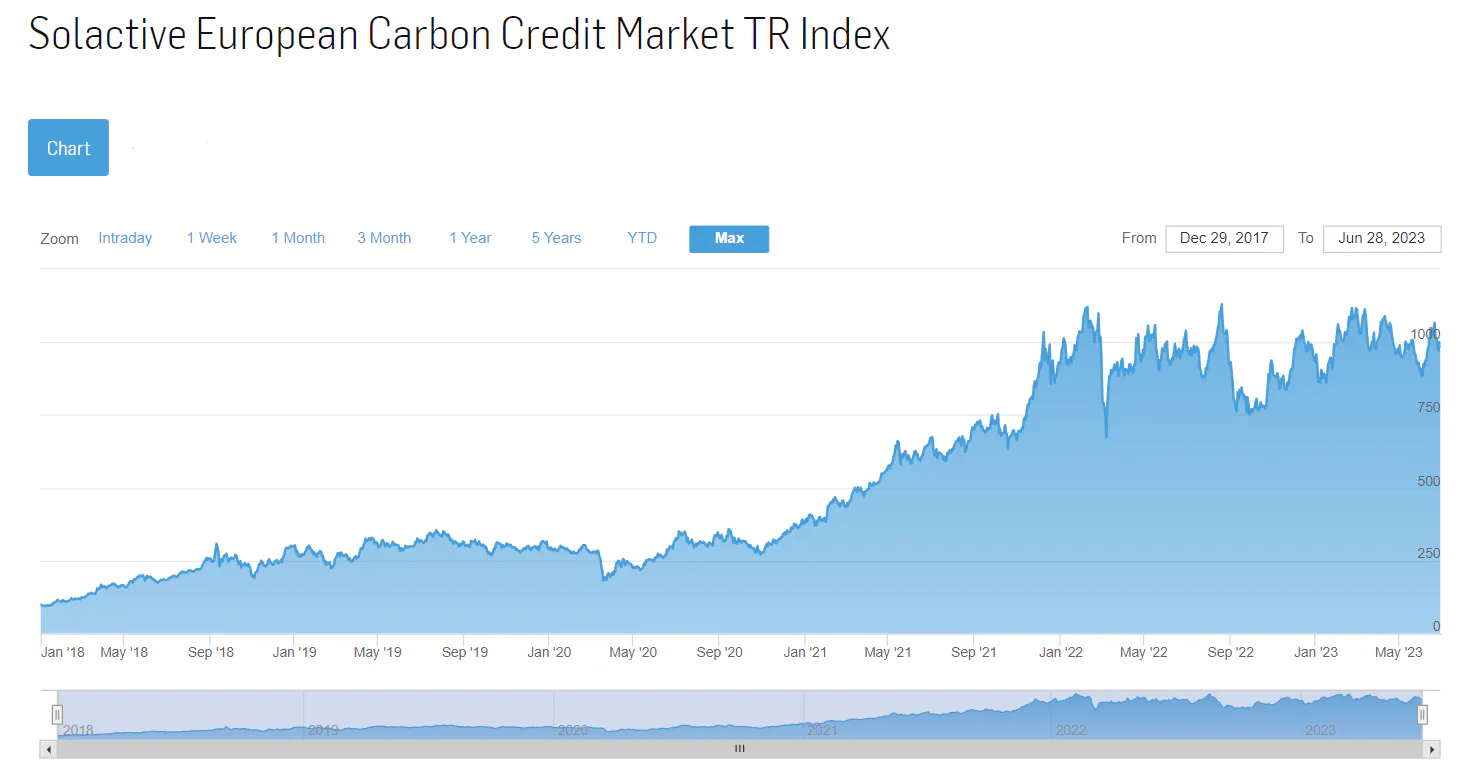
As prices for carbon credits rise, it becomes increasingly expensive for end users, such as power plants and aluminum smelters, to purchase them to increase output production. However, investors also play a role, bidding up the credits and making it more costly for carbon-intensive firms to operate. The outcome is dual in nature. Manufacturers are disincentivized to exceed their production limits – but if they do, the high cost they pay to acquire carbon credits is beneficial to investors, who are willing and ready to sell them at increasingly high prices.
COtwo Advisors Physical European Carbon Allowance Trust
For investors interested in getting exposure to carbon credits, the COtwo Advisors Physical European Carbon Allowance Trust (Ticker: CTWO) is worthy of consideration, as it will provide investors with access to the European Union Emissions Trading System.
The investment objective of the Trust is for the Shares to reflect the performance of the price of EUAs, less the expenses of the Trust’s operations. The Trust intends to achieve this objective by investing substantially all of its assets in EUAs. The Trust will invest in EUAs on a non-discretionary basis (i.e., without regard to whether the value of EUAs is rising or falling over any particular period).
Barring the forced liquidation of the Trust, the Trust will not purchase or sell EUAs directly, although the Sponsor may sell EUAs to pay certain expenses. Instead, when it sells or redeems its Shares, it will do so in “in-kind” transactions. Authorized Participants will deliver EUAs to the Trust in exchange for Shares when they purchase Shares, and the Trust will deliver EUAs to such Authorized Participants when they redeem Shares from the Trust. All EUAs will be held in the Union Registry. The Transfer Agent will facilitate the processing of purchase and sale orders in Baskets from the Trust.
Please note this article is for information purposes only and does not in any way constitute investment advice. It is essential that seek advice from a registered financial professional prior to making any investment decision.
Latest ETF News
See all ETF newsThe Two Best Types of Fixed-Income ETFs For Managing Cash


ETF Comparison: Roundhill Generative AI & Technology ETF Versus iShares A.I. Innovation and Tech Active ETF

Crypto Income ETFs: Futures, Options, or Staking?

There’s an ETF for That? Air Conditioning Stocks




 Advantages of ETFs over Mutual Funds1/6
Lower Costs
In this guide, we'll explore the advantages of ETFs over mutual funds, giving you valuable insights into why ETFs have gained significant popularity among investors like yourself.
Leveraged ETFs: Unlocking the Potential for Amplified Returns1/6
Understanding Leveraged ETFs
Explore leveraged ETFs: potential for amplified returns & risks. 5 ETFs to consider across equities, commodities & fixed income.
What is a Leveraged ETF?1/6
Introducing Leveraged and Inverse ETFs
In this guide, we'll dive into the world of leveraged ETFs, exploring their definition, mechanics, potential risks, and rewards.
Recent educational content

ETF Trends
ETF Industry KPIs July 13, 2026
This week’s KPI data overview highlights key metrics and trends shaping the ETF landscape.

First Look ETF
First Look ETF: Cash Deployment, Bond, and Hedged ETFs
In this season 6 episode of First Look ETF, Stephanie Stanton examines the latest ETF marketplace trends with NYSE and guests.

ETF Trends
ETF Industry KPIs July 6, 2026
This week’s KPI data overview highlights key metrics and trends shaping the ETF landscape.
Asset TV
The ETF Show - The Evolution of Leveraged & Inverse ETFs
Leveraged and inverse ETFs have exploded in popularity over the past decade capturing more assets as retail traders seek to capture volatility.

Browse all educational columns



Have you tried our ETF Compare tool?
Compare ETFs like a pro. Analyze fees, performance, exposure & holdings side-by-side.