ETF model portfolios designed for real investor needs. Discover →



Investing in the Canadian Stock Market: ETFs to Consider
U.S. investors seeking an inflation hedge and high dividends can consider an overweight to Canadian stocks.


Keep up with what matters in ETFs
Get timely ETF insights, market trends, and top ideas straight to your inbox.
Your newsletter subscriptions with us are subject to ETF Central's Privacy Policy and Terms and Conditions.
I'm not exactly a patriot, but I did feel a smidgen of pride this year as the benchmark index for Canada, the S&P/TSX 60 index, finished the year with a -9.07% loss. While this looks bad, it soundly outperformed the S&P 500 which fell right back into bear market territory with a -19.95% year end return.
Many investors do not consciously overweight Canada in their equity allocations. Currently, Canadian equities account for just 3% of the world's stock market by market cap. Investors who do tilt certain countries tend to favor emerging markets like China for the higher risk-reward possibilities.
However, there is good evidence to suggest that a Canadian tilt might be a suitable option for many U.S. investors. Thanks to ETFs, implementing this is as simple as ever. Let's break down the reasons behind investing in Canada and which ETFs are ideal for this strategy.
Get data on 14,000+ ETFs
Access Trackinsight's reliable and comprehensive data with 500M+ points on 14,000+ ETFs.
Why invest in Canada?
Compared to the U.S., the Canadian stock market is tiny and much less diversified in comparison. Comparing the S&P/TSX 60 and the S&P 500 Index, we can note the following differences. All figures and charts for each index are from S&P Global's respective factsheets for them.
First up, the S&P 500:
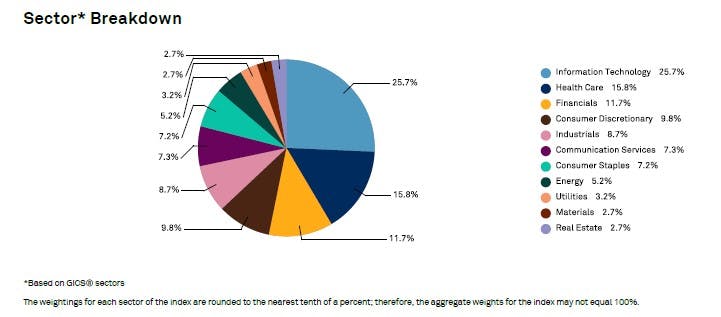
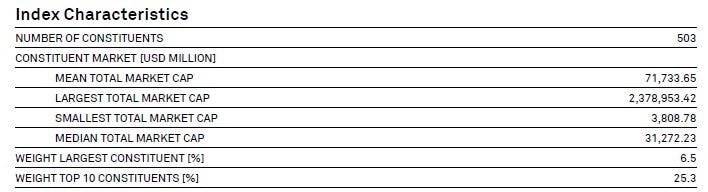

Next up, the S&P/TSX 60:
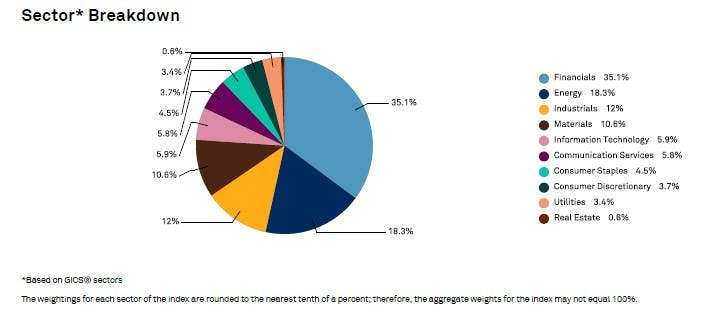
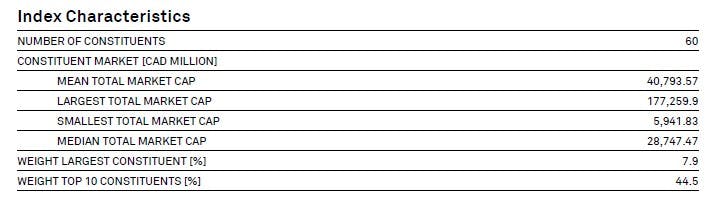

To summarize the main differences between the S&P/TSX 60 and the S&P 500:
- The Canadian stock market is weighted much heavier toward the financial and energy sectors. Indeed, both of these sectors are important economic drivers for Canada. The financial sector is dominated by an oligopoly of the "Big 5" banks and insurance companies, while the energy sector maintains a sizable presence due to Canada's natural resource reserves and exports.
- The Canadian stock market has a much lower mean and median market capitalization compared to the U.S. market, which is dominated by a select handful of mega-cap technology stocks, notably Apple (AAPL), Microsoft (MSFT), and Alphabet (GOOGL, GOOG).
- However, the Canadian stock market is much more top-heavy, with the top 10 holdings in the index accounting for 44.5% of its weight, compared to the U.S. at 25.3%. As noted earlier, these 10 holdings are mostly bank stocks and energy stocks.
- In terms of fundamentals, the Canadian market trades at much more favorable valuations and pays a significantly higher dividend yield.
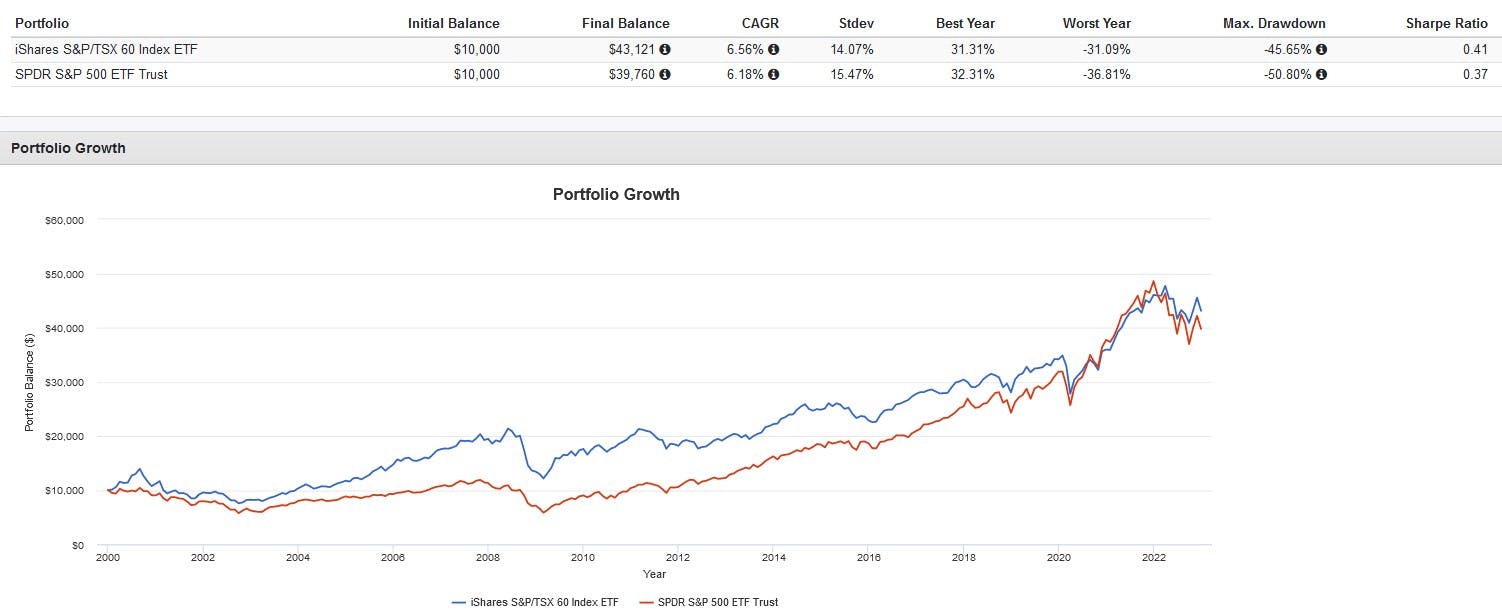
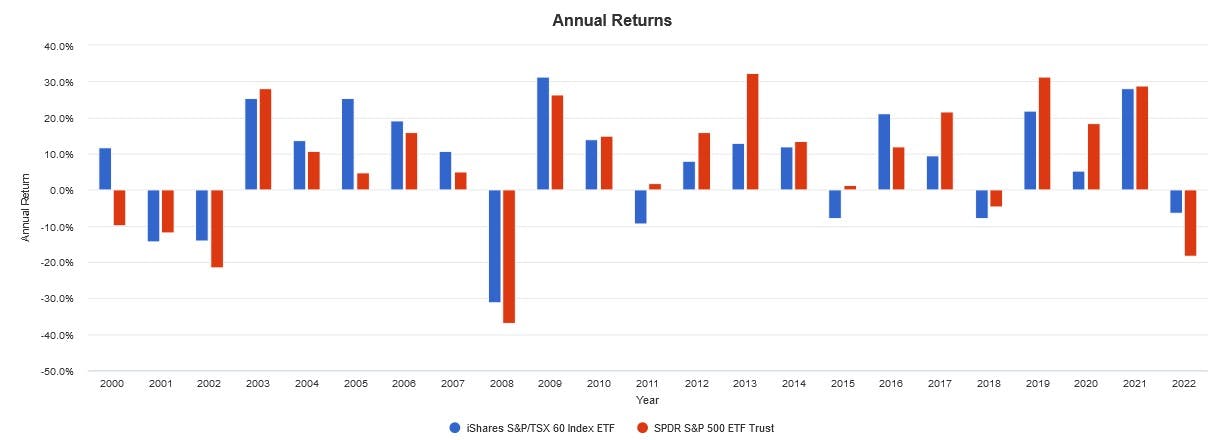
In terms of historical performance, the S&P 500 and S&P TSX 60 have taken turns outperforming each other with similar volatility. On a trailing basis since 2000, they are neck-and-neck. On a rolling basis, which is less sensitive to start dates the S&P 500 has historically outperformed.

ETF options for Canada
From the above, we can gather that a tilt to Canadian equities is best suited for investors looking to overweight financial and energy sector stocks. Indeed, Canadian equities have been a decent hedge in 2022 against inflation thanks to the high concentration of energy stocks.
In addition, the relatively high yield of Canadian stocks can be beneficial for dividend investors. Just keep in mind that in a taxable account, investors will need to account for the CAD-USD relationship when calculating their capital gains. In addition, there is a 15% foreign withholding tax on dividends.
Currently, the most popular U.S.-listed Canadian equity ETF is the JPMorgan BetaBuilders Canada ETF (BBCA). This ETF holds 83 stocks listed on the Toronto Stock Exchange (TSX) by tracking the Morningstar Canada Target Market Exposure Index. It charges a 0.19% expense ratio.
Another alternative is the iShares MSCI Canada ETF (EWC) which targets 88 large and mid-cap Canadian equities by tracking the MSCI Canada Custom Capped Index. This ETF is more expensive than BBCA at 0.50% but can serve as a tax-loss harvesting partner due to their different indexes.
One more thing to note: currency fluctuations can affect your returns as both ETFs are unhedged. Case in point, EWC is down 15.14% in 2022 despite the Canadian market only losing around -9%. During this time the USD appreciated against the CAD. Because the underlying holdings in EWC are in CAD, but the ETF is denominated in USD, the ETF lost additional value. The opposite will occur if the CAD appreciates against the USD.
Please note this article is for information purposes only and does not in any way constitute investment advice. It is essential that you seek advice from a registered financial professional prior to making any investment decision.
Latest ETF News
See all ETF newsCould Water ETFs Be the Next AI Bottleneck Trade?

What is a Boomer Candy ETF?

ETF Comparison: NEOS Nasdaq-100 High Income ETF (QQQI) Versus Goldman Sachs Nasdaq-100 Premium Income ETF (GPIQ)





 Advantages of ETFs over Mutual Funds1/6
Lower Costs
In this guide, we'll explore the advantages of ETFs over mutual funds, giving you valuable insights into why ETFs have gained significant popularity among investors like yourself.
Leveraged ETFs: Unlocking the Potential for Amplified Returns1/6
Understanding Leveraged ETFs
Explore leveraged ETFs: potential for amplified returns & risks. 5 ETFs to consider across equities, commodities & fixed income.
What is a Leveraged ETF?1/6
Introducing Leveraged and Inverse ETFs
In this guide, we'll dive into the world of leveraged ETFs, exploring their definition, mechanics, potential risks, and rewards.
Recent educational content

ETF Trends
ETF Industry KPIs September 8, 2026
This week’s KPI data overview highlights key metrics and trends shaping the ETF landscape.

ETF Trends
ETF Industry KPIs August 31, 2026
This week’s KPI data overview highlights key metrics and trends shaping the ETF landscape.
ETF Trends
ETF Industry KPIs August 24, 2026
This week’s KPI data overview highlights key metrics and trends shaping the ETF landscape.
What’sTheFund
What's the Fund | Ocean Park Diversified Income ETF (DUKZ)
James St Aubin, Chief Investment Officer at Ocean Park Asset Management, discuss the DUKZ ETF, exposing investors to the whole spectrum of asset classes in the fixed income markets, through their rules-based process.

Browse all educational columns



Build and Analyze Your ETF Portfolio Like a Pro
Create your own ETF portfolio in minutes and instantly see allocations, exposures, performance, and risk. Visualize diversification across asset classes, regions, and sectors. Stress-test ideas, compare benchmarks, and refine your strategy with professional-grade analytics.