Explore professionally built ETF model portfolios. Discover now →



Investing in the Aging Population: A Look at Bonds and Pharma ETFs
People are living longer. Learn more about how to invest amidst this trend.


Keep up with what matters in ETFs
Get timely ETF insights, market trends, and top ideas straight to your inbox.
Your newsletter subscriptions with us are subject to ETF Central's Privacy Policy and Terms and Conditions.
People are living longer on average across the world, representing a crowning achievement of the modern age. This is especially pronounced in developed countries such as Japan, Canada, the UK and the US.
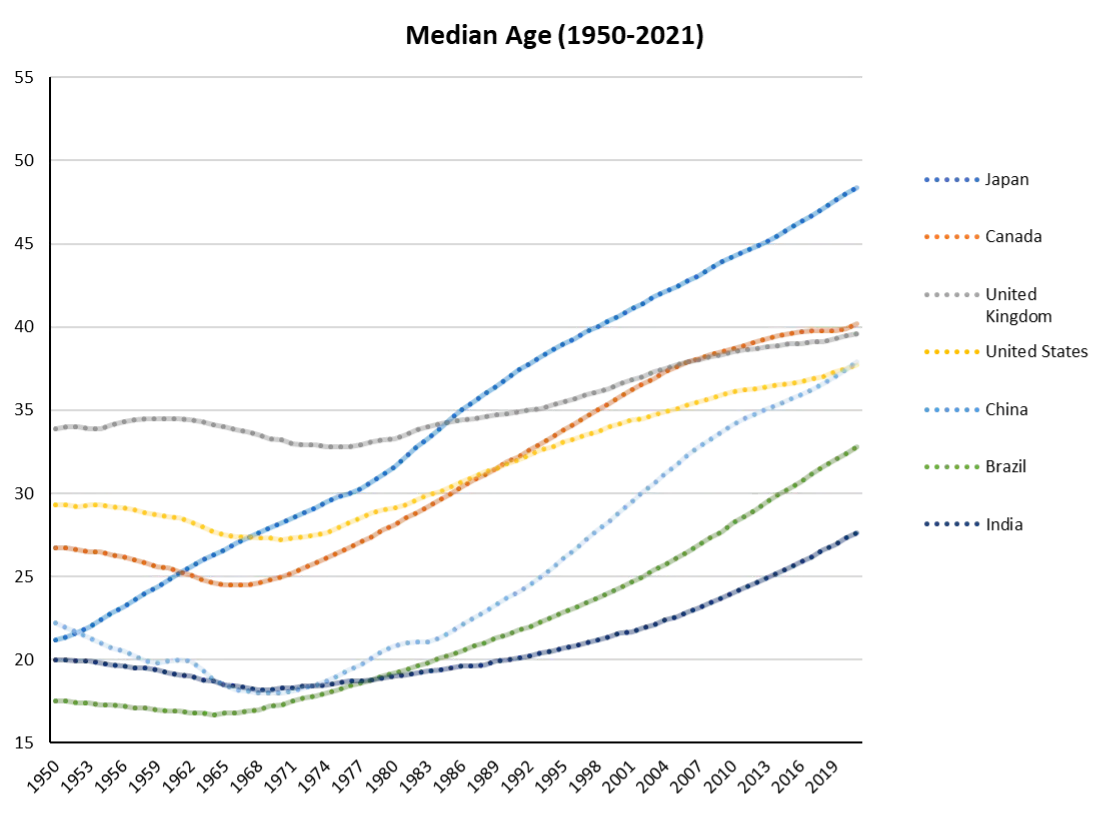
Source: United Nations – Population Division (2022)
The technical reason for this is simply that the birth rate is lower than the mortality rate.
The fundamental explanation is that improvements in medical technology have led to longer life expectancies. Furthermore, there are declining fertility rates given that well-educated populations appear to be less focused on starting a family and more focused on developing their career.
Looking at the US, based on data from the United Nations, the median age of Americans rose from around ~29 years in 1950 to ~38 years in 2021. This trend has shown no signs of slowing down, with the United Nations anticipating the median age of Americans to reach ~43 years by 2050.
Zooming out to a global picture, the United Nations pegs the global population of people aged 65+ at around 9% of the total population as of 2019. They anticipate this number to nearly double to approximately 16% of the total population by 2050.
Global ETF Survey 2026 is Live!
With 1,790 new products launched by July 2026, choosing is harder than ever. Our Global ETF Survey 2026, built on 620 professional investors and allocators, shows how active, fixed income, options-based and thematic ETFs are reshaping fund selection.
What does an aging population mean for investors?
An aging population will likely reshape the investment world.
When we think about our own demand for certain investments, our preferences undoubtedly changes throughout life. While we are young, we are more risk tolerant as we have a longer runway to grow our capital should we suffer losses in our investments. However, as we get closer to retirement, we don’t have that same runway anymore; thus, people become significantly more risk averse as they age. This means that fixed income investments will likely see increased demand as populations age.
Turning to stocks, there are certain companies that can benefit from aging populations. Older folks generally require greater expenditures on health care. The overall demand and dollar expenditures on health services should increase alongside aging populations. Investors can benefit by investing in pharmaceutical and biotech companies.
ETFs to play an aging population
As the global population ages, there are two investment areas well placed to benefit: (1) overall fixed income as an asset class, and; (2) healthcare (specifically pharmaceuticals and biotech).
On the bond side:
Vanguard Total International Bond ETF (BNDX)
Aging is an international trend. To play the increase in international bonds, BNDX holds various treasury-related bond securities in developed countries; with the largest holdings in France (3.7%), Spain (2.9%), Germany (2.7%), UK Gilts (2%), and Korea (2%).
- AUM: $48 billion
- 1mo Performance: +2.38%
- 1Mo Flows: +$150 million
On the healthcare side:
VanEck Pharmaceutical ETF (PPH)
The largest and most liquid Pharmaceutical ETF is PPH. This ETF tracks the largest pharmaceutical companies globally, with a tilt toward US companies. Largest holdings include Johnson & Johnson (8.3%), Abbvie (5.5%), and Eli Lilly (5.5%).
- AUM: $369 million
- 1mo Performance: -2.72%
- 1Mo Flows: -$45 million
iShares Biotechnology ETF (IBB)
Biotech companies generally carry more upside potential than pharmaceutical companies at the expense of greater risk and volatility. IBB is a core ETF holding for those looking for US biotech exposure. Largest holdings include Gilead Sciences (8.1%), Amgen (7.6%), and Vertex (7.1%).
- AUM: $7.95 billion
- 1mo Performance: -2.42%
- 1Mo Flows: -$90 million
Data as of March 24, 2023.
Please note this article is for information purposes only and does not in any way constitute investment advice. It is essential that you seek advice from a registered financial professional prior to making any investment decision.
Mentioned ETFs
Further reading
Latest ETF News
See all ETF newsBeyond Big Tech: The Increasing Specialization of AI ETFs


There's an ETF for That? Humanoid Robotics and Physical AI

How Some ETF Issuers Use Their Own Funds for Cash Management

These Public-Private ETFs Invest in Polymarket and Anduril

There's an ETF for That? Frontier Markets



 Advantages of ETFs over Mutual Funds1/6
Lower Costs
In this guide, we'll explore the advantages of ETFs over mutual funds, giving you valuable insights into why ETFs have gained significant popularity among investors like yourself.
Leveraged ETFs: Unlocking the Potential for Amplified Returns1/6
Understanding Leveraged ETFs
Explore leveraged ETFs: potential for amplified returns & risks. 5 ETFs to consider across equities, commodities & fixed income.
What is a Leveraged ETF?1/6
Introducing Leveraged and Inverse ETFs
In this guide, we'll dive into the world of leveraged ETFs, exploring their definition, mechanics, potential risks, and rewards.
Recent educational content
First Look ETF
First Look ETF: Income, International, and Cash Flow ETFs
In this season 6 episode of First Look ETF, Stephanie Stanton @etfguide examines the latest ETF marketplace trends with NYSE and guests.


ETF Trends
ETF Industry KPIs October 5, 2026
This week’s KPI data overview highlights key metrics and trends shaping the ETF landscape.

ETF Trends
ETF Industry KPIs September 28, 2026
This week’s KPI data overview highlights key metrics and trends shaping the ETF landscape.
ETF Trends
ETF Industry KPIs September 22, 2026
This week’s KPI data overview highlights key metrics and trends shaping the ETF landscape.