Explore professionally built ETF model portfolios. Discover now →



Invest Like Warren Buffett and Bill Ackman with These Two 15% Yield Income ETFs
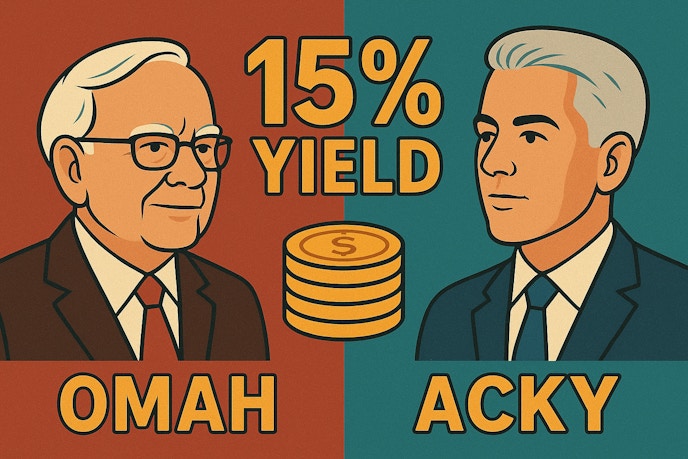
These two ETFs from VistaShares combine high-income covered call strategies with exposure to the stock-picking styles of Warren Buffett and Bill Ackman.

Keep up with what matters in ETFs
Get timely ETF insights, market trends, and top ideas straight to your inbox.
Your newsletter subscriptions with us are subject to ETF Central's Privacy Policy and Terms and Conditions.
If you wanted to invest like greats such as Warren Buffett and Bill Ackman, both have flagship companies that are publicly traded. Berkshire Hathaway Inc. (BRK.B) trades on the NYSE, while Pershing Square Holdings (PSH) is listed on the London Stock Exchange.
But these vehicles offer more than just exposure to the equity portfolios that attract headlines and move markets whenever they disclose new positions.
Berkshire, for example, also owns a sprawling collection of wholly owned businesses, including BNSF Railway, GEICO, and See’s Candies. Pershing Square combines its public holdings with other activities such as hedging strategies and occasional private investments.
For that reason, investing directly in Berkshire or Pershing is less about purely tracking Buffett’s or Ackman’s stock picks and more about accepting other factors that influence performance, such as operating subsidiaries and capital allocation decisions.
ETF issuer VistaShares is aiming to strip away those complications with two funds: the VistaShares Target 15™ ACKtivist Distribution ETF
Get data on 14,000+ ETFs
Access Trackinsight's reliable and comprehensive data with 500M+ points on 14,000+ ETFs.
VistaShares Target 15™ Berkshire Select Income ETF OMAH+0.05%
OMAH has been a very successful launch. Debuting in March 2025, it has already grown to $534 million in AUM. The fund is built on a core portfolio mirroring Berkshire Hathaway’s 20 largest public equity holdings, with a notable 10% allocation to BRK.B itself.
That means investors get exposure to longstanding Buffett picks like Apple, American Express, Bank of America, VeriSign, Chevron, Chubb, Occidental Petroleum, Visa, Coca-Cola, Kroger, and Kraft Heinz—without the influence of Berkshire’s non-public components like GEICO, Berkshire Hathaway Energy, or BNSF Railway.
As an actively managed ETF, OMAH isn’t bound to a benchmark. The portfolio can be adjusted to provide a more direct reflection of Buffett’s public holdings. For example, UnitedHealth Group was recently added after Berkshire initiated a stake, while newer homebuilder positions are still absent.
The second layer is the buy-write overlay. Options are sold on individual stocks, with strikes and expiries adjusted based on VistaShares’ estimates of what is required to support the 15% annualized distribution target above and beyond the underlying dividends paid.
However, distributions may exceed the fund’s income and realized gains for the year, which results in return of capital. The most recent monthly payout was 24.08% return of capital, which isn’t immediately taxable but instead reduces an investor’s cost basis.
The main drawback is cost. At 0.95%, the expense ratio is high relative to peers. A reduction closer to 0.75%, in line with other actively managed option-writing ETFs, would make OMAH more competitive.
VistaShares Target 15™ ACKtivist Distribution ETF ACKY-1.02%
ACKY applies the same structure but to Bill Ackman’s portfolio. His style is notably different—less defensive than Buffett’s blue-chip holdings and more tilted toward cyclical and growth-oriented names.
The ETF includes Uber, Restaurant Brands, Alphabet, Chipotle, Amazon, and Hilton, along with two Canadian companies, Brookfield Corp. and Restaurant Brands.
Like OMAH, ACKY uses an option overlay on individual names, with strikes and expiries varied to maintain a 15% distribution target. The ETF launched in September 2025, and while the first distribution is still to be determined, it’s likely to include a return-of-capital component.
The same concern applies here as with OMAH: a 0.95% expense ratio. Even so, investors have responded positively. In just 17 days since launch, ACKY has already surpassed $25 million in AUM.
My Thoughts on OMAH and ACKY
Many of the stocks in OMAH and ACKY trade at high share prices, which makes selling covered calls directly a capital-intensive strategy. Owning 100 shares of each position is unrealistic for most investors. These ETFs address this issue by pooling assets, leveraging economies of scale, and outsourcing strike and expiry decisions to professionals with the expertise to manage an option overlay.
The key to success will be staying on top of 13F filings and reacting quickly to changes in Buffett’s and Ackman’s portfolios. There’s no index to follow, so it comes down to the managers’ discretion—deciding whether a new addition is large and liquid enough to warrant inclusion while still being suitable for covered call writing.
My concern lies with the 15% target distribution. Personally, I would have preferred a 12% target, which translates to an even 1% a month. That would reduce pressure on NAV erosion during weaker markets, when it might be difficult to generate enough premium income from calls.
If that happens, the return of capital could rise. While ROC can be constructive when used to smooth distributions or defer taxes, it becomes destructive when used heavily to prop up payouts. We’ve seen this issue before with closed-end funds, and I hope OMAH and ACKY avoid repeating the same pattern.
Please note that this article reflects the author’s personal views and does not represent the opinions of the publication or its affiliates. It is for informational purposes only and does not constitute investment advice. It is essential to seek guidance from a registered financial professional before making any investment decisions.
Latest ETF News
See all ETF newsThere’s an ETF for That? Investing Like University Endowments

Could Water ETFs Be the Next AI Bottleneck Trade?

What is a Boomer Candy ETF?

ETF Comparison: NEOS Nasdaq-100 High Income ETF (QQQI) Versus Goldman Sachs Nasdaq-100 Premium Income ETF (GPIQ)



 Advantages of ETFs over Mutual Funds1/6
Lower Costs
In this guide, we'll explore the advantages of ETFs over mutual funds, giving you valuable insights into why ETFs have gained significant popularity among investors like yourself.
Leveraged ETFs: Unlocking the Potential for Amplified Returns1/6
Understanding Leveraged ETFs
Explore leveraged ETFs: potential for amplified returns & risks. 5 ETFs to consider across equities, commodities & fixed income.
What is a Leveraged ETF?1/6
Introducing Leveraged and Inverse ETFs
In this guide, we'll dive into the world of leveraged ETFs, exploring their definition, mechanics, potential risks, and rewards.
Recent educational content

ETF Trends
ETF Industry KPIs September 14, 2026
This week’s KPI data overview highlights key metrics and trends shaping the ETF landscape.

ETF Trends
ETF Industry KPIs September 8, 2026
This week’s KPI data overview highlights key metrics and trends shaping the ETF landscape.
ETF Trends
ETF Industry KPIs August 31, 2026
This week’s KPI data overview highlights key metrics and trends shaping the ETF landscape.
ETF Trends
ETF Industry KPIs August 24, 2026
This week’s KPI data overview highlights key metrics and trends shaping the ETF landscape.
Browse all educational columns



Expert-Built ETF Portfolios, All in One Place
Don’t start from scratch. Discover ready-made ETF portfolios built by professionals to match different goals, timelines, and market views. Use them as inspiration or as a starting point for your own allocation.