Open Now: The Global ETF Survey Take the Survey →



Insurance Investments Unveiled: Trends, ETFs, and the Changing Risk Landscape
In a rising rate environment, insurance companies can be of benefit to one’s portfolio.


Keep up with what matters in ETFs
Get timely ETF insights, market trends, and top ideas straight to your inbox.
Your newsletter subscriptions with us are subject to ETF Central's Privacy Policy and Terms and Conditions.
For many individuals, the topic of insurance engenders a feeling of dread due to the negative sentiment they may have of it, but investors in insurance companies feel differently, as they do well in unstable economic times largely because they aren’t affected by the downturn in the economy like other industries. They also provide essential services whose demand profile doesn’t fluctuate with economic cycles.
This article will focus on SPDR® S&P Insurance ETF (Ticker: KIE), iShares US Insurance ETF (Ticker: IAK), and Invesco KBW Property & Casualty Ins ETF (Ticker: KBWP); three solutions that provide pure-play exposure to the insurance industry and highlight recent developments occurring within the industry that are of material importance.
The ETF Industry Is Evolving Fast
From AI infrastructure to active strategies, the ETF landscape is shifting. Share your perspective in the 7th Annual Global ETF Survey and get exclusive early access to the final report.
Benefitting from a changing rate environment
The core function of insurance is managing risks driven by nature or related to human life. In managing these risks, insurance companies perform the functions of pooling the money of their clients in the present, but not paying out until a later date. Therefore, insurance companies have the money to own and manage until there is some claim event (e.g., someone dies or gets their home flooded) perhaps many years later. The traditional, conservative way for insurance companies to manage this float money (i.e., the money held by insurance companies that have not yet been paid out to claimants) was to invest it in low-paying but ultra-safe investment grade bonds.
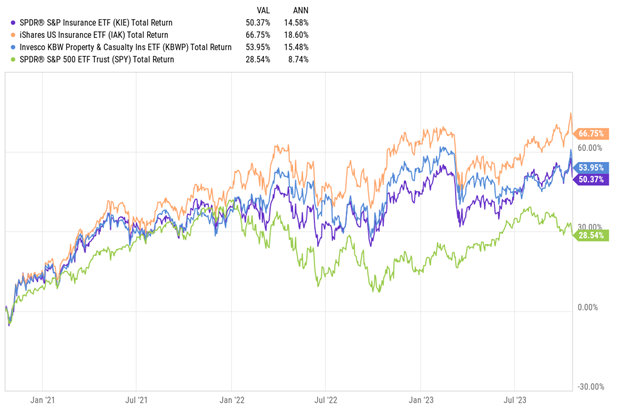
Against the backdrop of a market environment that has seen interest rates rise precipitously, there has been a material change in the performance of insurance companies, as over the past three years, approximately, KIE, IAK and KBWP have outperformed the market, partly due to changing rate environment.
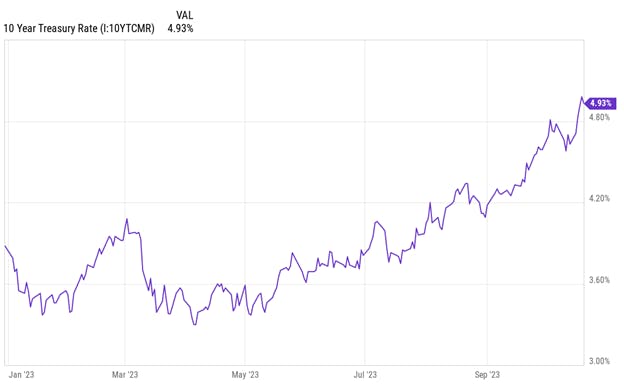
The relationship between interest rates and insurance companies is believed to be linear in nature, due to the implied fixed income implications. As the existing bonds that insurance companies hold mature, they will be replaced by bonds with higher interest earnings. Because insurers try to match the duration of their assets with the duration of their liabilities, many of the bonds they hold are long-term bonds, and they are usually held to maturity. Thus, the bonds obtained during a period of high interest rates would ostensibly be held on insurer balance sheets for an extended period of time. Another consideration is the yield garnered on investments with floating interest rates; that is, interest rates tied to a benchmark rate, such as the 10-year Treasury bond. With the yield on a 10-year Treasury bond being approximately five percent, the interest earned from the monies insurance companies would invest is material in nature.
A changing insurance landscape
In an environment where the frequency and severity of global risks that insurance companies must now account for grows significantly, the risk paradigm of insurers is changing. A recent report from The Washington Post outlines that at least five large U.S. property insurers — including Allstate, American Family, Nationwide, Erie Insurance Group and Berkshire Hathaway — have told regulators that extreme weather patterns caused by climate change have led them to stop writing coverages in some regions, exclude protections from various weather events and raise monthly premiums and deductibles. Furthermore, car insurance prices have risen 17% in the first six months of 2023, according to research done by Insurify. Presently, the national average cost of a car insurance policy is $1,668, representing about 2.4% of the average household income.
With insurers acting as society’s “financial safety net,” providing a backstop against financial loss for innumerable risks worldwide, the proliferation of new risk possibilities requires innovation to proactively observe and undertake risk mitigation actions before a disaster occurs. As noted in Deloitte’s 2024 global insurance outlook more insurers are expanding their policy portfolio to cover renewable energy projects, and capitalize on increasing interest and investment in green technologies. Beyond sustainability initiatives, the ever-expanding use of AI is also an opportunity. For example, Munich Re, for example, has launched a policy to cover those implementing self-developed AI programs in their own companies, mitigating potential financial losses from AI underperformance, insurers can also consider using AI to help clients reduce or mitigate risks. InsurTech, technological innovations that are created and implemented to improve the efficiency of the insurance industry, was estimated to have a market-size of US$81.5 billion in 2022 and is estimated to be US$130.1 billion in 2027.
A look at each ETF
For investors looking to gain exposure to the insurance industry via an ETF, the SPDR® S&P Insurance ETF (Ticker: KIE), iShares US Insurance ETF (Ticker: IAK), and Invesco KBW Property & Casualty Insurance ETF (Ticker: KBWP) are the primary solutions available.
Of the three funds, the SPDR® S&P Insurance ETF has both the largest AUM ($629.04M) and the broadest exposure to the insurance industry. The ETF’s benchmark is the S&P Insurance Select Industry Index, which comprises sub-industries, such as Insurance Brokers, Life & Health Insurance, Multi-Line Insurance, Property & Casualty Insurance, and Reinsurance; thus, investors would have full exposure to the insurance eco-system with this solution and be able to take a take a strategic or tactical position if desired.
The iShares US Insurance ETF has the second largest AUM ($360.69M) and a narrower focus, as exposure is limited primarily to life, property and casualty, and full line insurance; with property and casualty having an outsized allocation (i.e., 63.35% as of October 19th) within the portfolio. Finally, the Invesco KBW Property & Casualty Insurance ETF, the most specialized of the three, has an AUM of $151.96M and as its name suggests, focuses primarily on companies engaged in US property and casualty insurance activities.
For investors interested in gaining exposure to insurance firms, any of the solutions will suffice, however, given the context of the changing insurance landscape, opportunities centered around sustainability and renewable development would be of seminal importance in the future.
Please note this article is for information purposes only and does not in any way constitute investment advice. It is essential that you seek advice from a registered financial professional prior to making any investment decision.
Latest ETF News
See all ETF newsHow Investors can Maximize Tax Efficiency with Income ETFs


Trump Accounts: Here's Which ETFs You Can Invest In

The Two Best Types of Fixed-Income ETFs For Managing Cash

ETF Comparison: Roundhill Generative AI & Technology ETF Versus iShares A.I. Innovation and Tech Active ETF




 Advantages of ETFs over Mutual Funds1/6
Lower Costs
In this guide, we'll explore the advantages of ETFs over mutual funds, giving you valuable insights into why ETFs have gained significant popularity among investors like yourself.
Leveraged ETFs: Unlocking the Potential for Amplified Returns1/6
Understanding Leveraged ETFs
Explore leveraged ETFs: potential for amplified returns & risks. 5 ETFs to consider across equities, commodities & fixed income.
What is a Leveraged ETF?1/6
Introducing Leveraged and Inverse ETFs
In this guide, we'll dive into the world of leveraged ETFs, exploring their definition, mechanics, potential risks, and rewards.
Recent educational content

ETF Trends
ETF Industry KPIs July 20, 2026
This week’s KPI data overview highlights key metrics and trends shaping the ETF landscape.

ETF Trends
ETF Industry KPIs July 13, 2026
This week’s KPI data overview highlights key metrics and trends shaping the ETF landscape.
First Look ETF
First Look ETF: Cash Deployment, Bond, and Hedged ETFs
In this season 6 episode of First Look ETF, Stephanie Stanton examines the latest ETF marketplace trends with NYSE and guests.

ETF Trends
ETF Industry KPIs July 6, 2026
This week’s KPI data overview highlights key metrics and trends shaping the ETF landscape.
Browse all educational columns



Build and Analyze Your ETF Portfolio Like a Pro
Create your own ETF portfolio in minutes and instantly see allocations, exposures, performance, and risk. Visualize diversification across asset classes, regions, and sectors. Stress-test ideas, compare benchmarks, and refine your strategy with professional-grade analytics.