From idea to ETF portfolio in minutes. Build yours now →



Institutional Preferred Issuance Is Expected to Continue its Upward Trajectory
Moody’s update levels the playing field for preferreds. Discover why institutional $1,000 par securities are surging in issuance and investor interest.
Keep up with what matters in ETFs
Get timely ETF insights, market trends, and top ideas straight to your inbox.
Your newsletter subscriptions with us are subject to ETF Central's Privacy Policy and Terms and Conditions.
The preferred securities market has experienced a shift amongst its two largest segments; retail preferreds ($25 par) and institutional preferreds ($1,000 par). Last year, Moody’s aligned their equity credit assignment methodology for preferred securities to match that of S&P and Fitch, putting both segments on the same playing field from a liability management standpoint.¹
Subordinated debt coupons, a type of institutional preferred, are considered tax deductible for the issuer whereas retail preferred equity dividends are not.² The liquid U.S. capital securities market has seen its share of institutional preferred securities increase from 54% to 68% and this methodology update may enable further issuance growth.
$1,000 pars are typically sought after by institutional investors since they are traded over the counter and less influenced by more volatile, retail investor flows.
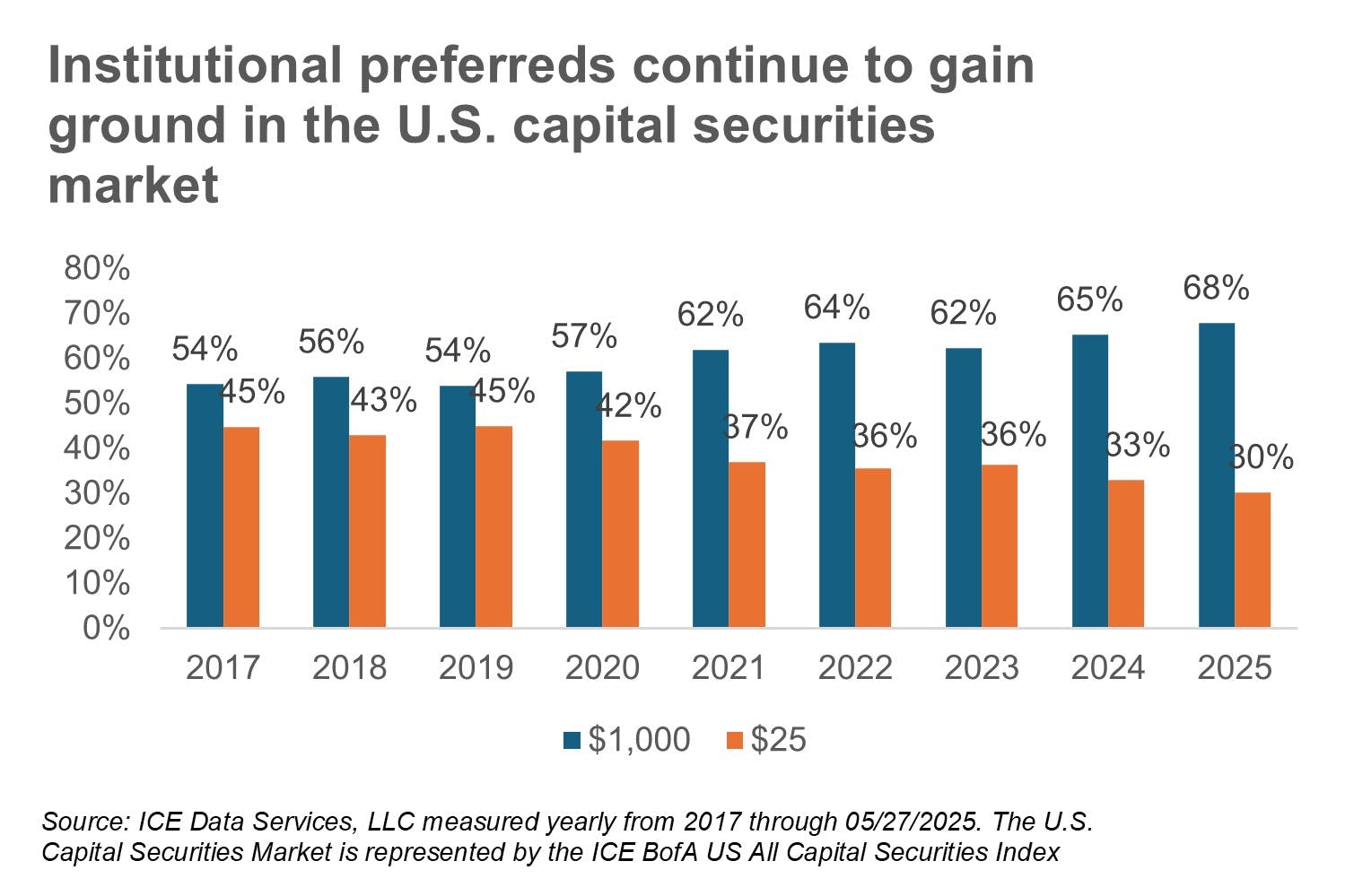
Source: ICE Data Services, LLC measured yearly from 2017 through 05/27/2025. The U.S. Capital Securities Market is represented by the ICE BofA US All Capital Securities Index.
Key Takeaways
- Issuance in the institutional preferred securities market is expected to grow amid favorable capital management trends.
- Institutional preferred securities demand is sought after for its potentially lower volatility characteristics.
- Preferred securities investors may want to consider if they have palatable exposure to the growing, $1,000 par segment of the market.
Explore this topic further and how institutional preferreds may be an enticing addition to a multi-asset portfolio. Read the full AAM ETF Monthly Insights here.
Sources
¹ Debevoise & Plimpton (2024, August 5) In the Moody’s for Subordinated Debt Securities: Methodology Changes for Awarding Equity Credit
² Ibid.
Like what you're reading?
Stay in the loop — get the latest ETF insights: trends, analysis, and expert picks.
Disclosures
Investing involves risk, including the possible loss of principal.
ICE BofA US All Capital Securities Index tracks the performance of a specific type of fixed-income security: fixed-rate, U.S. dollar-denominated hybrid corporate and preferred securities that are publicly issued in the U.S. domestic market. These securities are often referred to as "capital securities" and are a subset of the broader ICE BofA US Corporate Index. Subordinated debt coupons refer to the interest payments made on subordinated debt, which is a type of debt that ranks lower in priority for repayment compared to senior debt in the event of a company's liquidation or bankruptcy.
Any tax or legal information provided is a summary of our understanding and interpretation of some of the current income tax regulations and is not exhaustive. Investors must consult their tax professional or legal counsel for advice and information concerning their particular situation. Neither the Fund nor any of its representatives may give legal or tax advice.
AAM offers a suite of innovative Exchange Traded Funds (ETFs) to meet the ongoing needs of our clients. In addition to the benefits of the ETF wrapper – diversification, transparency, low-cost, trading flexibility and tax-efficiency – our practical ETF solutions focus on helping investors meet their cash-flow and capital appreciation goals. For more information, please contact your AAM Representative. You can also call us at 866.606.7220 or visit https://www.aamlive.com/ETF.
AAM ETFs are distributed by Quasar Distributors, LLC. Quasar and AAM are not affiliated.
The investment objectives, risks, charges and expenses must be considered carefully before investing. The statutory and summary prospectus contains this and other important information about the investment company, and it may be obtained by calling 800.617.0004 or visiting www.aamlive.com. Read it carefully before investing.
©2025 Advisors Asset Management, Inc. Advisors Asset Management, Inc. (AAM) is an SEC-registered investment advisor and member FINRA/SIPC. Registration does not imply a certain level of skill or training.
18925 Base Camp Road • Monument, CO 80132 • www.aamlive.com
CRN: 2025-0701-12690 R

Latest ETF News
See all ETF newsEntering A New Era of Defense Tech Spending


How SPXD Delivers a More Balanced S&P 500 Exposure


Autocallable Yield Advantage and Market Reception






 Advantages of ETFs over Mutual Funds1/6
Lower Costs
In this guide, we'll explore the advantages of ETFs over mutual funds, giving you valuable insights into why ETFs have gained significant popularity among investors like yourself.
Leveraged ETFs: Unlocking the Potential for Amplified Returns1/6
Understanding Leveraged ETFs
Explore leveraged ETFs: potential for amplified returns & risks. 5 ETFs to consider across equities, commodities & fixed income.
What is a Leveraged ETF?1/6
Introducing Leveraged and Inverse ETFs
In this guide, we'll dive into the world of leveraged ETFs, exploring their definition, mechanics, potential risks, and rewards.
Recent educational content

ETF Trends
ETF Industry KPIs September 8, 2026
This week’s KPI data overview highlights key metrics and trends shaping the ETF landscape.

ETF Trends
ETF Industry KPIs August 31, 2026
This week’s KPI data overview highlights key metrics and trends shaping the ETF landscape.
ETF Trends
ETF Industry KPIs August 24, 2026
This week’s KPI data overview highlights key metrics and trends shaping the ETF landscape.
What’sTheFund
What's the Fund | Ocean Park Diversified Income ETF (DUKZ)
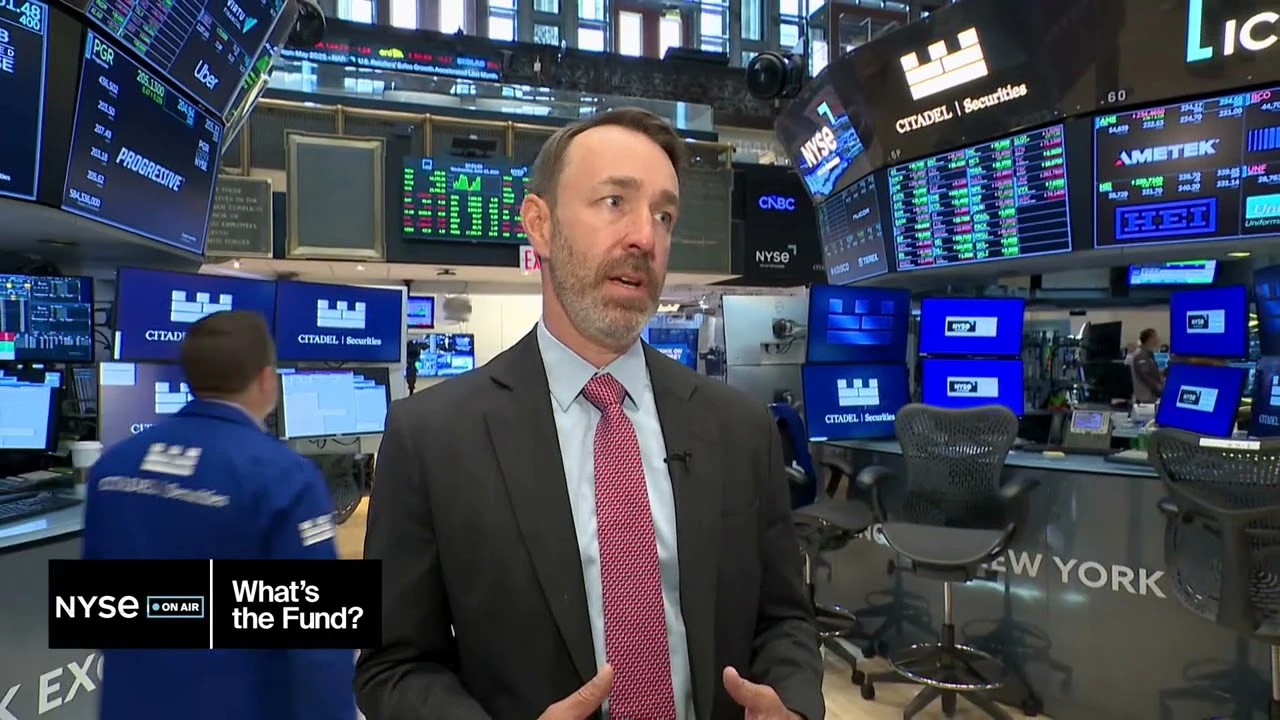
James St Aubin, Chief Investment Officer at Ocean Park Asset Management, discuss the DUKZ ETF, exposing investors to the whole spectrum of asset classes in the fixed income markets, through their rules-based process.

Browse all educational columns



Have you tried our ETF Compare tool?
Compare ETFs like a pro. Analyze fees, performance, exposure & holdings side-by-side.