Keep tabs on your favorite ETFs with a personalized weekly tracker. Create a Watchlist now →



Inflation Reduction Act: 3 renewable energy ETFs to watch
The passing of the Act could lead to further long-term upside for various clean energy industries.


Keep up with what matters in ETFs
Get timely ETF insights, market trends, and top ideas straight to your inbox.
Your newsletter subscriptions with us are subject to ETF Central's Privacy Policy and Terms and Conditions.
President Joe Biden's Inflation Reduction Act (IRA) should have been titled the "Climate Action Act" instead. Despite provisions focused on improving U.S. tax codes, the bulk of the IRA deals with tackling the current climate crisis. The IRA contains a slew of provisions intended to boost U.S. labor force participation and industrial manufacturing with a clean energy angle, including:
- Expanding tax credits for energy efficient commercial buildings, new energy efficient homes, and electric vehicle (EV) charging infrastructure.
- A "Make it in America" tax credit provision for the use of American-made equipment for clean energy production.
- Targeted tax incentives for manufacturing U.S.-sourced products such as batteries, solar, and offshore wind components.
Investors interested in capturing the long-term effects of the IRA still have time to act. While markets are forward-looking, the downstream consequences of the IRA's passing might not be fully priced in yet. Some of these provisions will take years, maybe decades, to be fully implemented. Investing in the renewables/clean energy industry might be a worthwhile thematic tilt in the coming years.
As a thematic tilt, clean energy stocks were hard hit in 2022. Previously, these high-beta growth stocks thrived in the low-interest rate environment of 2019 – 2021, which saw numerous companies soar in valuation. The opposite occurred in 2022, where high inflation, rising interest rates, and supply chain deadlocks sent the industry into a rout.
One thing is clear, though – clean energy remains a popular thematic tilt, with ETFs attracting high inflows despite the losses. I used the ETF Central screener to identify three clean energy funds, one broad-based and two industry-specific that investors could use for their thematic tilt.
Get data on 14,000+ ETFs
Access Trackinsight's reliable and comprehensive data with 500M+ points on 14,000+ ETFs.
Going broad to identify clean energy funds
Thematic investing doesn't require active management in the form of a fund manager picking individual stocks. Nowadays, the line between passive indexing and active management is becoming increasingly blurred, with many rules-based or quantitative methodology-based funds falling in the middle.
Investors looking for a more passive approach to their clean energy thematic tilt might like the iShares Global Clean Energy ETF (ICLN), which tracks the S&P Global Clean Energy Index. This ETF index holds a total of 98 global clean energy stocks, with 47% from the U.S., 11% from China, 10% from Denmark, and the rest from other countries.
The clean energy industry is broad and comprises many sub-industries. In ICLN, the highest represented sub-sector is semiconductor equipment at 22%, followed by renewable electricity at 19%, and then electric utilities at 15%. In terms of sector exposure, we mostly see technology, industrial, utilities, and materials stocks.
ICLN is the most popular clean energy ETF, having attracted assets under management (AUM) of $5.46 billion since inception. Be aware that the fund is fairly volatile, with a three-year standard deviation of 35.38% and beta of 1.13. In terms of fees, it charges a reasonable 0.40% expense ratio.
Investing in solar energy with TAN ETF
Investors who want to take on more risk for the chance of higher returns can make a more concentrated bet on a particular sub-industry of the clean energy industry. The IRA will provide a 30% tax credit for 7.5 million families to install solar on their roofs, and a commitment of 950 million solar panels by 2030.
A good option here is the Invesco Solar ETF (TAN) which tracks the MAC Global Solar Energy Index. TAN uses an interesting "pure play versus medium play" methodology to screen and weigh its 55 underlying holdings. If a company has revenues from solar comprising a majority, it is categorized as pure play. If solar revenues only account for one-third, the company s designed medium play.
Pure-play solar companies are weighted higher in the ETF. The top three holdings are Emphase Energy (ENPH), First Solar (FSLR), and SolarEdge Technologies (SEDG). Overall, the fund is skewed towards small and mid cap stocks, with a growth stock focus. The ETF has higher volatility as a result, with a five-year monthly beta of 1.47.
Investing in wind energy with FAN ETF
Investors can also target the wind energy sub-industry of the clean energy sector. The IRA extended existing tax credit provisions for wind projects, which could incentivize further industry activity and development. Investors can gain wind energy exposure via the First Trust ISE Global Wind Energy Index Fund ETF (FAN), which tracks the ISE Clean Edge Global Wind Energy Index.
FAN uses a similar pure vs. non-pure methodology as TAN to weigh its holdings. Companies with 50% of their revenues coming from wind energy are classified as pure play, while those with lower revenue exposure to wind energy are classified as diversified. Pure-play companies account for 60% of FAN by weight, with the remaining diversified companies accounting for 40%, each capped at 2%.
Surprisingly, FAN is slightly less volatile than the overall market, with a lower five-year monthly beta of 0.94. The ETF is almost entirely utilities and industrial stocks, with a smattering of materials companies. The former tends to be defensive in nature, while the latter tends to be cyclical.
Historical performance of ICLN, TAN & FAN
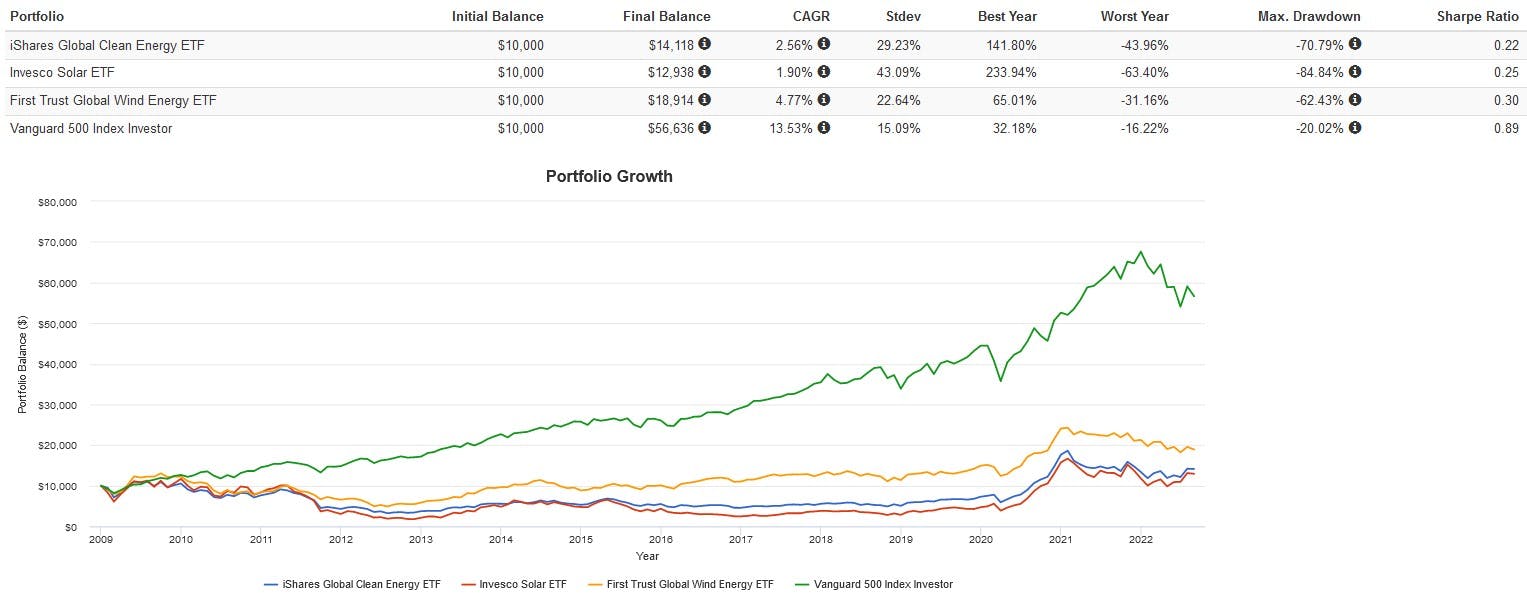
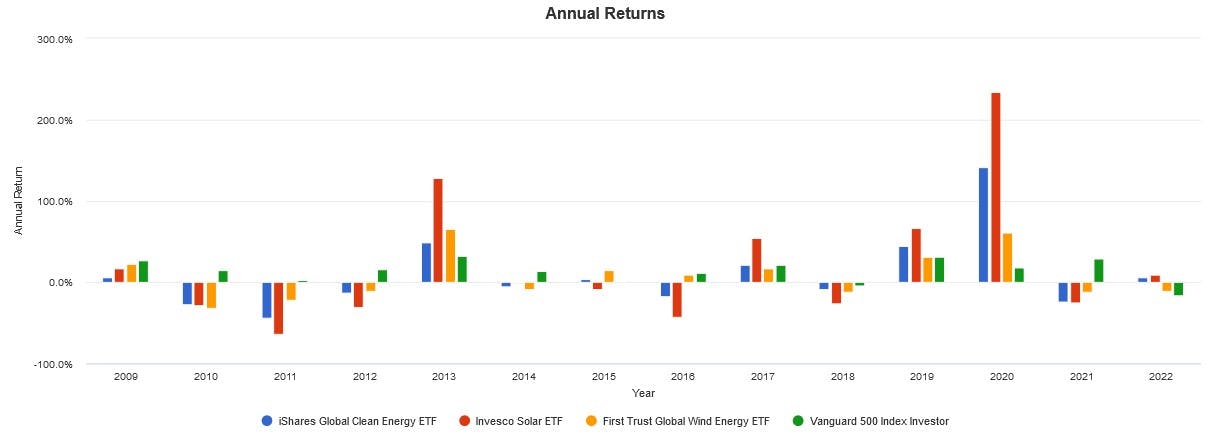
I've provided a backtest of all three ETFs' performance versus the S&P 500 from 2009 to the present below. Keep in mind that these returns are hypothetical in nature, do not reflect actual investment results and are not guarantees of future performance. The hypothetical returns do not reflect trading costs, transaction fees, commissions, or actual taxes due on investment returns.

Please note this article is for information purposes only and does not constitute investment advice.

Latest ETF News
See all ETF newsMoneyShow Chart of the Day 4/1/2026: Deal Volume Jumps in Q1 (But Will it PERSIST?)




MoneyShow Chart of the Day 3/9/2026: Tallying Up the Costs in Oil Markets




 Advantages of ETFs over Mutual Funds1/6
Lower Costs
In this guide, we'll explore the advantages of ETFs over mutual funds, giving you valuable insights into why ETFs have gained significant popularity among investors like yourself.
Leveraged ETFs: Unlocking the Potential for Amplified Returns1/6
Understanding Leveraged ETFs
Explore leveraged ETFs: potential for amplified returns & risks. 5 ETFs to consider across equities, commodities & fixed income.
What is a Leveraged ETF?1/6
Introducing Leveraged and Inverse ETFs
In this guide, we'll dive into the world of leveraged ETFs, exploring their definition, mechanics, potential risks, and rewards.
Recent educational content
Asset TV
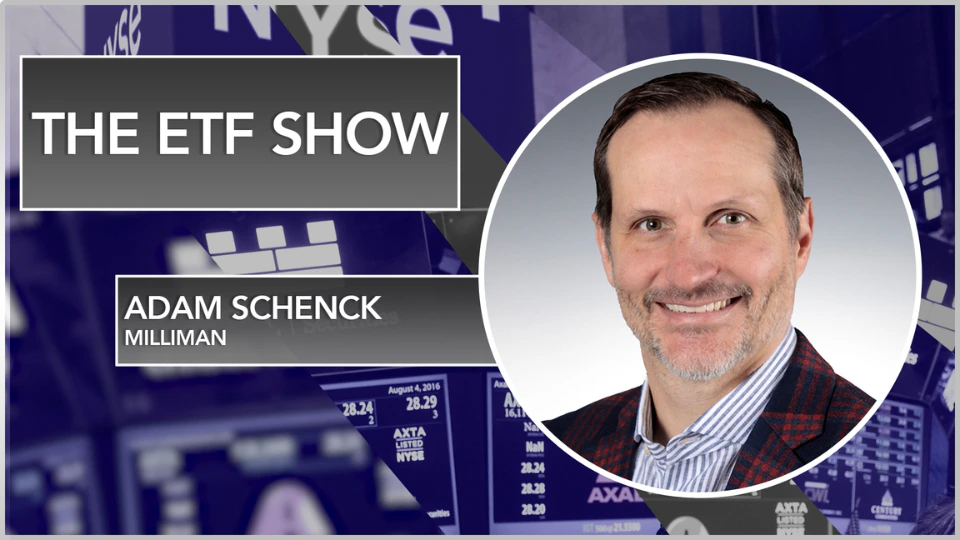
The ETF Show - Investors Can Fight Healthcare Inflation with Newly Launched ETFs
Adam Schenck, Principal and Managing Director of Fund Services at Milliman joined The ETF Show to discuss Milliman's first ETFs designed to hedge against rising healthcare inflation.


ETF Trends
ETF Industry KPIs April 20, 2026
The ETF Industry saw 14 New Launches, 1 Ticker Change and 16 closures last week.

Asset TV
The ETF Show - Investors Run to Cash Alternatives as Markets Remain Volatile
Jason England, Portfolio Manager and Fixed Income Strategist from Simplify joined The ETF Show to discuss investor allocations to fixed income as markets continue on their rollercoaster ride.
ETF Trends
ETF Industry KPIs March 30, 2026
The ETF Industry saw 33 New Launches, 1 Ticker Change and 9 closures last week.
Browse all educational columns



Build and Analyze Your ETF Portfolio Like a Pro
Create your own ETF portfolio in minutes and instantly see allocations, exposures, performance, and risk. Visualize diversification across asset classes, regions, and sectors. Stress-test ideas, compare benchmarks, and refine your strategy with professional-grade analytics.