Create, analyze, optimize your ETF portfolio. Start now →



India Charted: Exploring the Massive Internet Investment Opportunity in India - Part IV
In Part IV of the ETF Central series, "India Charted," we delve deeper into India's digital revolution, using insightful charts and graphics to identify the most promising investment opportunities.


Keep up with what matters in ETFs
Get timely ETF insights, market trends, and top ideas straight to your inbox.
Your newsletter subscriptions with us are subject to ETF Central's Privacy Policy and Terms and Conditions.
In recent years, the Indian internet sector has experienced unprecedented growth, driven by a surge in digital adoption across the country. India’s population, now over 1.4 billion, is rapidly urbanizing, with a growing middle class of consumers eager to embrace the online world. Affordable smartphones, coupled with the expansion of 4G and now 5G networks, have brought millions of Indians online for the first time. In fact, India's internet user base is expected to surpass 900 million by 2025¹, making it one of the largest and fastest-growing digital markets globally.
This digital transformation is not only reshaping the internet landscape but is also redefining daily life across India. E-commerce, digital payments, and online services are becoming mainstream, creating a vast opportunity for investors to tap into this evolving market. That’s precisely why we created The India Internet Index (INQQ)—to offer investors a comprehensive tool to track the investible universe of Indian internet companies. But don’t just take our word for it...these visuals tell the compelling story of India's digital revolution unfolding right now.
Like what you're reading?
Stay in the loop — get the latest ETF insights: trends, analysis, and expert picks.
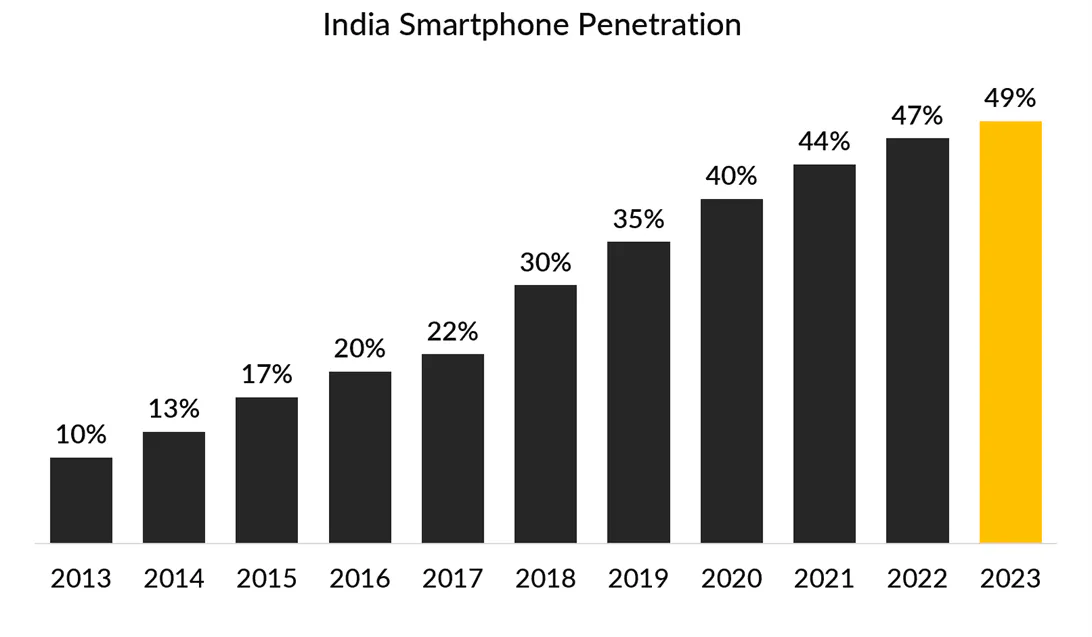
Chart#1: India Smartphone Penetration
India's smartphone penetration today is roughly where China and the USA were over a decade ago.
When India catches up, it will result in over 330 million new smartphone users in one country... the population of the U.S. today.
Millions of new smartphone users will serve as the backbone of growth for the Indian internet economy.
Source: Newzoo, EMQQ Global Analysis
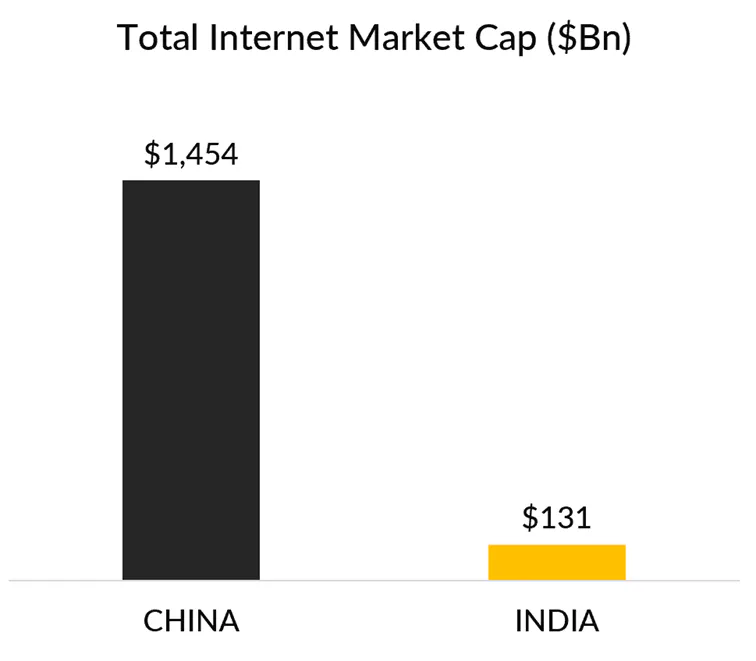
Chart#2: Total Internet Market Cap ($Bn)
The total market capitalization of the Chinese internet sector is 11x larger than India's. Meanwhile India's e-commerce penetration is only 1/5th of China's. Smartphone penetration of roughly 50% in India versus 70% for China. All the right ingredients for tremendous growth.
Source: Bloomberg, EMQQ Analysis
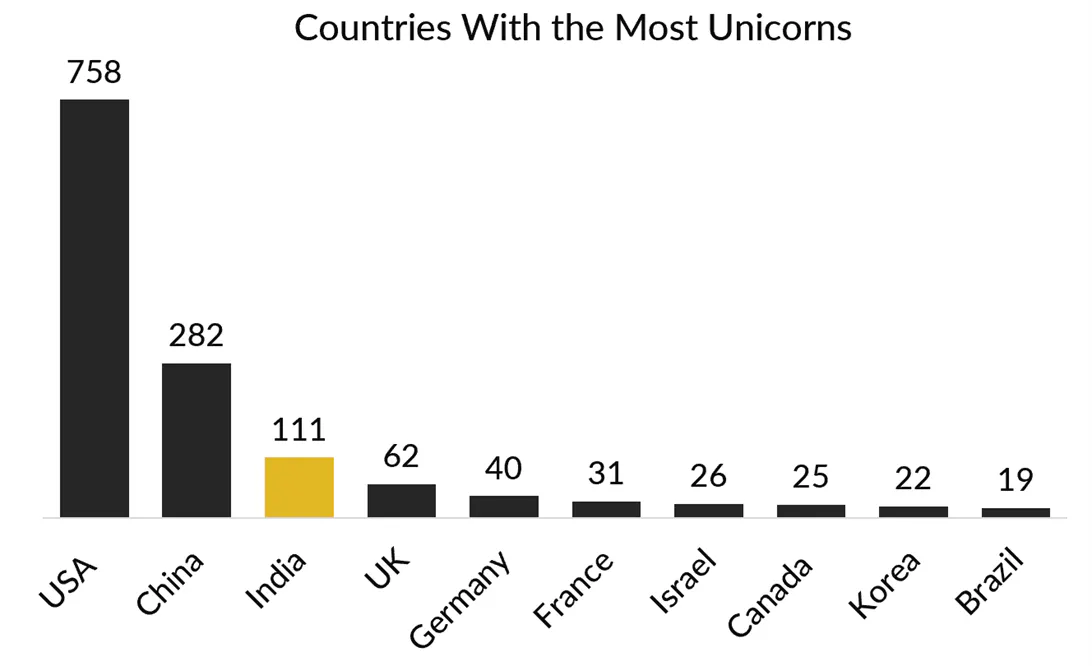
Chart#3: Countries With the Most Unicorns
India is home to more than 100 unicorns. Only China and the USA have more. These young innovative companies will drive the future growth of the Indian internet eonomu. Over the next 5 years, more than 30 new age tech companies in India could join the public equity markets, helpen broaden and enrich the space.
Source: Crunchbase, Inc42
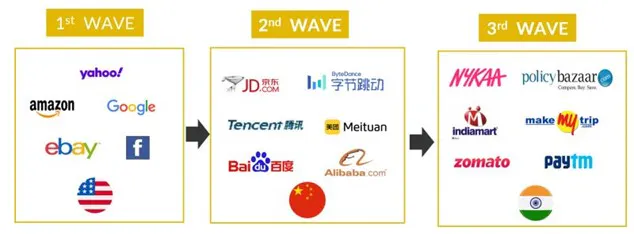
Chart #4: Internet Third Wave
The US and China were key drivers of the first two Internet waves. Both countries produced many of the tech behemoths we know very well today.
India is now the Internet Third Wave. What factors are driving this?
- Surging smartphone adoption. Penetration less than 50%
- Declining smartphone prices.
- Amongst the lowest mobile data costs in the world. Just $0.16 per 1GB.
- Rapidly growing e-commerce market. Penetration of only 5-6%.
- Burgeoning startup ecosystem. India home to more than 100 unicorns.
- One of the most innovative digital payment ecosystems in the world via “UPI.”
- Government aggressively pushing digitalization via the "India Stack."
Source: EMQQ Global Analysis
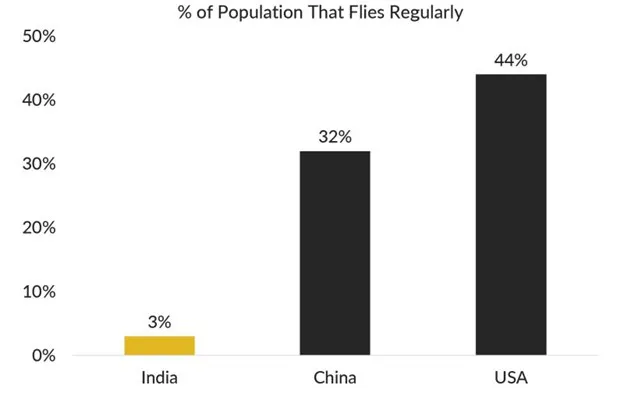
Chart#5: Regular Flyers
There’s a huge opportunity for Indian companies operating in the online travel agency (OTA) space.
That's India for you. Lots of categories with low penetration, runway for growth and tremendous opportunities for digitalization.
Source: Statista, New York Times
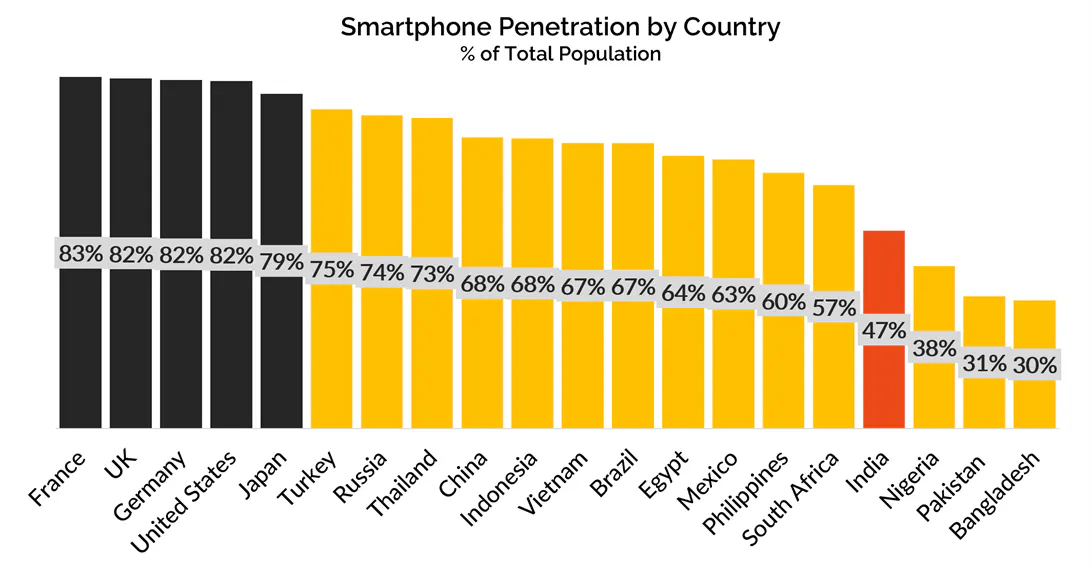
Chart#6: Smartphone Penetration by Country
Smartphone penetration in India is still very low compared to global standards.
As the country’s penetration increases, hundreds of millions of Indians will enter the digital age for the first time, providing a long-term bump to the local internet economy.
Source: NewZoo
Source:
¹ - India likely to have 900 million active internet users by 2025: Report
About the Author
Akeem Bailey is the Director of Research for EMQQ Global. Previously, Akeem worked at Rondure Global Advisors, where he helped oversee research and due diligence on emerging market equities and at Arisaig Partners, a Singapore-based hedge fund focused exclusively on consumer and internet companies in emerging markets. Akeem began his career living and working in India as a strategy consultant for the Mahindra Group. Akeem holds a B.A. in International Relations from the University of Pennsylvania.
Disclaimer
Please note this article is for information purposes only and does not in any way constitute investment advice. It is essential that you seek advice from a registered financial professional prior to making any investment decision.
Topics
See all
Mentioned ETFs
No specific ETFs were tagged
Further reading


Latest ETF News
See all ETF newsForm 4 Has 20 Transaction Codes. None Say "Section 351 ETF Swap"


Who Really Owns a White-Label ETF?


What If a Futures-Based ETF Never Had to Roll Again?

How Do You Build a Winning ETF Business?

Losers Of Q2 2026 REIT Earnings Season


Winners of Q2 2026 REIT Earnings Season


 Advantages of ETFs over Mutual Funds1/6
Lower Costs
In this guide, we'll explore the advantages of ETFs over mutual funds, giving you valuable insights into why ETFs have gained significant popularity among investors like yourself.
Leveraged ETFs: Unlocking the Potential for Amplified Returns1/6
Understanding Leveraged ETFs
Explore leveraged ETFs: potential for amplified returns & risks. 5 ETFs to consider across equities, commodities & fixed income.
What is a Leveraged ETF?1/6
Introducing Leveraged and Inverse ETFs
In this guide, we'll dive into the world of leveraged ETFs, exploring their definition, mechanics, potential risks, and rewards.
Recent educational content

ETF Trends
ETF Industry KPIs September 14, 2026
This week’s KPI data overview highlights key metrics and trends shaping the ETF landscape.

ETF Trends
ETF Industry KPIs September 8, 2026
This week’s KPI data overview highlights key metrics and trends shaping the ETF landscape.
ETF Trends
ETF Industry KPIs August 31, 2026
This week’s KPI data overview highlights key metrics and trends shaping the ETF landscape.
ETF Trends
ETF Industry KPIs August 24, 2026
This week’s KPI data overview highlights key metrics and trends shaping the ETF landscape.
Browse all educational columns



Expert-Built ETF Portfolios, All in One Place
Don’t start from scratch. Discover ready-made ETF portfolios built by professionals to match different goals, timelines, and market views. Use them as inspiration or as a starting point for your own allocation.