Open Now: The Global ETF Survey Take the Survey →



Impact Investing: Finding Your Investing North Star and Values Investing with Jason Howell
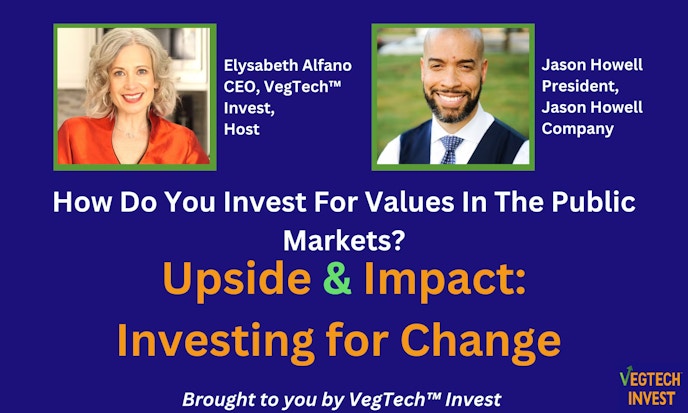
Jason Howell, President of First Generation Wealth Advisors, sits down to discuss how he helps his clients find their investing north star by encompassing financial, family, retirement, and philanthropic goals.

Keep up with what matters in ETFs
Get timely ETF insights, market trends, and top ideas straight to your inbox.
Your newsletter subscriptions with us are subject to ETF Central's Privacy Policy and Terms and Conditions.
Jason Howell, President of First Generation Wealth Advisors, sits down with Elysabeth Alfano, CEO of VegTech™ Invest, to discuss how he helps his clients find their investing north star by encompassing financial, family, retirement, and philanthropic goals.
- Why are you focusing on First Generation Clients?
- What are first generation clients most concerned with?
- How do you help them find their investing North Star?
- What is your number one tip for impact investors or those new to values investing?
The ETF Industry Is Evolving Fast
From AI infrastructure to active strategies, the ETF landscape is shifting. Share your perspective in the 7th Annual Global ETF Survey and get exclusive early access to the final report.
Transcript
Elysabeth: Hey everyone, welcome to the VegTech Invest Upside & Impact podcast. I’m your host, Elysabeth Alfano, the CEO of VegTech Invest, Advisor to the Plant-based Innovation and Climate ETF, EATV. On Upside & Impact I chat with the leaders and movers who are shaping and growing impact investing for meaningful change. We “pull up as we go up” as the expression goes so this podcast is all about making meaningful and productive impact while also managing one’s portfolio for upside. Of course, always managing for upside.
If you’d like more information about VegTech Invest you can visit us at VegTechInvest.com and subscribe to our newsletter. You can also find us on LinkedIn and on Twitter @VegTechInvest. We record live every first and third Wednesday of the month on our LinkedIn page at 1:30pm eastern standard time. So, check us out live and be sure to bring your questions.
Now if you’re listening as part of a podcast, of course subscribe to this podcast right now so that you never miss an episode. And if you’re listening on iTunes, be sure to leave a 5-star review. It really does help.
So now let’s get down to today’s show and thanks for being with me on today’s episode of VegTech Invest’s Upside & Impact. And as always, a reminder, this podcast is for informational purposes only and is not meant to recommend any specific company or investment. Now, onto the show.
Hi everyone. I’m Elysabeth Alfano, the CEO of VegTech Invest. Welcome to another episode of Upside & Impact. I think I’m going to have some very exciting news for this podcast. I can’t tell you quite yet, but right around October 1st I’m going to have some very exciting news about new distribution platforms for the podcast as more and more people are interested in impact investing and finding their north star, which is what we’re going to talk about today.
Before I hop in with a brilliant guest, I want to say that I just got back from New York. I still split my time between Chicago and Los Angeles. I just got back from New York where I spent a lot of time on the New York Stock Exchange which is where VegTech Invest has its ETF. I had some great interviews with Doug Yones, who’s the president of the New York Stock Exchange and the Impact Interview series by Jeff Gitterman on Fintech TV. So those fun things are coming down the pipeline and I will alert you to all of those. You might want to check those out in time.
But for today, let’s get right down to it. I want to bring on my guest, Jason Howell, who is the president of First Generation Wealth Advisors. Jason, thanks for being with me today.
Jason Howell: Thank you for having me, Elysabeth.
Elysabeth: It’s so great to be with you. I want to get right into it. You have focused on first generation wealth, and I just want to clarify what that means because it took me a second. This is going to sound silly but at first, because I so often explain to people that I’m first generation American because my father came over from Italy so I’m first generation American. But you don’t necessarily mean first generation as in born in the United States. You mean the first generation as the first person in their family, no matter how many generations were born in the United States, first person in their family to really have enough money to invest. Is that right?
Jason Howell: Yeah, that’s really it. You see this a lot in big cities. So, I’m in the DC metropolitan area. Many people come here. I met my wife because she came here from Kentucky to kind of get to that big city. We’re a little city, right? We’re sort of a big city.
Elysabeth: You act big.
Jason Howell: Yeah, we act big. We act big. Basically, they feel like they’re part of something that’s happening, making an impact in the world, doing something, and doing well. You know, you get a good education, you come here, you have to pay a lot for real estate so you get paid a lot in your job and you look up after a number of years and you’re in that six-figure realm and you marry someone who’s in six figures and then you realize, “Wow, we’re those people and we don’t have any siblings or parents that experience the same thing. We’re not comfortable with the big box brokerage firms that we see advertising on TV. Who can we talk to?”
So, when I set up my firm, I’d always had the thought that I wanted to be both an educator and someone that could be reliable and trustworthy. And this idea of independence gave me that opportunity. The way we set up our firm is sort of that fiduciary fee-only thing that some people know about. That also would give people that confidence and we limit it to a certain number of clients. So, all these things wrap together. We’re meant to say that “Hey we’re here for those people who are first generation wealth. And like you, my parents were immigrants, and so I also am a first generation American.”
So that personal experience is helpful, but also the reality that I’m the first in my family to even be involved in finance. So, because of that I know what it’s like to maybe look at what could be an imposter syndrome, I call it financial imposter syndrome, and not really know where to turn and not want to ask that question. They can ask me. They can be a part of what I’m doing, and you mentioned this right off the bat.
This sort of brings me to a friend of mine. I just came from not a book signing, but a sort of book introduction to one of the clients that came to us because of his interest in climate. I’ll show you his book. He himself is a boomer and the book is called Am I Too Old to Save the Planet? The Subtitle You Couldn’t Read. A Boomer’s Guide to Climate Action. His name is Lawrence McDonald. This book is on pre-order on Amazon and his belief is that as boomers, we were part of the problem over the past 40 years. We can be part of the solution. We do most of the voting. We have 70% of the wealth. I just got these stats an hour ago and so he really is passionate about bringing his peers together and doing something about it.
Here’s the key and why it’s an answer to your question. I’d consider Lawrence first generation wealth. You know, a 60-year-old Caucasian male based in this country but has seen the world. He used to work for the World Bank. He’s seen the world, but really no one would look at him and say, “Oh wow, first gen.” But it’s that first-generation wealth. It’s someone who has saved over some period, in his case 30 years, and you look up and you realize, “Wow, I’m one of those people.” Don’t call him wealthy. Don’t call him rich. But certainly, call him someone that is now in this space where with the resources that he’s accumulated, he can go out there and really try to affect the world and make a good impact.
Elysabeth: It’s funny with age, the wealth can sneak up on you.
Jason Howell: Yes, it can.
Elysabeth: It’s interesting that you say this that people sort of wake up and say, “Oh gosh, I hadn’t really looked at my finances or my bank account and now I’ve got something I need to manage and where do I go? I never thought I’d be in this position. I’m the first person in my family to have to manage wealth,” even if they don’t consider themselves or identify as wealthy or rich. Indeed, living in the United States with enough overflow that you need to manage something, then you’re on the borderline, let’s say. If you didn’t study this in college, or it’s like anything, if you haven’t worked out your whole life to suddenly start working out at 60, you’re going to need some help.
If you haven’t managed your finances your whole life, you’re going to wake up at 60 and say, “I need someone to help me find my north star.” So let me ask you, as you focus on this- I don’t want to call it a niche because I focus on food systems transformation and people call it a niche and I don’t think it sounds right because it’s so impactful. There are so many people.
Jason Howell: It’s a community. Let’s call it a community.
Elysabeth: A community. So, this community, do they have anything in common? And maybe this is it, that they all wake up one day with an aha moment, but do they have anything else in common about how they like to invest and how they want to structure their investments with you? Is it straight making money? Is it making money and taking care of their kids? Is it making money, taking care of their kids, and taking care of the planet? Where do they land?
Jason Howell: Typically, it’s that ladder. You know, the idea of meaning and money, and we’ve seen a lot of great catchphrases that put those together. So, it’s not my tagline, but I really have seen that. These are people that, yes, they did put in the effort. They did save because they were the first and then they listened to their parents often. So, they are close to their families. They want to do right by their siblings if their siblings are listening and are willing and the rest of it. They want to do right by their kids.
Now some of them, like Bill Gates or something, don't want to leave their kids a whole bunch of money. They want to look at philanthropy as part of what they’re doing. So, you see a lot of this overlap where they ask, “How can I be impactful?” For some folks it is because they’re family and they want their kids to essentially have the lion’s share of what they’re going to have. For some of them, even while we’ve done the arithmetic, they still don’t have it in their head that they’re philanthropists. “That seems ridiculous.”
Elysabeth: Another misidentification question.
Jason Howell: Yeah, we’ll ask it. We’ll sort of do the compounding through age 100 and say, alright, at the end of life here, there’s going to be five, six, seven more million dollars left over. So, you’ve got some choices to make. You can cut back on the work, but they love the work. So that isn’t the point. Alright, so you’re not going to do that. You could increase your spending some, but they’re not spendthrifts. Otherwise, they would have never saved in the first place. Or you can start looking at philanthropy today and say, “Well, if I carved out that world of philanthropy today, then what could I do?”
And we start having those conversations about community foundations, about donor advised funds, about really looking at organizing themselves around the principle that they care about and starting to act both with their time and volunteer hours, but also with their wealth. And that ends up being a really great conversation too. So, the summary to your question is, many of the people that we work with tend to have a community-based approach to their thinking. It’s more to them than just the money. That’s why you can’t call them rich because that’s not their thing. They want to make sure that the money is going to be important, not just to their nuclear family, probably their extended family, and if possible, their neighborhood.
Elysabeth: Gosh, there’s so much to explore there. I rarely do this on this show, but I think I want to share here that this just makes me so proud to be American. I’ve lived all over the world. I lived in Italy, I lived in France, I’ve lived in Bolivia, and in those countries, specifically Europe-based, they look to the government to do philanthropy. So, there’s this extension of keeping- keeping giving at arm's length. And to me, it’s so American to say, “I’ve made a lot of money. I’m going to roll up my sleeves and now I’m going to share or give or make change.” It’s just a life affirming beautiful thing.
I’m inspired to hear that this resonates with your clients, you know, because being a philanthropist is a different mindset and if you didn’t grow up with money then you probably have never seen philanthropy even in your own life let alone identified as a philanthropist, so it’s interesting to me that your clients touching money for the first time, come to this naturally. Would that be the case?
Jason Howell: It is natural, but it’s natural after we do some of the work. So, someone has seven figures in their accounts combined with themselves, their spouse, and they look up and see, “Wow, I didn’t realize this. I need to talk to somebody. This is important. I can’t manage this.” And yet they still don’t know, “Is this enough? Is it enough? I never even thought I could retire. It was some amorphous concept. So now that I’m here, I guess I could. So let me have a conversation with someone to say that I could.”
And it’s very similar. I’ve worked with business owners before in a former life when I was an accountant, and then a couple of clients have businesses. If you don’t have a bookkeeper with your business, you find yourself very tight with a dollar, like you don’t want to spend on anything because you just don’t know where it is. You just don’t know where you are, and you just don’t look at your financial statements very often. You’re just very tight. It’s all bank account based. It’s similar when you don’t have a professional working with you or if it’s not your passion and you haven’t done it yourself to really extend through age 100 and incorporate your concerns and incorporate some goals and speak. “We want to do these kinds of things and kind of do that arithmetic.”
It’s hard to say that I want to give because I don’t know if I’ll have enough. We have folks who want to help fund their adult children’s first home down payment. We have folks who want to contribute to a community foundation. And once you take away say some money, be it today or be it in five years, that takes away the compounding over the next 30, 40 years, too. So, it does help to have someone who specializes in this and says, “All right, instead of waiting until you die, let’s see what we can do today or over time.” And that’s something that we do for our clients.
My business partner, we kind of exchange hats, of course on business. That’s what all small businesses do, and I would consider our business as a small business. So, with the two of us, there’s a hundred hats and we have about fifty each. We do the same with designations and specialties. So, I’ve got a few designations, but so does my business partner. The most recent one he earned is the certified advisor in philanthropy. I must think of it, the cap. Typically, this designation is worked with people who are in charge of nonprofits, and they really want to understand philanthropy from this sort of business mindset and how to incorporate it. There’s many, many different categories that they study that my business partner, Doug T, studied. He studied it on purpose so that we would have in-house this expertise around philanthropy, not just the arithmetic. But all the other pieces that go around at the feeling, the idea of giving while living as opposed to just waiting until the end and how that could be so much more valuable.
Understand too, Elysabeth, we’re in the DC area and I was just, you know as I mentioned, over at Lawrence’s event. I don’t go to DC that often. I’m in Virginia. I’m in a suburb and walking through DC, when you haven’t been in a little while, there’s something unique about DC and part of that is everyone’s there dressed up because they’re trying to change the world. It’s different, I would imagine, I was born in LA from a Hollywood scene where everyone is dressed up and they’re trying to be a star, you know? In New York, it’s a different scene, everyone’s dressed up and you know I don’t know, I’m not cool enough to understand New York. But I do know DC and there are so many people whether they are in their early part of their career, middle of their career or other folks like Lawrence towards the end of their career that are saying, “What can I do?” It’s so focused, perhaps because the White House is there, and Congress is there and the Capitol building.
There’s such a focus, so many nonprofits, on what’s meaningful and what kind of things we can do. So, it isn’t a shock to me, having grown up here, that this is what people think of when they amass the funds. This is the area where people said, “If I were a millionaire, I would do XYZ.” In this area people would do it.
Elysabeth: Wow, that also is inspiring because starting a nonprofit- would they start a nonprofit? You mean they’re keen to fund a nonprofit, but not do the work because that’s its own thing.
Jason Howell: Yeah, you know, there are some great organizations that will help you effectively start a nonprofit without starting a nonprofit. We got a lot of lawyers in DC, but no one really wants the paperwork to start a nonprofit. So, there are organizations that are set up where you’re essentially using their tax ID number, but you could have the Elysabeth Alfano Climate Action Resources nonprofit. You could raise money perhaps using their staff and their technology and have a fun run and as far as anyone knew, you started a nonprofit. You kind of did. You just subverted the paperwork. They have lawyers too. They would make sure that the things you spent money on were aligned with your mission so that, you know their tax ID would be affected if it weren’t, right?
So, I mean, all these things, these organizations are set up. It’s just knowing that. It’s just finding a relationship, in this case, a financial advisor who understands that if you’re in that place where you want to affect change, you can do it through your investments, and that’s where my specialty came in. I got the Chartered SRI Counselor, Chartered Sustainable Responsible Investment Counselor designation back in 2020, way back in 2020. My specialty was on how we can make change through investments without affecting performance. But if you did want to give, then you can also do that. It’s more than just, “I’m going to give 100 bucks to the Cancer Society.” You can do it in certain ways where there are extended tax advantages. You can do it in a certain way where you do start a nonprofit. It just depends on the person and what their interests are.
Elysabeth: Yeah, I love this because one of the things I love about your firm and the way you and your partner run it is that you’re really looking at that whole person. When we think about finance, people often think that it’s a separate sector of their life and they’ll get to it maybe on Saturday morning. They’ll look at their books or whatever. But it’s part of a very big hole and it drives other areas of your life, such as what we’re talking about here. If you wanted to go down the philanthropy route, that nonprofit can perhaps create community and keep on giving and keep your legacy. It’s a whole perspective. That’s one of the things that I love about your practice is that you really take a very thoughtful and holistic view, but not everybody wants to go down the philanthropic route. What are some of the other concerns or initiatives that First Generation Wealth has in mind?
Jason Howell: Well, I’ll say most people that we interact with have some interests around climate and what’s happening. So, if it isn’t philanthropy and we do have folks who are in their early 40s and philanthropy isn’t top-of-mind yet for them. So, we know that’ll come over time. But one of the things that struck me in 2020 was the reality that you could position your investments for a vote. You know, we vote for our politicians for better or for worse, and who knew that there was an opportunity through our investments to also place a vote.
We know inherently that we have our government that runs the country, but we also have this feeling that large corporations are running the country. We know this crony capitalism that happens and we’ve always kind of felt it and known it. Who knew though, that even though we may not be personally titans of industry, that we could influence those corporations? I didn’t know, and I learned a lot of that in 2020 and that’s really what moved my thoughts to say, “How can we position our firm to be a part of that?” To give our clients the opportunity to say, “You know, for me and my dollars, I’d like performance, Jason and Doug, however, can we skew away from things that I don’t believe in?” Whether that be weaponry, whether that be human trafficking, whether that be fossil fuels, whether that be bribery, some of these things. We have 29 factors that we use. We use a tool called YourStake.
Elysabeth: Oh, so do we.
Jason Howell: Yeah, you know Gabe Rissman, I’m going to see him next week. So, you know, we use a tool to go through these, it couldn’t be 30, right? These 29 different areas that we look at on behalf of our clients so they can say, “Wow, I’m actually so happy.” We’re not sacrificing performance to do that. We’re just saying if we sidestep this, we’ll feel a little bit better about it. Now if I’ve got a young family and that’s something I care about, I can both care about that and provide for my young family. So that’s how people who may not be philanthropically engaged at this point can still be a part of the difference.
You know, in 2020, we all know how that felt. We all try to kind of dismiss how that felt. Early 2020, the pandemic was the onset. We didn’t quite know what was going to happen, and then later the George Floyd murder and it was right after that when I sat back on my couch, and I wondered what I could do. And Elysabeth, if you’re anyone like the people in the DC area or someone like me, you thought, “When I am a millionaire, I’m going to do all of these things.” Of course, you are, but I’m not a millionaire yet. So, what do I do? You mentioned a name at the very opening of this broadcast. Gitterman, was that right?
Elysabeth: Yeah, Jeff Gitterman. Love him.
Jason Howell: Jeff Gitterman. Jeff Gitterman and a few others had been emailing me and I would just sort of archive those emails or delete those emails and I thought to myself, “Sustainable investing.” I don’t know how it came up. I may have gotten the email. I said, “You know what? Let’s not just archive or delete this. Let me click.” I clicked and it was a Gitterman Wealth webinar. On that Gitterman Wealth webinar he and his colleagues shared that millennials were interested in affecting climate change positively and so were even some Gen Xers and we care about nothing. Women and all kinds of folks except financial advisors. I’ll never forget this. Only 6% of financial advisors were focused on this area of sustainable investing, and then he went to explain all the reasons why the other 94% were wrong.
I thought to myself, “Oh, I’m part of the 94%.” How embarrassing as an educated person to not have investigated this in detail and I’ve only taken the surface. It’s tough because there’s so much in the financial industry when you enter it as an advisor that there is to learn. It’s essentially table stakes to then go another layer deep, and whether it’s because someone is wrong, is in their 60s as a financial advisor and they don’t have the energy to go another layer deep or someone’s in their 20s and they’re just trying to learn what a sharp ratio is or something, they tend to accept this area. What I decided to do after that particular webinar and after serendipitously hearing from podcasts that I follow and other advisors who were in the space and reaching out to them and talking to them and realizing they were nice people, I decided to go ahead and get that designation, the CSRIC, so that I wouldn’t have to wait five to ten years to know what I’m talking about. That was a good learning lesson and a great experience for me and an opportunity now for me to be part of that 6% and be an advocate for this area.
Elysabeth: And that is 6% is hopefully growing. I love what you’re saying about having a roadmap. One for the client but also for your own business to understand the changing demographics of your clients, and that is more and more people interested in voting with their dollars or I’ll say investing with their vote.
Jason Howell: Yeah, either one.
Elysabeth: Either one. They’re sort of two sides of the same coin. They’re interested in impacting climate change with their dollars and getting the return for doing that. That’s what this podcast is all about: upside and impact, which is different from ESG.
I’ll just take a moment to explain this to people. ESG is screening out. I don’t want to be involved with bad actors. We’ve talked about some here, for-profit prisons, weaponry, etc. But then there’s screening in. I want to divest from fossil fuels, but maybe I’m going to invest in alternative energy. Divest from meat, but maybe I’m going to invest in food systems transformation and plant-based innovation. Those are the two most powerful tools for impacting climate change. Then it’s alternative building materials on electric vehicles, but food is way ahead of transportation. Food and energy really being the top ones.
So as younger generations inherit an enormous amount of money coming from boomers, I just put a newsletter on LinkedIn citing some Global X stats, but an incredible amount of wealth transfer is happening right now. Some people don’t have to wait until they’re 60 to have a lot of money in their hands.
Jason Howell: That’s right. It’s different.
Elysabeth: So, it’s smart of you to get on board with that right now and it’s wonderful to see. Do you see this growing at all? An educated body of investors that are looking to invest positively in climate change.
Jason Howell: To anyone that questions the growth of it, it really helps to look at where the serious money is. As financial advisors, we work with people anywhere from what’s called a mass affluent, so 500k or so, to say the private wealth where you have tens of millions of dollars. Most of the time, we’re bickering somewhere in the middle about what’s right, what’s wrong, whatever else, and how we do our investing. It’s a lovely conversation, but the real serious investors are the CFAs, the Charter Financial Analysts, that are managing pensions, endowments, and insurance funds. Billions of dollars. Hundreds of billions sometimes.
Those folks have already decided to not only look at sustainable investing, but also alternatives, which we are now only waking up to post-2022. If you want to have real conversations about investing, go look at what they are doing. It was interesting in 2020 it might have been, but I think it was 2021, on the front page of the Chartered Financial Analyst website they spoke to sustainable investing.
Elysabeth: Wonderful.
Jason Howell: Now they have a certificate that you can earn as a CFA, sort of like a graduate type certificate. So, when the CFA folks, which is a worldwide designation of over 200,000 people, when they are doing something, that’s where the truth of our industry is. What we financial advisors do, you know, is based in big brokerage firms that have their own leanings. Independents, who knows what we’re doing? We could be doing anything as independents. We can have all the little conversations we want to have, but if you want to know about serious investing, look to the pension fund managers, the endowment fund managers, and the rest. You know where the puck is kind of going to quote Wayne Gretzky. So, it’s happening. It’s also worldwide. Part of studying with the CSRAC- that designation was built in combination with the U.S. Foundation for Sustainable Investing, US SIF.
Elysabeth: Yes, I love them.
Jason Howell: Right, so US SIF is the real true organization that compartmentalizes, well that’s probably the wrong word, organizes all the information from around the country and in part around the world that’s happening with sustainable investing. That’s where you can get real information as opposed to sort of the opinion pieces that we might see in some of our newspapers and on different websites. They’re silly and I have friends of mine who know my interests and occasionally they’ll send me an article and say, “Jason, what do you think about this? It’s tearing down the idea of sustainable investing.” I’m happy to read it and I can read it and I know within the first few paragraphs that they haven’t studied this. They just haven’t and I understand.
I just hope that the public understands that the person writing this sort of hit piece hasn’t studied it. If they’d studied it, they’d know how fast it’s moving in say, Japan. It’s the fastest growing area of investing in Japan. It’s an incredibly fast-growing part of US investing. It’s already well past in Europe. If you wanted to research what’s happening in Europe, you could look at the Europeans Foundation for Sustainable Investing and see what’s happening there. So, there’s a whole world of what’s happening.
Our largest fund managers are doing it, which is why it’s gotten politicized, whether it be BlackRock, Vanguard is slower to this than many might think, but BlackRock is the largest. I think they’re managing about $9 trillion, and obviously, their CEO has been for this in a way that’s quite capitalist, you know. It was two or three letters ago, he wrote a letter to his shareholders and others every year, that he said to the investment community, “Let’s get on this before the government tells us how to do it. We are the ones managing the money. We have the responsibility of stakeholders. Let us set the rules.” And it was a very clear idea and then no one really said too much about it until these past 18 months where we’ve gotten politicians involved.
But let me clarify something that was a layer deep in this definition of ESG versus SRI and which one’s which. Sustainable investing is the concept we’re talking about and that goes way back to the Puritans. It goes back far. ESG are factors we can use to do sustainable investing. So, when someone says, “I’m a sustainable investing investor, advocate or allocator,” you still have no idea what they are doing. Whatever critique you might have for what you imagine to be ESG investing, which is not a phrase, but it has become part of vernacular now, you still must sort of check yourself and say, “Well, let me ask, Elysabeth, what are you talking about exactly before I criticize you in one way or another?”
Because there are environmental, social and governance factors that people typically refer to when it comes to sustainable investing. But there are five ways, not two, but five ways to incorporate environmental, social and governance factors. The one way to incorporate environmental, social and governance factors is to incorporate environmental, social and governance factors. The way that the United States does it, the way that I mentioned the CFA Institute would look at this, and the Yale Endowment and others would look at this is ESG integration, which is what we do.
So, there is exclusion, as you mentioned. There is inclusion, which you mentioned, and then there is also integration which says, “I’m looking at the entire universe of investments without cutting anyone out at the jump. And then I’m integrating the factors that I think, or my clients think, however you manage it, or my fund investment policy statement thinks, I’m incorporating those factors to the investment universe.” And whatever comes out of that, and we did this with YourStake, and we did this with five or six different sectors of funds, let’s say. A large-cap U.S., a large-cap fundamental international, small-cap U.S., and emerging international. We did this, and guess what? We didn’t get one fund. We got over a dozen for each category.
So, then what do you do? Well, this is integration, right? Then you go in and you do your same tried and true bedrock analysis and say, “Well gee, this fund is returning this, this one’s returning this, this past performance has no indicator of future results. So, what do I really think about what’s in this fund? Why analyze it as an investor? As a financial planner, as someone with twelve letters after my name, how do I do this for real because I’ve already done the ESG integration. Now I’m doing this.”
I like to share with people that ESG integration is another form, perhaps a higher form, of analysis akin to whatever other theory you may be hemming yourself to, whether it’s efficient market theory, adaptive efficient market theory, a thematic, whatever it is that you might be doing as an advisor, there is some, hopefully, method to your madness in investing. We have a multi-layered approach to what we do. What do you do? Whatever you do, I can’t really criticize it because we’ll see the answers over the long term not the short term.
Elysabeth: Yes, well again there’s just so much to unpack there. I’ll start with the politicization of ESG, sustainable investing, and impact investing. So, I think BlackRock has even backed off a little bit of its support and language in ESG because they are part of the political football which is why being with a firm like Jason’s and First Generation Wealth Advisors, you don’t have to worry, “Oh gosh, is someone giving me the real answer or the CNBC political answer?” You can just know that you’re getting personalized attention with a thoughtful approach, incorporating all that we’ve talked about.
So sustainable principles and that integration system you’re talking about, as well as the client’s life goals and what’s meaningful to them and what they want to get out of now being wealthier than they would they were. So again, this topic has become quite political but when you get rid of all the noise, you see how many people are taking their finances into their own hands and not following others’ advice and not being part of the football where they’re just bounced back and forth. “ESG is good. No ESG is bad. No, what else?” So, who wants to do that? So, they just sit down with someone like you, and they can invest with their dollars as we’ve been talking about and make change with their dollars.
Now, I’ll say from our perspective what we see because when a lot of people think about the impact, it must be climate change. Now, from what I see of institutional investors, university endowments and other things, people are very focused on biodiversity loss. Our food system is the number one factor for biodiversity loss because we cut down so many trees to grow crops to feed animals. So, biodiversity loss, water, land use, all these things impact climate of course. So, when you cut down a lot of trees, you’re not pulling carbon from the air. This has a negative impact on climate.
So, I’m seeing a lot of interest in food waste. So, this environmental factor, the E in ESG, is bigger than climate change, although many things contribute to climate change like biodiversity loss. There’s also more to the E than just climate change. So, you know, with someone as educated as Jason or anyone can reach out to me as well on LinkedIn, you get to understand the layers of impacting the environment that’s done through your investments with your dollars. And then I’ll say at VegTech Invest, we do a lot of shareholder engagement. So, we’re also reaching out to the companies and directly going to them and saying, “Hey, you know you would do better with your bottom line if you tightened up your sustainability supply chain.” We find most companies are very positively responding to that. They’re taking us up on our offer to help them find more sustainable options. They too want a better business bottom line.
Jason Howell: It’s capitalism. It’s really a political moment. There’s no way that I’m going to invest my clients in such a way that’s worse for them. That wouldn’t be proper. That’s not what we do here. It’s not the fiduciary responsibility. It’s just sort of silly banter when folks assume that’s what it must be. There is such a thing called impact investing. It typically has to do with investing in debt. It typically has to do with categories like affordable housing or so, or helping farmers get loans that would have otherwise not gotten loans. So, if you hate that kind of thing, where you might be getting below market rate for debt investments, then okay go ahead and hate that. But that’s not the same as investing along environmental, social and governance factors, which is typically speaking to equity.
So really getting your story straight when you’re doing the critique is important and if you did get your story straight on the critique, you would realize your critique is a little silly. So, you can’t get it straight and actually do it right and actually have it come across the way perhaps you would want it to come across. I don’t know if I mentioned this, but ESG integration is the way most people in the United States when they are doing investing sustainably, that is what they do.
I appreciate what you said about reaching out to someone like me or yourself, Elysabeth. I had the pleasure of having Elysabeth over an interview with some of the interviews that I do, and I learned from Elysabeth. I learned from the other podcasters in 2020 when I didn’t know a thing about this stuff. There’s so much to learn. There are people, not like Elysabeth because there’s no way she’s old enough, but there are some people who’ve been doing this since the 70s and who’ve been really a part of that initial tranche of fighting the good fight. That’s where some of this historical misalignment in conversation began. Back in the 70s, this was socially responsible investing and socially responsible investing was a different kind of thing. It was, “I’m telling you that you shouldn’t smoke, or you shouldn’t drink,” and so these were the concepts that were born at that time.
Really the beginning was really talking about apartheid and trying to divest from companies that were supporting that category. I guess if you liked apartheid then maybe you feel bad about it, but the ones that stick in people’s minds are the cigarettes and the oil. If you think of the 70s, what were the most profitable companies back then?
Elysabeth: Cigarettes and oil.
Jason Howell: Oil and tobacco. So, if you did the number one most popular, well-known version of what sustainable investing can be, which was exempt companies. If you exempted Phillip Morris and Exxon, you were going to underperform the market. There was no AI then to invest in.
Elysabeth: Right.
Jason Howell: You were going to underperform, and that’s legacy and what the older people in our industry like to hem there and sort of stick their minds to and say, “You’re trying to underperform the market so you’re against your fiduciary responsibility.” It’s a very different world here in the 2020s. When you look at the S&P 500, for example, that sort of highlights the different world. Oil and gas is a little under 3% of the S&P 500. So, if we’re talking about hitting that benchmark, then what we really need to look at is technology which is about 28% of that benchmark.
Many tech companies allow us to keep our 29 factors and still invest in the fastest growing part and largest part of the capitalization of the entire market. So, let’s sort of use the same information and be sensible about our conversation as we debate these issues, because debate is important. But as we debate them, let’s see where the sources of our leanings are and then be able to properly have a conversation.
Elysabeth: Yeah, I love what you say. It’s a misconception that oil and gas is a bigger part of the general market and there are many, many other options. There are so many options of what one can invest in. So, you can achieve both impact and your values investing and returns, and you exemplify that. So, it’s really no wonder that Investopedia just mentioned you as one of the top 100 financial advisors of 2023. So, I’d be remiss if I didn’t say congratulations to that.
Jason Howell: Thanks for mentioning that. I appreciate it.
Elysabeth: Well as we head out and we wrap up, is there one common tip that you give to your investors to help them frame their mindset or help them better understand their situation? Or is there one investing tip you would leave us with?
Jason Howell: Well, one line that I like, and I took this from a group that I think is just a small group, but I always think it's proper to quote them. They’re called the Sustainable Investing Alliance, and from what I understand- I’ve never reached out to them personally, but I quote them even on my website. They’re a group of financial advisors that wanted to invest along these lines and the sentence stuck with me, though I can never remember it word for word. So, I try to read it to get it exactly right because it’s just poetic. “Sustainable investing isn’t about changing the world. It’s about understanding how the world is changing.”
Elysabeth: Oh, I love that.
Jason Howell: Isn’t it beautiful? It just says everything that I tried to say over the past 30-some minutes and it’s the same way. You know, no one that I know of, even the people that write opinion pieces that are hit pieces, truly want the planet to implode. Some people believe that human interference is not part of it. It would be odd that 8 billion people wouldn’t be affecting the environment, but they can believe that.
Elysabeth: Going to 10 billion.
Jason Howell: So that’s why they’re against it. Some people are just great fanboys of oil, and so that’s why they’re against it. So, there are different reasons. Where you stand is often defined by where you sit. So, we can appreciate where people sit and understand that they have differences of concerns more than just differences of opinion. But the reality is we’re looking at long-term, in this case, wealth accumulation. And to do that, sustainability is important.
We get nowhere without people. We get nowhere without crops, without food, without water, without the oceans, and so to the extent that we can work through that, that’s great. To the extent that we on the S side can ensure that there isn’t human trafficking and that there aren't unnecessary complaints from companies in the LGBTQ area where people are having an inordinate number of complaints with the EEOC, that’s important. I think we would all want our peers to be safe wherever they worked. So, you know, some of these things are just sort of table stakes, humanity things. It’s always been about the long term. It’s always been about your fellow man. It’s always been about where we live and breathe and eat and drink. If you keep it to that and hone in on that, you won’t have to have a lot of crazy conversations.
Elysabeth: You’re just underscoring it really is a process of education and it’s impossible to get that education from the news because they have ulterior motives. You’ve mentioned some hit pieces several times. Hit pieces get clicks. If you want to truly understand, it’s your money, folks. So, you might want to understand, you just really can’t look at the press. You really must look to an expert like Jason or come find me. I’ll riff off what you said before we wrap up in full, but as you go through those ESG criteria about human trafficking, etc., so I liken it to real estate.
I am a real estate investor and of course I look at the rent rolls. I look at the financials of course. But I would be beyond remiss, I would be an awful investor if I didn’t check out the roof to see if I’m going to have to put on a new roof any moment and check out the boiler and check out the windows. Am I going to have risks like putting in a new boiler that’s going to cost me $30,000 that I didn’t see coming?
Jason Howell: Elysabeth, my father-in-law would ask you, “Are you in a flood zone?”
Elysabeth: Oh of course. Are you in a flood zone? An earthquake zone? So, you can just look at the finances, but you’re not getting the whole picture. So, if someone has pending lawsuits for sexual harassment, don’t you want to know that? That’s a financial risk. Well, that’s also an S criterion. This is why these things- we’re talking about integration. This is why these things make sense and go together. And to let one’s self, and I’m not saying that anyone on this podcast is doing that, but for those who might be swayed by the press headlines I’m just saying to be careful because it’s at your own demise potentially because ultimately you want to educate yourself to get the best impact in the world according to your own values and no one’s telling you your values. No one’s telling you how to invest, in fact quite the opposite. Jason’s asking you what’s meaningful to you and then we’ll invest around that and of course that includes making money because that is meaningful.
Jason Howell: Of course.
Elysabeth: Jason, I’ll let you have the last word if you want one.
Jason Howell: Remember where people stand is often determined by where they sit. So be kind, be gentle. Have the conversation, let them lead into what they believe in and give them space. If you can begin there, then maybe you can have a conversation versus a fight.
Elysabeth: Oh, my word, Jason Howell, an enlightened soul, and an incredibly experienced financial advisor. His firm, First Generation Wealth Advisors, you can find them. Note the website at the bottom. You can find him and his partner at JasonHowell.com.
Jason Howell: And we’re just called Jason Howell Company. The tagline is more first-generation wealth. I should have corrected that earlier.
Elysabeth: So sorry, so sorry. Jason Howell Company. Remember Jason Howell. That’s all you must remember. It has been wonderful to have you and I hope that you’ll come back. I’m just always so inspired by the work that you do and really enjoy being with you. Jason don’t go anywhere. Everybody else on Facebook, LinkedIn, YouTube, and Twitter, this has been a knowledge drop from Jason Howell. So, I hope you got as much out of this as I did.
Next time I see you I will have big news. Coming to the New York Stock Exchange, so that’s very fun for this podcast. Everybody download this podcast and share it with your friends. Write a review on iTunes. It really does make a difference. Thank you for all you do, everybody, and I will see you again in two weeks. By all.
Thanks for being with me everyone on today’s episode of VegTech Invest’s Upside & Impact. I hope that you’ve found this to be a knowledge drop and I’m always here to answer any questions so please feel free to reach out to me on LinkedIn. Elysabeth Alfano, you can find me there. I’m also on Twitter @ElysabethAlfano and you can find the VegTech Invest pages on both LinkedIn and Twitter.
Sign up for our newsletter at VegTechInvest.com and share this podcast with your colleagues, friends, and clients. And of course, be sure to subscribe to this podcast to never miss an episode. Remember we record live on the VegTech Invest LinkedIn page every first and third Wednesday of the month at 1:30pm eastern standard time. So come find us there to join the conversation live. Until then, thanks for leaving a 5-star review on this podcast app because it really does help.
If you’d like more information about VegTech Invest you can visit us at VegTechInvest.com and subscribe to our newsletter. Okay everyone, great show today. See you next time on VegTech Invest’s Upside & Impact.
VegTech Invest is a registered investment advisor focused on investing in sustainable food and materials. This podcast is for informational purposes only and should not be relied on as the basis for investment decisions. It does not constitute either explicitly or implicitly any provision of services or products by VegTech Invest. All statements made regarding companies and securities are strictly beliefs and points of view held by VegTech Invest or podcast guests and are not endorsements or recommendations to buy, sell, or hold any security. Clients of VegTech Invest may maintain positions in the securities discussed in this presentation. VegTech Invest believes that the information presented is accurate and was obtained from sources that VegTech Invest believes to be reliable. However, VegTech Invest does not guarantee the accuracy or completeness of any information and such information may be subject to change without notice from VegTech Invest.
Certain statements in this presentation may be statements of future expectations and other forward-looking statements that are based on VegTech Invest’s views and assumptions at the time of publication and involve risks that could cause actual results, performance or even events to differ materially from what is expressed or implied by such statements. VegTech Invest’s strategies are actively managed and not intended to replicate the performance of any cited index which may differ materially. You cannot invest directly in an index.
Segments
See all
Mentioned ETFs
No specific ETFs were tagged
Further reading
Latest ETF News
See all ETF newsThis is How Calamos Turned Wall Street’s $100 Billion Secret Into an ETF


From Dot-Com to ETFs: How One Entrepreneur Helped Spark an Investment Revolution
How Blossom Social Is Revolutionizing Retail Investing and ETF Marketing
Is 2025 the Year for Financing Food Fast?

 Advantages of ETFs over Mutual Funds1/6
Lower Costs
In this guide, we'll explore the advantages of ETFs over mutual funds, giving you valuable insights into why ETFs have gained significant popularity among investors like yourself.
Leveraged ETFs: Unlocking the Potential for Amplified Returns1/6
Understanding Leveraged ETFs
Explore leveraged ETFs: potential for amplified returns & risks. 5 ETFs to consider across equities, commodities & fixed income.
What is a Leveraged ETF?1/6
Introducing Leveraged and Inverse ETFs
In this guide, we'll dive into the world of leveraged ETFs, exploring their definition, mechanics, potential risks, and rewards.
Recent educational content

ETF Trends
ETF Industry KPIs July 13, 2026
This week’s KPI data overview highlights key metrics and trends shaping the ETF landscape.

First Look ETF
First Look ETF: Cash Deployment, Bond, and Hedged ETFs
In this season 6 episode of First Look ETF, Stephanie Stanton examines the latest ETF marketplace trends with NYSE and guests.

ETF Trends
ETF Industry KPIs July 6, 2026
This week’s KPI data overview highlights key metrics and trends shaping the ETF landscape.
Asset TV
The ETF Show - The Evolution of Leveraged & Inverse ETFs
Leveraged and inverse ETFs have exploded in popularity over the past decade capturing more assets as retail traders seek to capture volatility.

Browse all educational columns



Expert-Built ETF Portfolios, All in One Place
Don’t start from scratch. Discover ready-made ETF portfolios built by professionals to match different goals, timelines, and market views. Use them as inspiration or as a starting point for your own allocation.