Ready-made ETF portfolios built for real investor needs. Explore now →



Hunting for Value? Let Dividend ETFs Lead the Way
Here’s how these two WisdomTree dividend ETFs can deliver palpable value factor exposure at a competitive price.


Keep up with what matters in ETFs
Get timely ETF insights, market trends, and top ideas straight to your inbox.
Your newsletter subscriptions with us are subject to ETF Central's Privacy Policy and Terms and Conditions.
You’ll often hear pundits argue that dividends are “irrelevant.” Their reasoning? Dividends simply come out of a company’s cash pile, and all else being equal, a stock’s share price will drop by the same amount on the ex-dividend date.
Critics on the other side argue the opposite. They see dividends as an essential source of total return, a psychological boost—especially for novice investors—and an effective way to quickly identify quality companies.
To which I say: why not a third perspective? The dividend irrelevance argument misses the bigger picture. Dividends can be a valuable tool—not for income alone, but as a preliminary screen for identifying the value factor in stocks.
Let me show you what I mean with two WisdomTree dividend ETFs: the WisdomTree U.S. LargeCap Dividend ETF
Like what you're reading?
Stay in the loop — get the latest ETF insights: trends, analysis, and expert picks.
Why are dividends a good value screen?
When it comes to identifying value, there’s no shortage of metrics—price-to-earnings, price-to-book, and price-to-free-cash-flow ratios all come to mind. But sometimes, it’s simpler than that. A depressed share price can often signal value, but how do you determine whether it’s a bargain or a sign of trouble? For dividend stocks, this question becomes much easier to answer.
Consider a dividend-paying stock that has a consistent track record of growing its payouts. Imagine it trades at $100 per share and pays an annual dividend of $5, resulting in a 5 percent yield. Now, if the share price drops to $90 and the dividend remains unchanged, the yield increases to 5.56 percent.
Why does this matter? If the company continues to perform well—generating cash and maintaining its dividend—this higher yield could indicate better value than before. A higher yield, in this case, suggests that the stock might be undervalued relative to its historical metrics.
This is why dividend yield can serve as a solid “first look” for value, particularly when applied to reliable blue-chip companies. For large-cap stocks in the U.S. market, dividend-paying companies often combine strong fundamentals with predictable cash flows, making their yields a useful tool for spotting potential bargains.
Why use a dividend ETF?
If you understand the value of using dividend yields as a screen for quality and value, then a dividend ETF becomes an easier, automated, and methodical way to implement this strategy.
Take DLN for example. It focuses on U.S.-listed stocks that not only pay dividends but also meet certain liquidity and market cap requirements. The holdings in DLN are weighted annually based on the total cash dividends each company is projected to pay, ensuring a focus on companies with strong income-generation capabilities.
DHS takes this approach a step further. While it also selects companies based on the proportionate share of projected aggregate cash dividends, it incorporates an additional layer of analysis. DHS uses a composite risk score, examining trends in return on equity (ROE), return on assets (ROA), gross profits over assets, and cash flows over assets within industry groups.
The result is a portfolio of around 300 large-cap stocks. DLN
But as we’ll explore shortly, these ETFs offer not just reliable income but also significant opportunities for value-focused investors.
DLN and DHS: value ETFs in disguise
I conducted a factor regression analysis for DLN and DHS against the iShares Russell 1000 Value ETF (IWD) from July 2006 to October 2024. Factor regression is a method that assesses how much an ETF’s returns are influenced by specific investment factors.
In this case, I looked at five commonly used factors:
- Rm-Rf: The market risk premium, measuring overall market exposure
- SMB: The size factor, indicating exposure to smaller stocks
- HML: The value factor, reflecting a preference for undervalued stocks
- RMW: Profitability, based on companies with strong returns on equity or assets
- CMA: Investment, related to companies’ asset growth rates
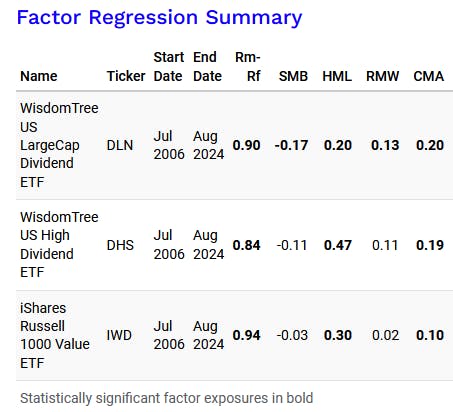
Notably, DLN
Taken together, this means the stocks in DLN are, on average, undervalued yet profitable and disciplined in their growth—hallmarks of high-quality value stocks.
DHS
On the performance side, DLN has delivered. From June 16, 2006, to November 21, 2024, it returned 9.42 percent annualized versus 8.08 percent for IWD. DLN also had a better risk-adjusted return, with a Sharpe ratio of 0.5 compared to IWD’s 0.42.
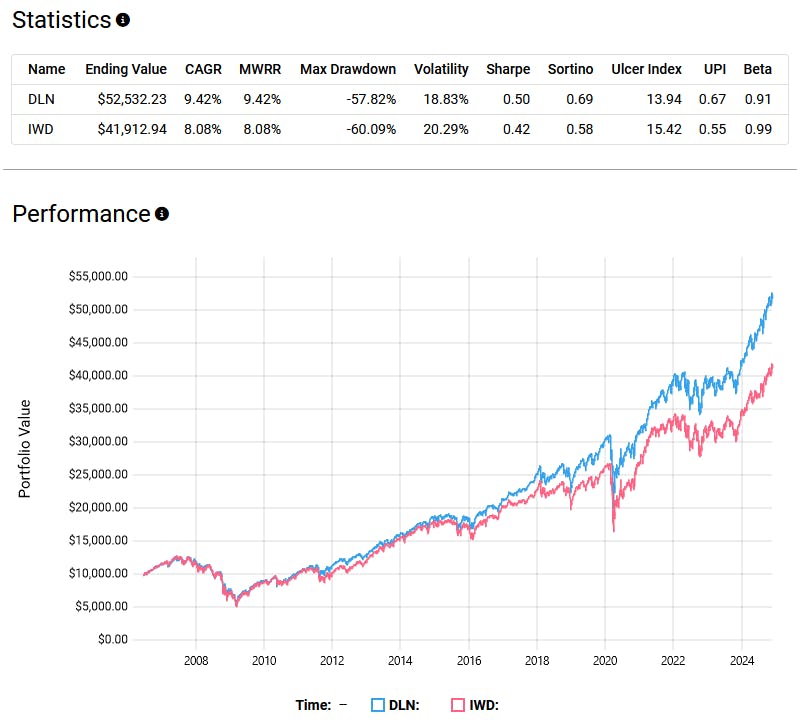
These findings suggest that both DLN
Please note this article is for information purposes only and does not in any way constitute investment advice. It is essential that you seek advice from a registered financial professional prior to making any investment decision.
Latest ETF News
See all ETF newsCould Water ETFs Be the Next AI Bottleneck Trade?

What is a Boomer Candy ETF?

ETF Comparison: NEOS Nasdaq-100 High Income ETF (QQQI) Versus Goldman Sachs Nasdaq-100 Premium Income ETF (GPIQ)





 Advantages of ETFs over Mutual Funds1/6
Lower Costs
In this guide, we'll explore the advantages of ETFs over mutual funds, giving you valuable insights into why ETFs have gained significant popularity among investors like yourself.
Leveraged ETFs: Unlocking the Potential for Amplified Returns1/6
Understanding Leveraged ETFs
Explore leveraged ETFs: potential for amplified returns & risks. 5 ETFs to consider across equities, commodities & fixed income.
What is a Leveraged ETF?1/6
Introducing Leveraged and Inverse ETFs
In this guide, we'll dive into the world of leveraged ETFs, exploring their definition, mechanics, potential risks, and rewards.
Recent educational content

ETF Trends
ETF Industry KPIs September 8, 2026
This week’s KPI data overview highlights key metrics and trends shaping the ETF landscape.

ETF Trends
ETF Industry KPIs August 31, 2026
This week’s KPI data overview highlights key metrics and trends shaping the ETF landscape.
ETF Trends
ETF Industry KPIs August 24, 2026
This week’s KPI data overview highlights key metrics and trends shaping the ETF landscape.
What’sTheFund
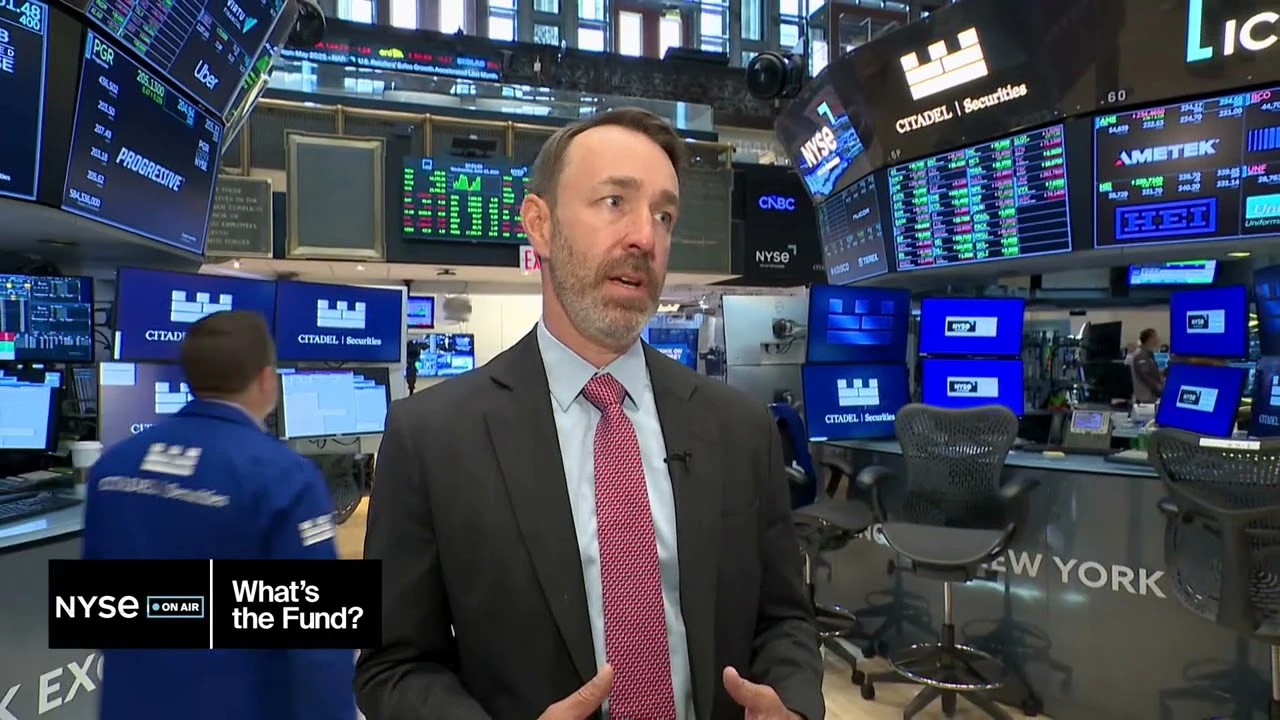
What's the Fund | Ocean Park Diversified Income ETF (DUKZ)
James St Aubin, Chief Investment Officer at Ocean Park Asset Management, discuss the DUKZ ETF, exposing investors to the whole spectrum of asset classes in the fixed income markets, through their rules-based process.

Browse all educational columns



Expert-Built ETF Portfolios, All in One Place
Don’t start from scratch. Discover ready-made ETF portfolios built by professionals to match different goals, timelines, and market views. Use them as inspiration or as a starting point for your own allocation.