Open Now: The Global ETF Survey Take the Survey →



How Well Did CLO ETFs Hold Up During Market Volatility?
CLO ETFs are marketed as resilient, but how have they performed compared with traditional bond ETFs in volatile markets?


Keep up with what matters in ETFs
Get timely ETF insights, market trends, and top ideas straight to your inbox.
Your newsletter subscriptions with us are subject to ETF Central's Privacy Policy and Terms and Conditions.
This article won’t be a recap of how resilient collateralized loan obligations (CLOs) are. Numerous asset managers, including Janus Henderson, VanEck, and BlackRock, have published extensive research showing how CLOs weathered major stress periods like the 2008 financial crisis and the COVID-19 crash with relatively few defaults.
While nothing in markets is guaranteed, the consensus is that CLOs have proven fairly stable among so-called “exotic” fixed income assets. But what happens when CLOs are packaged into ETFs?
All of the CLO ETFs available today launched after the March 2020 COVID selloff, so they weren’t tested in that specific period. Still, the memory is fresh of how many plain-vanilla fixed income ETFs saw steep drawdowns and, in some cases, traded well below their net asset value (NAV) when liquidity in underlying securities dried up.
That’s what we’re examining today. The focus will be on two of the most popular CLO ETFs—the Janus Henderson AAA CLO ETF
Get data on 14,000+ ETFs
Access Trackinsight's reliable and comprehensive data with 500M+ points on 14,000+ ETFs.
CLO ETFs: drawdowns
Looking at the drawdown chart from January 2022 through September 2025, the differences between CLO ETFs and traditional bond ETFs stand out.
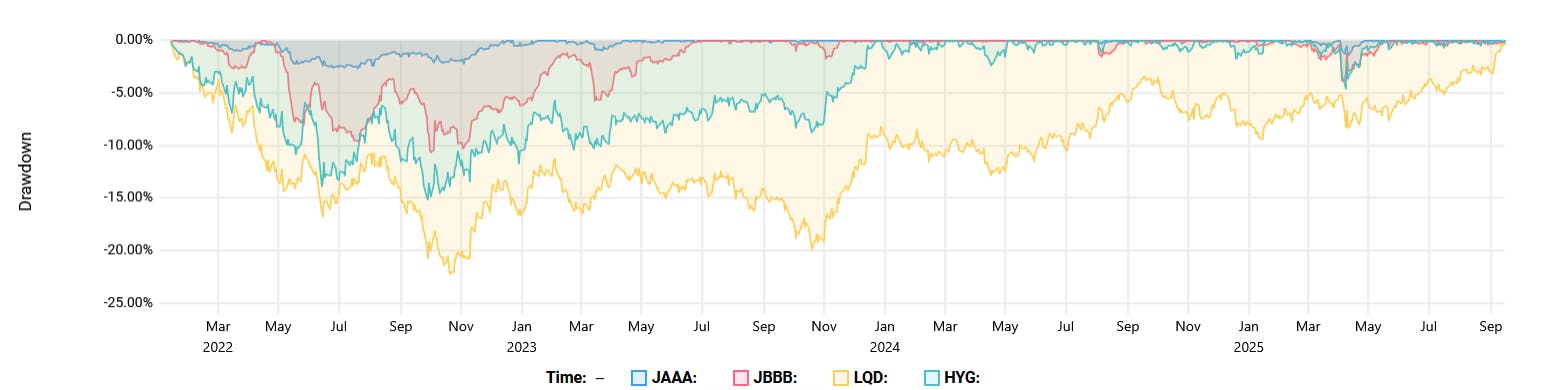
JAAA was the most stable of the group. Its drawdowns were minimal, even during periods of market stress, and it quickly reverted to par. That reflects the structure of AAA CLO tranches, which sit at the top of the repayment waterfall and are designed to be highly resilient to credit shocks.
JBBB showed more volatility, but still fared better than traditional credit ETFs. Its largest drawdowns were modest compared to high yield bonds and were quickly recovered, suggesting the market sees BBB CLOs as less risky than a diversified basket of speculative-grade corporate bonds.
By contrast, LQD and HYG both suffered materially deeper drawdowns. LQD, despite being investment grade, faced sustained losses due to its higher duration and sensitivity to rising rates. HYG was hit hardest, with drawdowns exceeding -20% at times, reflecting its higher credit risk and exposure to market liquidity.
From my perspective, this backtest underscores that CLO ETFs, particularly JAAA, have held up well in volatile markets, living up to expectations.
CLO ETFs: discount to NAV
Drawdowns don’t capture the full picture of fixed income ETF resilience. Another key test is whether market prices stay aligned with NAV, since investors transact at market price, not NAV. Normally, authorized participants keep prices close through creations and redemptions.
But in stressed markets, when liquidity in the underlying securities dries up, that mechanism can break down and gaps can appear, as seen below.
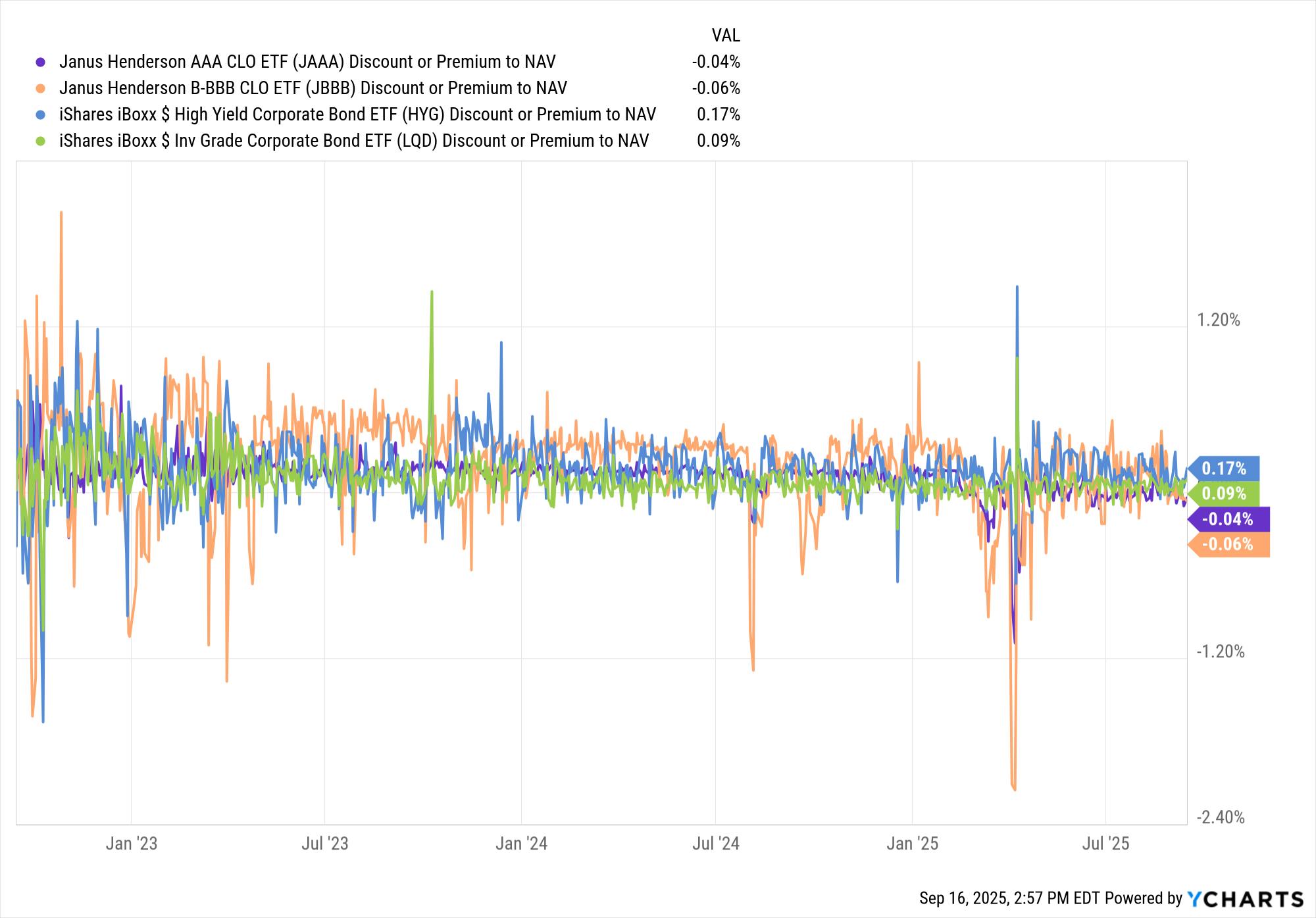
Looking at the worst points in the chart, JAAA held up the best. Its steepest discounts were brief and shallow, around −0.8% to −1.0%, with quick mean reversion. JBBB was more volatile, at times falling to roughly −1.8% to −2.0% during mid-2024 and early-2025. That’s consistent with the lower liquidity of BBB-rated tranches and their higher sensitivity to risk-off events.
Among the traditional bond ETFs, LQD’s deepest discount reached about −1.0% to −1.2%, with occasional spikes into premium territory near +1%. HYG showed the widest swings overall, with discounts near −1.5% to −2.0% at its worst, and premiums as high as +1%, reflecting the more volatile nature of high-yield credit.
The takeaway is that CLO ETFs weathered stress periods without major dislocations. JAAA was the most stable, JBBB showed more movement but remained manageable, and both stayed tighter to NAV than HYG, which proved the most volatile.
For investors, this suggests CLO ETFs have so far avoided the structural pricing gaps that have historically troubled some fixed income ETFs, though 1–2% air pockets remain possible in periods of severe stress. That being said, a COVID-19-like drawdown would likely result in higher discounts to NAV.
Please note that this article reflects the author’s personal views and does not represent the opinions of the publication or its affiliates. It is for informational purposes only and does not constitute investment advice. It is essential to seek guidance from a registered financial professional before making any investment decisions.
Latest ETF News
See all ETF newsAvoid S&P 500 Concentration Risk with These Two ETFs

How Investors can Maximize Tax Efficiency with Income ETFs

Trump Accounts: Here's Which ETFs You Can Invest In

The Two Best Types of Fixed-Income ETFs For Managing Cash




 Advantages of ETFs over Mutual Funds1/6
Lower Costs
In this guide, we'll explore the advantages of ETFs over mutual funds, giving you valuable insights into why ETFs have gained significant popularity among investors like yourself.
Leveraged ETFs: Unlocking the Potential for Amplified Returns1/6
Understanding Leveraged ETFs
Explore leveraged ETFs: potential for amplified returns & risks. 5 ETFs to consider across equities, commodities & fixed income.
What is a Leveraged ETF?1/6
Introducing Leveraged and Inverse ETFs
In this guide, we'll dive into the world of leveraged ETFs, exploring their definition, mechanics, potential risks, and rewards.
Recent educational content

ETF Trends
ETF Industry KPIs July 20, 2026
This week’s KPI data overview highlights key metrics and trends shaping the ETF landscape.

ETF Trends
ETF Industry KPIs July 13, 2026
This week’s KPI data overview highlights key metrics and trends shaping the ETF landscape.

First Look ETF
First Look ETF: Cash Deployment, Bond, and Hedged ETFs
In this season 6 episode of First Look ETF, Stephanie Stanton examines the latest ETF marketplace trends with NYSE and guests.

ETF Trends
ETF Industry KPIs July 6, 2026
This week’s KPI data overview highlights key metrics and trends shaping the ETF landscape.
Browse all educational columns



Build and Analyze Your ETF Portfolio Like a Pro
Create your own ETF portfolio in minutes and instantly see allocations, exposures, performance, and risk. Visualize diversification across asset classes, regions, and sectors. Stress-test ideas, compare benchmarks, and refine your strategy with professional-grade analytics.