Keep tabs on your favorite ETFs with a personalized weekly tracker. Create a Watchlist now →



How to Unlock Value Factor Exposure in EAFE Equities with a High Yield Dividend Strategy
The Xtrackers MSCI EAFE High Dividend Yield Equity ETF (HDEF) offers an inexpensive alternative to international equity factor ETFs with a time-tested and straightforward index benchmark.


Keep up with what matters in ETFs
Get timely ETF insights, market trends, and top ideas straight to your inbox.
Your newsletter subscriptions with us are subject to ETF Central's Privacy Policy and Terms and Conditions.
With the U.S. dollar facing renewed headwinds, some investors may find better value in international equity funds. When the dollar weakens and local currencies like the euro or yen strengthen, unhedged ETFs tracking international markets can benefit from this currency lift, adding to total return. That makes now an opportune time to revisit global strategies beyond the S&P 500.
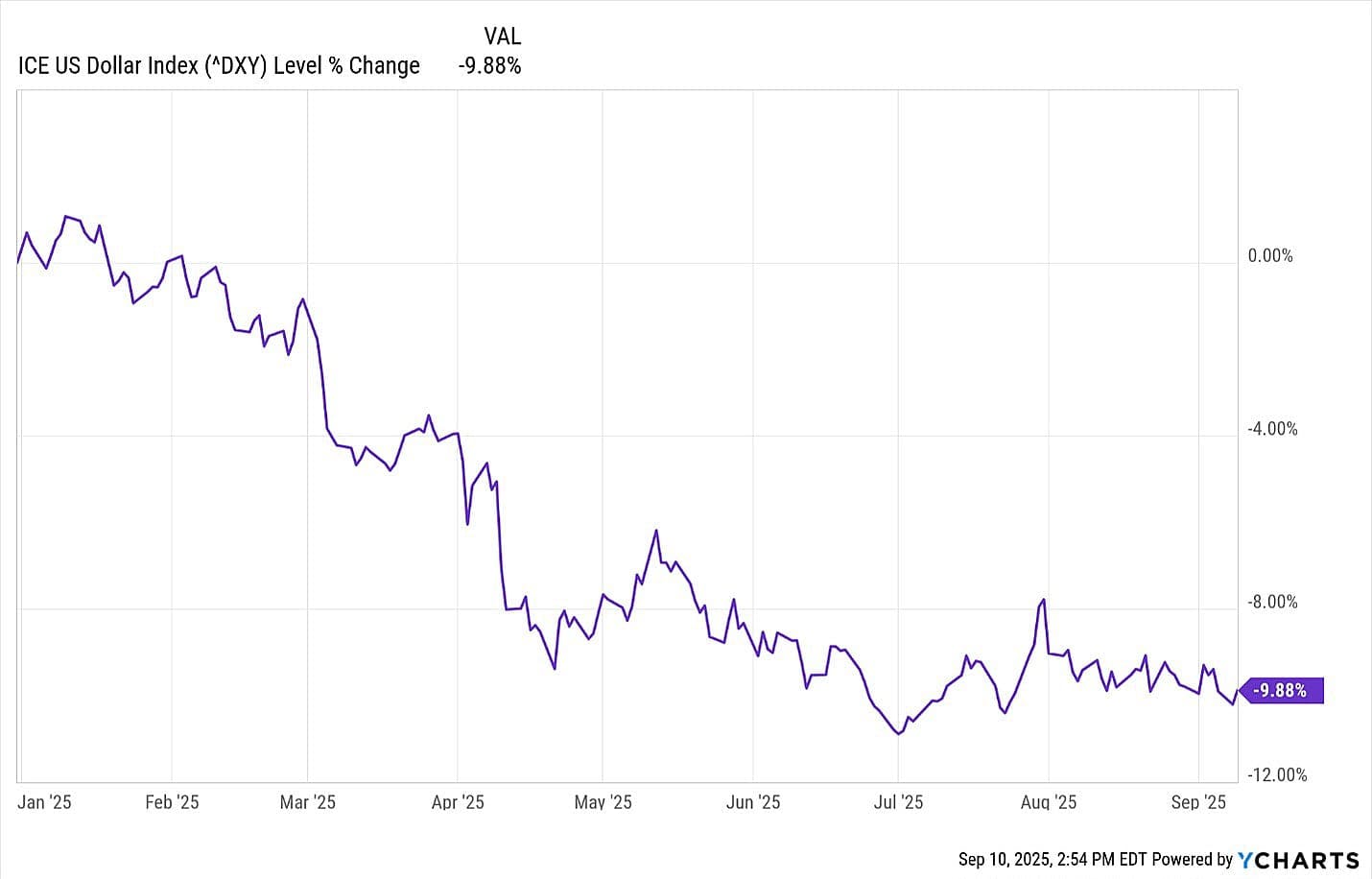
The MSCI EAFE Index is one of the most popular benchmarks for international developed markets. It covers large and mid-cap stocks across Europe, Australasia, and the Far East, excluding the U.S. and Canada. As a result, there's no shortage of ETFs tracking the plain-vanilla index. There are also plenty of factor-based variants for investors chasing style tilts, especially value.
But dividend strategies tied to the EAFE region have largely flown under the radar. As investors increasingly flock to covered call ETFs pumping out double-digit yields, traditional dividend ETFs have taken a backseat. Still, total return is what matters, and many of these have held up surprisingly well.
One worth highlighting is the Xtrackers MSCI EAFE High Dividend Yield Equity ETF
In reality, though, it delivers concentrated exposure to both value and quality factors via a sophisticated index, along with competitive historical performance. Here’s my take.
Global ETF Survey 2026 is Live!
With 1,790 new products launched by July 2026, choosing is harder than ever. Our Global ETF Survey 2026, built on 620 professional investors and allocators, shows how active, fixed income, options-based and thematic ETFs are reshaping fund selection.
How HDEF works
HDEF is a passive ETF that tracks the MSCI EAFE High Dividend Yield Index, which starts with large- and mid-cap stocks across developed markets outside the U.S. and Canada.
But it doesn’t just chase high yields blindly. HDEF’s benchmark also applies several screens to target companies with high, sustainable dividends and solid fundamentals:
- No REITs. Real estate investment trusts are excluded to avoid skewed results since their yields are structurally high, tax-inefficient, and often don't fit into institutional portfolios.
- Dividend sustainability. Companies with no earnings (negative payout ratios), extremely high payout ratios (top 5% of the group), or no dividend history are removed to avoid yield traps.
- Dividend persistence. Stocks with negative five-year dividend-per-share growth are excluded, unless they already belong to the index and have maintained their dividend over the last year.
- Quality screen. Companies with weak fundamentals based on low return on equity, high debt, or inconsistent earnings get filtered out using a “Quality Z-score.”
- Price momentum. The worst performers over the past year (bottom 5%) are also excluded to avoid catching falling knives.
- Yield threshold. To qualify, a stock’s yield must be at least 1.3 times that of its regional MSCI parent index (e.g., MSCI Europe for European stocks).
- Diversification cap. Finally, no single stock can be more than 5% of the portfolio. Weights are based on float-adjusted market cap and rebalanced twice a year.
Because of its high dividend screen and quality filters, HDEF ends up with very different sector and country exposures compared to ETFs that track the standard MSCI EAFE index.
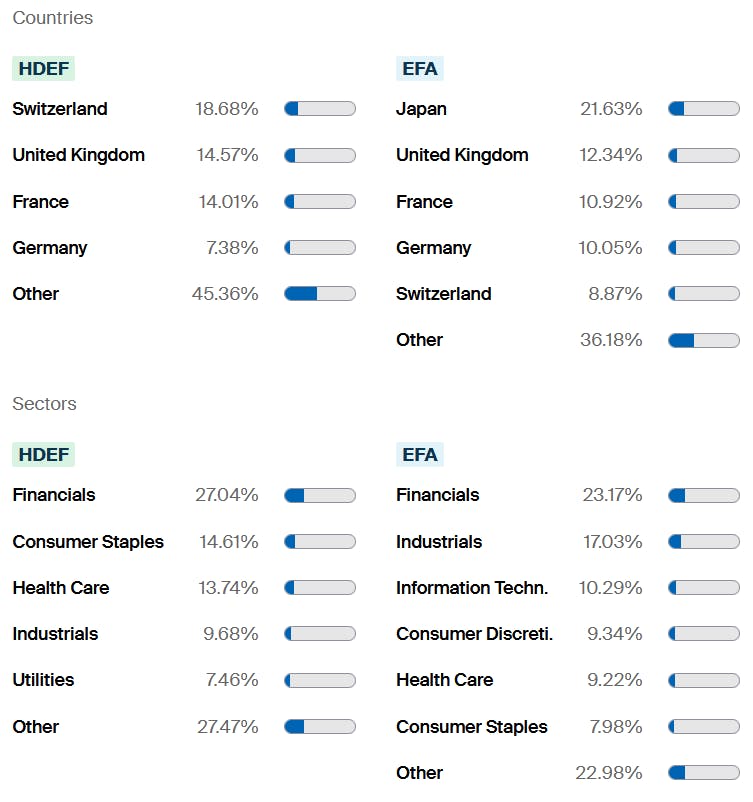
For example, HDEF leans more into defensive sectors like consumer staples, health care, and utilities—these tend to have steadier cash flows and more reliable dividends. On the flip side, it underweights more cyclical or lower-yielding areas like consumer discretionary and tech, which often don’t meet the index’s dividend or quality criteria.
You also get country differences. HDEF has a much bigger weighting to Switzerland and less exposure to Japan. That’s just a result of where the sustainable high-yield opportunities are. The portfolio is built from the bottom up based on stock screens, not top-down country allocation.
HDEF: factor exposure
A multi-factor regression from September 2015 to May 2025 highlights just how well HDEF stacks up against two peers: the iShares MSCI EAFE ETF
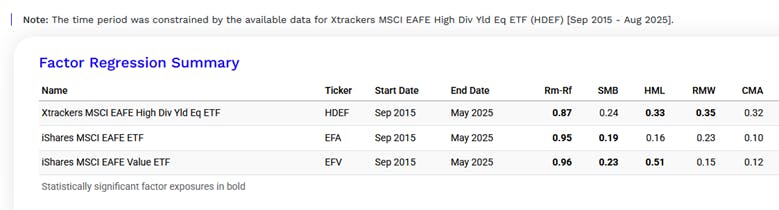
- Market Beta (Rm-Rf): HDEF’s market beta comes in at 0.87, slightly lower than EFA (0.95) and EFV (0.96). That lower beta suggests HDEF carries less sensitivity to broad equity market swings, which complements its defensive characteristics like overweights to consumer staples and utilities.
- Value (HML). HDEF shows a strong and statistically significant value tilt, with a 0.33 loading on the HML (high minus low) factor. That’s much higher than the 0.16 for EFA and behind EFV’s 0.51, which is designed to target value stocks explicitly. HDEF’s value exposure comes through its dividend screen, not through book-to-price metrics, but still ranks as a legitimate value strategy.
- Profitability (RMW): The RMW (robust minus weak) factor captures exposure to high-profitability companies. HDEF loads 0.35, higher than both EFA (0.23) and EFV (0.15), suggesting HDEF tends to hold companies with stronger earnings quality and operational efficiency. This aligns with the index's quality and payout screens, which help filter out structurally weak firms.
Despite being branded as a high dividend yield strategy, HDEF delivers more than just income. Its portfolio construction effectively captures both the value and quality factors, with exposures nearly as strong as those seen in dedicated factor ETFs. That makes HDEF not only a dividend play but also a well-rounded multifactor strategy.
HDEF: risk and return
From August 18, 2015, to September 8, 2025, HDEF delivered a cumulative return of 99.08%, or 7.08% annually. That performance was higher than both EFA, which returned 95.65% with a 6.90% annualized growth rate, and EFV, which returned 92.02% with a 6.70% annual rate.

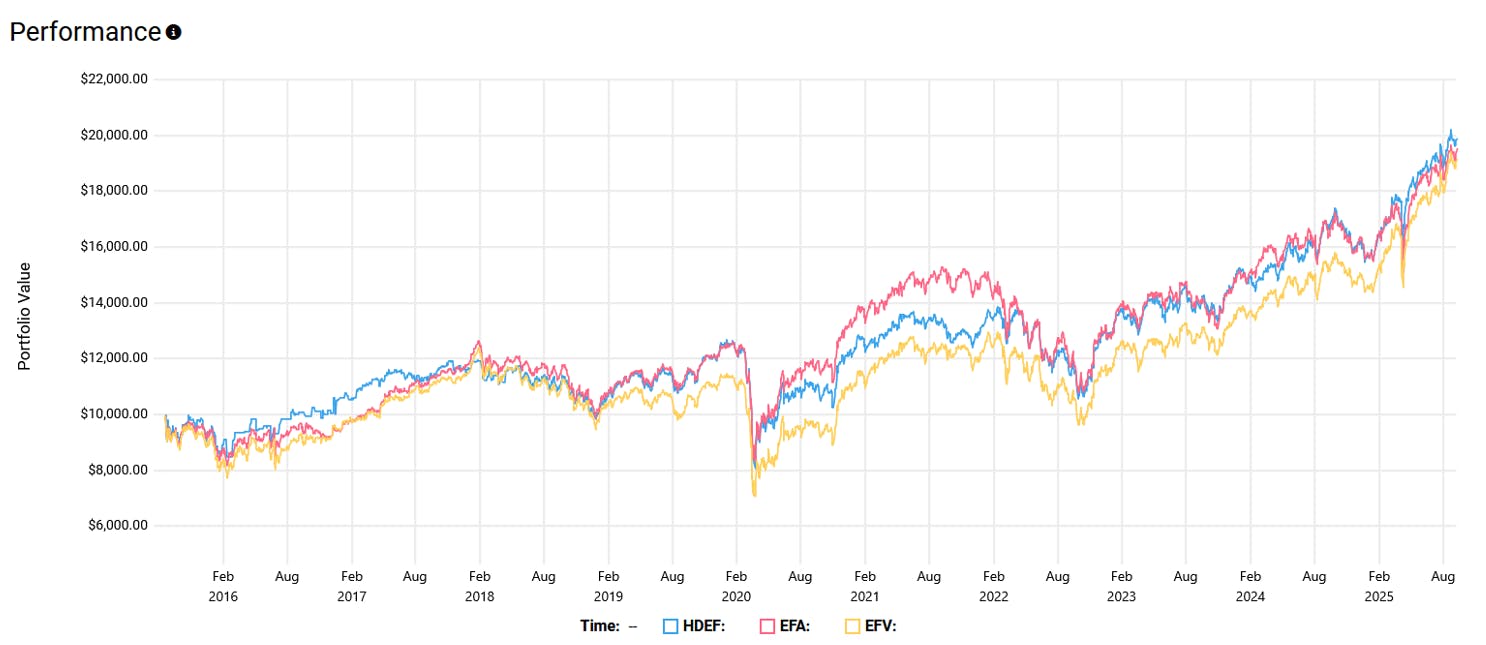
HDEF also demonstrated stronger risk-adjusted performance. Its Sharpe ratio of 0.37 edged out EFA at 0.35 and EFV at 0.34. The same pattern held for the Sortino ratio, where HDEF posted 0.51 compared to EFA’s 0.48 and EFV’s 0.45.
HDEF experienced slightly less volatility at 17.07%, versus 17.48% for EFA and 18.31% for EFV. Drawdowns were large across the board, but HDEF fell less than its peers at its worst point. Its maximum drawdown was -36.42%, compared to -34.19% for EFA and a deeper -43.16% for EFV.
Despite using a rules-based dividend yield screen, HDEF managed to outperform both a broad market EAFE fund and a dedicated value strategy. This shows that an index-based dividend approach with the right quality screens can deliver consistent factor exposure and competitive returns.
Why HDEF makes sense
If you're seeking international developed market equity exposure and want more than plain vanilla beta, HDEF deserves a closer look. It offers a thoughtful dividend screen that helps avoid yield traps, while also tilting toward value and quality stocks.
This strategy has translated into meaningful outperformance over both broad-based and value-focused EAFE ETFs across the last decade. With a low 0.09% expense ratio and consistent factor exposure, HDEF is a cost-effective way to enhance your international equity sleeve.
Please note that this article reflects the author’s personal views and does not represent the opinions of the publication or its affiliates. It is for informational purposes only and does not constitute investment advice. It is essential to seek guidance from a registered financial professional before making any investment decisions.

Latest ETF News
See all ETF newsBeyond Big Tech: The Increasing Specialization of AI ETFs

There's an ETF for That? Humanoid Robotics and Physical AI

How Some ETF Issuers Use Their Own Funds for Cash Management

These Public-Private ETFs Invest in Polymarket and Anduril

There's an ETF for That? Frontier Markets



 Advantages of ETFs over Mutual Funds1/6
Lower Costs
In this guide, we'll explore the advantages of ETFs over mutual funds, giving you valuable insights into why ETFs have gained significant popularity among investors like yourself.
Leveraged ETFs: Unlocking the Potential for Amplified Returns1/6
Understanding Leveraged ETFs
Explore leveraged ETFs: potential for amplified returns & risks. 5 ETFs to consider across equities, commodities & fixed income.
What is a Leveraged ETF?1/6
Introducing Leveraged and Inverse ETFs
In this guide, we'll dive into the world of leveraged ETFs, exploring their definition, mechanics, potential risks, and rewards.
Recent educational content

First Look ETF
First Look ETF: Income, International, and Cash Flow ETFs
In this season 6 episode of First Look ETF, Stephanie Stanton @etfguide examines the latest ETF marketplace trends with NYSE and guests.


ETF Trends
ETF Industry KPIs October 5, 2026
This week’s KPI data overview highlights key metrics and trends shaping the ETF landscape.

ETF Trends
ETF Industry KPIs September 28, 2026
This week’s KPI data overview highlights key metrics and trends shaping the ETF landscape.
ETF Trends
ETF Industry KPIs September 22, 2026
This week’s KPI data overview highlights key metrics and trends shaping the ETF landscape.
Browse all educational columns



ETFs’ Next Act: From Access to Selection
With 1,790 new products launched by July 2026, choosing is harder than ever. Our Global ETF Survey 2026, built on 620 professional investors and allocators, shows how active, fixed income, options-based and thematic ETFs are reshaping fund selection.