Explore professionally built ETF model portfolios. Discover now →



How to Start Investing in ETFs in 2024: A Beginner's Guide
Here's my step-by-step guide on how you, as a beginner investor can get a complete ETF portfolio going in just a few steps.


Keep up with what matters in ETFs
Get timely ETF insights, market trends, and top ideas straight to your inbox.
Your newsletter subscriptions with us are subject to ETF Central's Privacy Policy and Terms and Conditions.
Did your investment journey last year involve a rollercoaster ride with a "to the moon" meme stock? Perhaps you found yourself caught in the aftermath of the Bed Bath & Beyond bankruptcy, lured by the siren song of some YouTube guru?
Maybe you were still holding onto AMC Entertainment or GameStop nearly 3 years after the initial short squeeze, hoping for a turnaround and repeat that never materialized, leading to significant losses.
Fear not. If these experiences left you feeling uncertain about your investment, there’s a more stable and informed path awaiting you. ETF investing offers a world of opportunities, balancing risk while providing exposure to a wide array of assets, sectors, and investment strategies.
This guide is designed specifically for beginners like you, who may not have any prior knowledge about ETFs. In just a five-minute read, you'll gain the foundational understanding needed to start building a successful and diversified ETF portfolio.
Get data on 14,000+ ETFs
Access Trackinsight's reliable and comprehensive data with 500M+ points on 14,000+ ETFs.
Step one: define your risk tolerance, objectives, and time horizon
The first step in building your ETF portfolio is a crucial one: defining your risk tolerance, investment objectives, and time horizon. This begins with an honest self-assessment, where you'll need to ask yourself three fundamental questions:
- Understanding Your Risk Tolerance: How comfortable are you with seeing your investments fluctuate, sometimes significantly, in value? Can you withstand seeing your portfolio's value go down for an extended period without feeling the urge to sell in a panic? Your emotional response to market volatility is a key indicator of your risk tolerance.
- Clarifying Your Investment Objectives: What are you investing for? Is it for long-term goals like retirement, or shorter-term objectives like saving for a down payment on a house? Also, consider the type of account you are using – is it a taxable account, a Roth IRA, a Health Savings Account (HSA), or something else? Your investment goals will influence the types of ETFs you choose.
- Determining Your Time Horizon: How long do you plan to keep your money invested before you need to withdraw it? This is closely related to your investment objectives and will affect your investment strategy.
Understanding these factors is vital because they collectively determine your asset allocation – the mix of stocks, bonds, and cash in your portfolio.
For instance, someone with a low-risk tolerance who is already retired might prefer a conservative portfolio focused on income generation. Conversely, a younger investor with a long-time horizon until retirement can afford to take on more risk by focusing on equities for growth.
Take your time with this step and be truthful in your self-assessment. The goal is to establish an investment strategy that you can comfortably maintain over the long term, rather than attempting to over-optimize based on short-term market conditions or predictions.
Step two: build the core of your portfolio
After you've established your asset allocation, the next important step is building the core of your portfolio. Using the ETF Central Screener, you can easily begin with your stock allocation.
By selecting 'stocks' as the asset class, 'global' for the geographic zone, and opting for 'passive ETFs only' in the ETF characteristic filters, you'll be presented with a comprehensive list of globally diversified ETFs. This selection process currently results in 151 options.
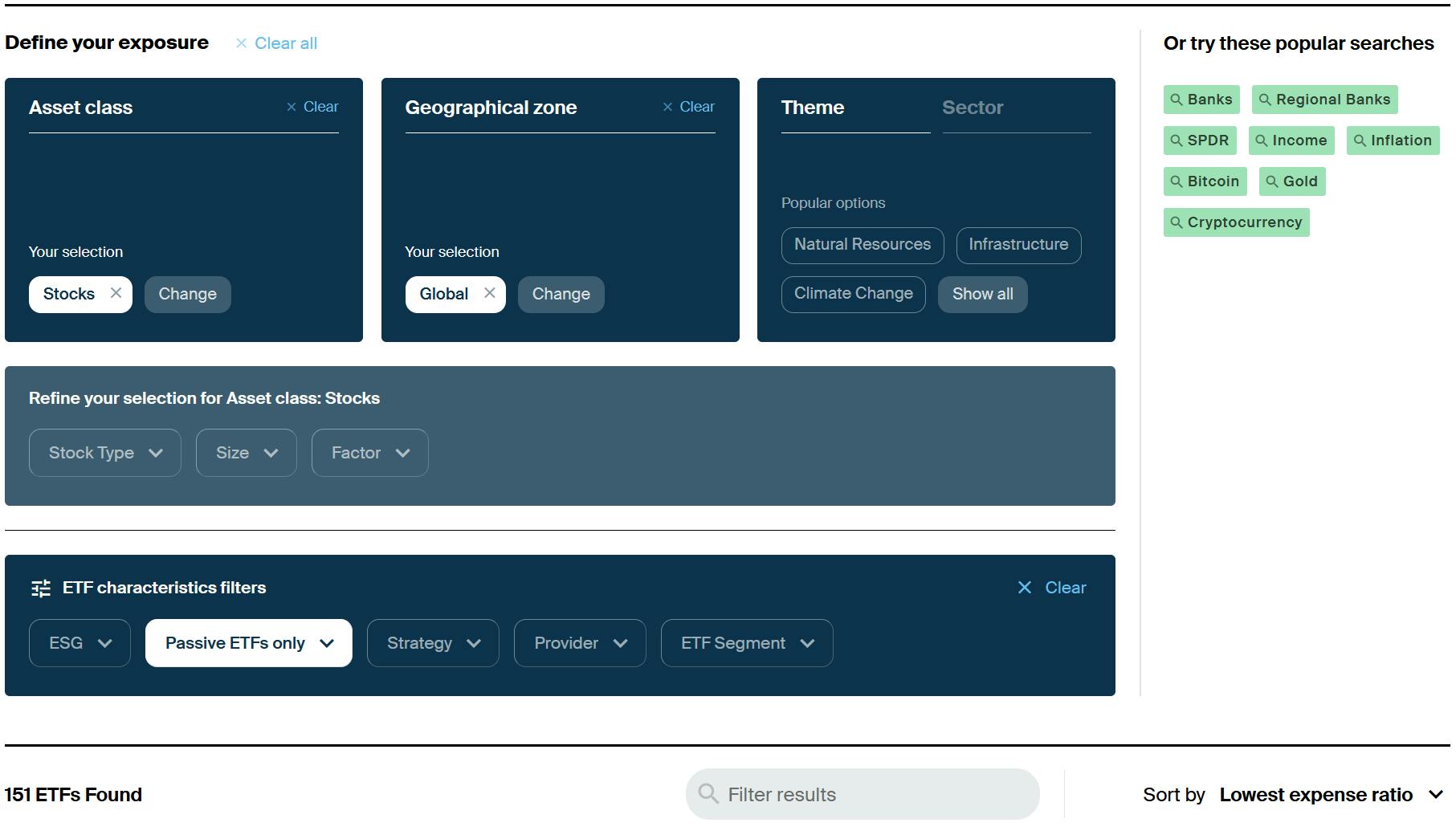
You can then sort these ETFs by assets under management (AUM) to gauge their popularity and size, or by expense ratios to identify the most cost-efficient choices. You can also sort them by their historical performance, but remember, picking the best performing ETF of the past isn't a reliable way!
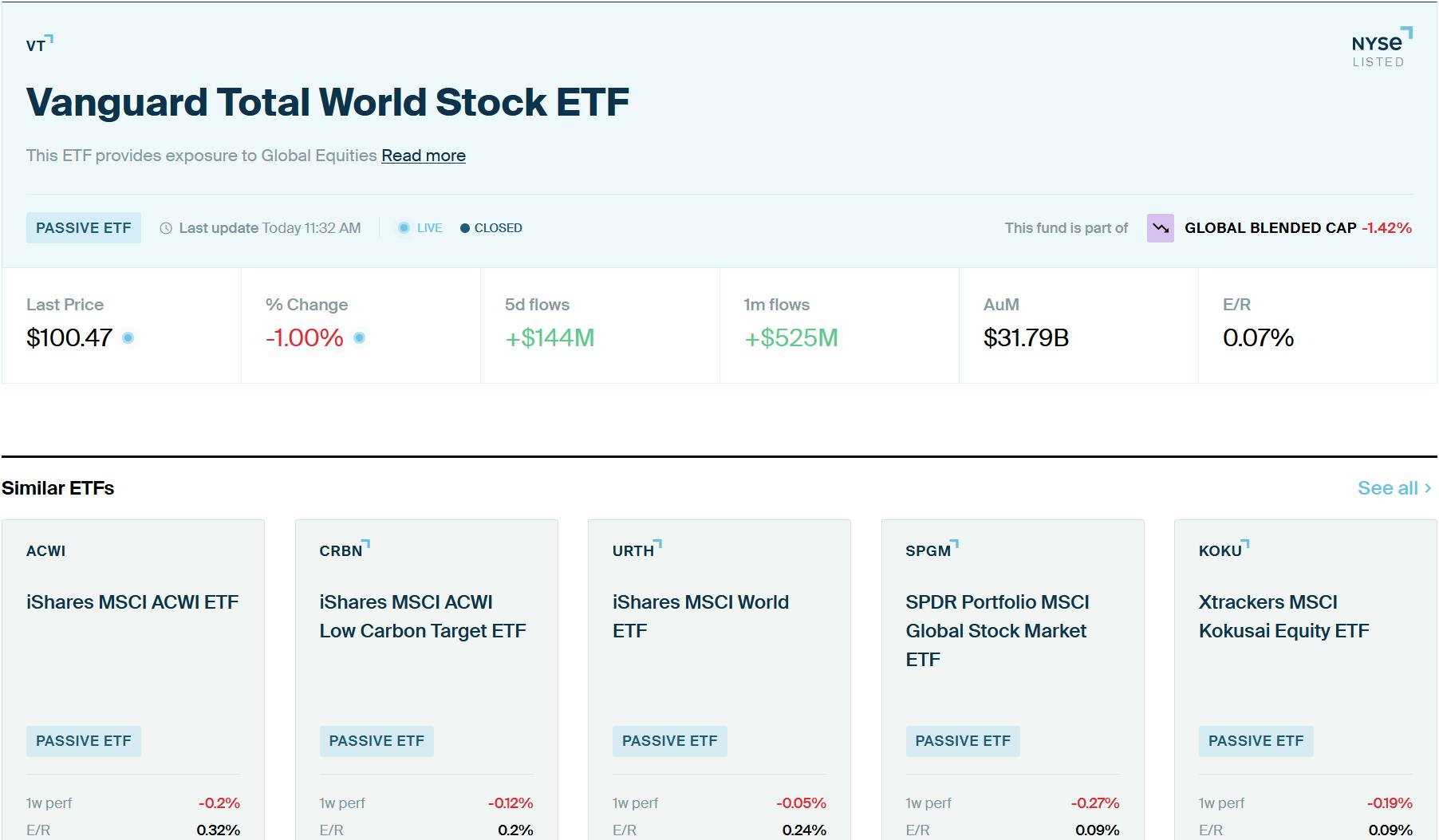
Among these, I think a standout option for beginners is the Vanguard Total World Stock ETF (VT). This ETF encapsulates the global stock market in a single investment vehicle, offering exposure to over 9,700 stocks from diverse regions including the U.S., Europe, Asia, the Middle East, and Africa.
With an expense ratio of only 0.07%, it's a remarkably affordable way to invest in a wide array of global stocks. For example, if you invest $10,000 in VT, your annual fees would be a mere $7. That being said, if you want some alternatives to VT, scrolling down on its page will present some similar ETFs.
Following this, you can also apply the same method to choose bonds for your portfolio, if that's what your asset allocation calls for. Adjust your search in the ETF Central Screener to focus on bond ETFs, aligning their ratio in your portfolio with your overall investment strategy and goals.
Step three: build the satellite of your portfolio
Building a satellite portion of your portfolio allows for a bit more speculation. However, it's generally advisable to allocate a modest portion of your portfolio, say 5-10%, to these more speculative investments. Rather than single stocks, consider exploring thematic ETFs.
Thematic ETFs are designed to capture growth-oriented investment opportunities in specific trends or sectors. These ETFs provide exposure to a range of forward-looking themes like cybersecurity, defense, artificial intelligence, electric vehicles, biotechnology, and more.
This type of investment can be particularly appealing as it aligns with emerging trends and industries, potentially offering higher growth prospects.
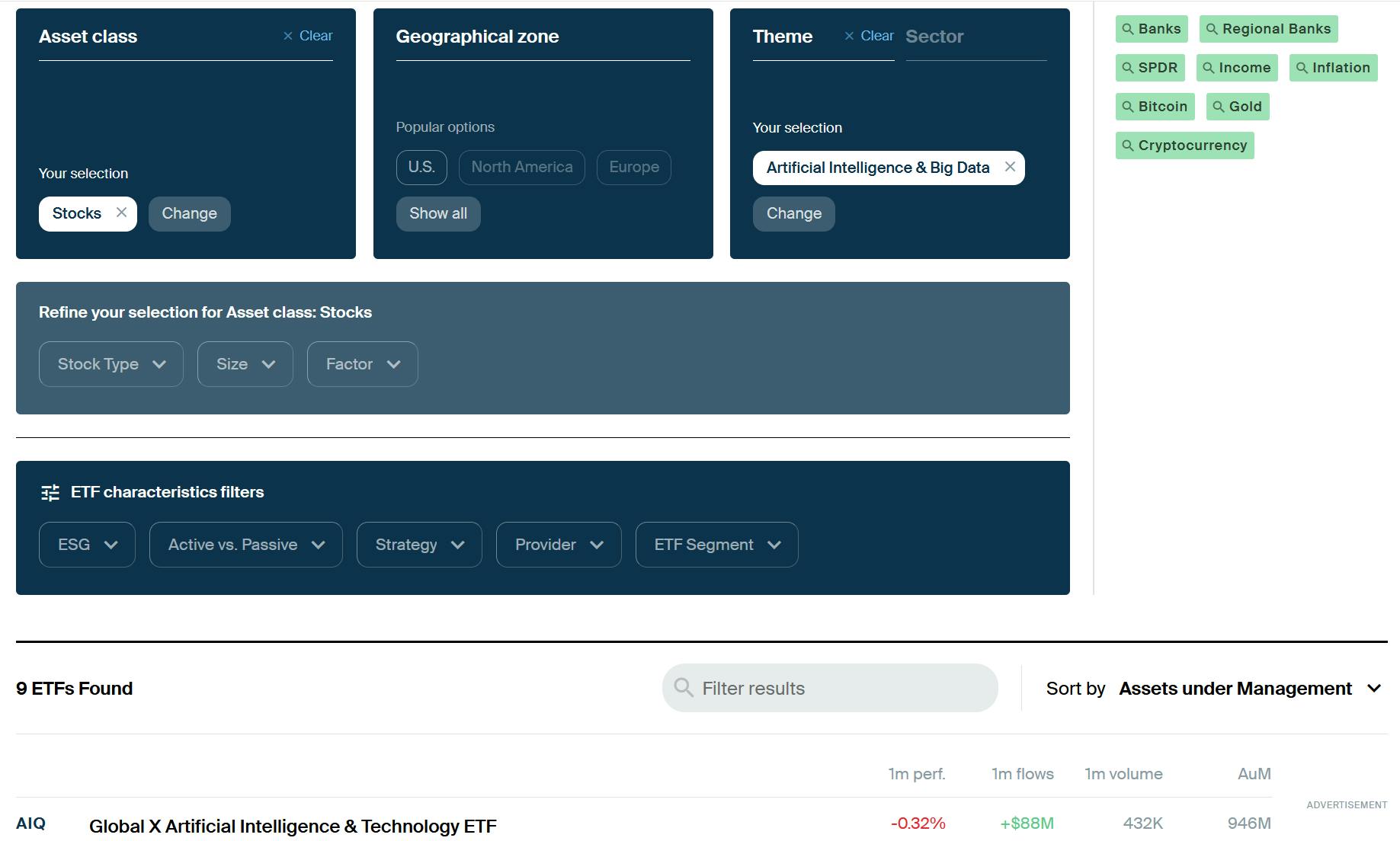
To find thematic ETFs that align with your interests, the ETF Central screener is an excellent tool. For instance, if you select 'stocks' as the asset class and then filter by themes like 'artificial intelligence' and 'big data,' the screener will present a list of ETFs that provide exposure to these specific areas.
For a broader exploration of the current thematic niches available, resources like Trackinsight's thematic taxonomy can be incredibly helpful. They offer an overview of various themes, helping you find one that resonates with your beliefs or interests.
However, it’s important to keep in mind that thematic ETFs often come with higher expense ratios compared to broad-market ETFs. They also tend to be less diversified, as they focus on a specific theme or sector. Finally, they can be somewhat volatile.
Due to these factors, it’s wise to keep the allocation to these ETFs smaller compared to your core portfolio. This approach helps limit the overall risk to your portfolio while still allowing you to pursue potentially higher growth opportunities in specific areas of interest.
In summary, the satellite portion of your portfolio is where you can take calculated risks with thematic ETFs, exploring areas you believe have growth potential. Just remember to balance this with the overall risk and diversification of your entire investment portfolio.
Please note this article is for information purposes only and does not in any way constitute investment advice. It is essential that you seek advice from a registered financial professional prior to making any investment decision.

Latest ETF News
See all ETF newsETF comparison: NEOS S&P 500 High Income ETF (SPYI) Versus Goldman Sachs S&P 500 Premium Income ETF (GPIX)

There’s an ETF for That? Investing Like University Endowments

Could Water ETFs Be the Next AI Bottleneck Trade?

What is a Boomer Candy ETF?




 Advantages of ETFs over Mutual Funds1/6
Lower Costs
In this guide, we'll explore the advantages of ETFs over mutual funds, giving you valuable insights into why ETFs have gained significant popularity among investors like yourself.
Leveraged ETFs: Unlocking the Potential for Amplified Returns1/6
Understanding Leveraged ETFs
Explore leveraged ETFs: potential for amplified returns & risks. 5 ETFs to consider across equities, commodities & fixed income.
What is a Leveraged ETF?1/6
Introducing Leveraged and Inverse ETFs
In this guide, we'll dive into the world of leveraged ETFs, exploring their definition, mechanics, potential risks, and rewards.
Recent educational content

ETF Trends
ETF Industry KPIs September 14, 2026
This week’s KPI data overview highlights key metrics and trends shaping the ETF landscape.

ETF Trends
ETF Industry KPIs September 8, 2026
This week’s KPI data overview highlights key metrics and trends shaping the ETF landscape.
ETF Trends
ETF Industry KPIs August 31, 2026
This week’s KPI data overview highlights key metrics and trends shaping the ETF landscape.
ETF Trends
ETF Industry KPIs August 24, 2026
This week’s KPI data overview highlights key metrics and trends shaping the ETF landscape.
Browse all educational columns



Build and Analyze Your ETF Portfolio Like a Pro
Create your own ETF portfolio in minutes and instantly see allocations, exposures, performance, and risk. Visualize diversification across asset classes, regions, and sectors. Stress-test ideas, compare benchmarks, and refine your strategy with professional-grade analytics.