Global ETF Survey Is Live! 600+ ETF Professionals Weigh In. See Results →



How to Invest in America's Critical Technologies Via This Unique ETF
CRTC provides targeted exposure to the dominant technology, healthcare, defense, communication, and energy companies critical to America's future.


Keep up with what matters in ETFs
Get timely ETF insights, market trends, and top ideas straight to your inbox.
Your newsletter subscriptions with us are subject to ETF Central's Privacy Policy and Terms and Conditions.
In an era marked by escalating geopolitical tensions and evolving global dynamics, the United States again finds itself at a crossroads. The resilience of its critical supply chains is under unprecedented stress, influenced by multifaceted geopolitical risks that threaten its technological and energy sovereignty.
As global competition intensifies, particularly in the realms of technology and energy, the urgency for America to secure its leadership through strengthened domestic production and reduced dependencies has never been more pronounced.
Despite America's prominence on the global stage, maintaining its leadership requires significant domestic investment in critical technologies and resources. This is particularly pressing given the current vulnerabilities in key sectors.
For example, OPEC controls over 80% of the world's proven oil reserves and accounts for 40% of the world's crude oil production, which underscores the importance of energy security. Similarly, the U.S. faces challenges in semiconductor manufacturing, a sector dominated by foreign companies.
In addition, major portions of the world's computing and memory chips are currently produced outside the U.S. in Taiwan and Korea, and all advanced chip-making machines are manufactured by a single Dutch company, highlighting a strategic vulnerability.
This situation underscores the urgent need for America to reduce its dependence on international sources for essential technologies and energy, which can be achieved through reshoring—bringing production and manufacturing back to domestic soil.
While investors can approach this theme by assembling a mix of infrastructure, energy, semiconductor, and defense ETFs, there is a simpler solution available.
The Xtrackers U.S. National Critical Technologies ETF
Global ETF Survey 2026 is Live!
With 1,790 new products launched by July 2026, choosing is harder than ever. Our Global ETF Survey 2026, built on 620 professional investors and allocators, shows how active, fixed income, options-based and thematic ETFs are reshaping fund selection.
How does CRTC ETF work?
CRTC
Modernization priorities refer to the sectors and technologies that the U.S. government identifies as essential for maintaining and advancing the nation's competitive edge in the global economy.
For an investor, this means focusing on companies that are actively involved in areas like artificial intelligence, renewable energy, cybersecurity, and advanced manufacturing. These areas are crucial because they not only represent the future of technology but are also supported by government policies and funding, which can enhance their growth potential and stability.
Geopolitical risks involve the potential for a company's operations or profitability to be affected by political decisions or conflicts. This can include sanctions imposed by governments, trade disputes, or military conflicts that might affect a company's ability to operate in certain regions or trade.
From an investor's perspective, understanding these risks is vital because they can affect a company's bottom line and, consequently, the investor's returns. Companies with higher exposure to geopolitical risks might face sudden and severe impacts on their operations and stock prices.
Companies are also evaluated for their industry's connection to critical technology areas defined by U.S. strategic objectives, which in this context include fostering innovation and securing a technological advantage over other nations. Additionally, a geostrategic risk rating score assesses each company's involvement in countries considered risky by the U.S. government.
Specifically, critical technologies are defined by the U.S. Department of Defense in the National Defense Science and Technology Strategy (NDSTS). Guided by the overarching National Defense Strategy, the NDSTS identifies 14 key technological domains that are vital for maintaining U.S. military and economic supremacy:
- Biotechnology
- Quantum science
- Future Generation Wireless Technology (FutureG)
- Advanced Materials
- Trusted AI and Autonomy
- Integrated Network Systems-of-Systems
- Microelectronics
- Space Technology
- Renewable Energy Generation and Storage
- Advanced Computing and Software
- Human-Machine Interfaces
- Directed Energy
- Hypersonics
- Integrated Sensing and Cyber
For investors, companies engaged in developing or manufacturing these technologies represent opportunities for growth driven by sector trends and government support. These technologies often receive favorable regulatory conditions and financial incentives, such as those provided by the CHIPS Act, which can lead to higher profitability and stock performance.
Finally, the geostrategic risk rating score is a measure used to evaluate a company's exposure to countries that pose high geopolitical risks, as identified by the U.S. government. This scoring helps minimize the potential negative impacts on investments due to international tensions or unfavorable government actions like sanctions or regulatory crackdowns.
For investors, a favorable score means that a company has managed its international exposure wisely, limiting its operations in high-risk regions, which in turn reduces the likelihood of sudden adverse impacts on the company's financial health and stock price.
What's under the hood of CRTC ETF?
As of April 16th, 2024, CRTC's portfolio includes a diverse mix of 226 holdings, strategically spread across various sectors: information technology (38.97%), health care (16.96%), industrials (11.08%), communication services (10.68%), energy (8.20%), consumer discretionary (6.37%), utilities (4.35%), and materials (3.18%).
The ETF's top holdings showcase a balance between large-cap companies, combining growth-oriented stocks such as Nvidia, Amazon, Alphabet, and Microsoft with value-oriented firms like Exxon Mobil, Chevron, Verizon, and BP.
Investors in CRTC
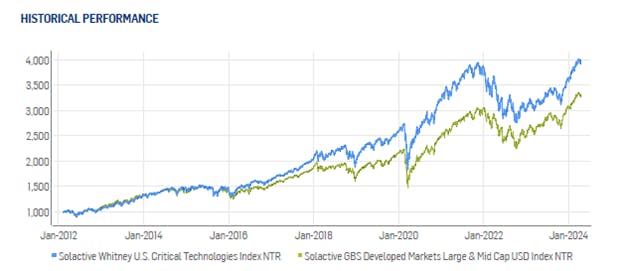
Historically, the strategy employed by CRTC has shown its effectiveness, as the ETF has outperformed the Solactive GBS Developed Markets Large & Mid Cap USD Index from January 2012 to January 2024.
Whether used as a core holding or a satellite allocation, CRTC offers a comprehensive investment solution for those looking to invest in America's critical sectors and technologies.
Please note this article is for information purposes only and does not in any way constitute investment advice. It is essential that you seek advice from a registered financial professional prior to making any investment decision.
Latest ETF News
See all ETF newsBeyond Big Tech: The Increasing Specialization of AI ETFs

There's an ETF for That? Humanoid Robotics and Physical AI

How Some ETF Issuers Use Their Own Funds for Cash Management

These Public-Private ETFs Invest in Polymarket and Anduril

There's an ETF for That? Frontier Markets



 Advantages of ETFs over Mutual Funds1/6
Lower Costs
In this guide, we'll explore the advantages of ETFs over mutual funds, giving you valuable insights into why ETFs have gained significant popularity among investors like yourself.
Leveraged ETFs: Unlocking the Potential for Amplified Returns1/6
Understanding Leveraged ETFs
Explore leveraged ETFs: potential for amplified returns & risks. 5 ETFs to consider across equities, commodities & fixed income.
What is a Leveraged ETF?1/6
Introducing Leveraged and Inverse ETFs
In this guide, we'll dive into the world of leveraged ETFs, exploring their definition, mechanics, potential risks, and rewards.
Recent educational content

First Look ETF
First Look ETF: Income, International, and Cash Flow ETFs
In this season 6 episode of First Look ETF, Stephanie Stanton @etfguide examines the latest ETF marketplace trends with NYSE and guests.


ETF Trends
ETF Industry KPIs October 5, 2026
This week’s KPI data overview highlights key metrics and trends shaping the ETF landscape.

ETF Trends
ETF Industry KPIs September 28, 2026
This week’s KPI data overview highlights key metrics and trends shaping the ETF landscape.
ETF Trends
ETF Industry KPIs September 22, 2026
This week’s KPI data overview highlights key metrics and trends shaping the ETF landscape.