Open Now: The Global ETF Survey Take the Survey →



How Investors Can Benefit From the New Era of Manufacturing
Automation is ushering in a new era of manufacturing, one that investors can materially benefit from.


Keep up with what matters in ETFs
Get timely ETF insights, market trends, and top ideas straight to your inbox.
Your newsletter subscriptions with us are subject to ETF Central's Privacy Policy and Terms and Conditions.
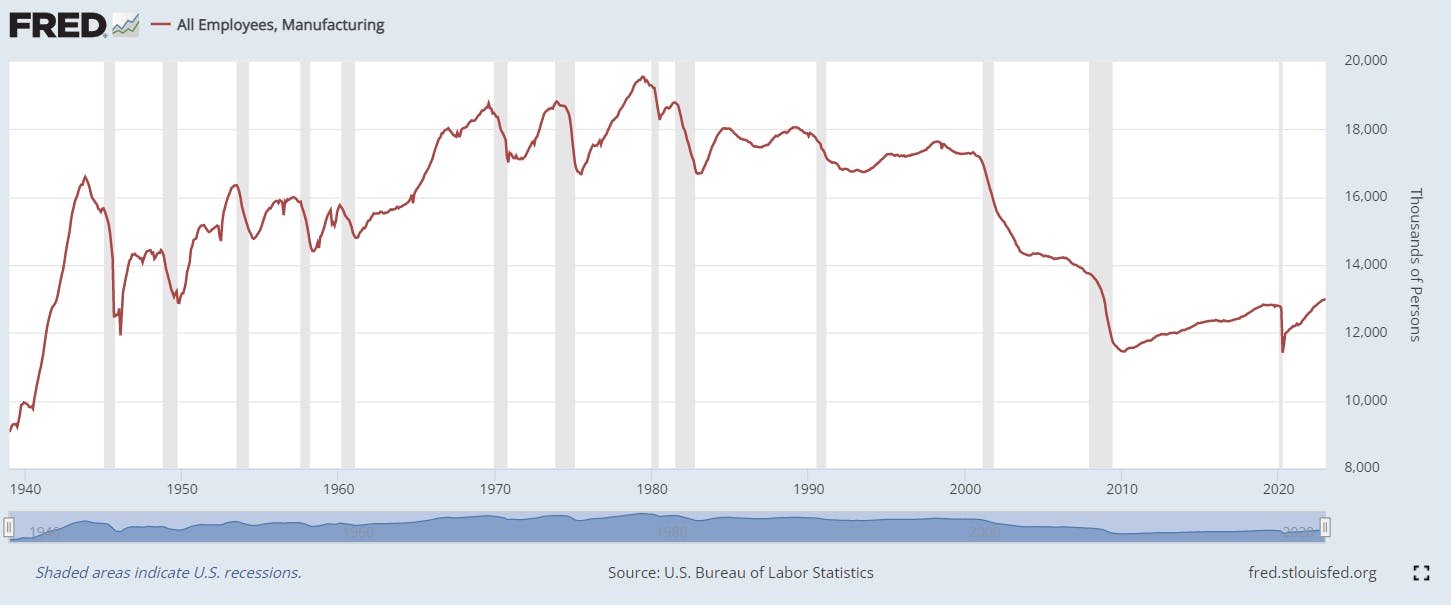
Historically, the manufacturing sector has played an integral role in the US economy, with it accounting for 25% of US GDP in the 1980s. However, over the past four decades, contributions from the manufacturing sector to the US GDP have steadily declined, with it accounting for approximately 11 % as of 2021. While the decline in US manufacturing can be attributed to various economic developments, namely globalization, the transformation of the US into a service-based economy, and companies outsourcing production to countries with lower labor costs, the US remains one of the largest manufacturing economies in the world, and manufacturing continues to play a significant role in the overall health of the US economy.
Get data on 14,000+ ETFs
Access Trackinsight's reliable and comprehensive data with 500M+ points on 14,000+ ETFs.
Assessing the current manufacturing landscape
Against the backdrop of the global pandemic, the inefficiencies and limitations of a global supply chain that depended on the low-cost manufacturing capabilities of China applied to any business. Furthermore, with geopolitical tensions – both realized (Russian-Ukraine War) and anticipated (China-Taiwan) arising globally, many companies have begun re-examining their manufacturing business model, ultimately deciding to reshore their operations to the United States. In making this decision, companies are choosing to forgo beneficial production cost inputs, such as low-cost labor, which will be comparatively higher in the US – in an effort to mitigate supply chain risk that would greatly impact business continuity.
As detailed in Deloitte’s The future of freight: Transforming the movement of goods, American companies are believed to have reshored nearly 350,000 jobs in 2022, up from 260,000 in 2021. Major automobile and electronics manufacturers are set to build new facilities costing billions of dollars to manufacture their highest-value products in the United States—investments in battery production plants announced by automotive companies in 2022 alone exceed US$13 billion. Labor availability and cost of manufacturing in Western Europe and the United States are being mitigated by advances in robotics and automation, stimulating the reshoring of manufacturing for everything from kitchen utensils to hardwood flooring.
Reshaping the manufacturing landscape, through automation
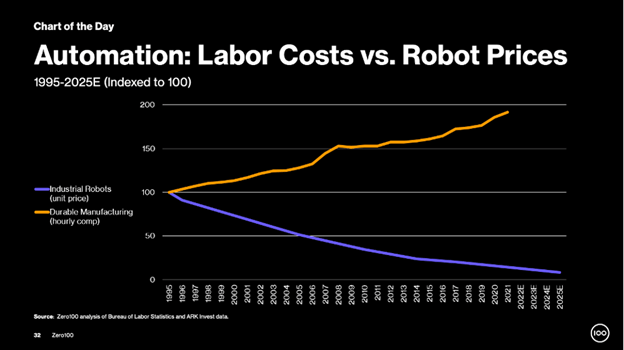
For manufacturing businesses re-entering the US, utilizing technology – specifically the introduction of robotics automation – has enabled them to reshape their manufacturing process in a manner that allows them to achieve economies of scale fairly quickly. While one of the immediate benefits of robotics automation is the labor cost savings that can be achieved, it is also an avenue for great production efficiency and higher quality outputs.
Investing in automation
As more manufacturing businesses, across different industries, adopt automation as a means of production, the businesses that are the source of these robotic innovations are best positioned to be investments capable of offering growth over a long-term horizon. For investors interested in gaining exposure to the robotics and automation industry, the following solutions provide you with pure-play access.
iShares Robotics and Artificial Intelligence Multisector ETF (IRBO) is a global fund following companies from both developed and emerging markets that are involved in robotics and artificial intelligence. The fund’s underlying index uses company filings and public disclosures to identify eligible stocks. To be selected, a company must either derive 50% of its revenue, have a 20% market share, or generate $1 billion in annual revenue from industries with exposure to a robotics and artificial intelligence theme.
Global X Robotics & Artificial Intelligence ETF (BOTZ) provides cross-sector exposure to companies working on the development and production of robotics and artificial intelligence through a market-cap selected and weighted index. Eligible companies are listed in developed countries and must earn a significant portion of their revenue from, or have a stated business purpose in, the field of robotics or artificial intelligence. This field includes varied applications from the development of drones to healthcare robots and predictive analytics software.
As more companies decide to relocate to the US, the adoption of robotic automation represents the reinvigoration of American manufacturing and an opportunity for investors to benefit from technological advancements that will reshape an industry for years to come.
Please note this article is for information purposes only and does not in any way constitute investment advice. It is essential that you seek advice from a registered financial professional prior to making any investment decision.
Topics
See all
Segments
See all
Mentioned ETFs
No specific ETFs were tagged

Latest ETF News
See all ETF newsChart of the Day 8/14/26: The Great "Hot Money" Migration


MoneyShow Chart of the Day 7/29/26: Now, THAT's What I Call Market Rotation!

MoneyShow Chart of the Day 7/16/26: Good News/Bad News on Inflation (and the Fed)

MoneyShow Chart of the Day 7/1/26: The H1 Scorecard – and What Comes Next




 Advantages of ETFs over Mutual Funds1/6
Lower Costs
In this guide, we'll explore the advantages of ETFs over mutual funds, giving you valuable insights into why ETFs have gained significant popularity among investors like yourself.
Leveraged ETFs: Unlocking the Potential for Amplified Returns1/6
Understanding Leveraged ETFs
Explore leveraged ETFs: potential for amplified returns & risks. 5 ETFs to consider across equities, commodities & fixed income.
What is a Leveraged ETF?1/6
Introducing Leveraged and Inverse ETFs
In this guide, we'll dive into the world of leveraged ETFs, exploring their definition, mechanics, potential risks, and rewards.
Recent educational content

First Look ETF
First Look ETF: Cycle Aware Investing & Next-Gen Nicotine Shifts
In this season 6 episode of First Look ETF, Stephanie Stanton examines the latest ETF marketplace trends with NYSE and guests.


ETF Trends
ETF Industry KPIs August 10, 2026
This week’s KPI data overview highlights key metrics and trends shaping the ETF landscape.

ETF Trends
ETF Industry KPIs July 20, 2026
This week’s KPI data overview highlights key metrics and trends shaping the ETF landscape.
ETF Trends
ETF Industry KPIs July 13, 2026
This week’s KPI data overview highlights key metrics and trends shaping the ETF landscape.
Browse all educational columns



Expert-Built ETF Portfolios, All in One Place
Don’t start from scratch. Discover ready-made ETF portfolios built by professionals to match different goals, timelines, and market views. Use them as inspiration or as a starting point for your own allocation.