Explore professionally built ETF model portfolios. Discover now →



High-Yield Muni Bonds: Attractive Taxable Equivalent Yields Favorable Relative Risk
Uncertainty around tariffs combined with seasonal technical factors may present a compelling opportunity to lock in attractive yields.

Keep up with what matters in ETFs
Get timely ETF insights, market trends, and top ideas straight to your inbox.
Your newsletter subscriptions with us are subject to ETF Central's Privacy Policy and Terms and Conditions.
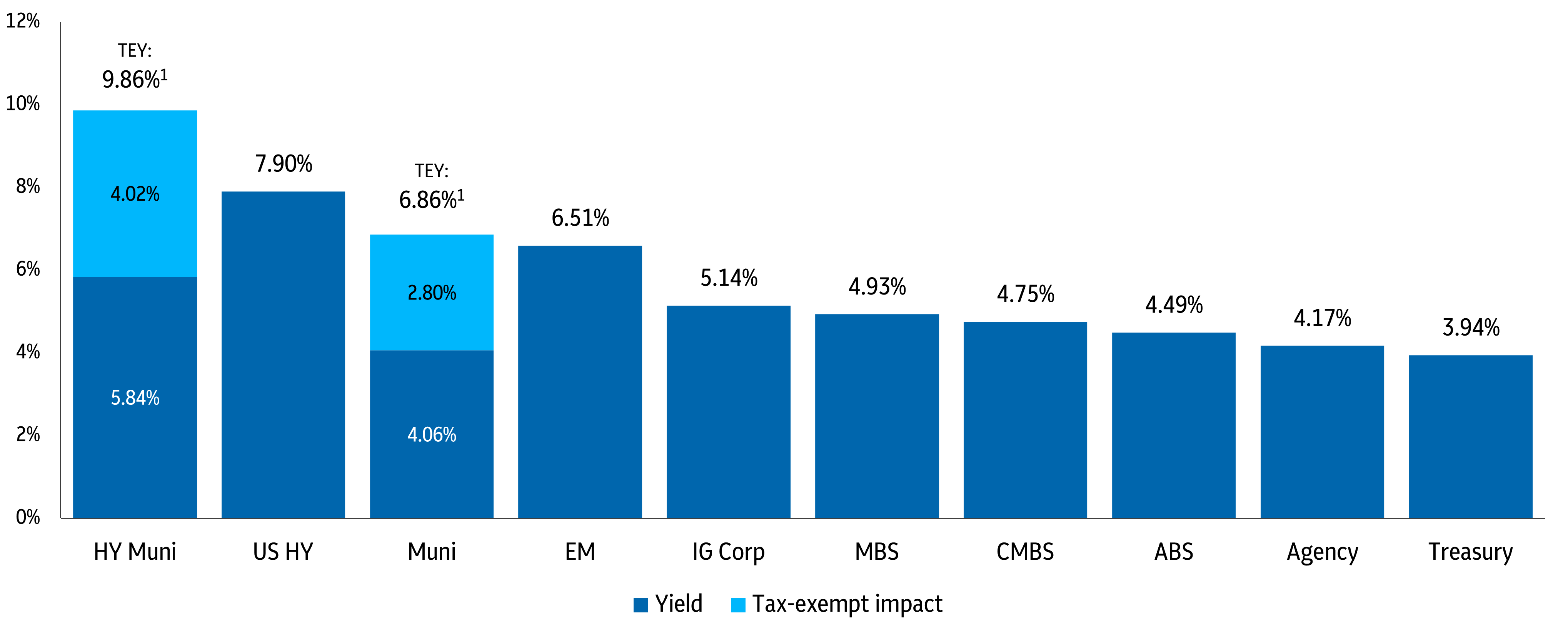
Fixed income yields (as of April 30, 2025)
Global ETF Survey 2026 is Live!
With 1,790 new products launched by July 2026, choosing is harder than ever. Our Global ETF Survey 2026, built on 620 professional investors and allocators, shows how active, fixed income, options-based and thematic ETFs are reshaping fund selection.
TEY = Taxable-equivalent yield. It is the yield that is required on a taxable investment to make it equal to the yield of a tax-exempt investment. The top federal income tax bracket of 37% plus 3.8% Medicare tax were used to calculate the taxable-equivalent yield.
Sector yields are represented by the following indices: HY Muni: Bloomberg High-Yield Municipal Bond Index; US HY: Bloomberg US Corporate High Yield Index; EM: Bloomberg Emerging Markets USD Aggregate Index; Muni: Bloomberg Municipal Bond Index; IG Corp: Bloomberg US Corporate Bond Index; MBS: Bloomberg US Mortgage-Backed Securities (MBS) Index; CMBS: Bloomberg US CMBS ERISA-Eligible Index; ABS: Bloomberg US Fixed-Rate Asset-Backed Securities (ABS) Index; Agency: Bloomberg US Agency Index; Treasury: Bloomberg US Treasury Index. For Illustrative purposes only. Index performance does not reflect fund performance and it is not possible to invest directly in an index. Past performance does not guarantee future results.
Municipal bonds can offer attractive taxable-equivalent yields, and in today’s volatile environment, the yield advantage is even more pronounced with yields approaching decade highs at the longer end of the curve. We believe high yield municipal bonds may be particularly appealing, with a taxable-equivalent yield of 9.86%,¹ making them more attractive than both investment grade municipal bonds and taxable fixed income bonds. Additionally, high yield municipal bonds may present a favorable risk-return profile and default at a fraction of the rate of high yield corporates.²
Continued uncertainty around tariffs and the status of the municipal tax exemption, combined with seasonally weak technical factors (municipal bond supply and demand), may present a compelling opportunity to lock in elevated yields. For investors in higher tax brackets, the tax-advantaged income stream may be especially attractive.
This commentary is provided by the award-winning³ Municipal Bond Team at Macquarie Asset Management. For investors seeking an income-focused approach to accessing the high yield municipal bond markets, consider accessing Macquarie National High-Yield Municipal Bond ETF (HTAX). HTAX is an actively managed ETF with a competitive 0.49% expense ratio.
Important Disclosures
¹ As of April 30, 2025 based on the Bloomberg High-Yield Municipal Bond Index. Taxable-equivalent yield is the yield that is required on a taxable investment to make it equal to the yield of a tax-exempt investment. The top federal income tax bracket of 37% plus 3.8% Medicare tax were used to calculate the taxable-equivalent yield.
² Source: Moody’s Investors Service, US Municipal Bond Defaults and Recoveries, 1970-2023 (most recent data available). 10-year average cumulative issuer-weighted default rate for municipal rated debt is 6.83% and corporate rated debt is 29.71%.
³ Barron’s Best Fund Families ranked Macquarie Asset Management #1 in the tax-exempt bond category for 2023 and 2020. The ranking looks at one-year relative performance of fund firms that offer a diversified lineup of actively managed mutual funds and ETFs. The ranking eliminates index funds. Results are based on firms’ skill in active management. Ranking calculates returns before any 12b-1 fees are deducted. Similarly, fund loads, or sales charges are not included in the return calculations. 49 asset managers were included in Barron’s one-year ranking list for the year ending December 31, 2023. 53 asset managers were included in Barron’s one-year ranking list for the year ending December 31, 2020. In 2020, the Macquarie Municipal Bond Team was listed under Delaware Management. This ranking is not based on total return. The ranking is the opinion of Barron’s and not Macquarie Group. No such person creating the ranking is affiliated with Macquarie Group. There can be no assurances that other providers or surveys would reach the same conclusions as this ranking.
Carefully consider the Fund's investment objectives, risk factors, and charges and expenses before investing. This and other information can be found in the Fund's prospectus or the summary prospectus, which may be obtained by visiting macquarie.com/mam/etf-literature or calling 844 469-9911. Read the prospectus carefully before investing.
The Macquarie ETF Trust Funds are distributed by Foreside Financial Services, LLC. Foreside Financial Services, LLC is not affiliated with any Macquarie entity, including Macquarie Asset Management and Delaware Distributors, L.P.
Investing involves risk, including possible loss of principal.
Fixed income securities can lose value, including the possible loss of principal. Fixed income securities are subject to credit risk and interest rate risk. Credit risk is the risk that an issuer of a fixed income security may be unable to make interest payments and/or repay principal in a timely manner. Interest rate risk is the risk that prices of bonds and other fixed income securities will increase as interest rates fall and decrease as interest rates rise. Fixed income securities with longer maturities or duration generally are more sensitive to interest rate changes
High yield securities (“junk bonds”) are subject to reduced creditworthiness of issuers, increased risk of default, and a more limited and less liquid secondary market. High yield securities may also be subject to greater price volatility and risk of loss of income and principal than higher-rated securities.
Nothing presented should be construed as a recommendation to purchase or sell any security or follow any investment technique or strategy.
Transactions in shares of ETFs will result in brokerage commissions and will generate tax consequences. All regulated investment companies are obliged to distribute portfolio gains to shareholders.
The Bloomberg High-Yield Municipal Bond Index measures the total return performance of the long-term, non-investment-grade tax-exempt bond market.
The Bloomberg US Corporate High-Yield Index is composed of US dollar–denominated, noninvestment grade corporate bonds for which the middle rating among Moody’s Investors Service, Inc., Fitch, Inc., and Standard & Poor’s is Ba1/BB+/BB+ or below.
The Bloomberg Emerging Markets USD Aggregate Index is a hard currency emerging markets debt benchmark that includes US dollar-denominated debt from sovereign, quasi-sovereign, and corporate emerging market issuers.
The Bloomberg Municipal Bond Index measures the total return performance of the long-term, investment grade tax-exempt bond market.
The Bloomberg US Corporate Bond Index is composed of US dollar-denominated, investment grade corporate bonds that are US Securities and Exchange Commission (SEC)-registered or 144A with registration rights, and issued by industrial, utility, and financial companies. All bonds in the index have at least one year to maturity.
The Bloomberg US Mortgage-Backed Securities (MBS) Index measures the performance of agency mortgage-backed pass-through securities (both fixed-rate and hybrid adjustable-rate mortgage) issued by the Federal National Mortgage Association (Fannie Mae), Federal Home Loan Mortgage Association (Freddie Mac), and Government National Mortgage Association (Ginnie Mae).
The Bloomberg US Commercial Mortgage-Backed Securities (CMBS) ERISA-Eligible Index measures the market of commercial mortgage-backed securities transactions with a minimum current size of $300 million, and includes investment grade securities that are Employee Retirement Income Security Act (ERISA)-eligible under the underwriter’s exemption.
The Bloomberg US Fixed-Rate Asset-Backed Securities (ABS) Index tracks the fixed-rate ABS market for bonds with collateral types of credit cards, autos, and stranded-cost utility (rate reduction bonds). To be included in the index, an issue must have a fixed-rate coupon structure, have an average maturity of greater than or equal to one year, and be part of a public deal.
The Bloomberg US Agency Index is composed of publicly issued debt of US government agencies, quasi-federal corporations, and corporate or foreign debt guaranteed by the US government. The largest issuers are Fannie Mae, Freddie Mac, and the Federal Home Loan Bank System (FHLB).
The Bloomberg US Treasury Index measures the performance of US Treasury bonds and notes that have at least one year to maturity.
Macquarie Asset Management (MAM) is the asset management division of Macquarie Group. MAM is an integrated asset manager across public and private markets offering a diverse range of capabilities, including real assets, real estate, credit, equities and multi-asset solutions. Macquarie Group refers to Macquarie Group Limited and its subsidiaries and affiliates worldwide. Investment advisory services are provided to the Macquarie ETF Trust Funds by Delaware Management Company, a series of Macquarie Investment Management Business Trust (MIMBT), a Securities and Exchange Commission (SEC) registered investment adviser.
Other than Macquarie Bank Limited ABN 46 008 583 542 (“Macquarie Bank”), any Macquarie Group entity noted in this document is not an authorized deposit-taking institution for the purposes of the Banking Act 1959 (Commonwealth of Australia). The obligations of these other Macquarie Group entities do not represent deposits or other liabilities of Macquarie Bank. Macquarie Bank does not guarantee or otherwise provide assurance in respect of the obligations of these other Macquarie Group entities. In addition, if this document relates to an investment, (a) the investor is subject to investment risk including possible delays in repayment and loss of income and principal invested and (b) none of Macquarie Bank or any other Macquarie Group entity guarantees any particular rate of return on or the performance of the investment, nor do they guarantee repayment of capital in respect of the investment.
All third-party marks cited are the property of their respective owners.
© 2025 Macquarie Management Holdings, Inc.


Latest ETF News
See all ETF newsEntering A New Era of Defense Tech Spending


How SPXD Delivers a More Balanced S&P 500 Exposure

Autocallable Yield Advantage and Market Reception







 Advantages of ETFs over Mutual Funds1/6
Lower Costs
In this guide, we'll explore the advantages of ETFs over mutual funds, giving you valuable insights into why ETFs have gained significant popularity among investors like yourself.
Leveraged ETFs: Unlocking the Potential for Amplified Returns1/6
Understanding Leveraged ETFs
Explore leveraged ETFs: potential for amplified returns & risks. 5 ETFs to consider across equities, commodities & fixed income.
What is a Leveraged ETF?1/6
Introducing Leveraged and Inverse ETFs
In this guide, we'll dive into the world of leveraged ETFs, exploring their definition, mechanics, potential risks, and rewards.
Recent educational content

First Look ETF
First Look ETF: Income, International, and Cash Flow ETFs
In this season 6 episode of First Look ETF, Stephanie Stanton @etfguide examines the latest ETF marketplace trends with NYSE and guests.


ETF Trends
ETF Industry KPIs October 5, 2026
This week’s KPI data overview highlights key metrics and trends shaping the ETF landscape.

ETF Trends
ETF Industry KPIs September 28, 2026
This week’s KPI data overview highlights key metrics and trends shaping the ETF landscape.
ETF Trends
ETF Industry KPIs September 22, 2026
This week’s KPI data overview highlights key metrics and trends shaping the ETF landscape.
Browse all educational columns



ETFs’ Next Act: From Access to Selection
With 1,790 new products launched by July 2026, choosing is harder than ever. Our Global ETF Survey 2026, built on 620 professional investors and allocators, shows how active, fixed income, options-based and thematic ETFs are reshaping fund selection.