Keep tabs on your favorite ETFs with a personalized weekly tracker. Create a Watchlist now →



HELO: Could this JPMorgan Laddered Options ETF Be a Good Alternative to the 60/40 Portfolio?
Bonds aren't always negatively correlated with stocks, so it might be a good idea to add an additional source of diversification.


Keep up with what matters in ETFs
Get timely ETF insights, market trends, and top ideas straight to your inbox.
Your newsletter subscriptions with us are subject to ETF Central's Privacy Policy and Terms and Conditions.
The 60/40 portfolio has long been the go-to strategy, a testament to the enduring appeal of Modern Portfolio Theory simplified for the everyday investor and retiree.
This strategy, dividing assets between 60% equities and 40% bonds, aims to strike a balance on the efficient frontier—achieving the best possible returns for a given level of risk through the historically low to negative correlation between stocks and bonds.
However, recent times, like the year 2022, have showcased the limitations of this model. As both interest rates and inflation spiked, the supposed diversification benefit of bonds evaporated, with bonds moving in tandem with stocks, thereby amplifying risks instead of mitigating them.
While 2022 might have been an anomaly, it does prompt a reconsideration of alternative strategies that can enhance a portfolio's resilience. One such alternative is the introduction of options-based strategies that offer potential risk management benefits at a lower cost and higher liquidity.
A prime example is the JPMorgan Hedged Equity Laddered Overlay ETF
Like what you're reading?
Stay in the loop — get the latest ETF insights: trends, analysis, and expert picks.
How does HELO work?
HELO is essentially the ETF adaptation of the JPMorgan Hedged Equity A (JHQAX) mutual fund, featuring a more accessible format with a comparable strategy. Analyzing the mutual fund is beneficial due to its longer track record.
JHQAX primarily constructs a low-volatility equity portfolio through active management, which involves some opacity due to its discretionary nature. However, the more discernible and critical aspect of JHQAX's approach is its options overlay strategy.
This strategy involves buying puts that are 5% out of the money relative to the current price of the S&P 500, financed by selling puts that are 20% out of the money and selling calls, typically 3.5-5.5% out of the money.
This structured options approach shields the fund from losses between a 5-20% drop in the market. Losses less than 5% parallel those of the S&P 500, but the protection kicks in up to a 20% market drop, effectively offering a 15% cushion compared to the market. The fund resumes participating in losses only beyond a 20% drop.
A notable advantage of both JHQAX and its ETF counterpart, HELO
Reflecting the trend towards cost-efficiency in active ETFs, HELO offers a lower expense ratio of 0.5% compared to JHQAX's 0.83%, with the added convenience of no minimum investment beyond the price of a single share.
How has HELO performed?
Analyzing the performance of JHQAX compared to the Vanguard Balanced Index Fund Admiral Shares (VBIAX), it's evident that JHQAX has delivered on its promise of lower drawdowns and volatility while maintaining competitive returns.
From the data provided, JHQAX has a Compound Annual Growth Rate (CAGR) of 8.09%, slightly lower than VBIAX's 8.25%. Moreover, the standard deviation, a measure of volatility, is lower for JHQAX at 9.17% compared to 10.82% for VBIAX. Overall Sharpe ratio for JHQAX is also higher at 0.68 compared to 0.59 for VBIAX, indicating better risk-adjusted returns.
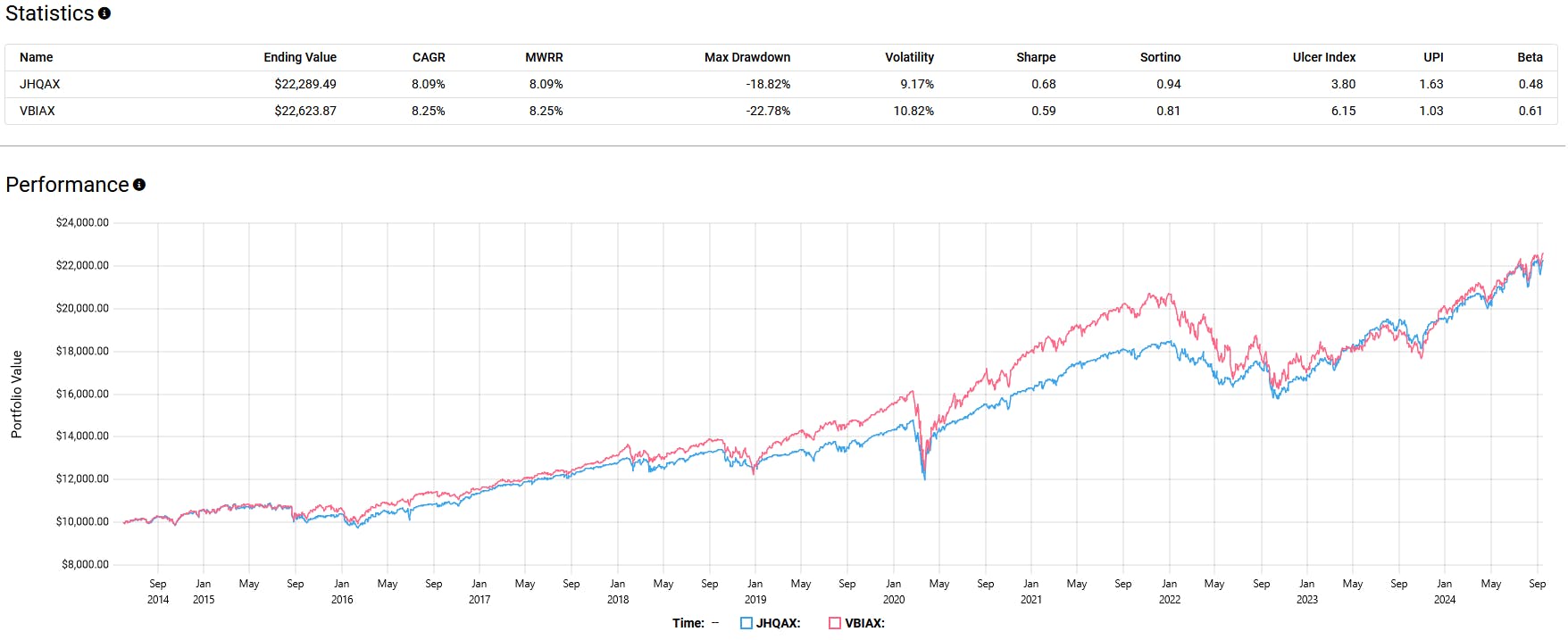
JHQAX's maximum drawdown was significantly less severe at -18.82% compared to VBIAX's -22.78%, demonstrating its resilience during market downturns, particularly during the COVID-19 pandemic in early 2020 and the financial upheaval of 2022.

This is indicative of the protective nature of JHQAX's laddered options strategy, which provides a mathematically guaranteed payoff profile like guardrails, unlike the protection offered by bonds which relies on their low correlation with equities.
Given these metrics and the strategic benefits of a laddered options approach that does not involve interest rate or credit risk inherent to bonds, incorporating an ETF like HELO
While it might not completely replace the traditional 60/40 strategy, it presents an option for an alternative investment sleeve, suggesting an allocation of perhaps 50% equities, 30% fixed income, and 20% in alternatives like HELO for enhanced protection.
Please note this article is for information purposes only and does not in any way constitute investment advice. It is essential that you seek advice from a registered financial professional prior to making any investment decision.
Latest ETF News
See all ETF newsBeyond Big Tech: The Increasing Specialization of AI ETFs

There's an ETF for That? Humanoid Robotics and Physical AI

How Some ETF Issuers Use Their Own Funds for Cash Management

These Public-Private ETFs Invest in Polymarket and Anduril

There's an ETF for That? Frontier Markets



 Advantages of ETFs over Mutual Funds1/6
Lower Costs
In this guide, we'll explore the advantages of ETFs over mutual funds, giving you valuable insights into why ETFs have gained significant popularity among investors like yourself.
Leveraged ETFs: Unlocking the Potential for Amplified Returns1/6
Understanding Leveraged ETFs
Explore leveraged ETFs: potential for amplified returns & risks. 5 ETFs to consider across equities, commodities & fixed income.
What is a Leveraged ETF?1/6
Introducing Leveraged and Inverse ETFs
In this guide, we'll dive into the world of leveraged ETFs, exploring their definition, mechanics, potential risks, and rewards.
Recent educational content

First Look ETF
First Look ETF: Income, International, and Cash Flow ETFs
In this season 6 episode of First Look ETF, Stephanie Stanton @etfguide examines the latest ETF marketplace trends with NYSE and guests.


ETF Trends
ETF Industry KPIs October 5, 2026
This week’s KPI data overview highlights key metrics and trends shaping the ETF landscape.

ETF Trends
ETF Industry KPIs September 28, 2026
This week’s KPI data overview highlights key metrics and trends shaping the ETF landscape.
ETF Trends
ETF Industry KPIs September 22, 2026
This week’s KPI data overview highlights key metrics and trends shaping the ETF landscape.
Browse all educational columns



ETFs’ Next Act: From Access to Selection
With 1,790 new products launched by July 2026, choosing is harder than ever. Our Global ETF Survey 2026, built on 620 professional investors and allocators, shows how active, fixed income, options-based and thematic ETFs are reshaping fund selection.