From idea to ETF portfolio in minutes. Build yours now →



Hedged Equity ETFs: Options-Based Alternatives to the 60/40 Portfolio
These advanced options-based ETFs can help investors achieve better risk-adjusted returns without relying on finicky correlations.


Keep up with what matters in ETFs
Get timely ETF insights, market trends, and top ideas straight to your inbox.
Your newsletter subscriptions with us are subject to ETF Central's Privacy Policy and Terms and Conditions.
The traditional 60/40 portfolio—a mix of broad market equities (60%) and aggregate bonds (40%)—is built on two key pillars: stocks drive growth, while bonds provide income and downside protection.
The underlying principle behind this allocation is low-to-negative correlation between stocks and bonds, meaning that when stocks decline, bonds should hold steady or even rise, helping to cushion losses.
This inverse relationship has historically allowed the 60/40 model to provide steady long-term returns with reduced volatility…but only through a long falling-rate environment.
However, since 2022, the correlation between stocks and bonds has been steadily rising, largely due to higher interest rates and inflation. When both asset classes sell off at the same time, the traditional diversification benefit breaks down.
Additionally, even with 40% of the portfolio in bonds, the 60% equity allocation still contributes the vast majority of risk, making it more volatile than many investors realize.
One alternative approach that doesn’t rely on correlations holding is hedging with options strategies—particularly, the put-spread collar.
Here’s an overview of how put-spread collars work and a look at two actively managed, NYSE-listed ETFs from JPMorgan Asset Management and Simplify that execute variants of this strategy at reasonable fees.
Get data on 14,000+ ETFs
Access Trackinsight's reliable and comprehensive data with 500M+ points on 14,000+ ETFs.
What are put-spread collars?
A put-spread collar is a multi-leg options strategy designed to reduce downside risk while limiting upside potential. This strategy involves three options trades layered on top of an existing long position in an ETF or stock.
For example, if I own an ETF tracking the S&P 500 index, I could hedge with a put-spread collar by:
- Buying a 5% out-of-the-money (OTM) put – This protects against losses beyond 5% by giving me the right to sell at that price.
- Selling a 20% OTM put – This helps finance the cost of the 5% put by obligating me to buy the ETF at a much lower price if it drops more than 20%.
- Selling a covered call – The strike price depends on how much premium I need to generate to fully offset the cost of the long put, effectively capping my upside potential.
Ideally, all three options expire on the same date, typically three months into the future. This setup buffers losses if the S&P 500 declines between 5% and 20%, while limiting gains beyond a certain level.
A put-spread collar is superior to a typical collar because buying a put outright is expensive, and a standard collar would require selling a covered call closer to at-the-money (ATM) to fully finance it, significantly capping upside.
By selling a short put, you generate additional premium to offset the cost of the long put, allowing for less restrictive upside while still hedging losses between 5- 20% in the aforementioned example.
Simplify Hedged Equity ETF HEQT+0.72%
HEQT deploys a laddered approach to put-spread collars, meaning it staggers three separate expirations over sequential months rather than rolling the entire hedge at once.
This structure reduces timing risk, ensuring that not all positions are reset at the same time, which helps smooth performance across different market conditions.
Historically, HEQT has performed exceptionally well, earning a five-star Morningstar rating and delivering superior risk-adjusted returns compared to 149 funds in the Equity Hedged category as of February 28, 2025.
From November 2, 2021, to March 14, 2025, it has strongly outperformed a traditional 60/40 portfolio, with a compound annual growth rate (CAGR) of 7.22% vs. 3.11%, lower volatility (8.62% standard deviation vs. 11.53%), and a much smaller maximum drawdown (11.51% vs. 21.53%).
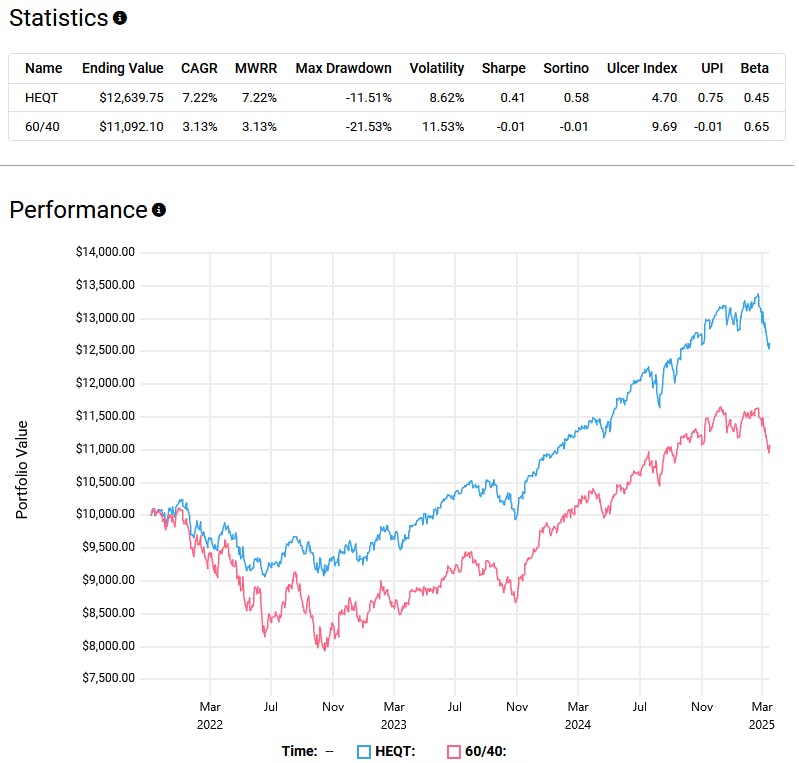
The ETF is also relatively affordable, charging a 0.44% expense ratio, though one thing to watch out for is its slightly wider 0.13% 30-day median bid-ask spread, which can add to trading costs.
JPMorgan Hedged Equity Laddered Overlay ETF HELO+0.44%
HELO is HEQT’s main competitor, managed by Hamilton Reiner, the same portfolio manager behind the hugely successful JPMorgan Equity Premium Income ETF
HELO’s strategy mirrors that of the five-star Morningstar-rated mutual fund JPMorgan Hedged Equity I (JHEQX), employing a 5-20 put spread collar, where downside protection is financed by selling a covered call usually set 3.5% to 5.5% out of the money (OTM).
Since HELO’s track record is too short to gauge how it would have performed during 2022’s bear market, we can use JHEQX as a proxy.
From May 30, 2014, to March 14, 2025, JHEQX delivered a compound annual growth rate (CAGR) of 8.05%, slightly outperforming the 7.91% CAGR of a traditional 60/40 portfolio. It also had lower volatility (9.16% standard deviation vs. 10.74%) and a smaller maximum drawdown (18.85% vs. 22.78%), predictably producing a better risk-adjusted return, with a Sharpe ratio of 0.7 vs. 0.6.
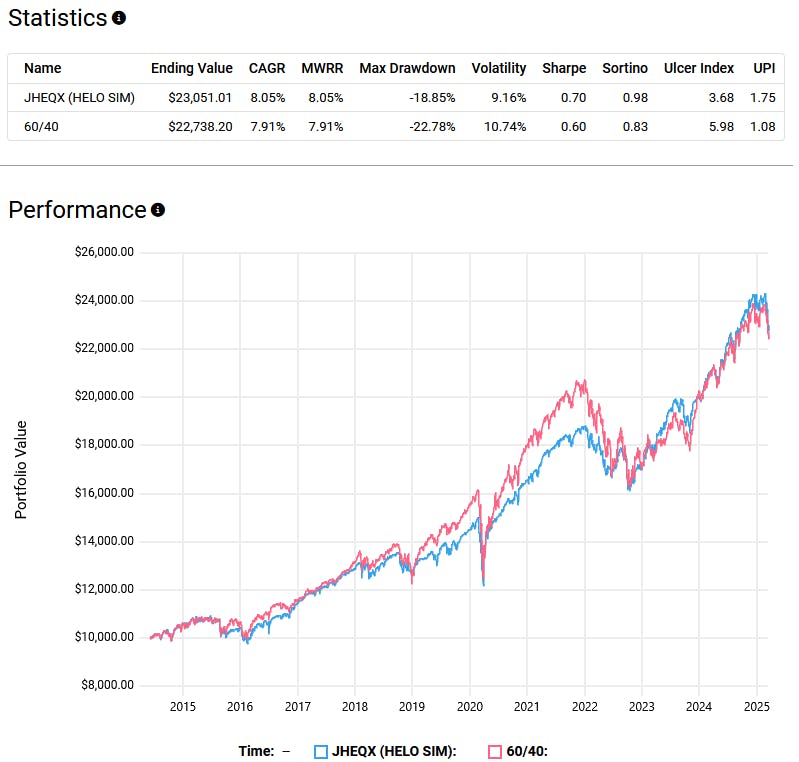
HELO is also markedly less expensive and more accessible than JHEQX, with a 0.50% expense ratio and a $60 share price, compared to JHEQX’s 0.58% fee and its $1 million investment minimum.
This article is for informational purposes only and does not in any way constitute investment advice. The author may express their own opinions, which may not represent the opinions of ETF Central or its affiliated partners. It is essential that you seek advice from a registered financial professional prior to making any investment decisions.

Latest ETF News
See all ETF newsCould Water ETFs Be the Next AI Bottleneck Trade?

What is a Boomer Candy ETF?

ETF Comparison: NEOS Nasdaq-100 High Income ETF (QQQI) Versus Goldman Sachs Nasdaq-100 Premium Income ETF (GPIQ)





 Advantages of ETFs over Mutual Funds1/6
Lower Costs
In this guide, we'll explore the advantages of ETFs over mutual funds, giving you valuable insights into why ETFs have gained significant popularity among investors like yourself.
Leveraged ETFs: Unlocking the Potential for Amplified Returns1/6
Understanding Leveraged ETFs
Explore leveraged ETFs: potential for amplified returns & risks. 5 ETFs to consider across equities, commodities & fixed income.
What is a Leveraged ETF?1/6
Introducing Leveraged and Inverse ETFs
In this guide, we'll dive into the world of leveraged ETFs, exploring their definition, mechanics, potential risks, and rewards.
Recent educational content

ETF Trends
ETF Industry KPIs September 8, 2026
This week’s KPI data overview highlights key metrics and trends shaping the ETF landscape.

ETF Trends
ETF Industry KPIs August 31, 2026
This week’s KPI data overview highlights key metrics and trends shaping the ETF landscape.
ETF Trends
ETF Industry KPIs August 24, 2026
This week’s KPI data overview highlights key metrics and trends shaping the ETF landscape.
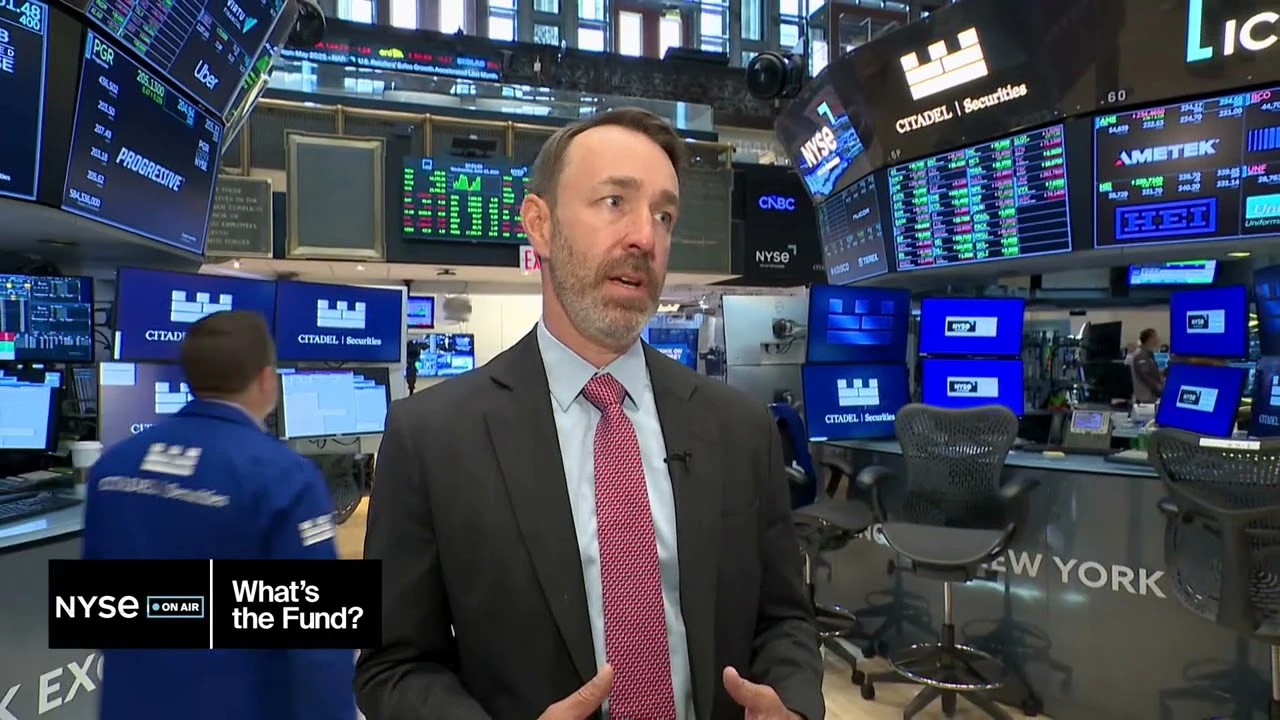
What’sTheFund
What's the Fund | Ocean Park Diversified Income ETF (DUKZ)
James St Aubin, Chief Investment Officer at Ocean Park Asset Management, discuss the DUKZ ETF, exposing investors to the whole spectrum of asset classes in the fixed income markets, through their rules-based process.

Browse all educational columns



Expert-Built ETF Portfolios, All in One Place
Don’t start from scratch. Discover ready-made ETF portfolios built by professionals to match different goals, timelines, and market views. Use them as inspiration or as a starting point for your own allocation.