NYSE CRTR Economy Event Watch the replay →



Harbor Capital’s Commodity ETF Quietly Outperforms Bigger Rivals
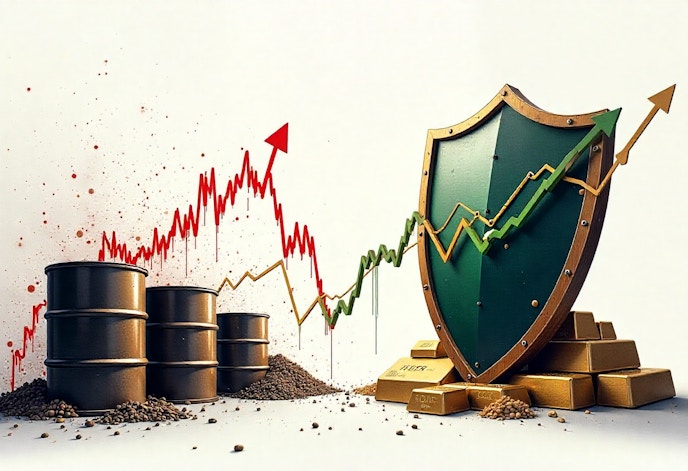
The Harbor Commodity All-Weather Strategy ETF (HGER) has outperformed peers by sidestepping common structural pitfalls.

Keep up with what matters in ETFs
Get timely ETF insights, market trends, and top ideas straight to your inbox.
Your newsletter subscriptions with us are subject to ETF Central's Privacy Policy and Terms and Conditions.
It’s been a tough half-decade for commodity investors, marked by extreme volatility. Oil prices briefly went negative during the March 2020 COVID shock, only to spike again during the Russian invasion of Ukraine in 2022. More recently, the second Trump administration’s shifting tariff policies have added another layer of uncertainty.
These swings, combined with structural flaws in many commodity ETFs, have meant poor returns for investors. Contango—when futures prices are higher than spot prices—erodes returns when ETFs roll contracts. Layer on high management fees, and it’s no surprise many investors have fled the space, despite commodities’ potential for diversification thanks to their low correlation with stocks and bonds.
But not every commodity ETF has struggled. One standout has been the Harbor Commodity All-Weather Strategy ETF
Get data on 14,000+ ETFs
Access Trackinsight's reliable and comprehensive data with 500M+ points on 14,000+ ETFs.
HGER explained
HGER tracks the Quantix Commodity Index, which is built on 24 of the most liquid commodity futures listed on U.S. or U.K. exchanges.
Instead of simply spreading assets across sectors, the index uses a quantitative framework to emphasize commodities with the strongest link to inflation and the most favorable cost of ownership. In plain terms, the goal is to hold futures contracts where expected inflation sensitivity is highest and roll costs are least punitive.
The methodology is flexible across different economic regimes. Two key lenses are used: scarcity, when physical shortages drive price spikes, and debasement, when monetary or fiscal policies erode the purchasing power of currency.
Depending on the environment, the index shifts weights toward commodities that best reflect those dynamics, whether it’s increasing exposure to gold in a debasement scenario or boosting industrial inputs when scarcity is the bigger concern.
This framework ensures that allocations are not static. Commodities with weak inflation pass-through are screened out, while those with strong correlations to consumer price trends are emphasized.
Sector weights are also balanced to capture inflation protection from multiple sources and roll yield—the cost or benefit of rolling futures contracts forward—is actively managed to minimize performance drag. The index is rebalanced quarterly to keep the portfolio aligned with current conditions.
HGER is structured as a 1940 Act fund, which means investors avoid the headaches of K-1 tax forms. The 0.68% expense ratio isn’t cheap, but for an actively designed commodity strategy, it’s in line with category norms.
HGER performance versus peers
From 2022-02-10 to 2025-09-22, HGER led a peer set of broad commodity funds on total return and quality-of-return metrics. HGER returned +40.3% cumulative with a 9.8% CAGR. HGER’s low beta also suggests better diversification benefits alongside equities and bonds than the index trackers.
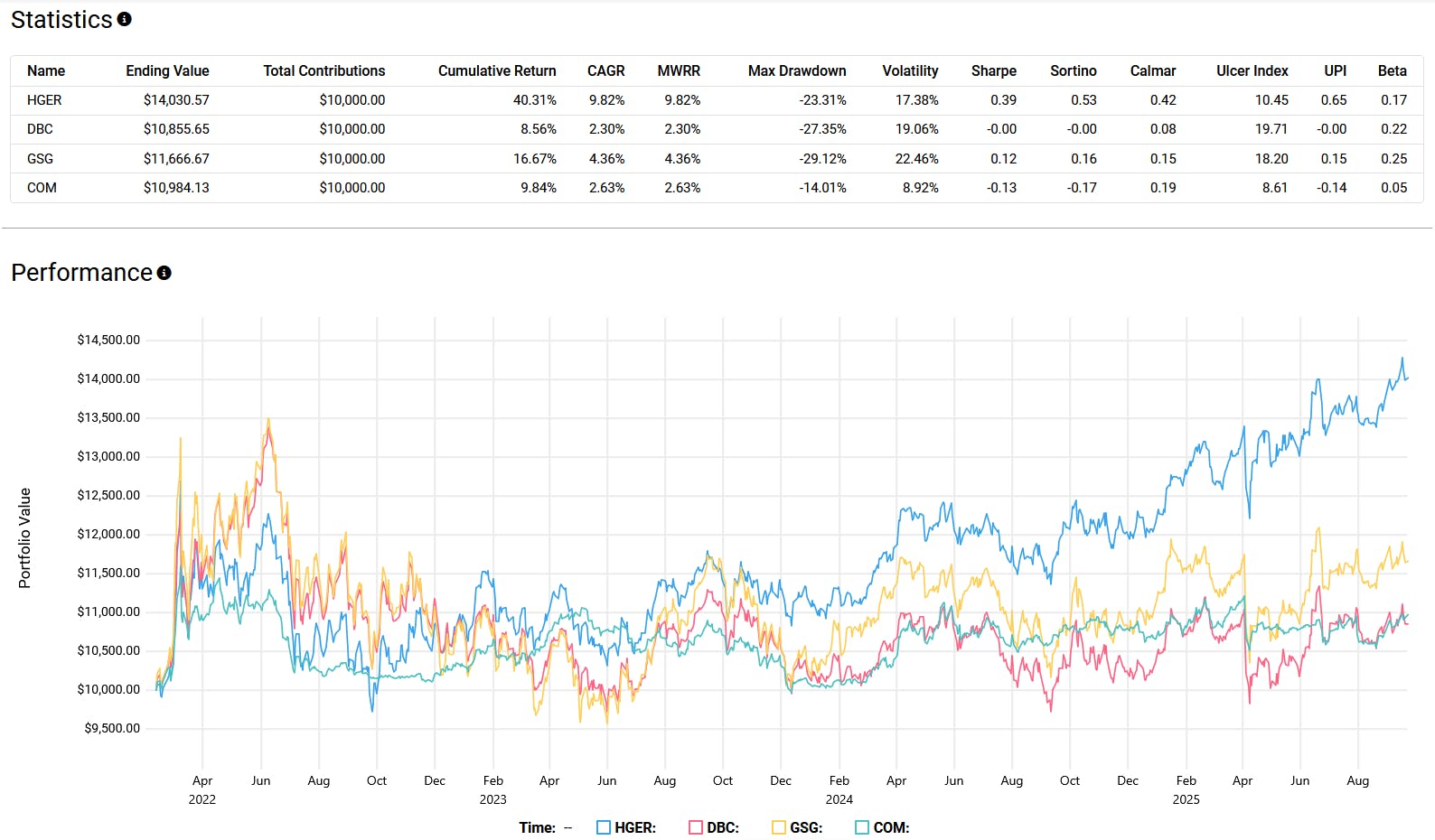
By comparison, the Invesco DB Commodity Index Tracking Fund
When it came to risk management, HGER’s max drawdown of −23.3% was meaningfully smaller than GSG’s −29.1% and DBC’s −27.4%, which were locked into taking losses as their indices rolled through adverse curves. COM fared best on downside with a −14.0% max drawdown because its rules can take the portfolio flat in difficult regimes.
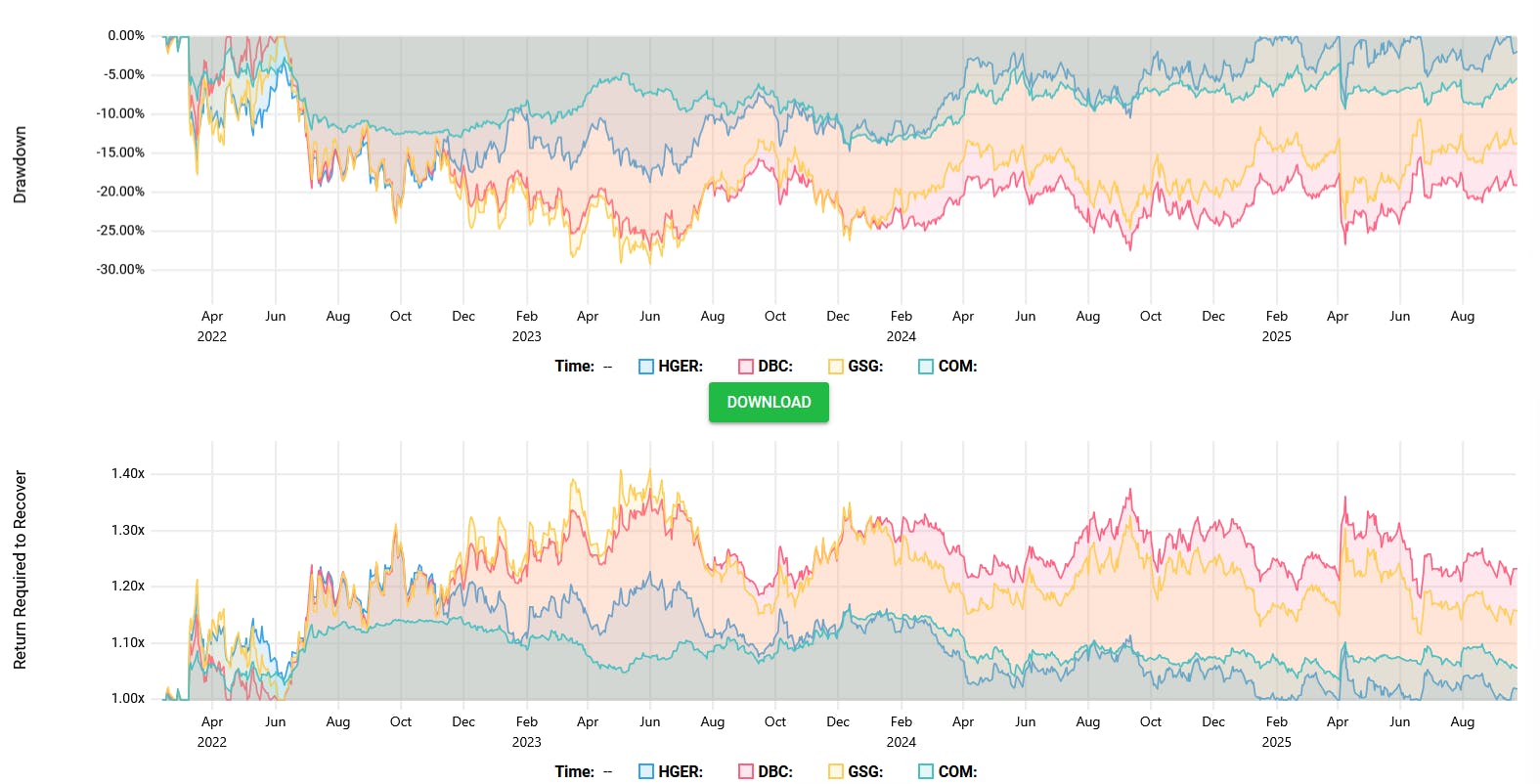
Even so, HGER managed a solid balance of return and risk, pairing stronger compounding with drawdowns that were moderate relative to the traditional index-based products.
My Thoughts on HGER
In my view, HGER is a good example of how a commodities ETF can get it right.
It diversifies across a broad basket rather than concentrating in a single contract, and weights exposures through an inflation and debasement lens rather than simply by trading volume or index prominence.
The fund’s roll process is also more thoughtful than the plain-vanilla approach of always buying the front month, which often leaves investors exposed to heavy contango.
Structuring it as a 1940 Act fund avoids saddling shareholders with a K-1 at tax time, and keeping the expense ratio at 0.68% helps minimize drag compared to other active or rules-based commodity strategies.
That said, it isn’t perfect, as I particularly like how COM can go flat in difficult markets, which HGER doesn’t allow. But overall, HGER gets the critical elements right, and the payoff has been clear in its relative performance.
Please note that this article reflects the author’s personal views and does not represent the opinions of the publication or its affiliates. It is for informational purposes only and does not constitute investment advice. It is essential to seek guidance from a registered financial professional before making any investment decisions.

Latest ETF News
See all ETF newsMoneyShow Chart of the Day 6/3/26: AI. AI. AI. (And a Handful of Other Stocks, Too)


MoneyShow Chart of the Day 5/27/26: SpaceX Hype Sends Space Stocks into Orbit






 Advantages of ETFs over Mutual Funds1/6
Lower Costs
In this guide, we'll explore the advantages of ETFs over mutual funds, giving you valuable insights into why ETFs have gained significant popularity among investors like yourself.
Leveraged ETFs: Unlocking the Potential for Amplified Returns1/6
Understanding Leveraged ETFs
Explore leveraged ETFs: potential for amplified returns & risks. 5 ETFs to consider across equities, commodities & fixed income.
What is a Leveraged ETF?1/6
Introducing Leveraged and Inverse ETFs
In this guide, we'll dive into the world of leveraged ETFs, exploring their definition, mechanics, potential risks, and rewards.
Recent educational content
Asset TV
The ETF Show - New Autism-Impact ETF Launched
Defiance ETFs has launched the first ETF, $ASD, focused on the autism ecosystem, investing in companies that provide services, products, and research related to autism and neurodivergence.


ETF Trends
ETF Industry KPIs June 1, 2026
The ETF Industry saw 22 New Launches, 1 Ticker Change and 1 closure last week.

ETF Trends
ETF Industry KPIs May 20, 2026
The ETF Industry saw 44 New Launches, 3 Mutual Fund Conversions and 9 closures last week.
Asset TV
The ETF Show - Politics Becomes Investable Trade through ETFs
Dan Weiskopf, Senior Portfolio Manager at Tidal Financial Group spoke with the ETF Show about Subversive ETFs that help investors trade like politicians.
Browse all educational columns



Expert-Built ETF Portfolios, All in One Place
Don’t start from scratch. Discover ready-made ETF portfolios built by professionals to match different goals, timelines, and market views. Use them as inspiration or as a starting point for your own allocation.