ETF model portfolios designed for real investor needs. Discover →



Gravity Wins: Buy the Dip, Skip the Risk with Protected Bitcoin ETFs
Calamos Protected Bitcoin ETFs help investors stay exposed to bitcoin while reducing deep drawdowns, offering defined protection levels (100%, 90%, 80%) and capped upside through quarterly vintages.


Keep up with what matters in ETFs
Get timely ETF insights, market trends, and top ideas straight to your inbox.
Your newsletter subscriptions with us are subject to ETF Central's Privacy Policy and Terms and Conditions.
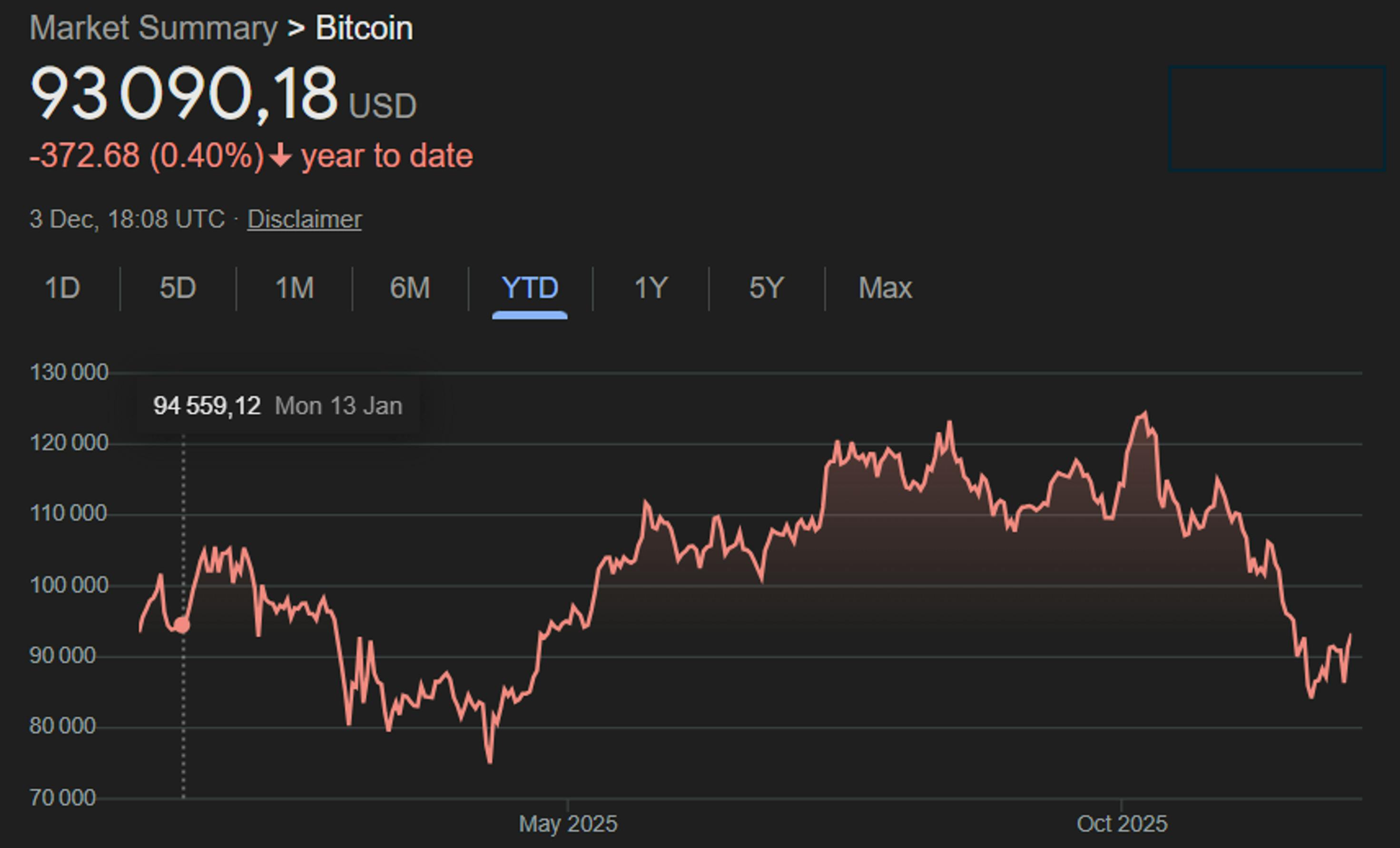
Enthusiasm for Bitcoin has faded in 2025 as price appreciation vanishes. After hitting a high of $123,900 on Tuesday, October 7, bitcoin slid into a sharp 32.26% drawdown and broke through the $100,000 support level, falling to $84,209 by November 22 and rising back to $93,090 on December 3rd.
In contrast, the new breed of protected Bitcoin ETFs has held up far better. But this isn’t about covered call products that sacrifice upside potential for oversized distributions and minimal hedging.
I’m talking about the Calamos Protected Bitcoin ETFs, which are designed to reduce drawdowns and calm volatility during periods like this one.
The case for this approach is straightforward. The long-term return potential of Bitcoin only matters if investors can stay invested, and many new or younger investors tend to misjudge their risk tolerance when markets are steadily rising.
The Calamos lineup provides upside exposure with a built-in safeguard meant to cushion declines, to avoid a crash landing. After all, if investors thinks any asset is going to the moon, it should prepare for gravity.
Like what you're reading?
Stay in the loop — get the latest ETF insights: trends, analysis, and expert picks.
The risk is real with Bitcoin
The day-to-day swings get a lot of attention, but the real risk in bitcoin is the potential for deep capital losses and the amount of time it can take to climb back out of a trough.
As seen in the following chart, Bitcoin’s historical return ranges have shifted widely from year to year, illustrating how extreme the asset’s upside and downside variability can be.
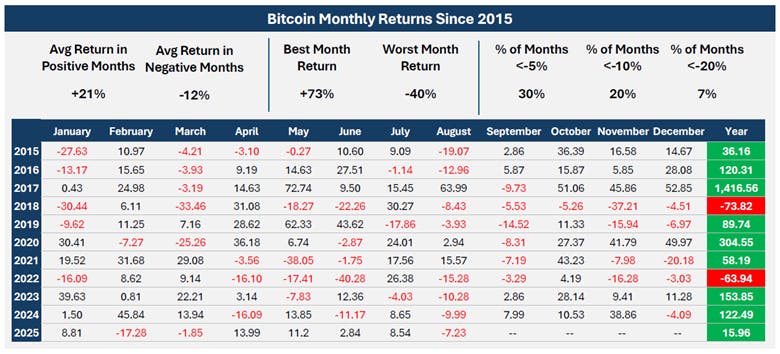
Source: Calamos and Morningstar Direct as of 8/31/25.
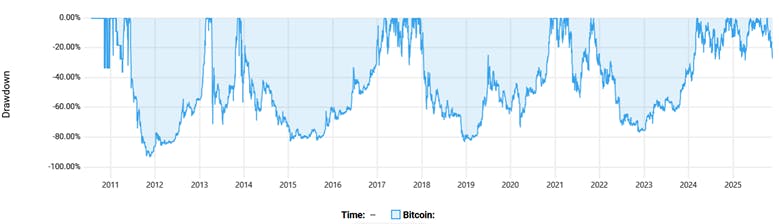
The key metric to watch is the drawdown, which measures how far an asset falls from its most recent peak. Bitcoin has posted some of the steepest drawdowns of any mainstream asset class.
The first chart shows how often and how far Bitcoin has dropped from prior highs. These extended periods of severe decline are commonly referred to as “bitcoin winters.”
The second chart shows the return needed to recover after each drawdown. As losses deepen, the required return rises at a much faster rate.
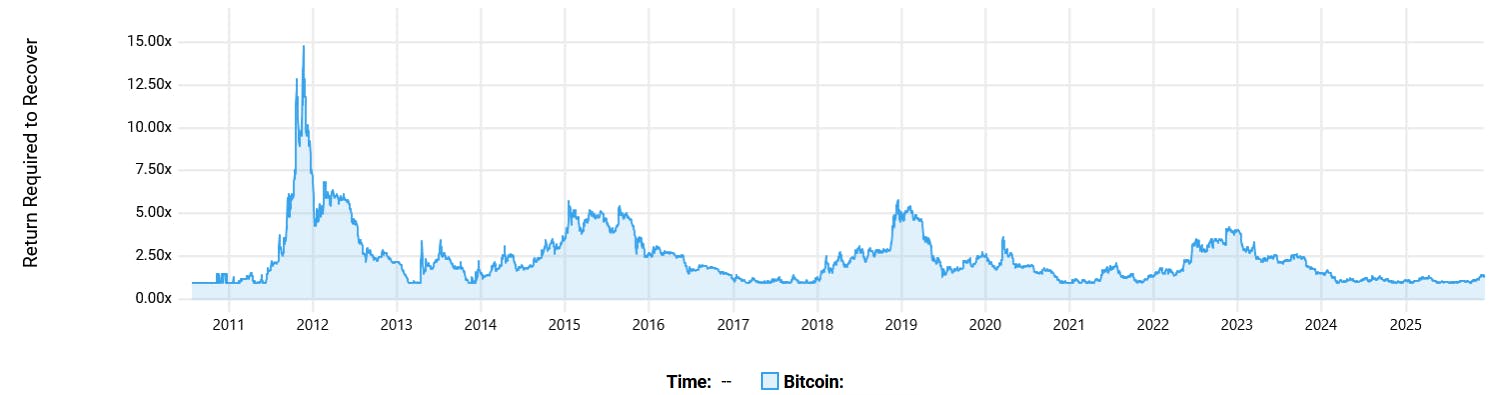
A 50% decline needs a 100% recovery, a 70% decline needs more than a 230% recovery, and the math only gets more punishing from there. For many investors, accessing bitcoin’s upside is less about chasing peaks and more about avoiding these large impairments of capital.
Before structured alt protection ETFs entered the market, managing risk in bitcoin meant relying on tactical rules or derivatives. Investors used moving-average crossovers to sidestep downtrends or implemented futures-based hedges to offset part of their exposure.
Both approaches introduce challenges. Signals can whipsaw during volatile periods. Futures require rolling, margin, and active monitoring. These tools are also unrealistic for newer or less experienced investors to operate effectively.
A better way to hedge Bitcoin risk
Calamos has long used derivatives-based strategies and hedging techniques across its options portfolios, and the firm applies that same expertise here. Each Protected Bitcoin ETF is issued in quarterly “vintages,” which begin every January, April, July, and October.
Timing matters with these ETFs, though not in the market-timing sense. The outcome period that defines each vintage’s gain and loss parameters is based on buying at the start and holding through the full term.
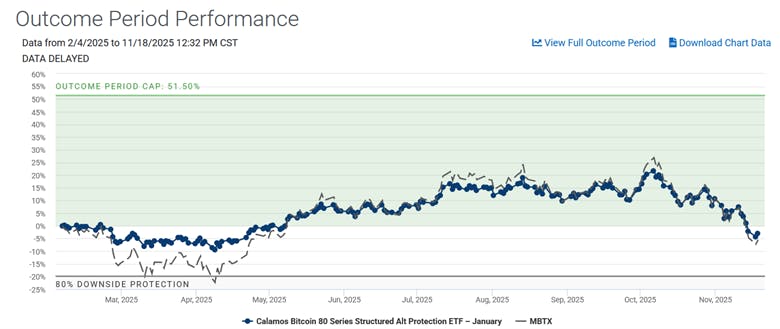
For example, the Calamos Bitcoin 80 Series Structured Alt Protection ETF – January
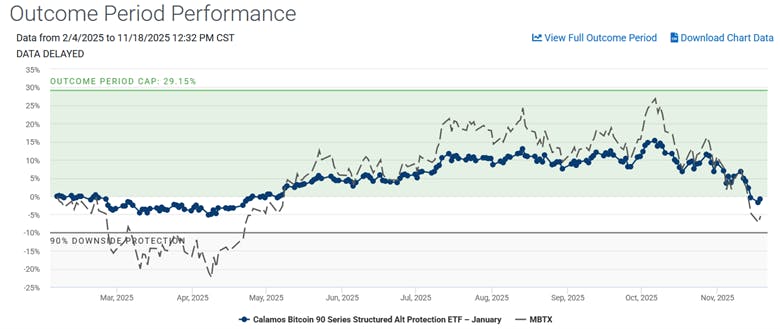
The Calamos Bitcoin 90 Series Structured Alt Protection ETF – January
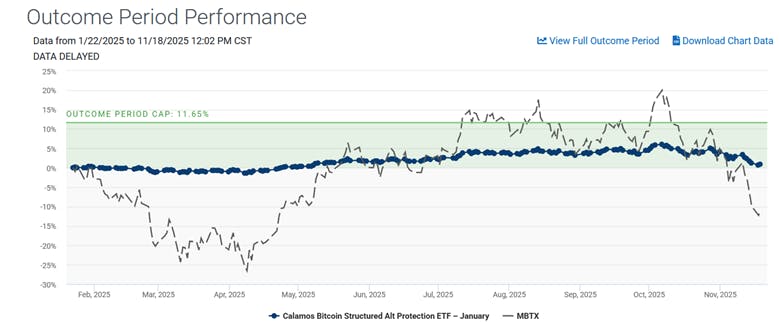
The most resilient is the Calamos Bitcoin Structured Alt Protection ETF – January
However, this protection come with trade-offs. These ETFs use combinations of call and put options to build a collar that finances the downside buffer by capping the upside.
As a general rule of thumb, more protection means a lower cap. For the most recent January vintage, CBTJ’s starting cap was 50.81%, CBXJ’s was 29.37%, and CBOJ’s was 10.96%.
The structure gives investors clear numbers to match with their risk tolerance. It’s often difficult to articulate what level of risk and reward feels acceptable, but defined loss limits and defined upside caps make the choice more concrete, especially for less experienced investors.
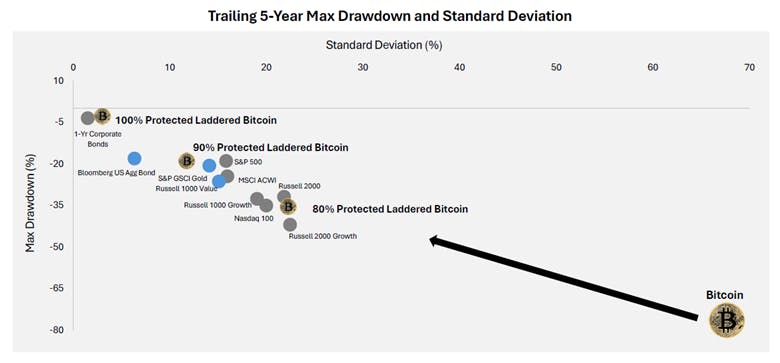
Source: Calamos and Morningstar Direct as of 8/31/25.
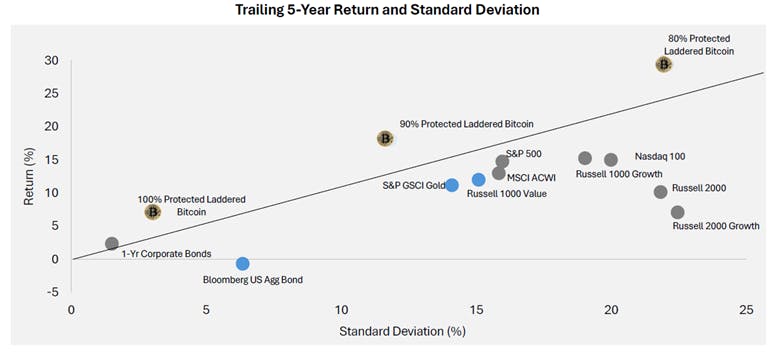
Source: Calamos and Morningstar Direct as of 8/31/25.
The cap is mathematically determined by the option structure. It doesn’t depend on unstable correlations with bonds, and it avoids the negative carry common in many tail-risk hedges.
Finally, investors who miss the January window can still access ongoing protection. The “laddered” versions of the strategy use a fund-of-funds structure to provide the same 80%, 90%, and 100% downside buffers with outcome periods that refresh across the calendar.
Learn more about Calamos Bitcoin Protected ETFs.
Please note this article is for information purposes only and does not in any way constitute investment advice. It is essential that you seek advice from a registered financial professional prior to making any investment decision.


Latest ETF News
See all ETF newsThese Public-Private ETFs Invest in Polymarket and Anduril

There's an ETF for That? Frontier Markets

10-Year Treasury Yield Hits 5%: Which Bond ETFs Offer the Most Direct Exposure?

ETF comparison: NEOS S&P 500 High Income ETF (SPYI) Versus Goldman Sachs S&P 500 Premium Income ETF (GPIX)




 Advantages of ETFs over Mutual Funds1/6
Lower Costs
In this guide, we'll explore the advantages of ETFs over mutual funds, giving you valuable insights into why ETFs have gained significant popularity among investors like yourself.
Leveraged ETFs: Unlocking the Potential for Amplified Returns1/6
Understanding Leveraged ETFs
Explore leveraged ETFs: potential for amplified returns & risks. 5 ETFs to consider across equities, commodities & fixed income.
What is a Leveraged ETF?1/6
Introducing Leveraged and Inverse ETFs
In this guide, we'll dive into the world of leveraged ETFs, exploring their definition, mechanics, potential risks, and rewards.
Recent educational content

ETF Trends
ETF Industry KPIs September 28, 2026
This week’s KPI data overview highlights key metrics and trends shaping the ETF landscape.

ETF Trends
ETF Industry KPIs September 22, 2026
This week’s KPI data overview highlights key metrics and trends shaping the ETF landscape.

First Look ETF
First Look ETF: Income, Corporate Arbitrage, and Growth and Value Investing
First Look ETF September 2026: iCapital, Mast Investments and North Square unpack new ETFs targeting monthly income, merger arbitrage and complementary growth and value exposure.

ETF Trends
ETF Industry KPIs September 14, 2026
This week’s KPI data overview highlights key metrics and trends shaping the ETF landscape.
Browse all educational columns



Expert-Built ETF Portfolios, All in One Place
Don’t start from scratch. Discover ready-made ETF portfolios built by professionals to match different goals, timelines, and market views. Use them as inspiration or as a starting point for your own allocation.