Global ETF Survey Is Live! 600+ ETF Professionals Weigh In. See Results →



Goldman Sachs Asset Management Strengthens Active Fixed Income Offering with GBND and GIGL
Goldman Sachs Asset Management expands its active ETF lineup with GBND and GIGL, aiming to deliver flexible fixed income solutions for income and total return.

Keep up with what matters in ETFs
Get timely ETF insights, market trends, and top ideas straight to your inbox.
Your newsletter subscriptions with us are subject to ETF Central's Privacy Policy and Terms and Conditions.
Goldman Sachs Asset Management (GSAM) has strengthened its ETF lineup with the launch of two actively managed fixed income funds on the NYSE: the Goldman Sachs Core Bond ETF
“Fixed income investors are increasingly looking for ways to outperform benchmark indices, dynamically manage portfolio risk, and adapt to changing market conditions through active management of bond portfolios,” said Brendan McCarthy, Global Head of ETF Distribution at Goldman Sachs Asset Management. “To help meet this demand, Goldman Sachs Asset Management has expanded our range of actively managed fixed income ETFs. Along with our active municipal bond ETFs launched last year, GIGL and GBND combine our deep experience of active fixed income investing with the flexibility and transparency of the ETF vehicle.”
Global ETF Survey 2026 is Live!
With 1,790 new products launched by July 2026, choosing is harder than ever. Our Global ETF Survey 2026, built on 620 professional investors and allocators, shows how active, fixed income, options-based and thematic ETFs are reshaping fund selection.
How the ETFs Work
The Goldman Sachs Core Bond ETF
The Goldman Sachs Corporate Bond ETF
Both ETFs apply Goldman Sachs Asset Management’s rigorous research framework and institutional risk management tools, designed to optimize income potential and total return within clearly defined parameters.
Why Investors May Consider These ETFs
With bond yields and inflation expectations shifting throughout 2025, investors may seek out active fixed income strategies that can adapt to changing macroeconomic conditions.
GBND
GIGL
Together, these ETFs enable investors who may be considering fixed income and active management expertise to build or complement their fixed income exposure, while benefiting from the liquidity and transparency of the ETF structure.
About the Issuer
Goldman Sachs Asset Management is the primary investing arm of Goldman Sachs, managing approximately $3.5 trillion in assets under supervision as of September 30, 2025. The firm delivers investment and advisory services across public and private markets for institutions, financial advisors, and individuals worldwide.
Driven by a focus on partnership, research, and innovation, Goldman Sachs Asset Management offers strategies across fixed income, equity, liquidity, alternatives, and multi-asset solutions. Its growing ETF platform integrates Goldman Sachs Asset Management’s institutional capabilities with the flexibility of exchange-traded funds, allowing investors to access active management across a variety of asset classes. Learn more at am.gs.com.
Please note this article is for information purposes only and does not in any way constitute investment advice. It is essential that you seek advice from a registered financial professional prior to making any investment decision.
FUND RISK CONSIDERATIONS AND GENERAL DISCLOSURES
Glossary
Liquidity: An asset’s ability to be easily converted through an act of buying or selling without causing a significant movement in the price and with minimum loss of value.
Transparency: Portfolio holdings are disclosed on a daily basis.
The Goldman Sachs Core Bond ETF (the “Fund”) seeks to provide a total return consisting of capital appreciation and income. The Fund is an actively managed exchange-traded fund. The Fund pursues its investment objective by primarily investing in core fixed income securities, including U.S. government securities (including agency mortgage-related securities), corporate debt securities, private mortgage-backed securities and asset-backed securities (including collateralized loan obligations). Core fixed income securities are fixed income securities that are rated investment grade (i.e., securities rated BBB-, Baa3 or higher by a nationally recognized statistical rating organization or, if unrated, determined by the Investment Adviser to be of comparable credit quality). The Fund’s investments in core fixed income securities are subject to the risks associated with debt securities generally, including credit and interest rate risk. Any guarantee on U.S. government securities applies only to the underlying securities of the Fund if held to maturity and not to the value of the Fund’s shares. Investments in mortgage-backed securities and other asset-backed securities are also subject to prepayment risk (i.e., the risk that in a declining interest rate environment, issuers may pay principal more quickly than expected, causing the Fund to reinvest proceeds at lower prevailing interest rates). Foreign and emerging markets investments may be more volatile and less liquid than investments in U.S. securities and are subject to the risks of currency fluctuations and adverse economic, social or political developments, including regional armed conflicts, sanctions, tariffs, counter-sanction, retaliatory tariffs and other retaliatory actions. The Fund’s investments are subject to market risk, which means that the value of the securities in which it invests may go up or down in response to the prospects of individual companies, particular sectors, governments or countries and/or general economic conditions in the U.S. or throughout the world. Derivative instruments may involve a high degree of financial risk. These risks include the risk that a small movement in the price of the underlying security or benchmark may result in a disproportionately large movement, unfavorable or favorable, in the price of the derivative instrument; risks of default by a counterparty; and liquidity risk (i.e., the risk that an investment may not be able to be sold without a substantial drop in price, if at all). Taking short positions and utilizing reverse repurchase agreements involve leverage of the Fund’s assets and present various other risks. Losses on short positions are potentially unlimited as a loss occurs when the value of an asset with respect to which the Fund has a short position increases. The Fund may have a high rate of portfolio turnover, which involves correspondingly greater expenses which must be borne by the Fund and its shareholders, and is also likely to result in short-term capital gains taxable to shareholders. The Fund’s investments in other investment companies (including exchange-traded funds) subject it to additional expenses. The Fund is “non-diversified” and may invest a larger percentage of its assets in one or more issuers or in fewer issuers than “diversified” funds. Accordingly, the Fund may be more susceptible to adverse developments affecting any single issuer held in its portfolio and to greater losses resulting from these developments.
The Goldman Sachs Corporate Bond ETF (the “Fund”) seeks to provide a high level of total return consisting of capital appreciation and income. The Fund is an actively managed exchange-traded fund. The Fund pursues its investment objective by primarily investing in corporate bonds. The Fund’s investments in corporate bonds are subject to the risks associated with debt securities generally, including credit and interest rate risk. Any guarantee on U.S. government securities applies only to the underlying securities of the Fund if held to maturity and not to the value of the Fund’s shares. Foreign investments may be more volatile and less liquid than investments in U.S. securities and are subject to the risks of currency fluctuations and adverse economic, social or political developments, including regional armed conflicts, sanctions, counter-sanctions and other retaliatory actions. The Fund’s investments are subject to market risk, which means that the value of the securities in which it invests may go up or down in response to the prospects of individual companies, particular sectors, governments or countries and/or general economic conditions in the U.S. or throughout the world. Derivative instruments may involve a high degree of financial risk. These risks include the risk that a small movement in the price of the underlying security or benchmark may result in a disproportionately large movement, unfavorable or favorable, in the price of the derivative instrument; the risk of default by a counterparty; and liquidity risk (i.e., the risk that an investment may not be able to be sold without a substantial drop in price, if at all). The Fund may be more sensitive to adverse economic, business or political developments if it invests a substantial portion of its assets in bonds of similar projects or in particular types of municipal securities. The Fund’s investments in other investment companies (including exchange-traded funds) subject it to additional expenses. The Fund is “non-diversified” and may invest a larger percentage of its assets in one or more issuers or in fewer issuers than “diversified” funds. Accordingly, the Fund may be more susceptible to adverse developments affecting any single issuer held in its portfolio and to greater losses resulting from these developments.
Fund shares are not individually redeemable and are issued and redeemed by the Fund at their net asset value (“NAV”) only in large, specified blocks of shares called creation units. Shares otherwise can be bought and sold only through exchange trading at market price (not NAV). Shares may trade at a premium or discount to their NAV in the secondary market. Brokerage commissions will reduce returns.
General Disclosures
THIS MATERIAL DOES NOT CONSTITUTE AN OFFER OR SOLICITATION IN ANY JURISDICTION WHERE OR TO ANY PERSON TO WHOM IT WOULD BE UNAUTHORIZED OR UNLAWFUL TO DO SO.
This material is provided for informational purposes only and should not be construed as investment advice or an offer or solicitation to buy or sell securities. This material is not intended to be used as a general guide to investing, or as a source of any specific investment recommendations, and makes no implied or express recommendations concerning the manner in which any client’s account should or would be handled, as appropriate investment strategies depend upon the client’s investment objectives.
Views and opinions expressed are for informational purposes only and do not constitute a recommendation by Goldman Sachs Asset Management to buy, sell, or hold any security. Views and opinions are current as of the date of this presentation and may be subject to change, they should not be construed as investment advice.
A summary prospectus, if available, or a Prospectus for the Fund containing more information may be obtained from your authorized dealer or from Goldman Sachs & Co. LLC by calling (retail - 1-800-526-7384) (institutional – 1-800-621-2550). Please consider a fund's objectives, risks, and charges and expenses, and read the summary prospectus, if available, and the Prospectus carefully before investing. The summary prospectus, if available, and the Prospectus contains this and other information about the Fund.
The Investment Company Act of 1940 (the “Act”) imposes certain limits on investment companies purchasing or acquiring any security issued by another registered investment company. For these purposes the definition of “investment company” includes funds that are unregistered because they are excepted from the definition of investment company by sections 3(c)(1) and 3(c)(7) of the Act. You should consult your legal counsel for more information.
GBND and GIGL are newly organized and do not have operating histories.
There is no guarantee that objectives will be met.
This information discusses general market activity, industry or sector trends, or other broad-based economic, market or political conditions and should not be construed as research or investment advice. This material has been prepared by Goldman Sachs Asset Management and is not financial research nor a product of Goldman Sachs Global Investment Research (GIR). It was not prepared in compliance with applicable provisions of law designed to promote the independence of financial analysis and is not subject to a prohibition on trading following the distribution of financial research. The views and opinions expressed may differ from those of Goldman Sachs Global Investment Research or other departments or divisions of Goldman Sachs and its affiliates. Investors are urged to consult with their financial advisors before buying or selling any securities. This information may not be current and Goldman Sachs Asset Management has no obligation to provide any updates or changes.
ALPS Distributors, Inc. is the distributor of the Goldman Sachs ETF Funds. ALPS Distributors, Inc. is unaffiliated with Goldman Sachs Asset Management.
© 2025 Goldman Sachs. All rights reserved.
469178 GST Code: GST 3358
Date of First Use: November 17, 2025.
Mentioned ETFs
Further reading

Latest ETF News
See all ETF newsxETFs Launches NECK to Focus on the Physical Bottlenecks Behind the AI Buildout


Jensen Launches JQTY ETF With a Strict 10-Year Profitability Test





 Advantages of ETFs over Mutual Funds1/6
Lower Costs
In this guide, we'll explore the advantages of ETFs over mutual funds, giving you valuable insights into why ETFs have gained significant popularity among investors like yourself.
Leveraged ETFs: Unlocking the Potential for Amplified Returns1/6
Understanding Leveraged ETFs
Explore leveraged ETFs: potential for amplified returns & risks. 5 ETFs to consider across equities, commodities & fixed income.
What is a Leveraged ETF?1/6
Introducing Leveraged and Inverse ETFs
In this guide, we'll dive into the world of leveraged ETFs, exploring their definition, mechanics, potential risks, and rewards.
Recent educational content
First Look ETF
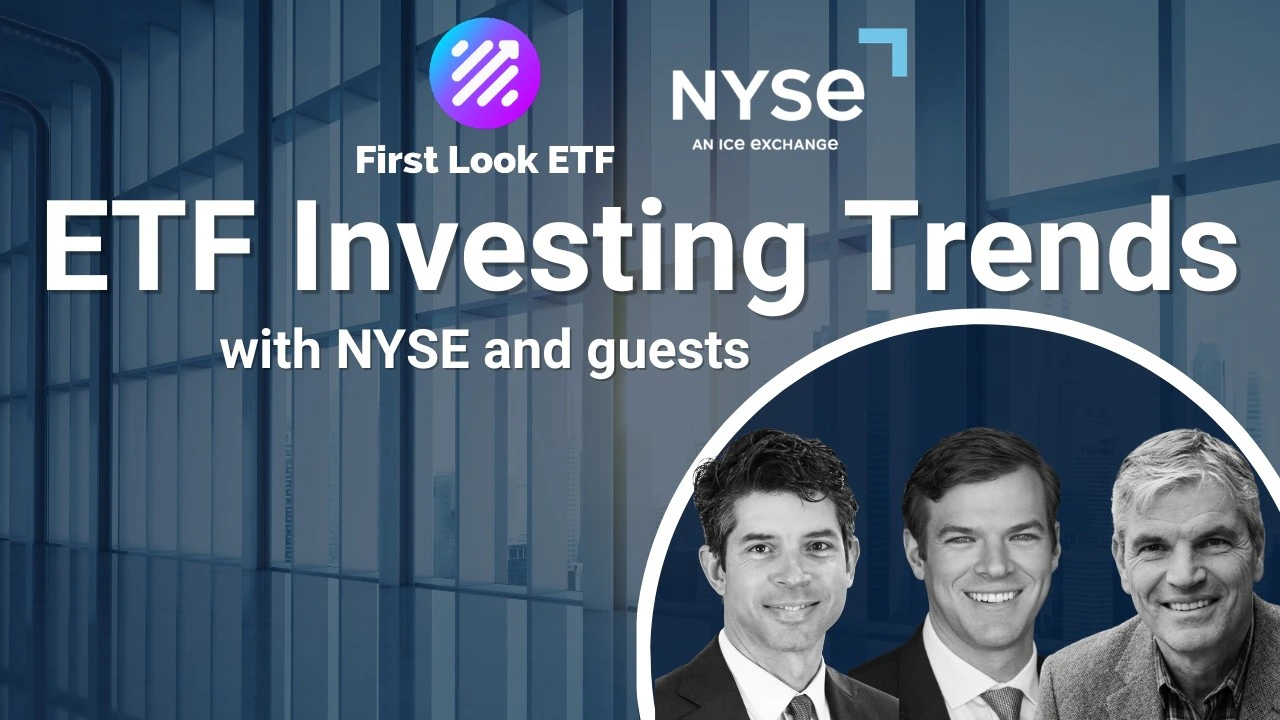
First Look ETF: Income, International, and Cash Flow ETFs
In this season 6 episode of First Look ETF, Stephanie Stanton @etfguide examines the latest ETF marketplace trends with NYSE and guests.


ETF Trends
ETF Industry KPIs October 5, 2026
This week’s KPI data overview highlights key metrics and trends shaping the ETF landscape.

ETF Trends
ETF Industry KPIs September 28, 2026
This week’s KPI data overview highlights key metrics and trends shaping the ETF landscape.
ETF Trends
ETF Industry KPIs September 22, 2026
This week’s KPI data overview highlights key metrics and trends shaping the ETF landscape.