Create, analyze, optimize your ETF portfolio. Start now →



Gold ETFs: Top 5 picks for December 2022
These five ETFs offer easy, affordable exposure to gold prices.


Keep up with what matters in ETFs
Get timely ETF insights, market trends, and top ideas straight to your inbox.
Your newsletter subscriptions with us are subject to ETF Central's Privacy Policy and Terms and Conditions.
With the 60/40 portfolio of stocks and bonds in trouble, investors are increasingly looking towards adding additional asset classes that might provide a diversification benefit. One of those is gold, the dominant precious metal circulating in the economy.
Juan Carlos Artigas, head of investment research for the World Gold Council says that an allocation to gold can provide (risk) management and capital preservation benefits.
According to Artigas, gold is liquid, lacks credit risk, and can hedge against high inflation, geopolitical risk, and currency devaluation.
Artigas also notes how gold is highly in demand, not only being used in jewelry and electronics, but also backed by central banks which have become some of the largest purchasers of gold in recent years.
From a portfolio management perspective, gold can provide diversification benefits thanks to its low correlation with stocks and bonds. A small allocation to gold, rebalanced periodically, improves the long-term risk-adjusted returns of a portfolio
Case in point, consider how a 60/30/10 portfolio of U.S. stocks, 10-year Treasurys, and gold has outperformed a traditional 60/40 portfolio of stocks and Treasurys from 1972 to the present, especially during the high-inflation environment of the 1970s.
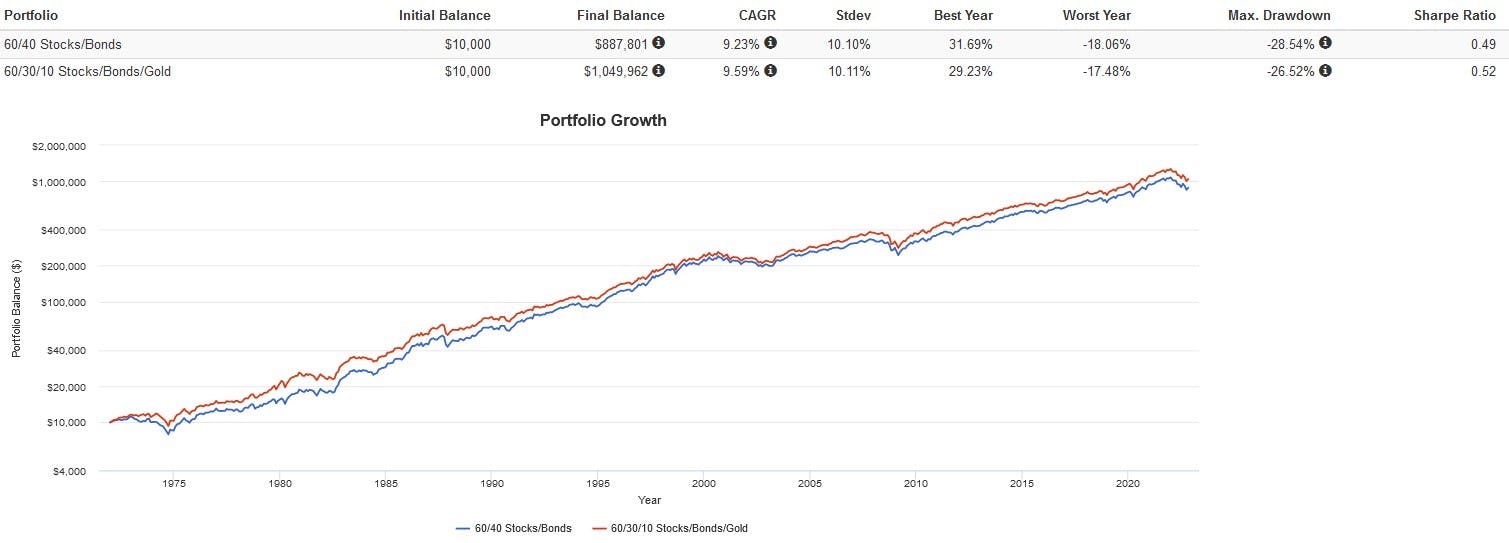
A good alternative to buying and storing physical bullion is physically backed gold ETFs. Because they store gold and don't use futures contracts, physically-backed gold ETFs have low expense ratios and minimal tracking error. Here are my top five gold ETF picks for December 2022.
Like what you're reading?
Stay in the loop — get the latest ETF insights: trends, analysis, and expert picks.
1. SPDR Gold Shares / Gold MiniShares
The most popular gold ETF in terms of assets under management (AUM) today is the SPDR Gold Shares (GLD). GLD currently holds 906 tonnes of gold in trust and currently sports just over $50 billion in AUM. The ETF is popular due to its well-developed options chain, good daily volume, and low bid-ask spread.
However, its expense ratio (0.40%) isn't exactly cheap. While this doesn't deter traders, buy-and-hold investors looking for a long-term investment might baulk at it. To remedy this, State Street launched the SPDR Gold MiniShares (GLDM), a lower-priced alternative.
Shares of GLDM currently trade at around $34 at the time of writing (November 22nd), compared to $162 for GLD, making the former capital efficient. The expense ratio is also much lower at 0.10%. Liquidity is still good, with low bid-ask spreads, but there's no options chain.
2. iShares Gold Trust / iShares Gold Trust Micro
GLD's biggest and longstanding competitor is the iShares Gold Trust (IAU), which has just over $25 billion in AUM, making it around half the size of GLD. Like GLD, IAU is also highly liquid and has a high daily traded volume. It also has a lower expense ratio at 0.25%.
In response to GLDM, iShares launched a lower-cost version of IAU on June 15th, 2021, called the iShares Gold Trust Micro (IAUM). It originally debuted with a 0.15% expense ratio, but that was slashed to 0.09% recently, making IAUM the cheapest gold ETF on the market.
3. abrdn Physical Gold Shares
The abrdn Physical Gold Shares (SGOL) sits in a weird spot – it's not as popular, large, or as widely traded as GLD, nor is it as cheap as GLDM. Still, the fund has some benefits for buy-and-hold gold investors who favor transparency. It's also fairly cheap, with an expense ratio of 0.17%.
SGOL actually holds allocated gold, meaning that you, the investor, is an owner of a certain amount of bullion as opposed to just a creditor for an aggregate deposit. SGOL also publishes a daily list of the bars held, with their brand, serial number, assay, and vault location.
4. GraniteShares Gold Trust
The GraniteShares Gold Trust (BAR) operates in a pretty similar way to SGOL: holds physical gold bullion bars in a London vault, audits it twice a year, and publishes a daily list of individual holdings with serial numbers, brand names, weights, fineness, and packing ID.
There's not much to say about BAR that hasn’t been noted already. Like most of the ETFs listed here, it's liquid, tracks the spot price of gold well, and charges a low expense ratio (0.1749%). Like SGOL, each bar of gold is segregated, individually identified, and allocated.
5. Sprott Physical Gold Trust
The Sprott Physical Gold Trust (PHYS) isn't actually an ETF, but I'm including it on this list due to its popularity. PHYS is actually a close-ended fund, which does not issue additional shares after the initial public offering. Why is this important to know?
Well, it means that the market price of PHYS can occasionally diverge from its net asset value (NAV), trading at either a discount (due to excess supply) or a premium (due to overwhelming demand). This adds another dimension that prospective investors need to be aware of.
PHYS currently has $5.47 billion in AUM and charges an expense ratio of 0.41%, which, along with its close-ended structure, explains its lower popularity. However, it is dual-listed in Canada and the U.S., so it’s a favorite among Canadian investors.
Please note this article is for information purposes only and does not constitute investment advice.
Segments
See all
Mentioned ETFs
Further reading
Latest ETF News
See all ETF newsThere's an ETF for That? Humanoid Robotics and Physical AI

How Some ETF Issuers Use Their Own Funds for Cash Management

These Public-Private ETFs Invest in Polymarket and Anduril

There's an ETF for That? Frontier Markets




 Advantages of ETFs over Mutual Funds1/6
Lower Costs
In this guide, we'll explore the advantages of ETFs over mutual funds, giving you valuable insights into why ETFs have gained significant popularity among investors like yourself.
Leveraged ETFs: Unlocking the Potential for Amplified Returns1/6
Understanding Leveraged ETFs
Explore leveraged ETFs: potential for amplified returns & risks. 5 ETFs to consider across equities, commodities & fixed income.
What is a Leveraged ETF?1/6
Introducing Leveraged and Inverse ETFs
In this guide, we'll dive into the world of leveraged ETFs, exploring their definition, mechanics, potential risks, and rewards.
Recent educational content

ETF Trends
ETF Industry KPIs October 5, 2026
This week’s KPI data overview highlights key metrics and trends shaping the ETF landscape.

ETF Trends
ETF Industry KPIs September 28, 2026
This week’s KPI data overview highlights key metrics and trends shaping the ETF landscape.
ETF Trends
ETF Industry KPIs September 22, 2026
This week’s KPI data overview highlights key metrics and trends shaping the ETF landscape.

First Look ETF
First Look ETF: Income, Corporate Arbitrage, and Growth and Value Investing
First Look ETF September 2026: iCapital, Mast Investments and North Square unpack new ETFs targeting monthly income, merger arbitrage and complementary growth and value exposure.

Browse all educational columns



Build and Analyze Your ETF Portfolio Like a Pro
Create your own ETF portfolio in minutes and instantly see allocations, exposures, performance, and risk. Visualize diversification across asset classes, regions, and sectors. Stress-test ideas, compare benchmarks, and refine your strategy with professional-grade analytics.